
Quick Summary:
- Fitness app development in Dubai requires the right app type, a 3-to-12-month delivery plan, UAE-ready compliance, and a scope-based budget from about AED 110,000 to AED 1.2 million or more.
- Grand View Research values the global fitness apps market at USD 13.9 billion in 2026 and forecasts USD 33.6 billion by 2033.
- A subscription product with 5,000 paying members at AED 45 monthly represents AED 2.7 million in illustrative gross ARR before churn, fees, VAT, acquisition, and operating costs.
- Consumer subscriptions, corporate licenses, gym memberships, coaching commissions, and white-label fees give UAE fitness products several recurring-revenue routes.
- Strong retention, Arabic and English UX, wearable reliability, privacy controls, and a measurable activation event matter more than a long feature inventory.
The fitness app development rarely needs another basic workout library. They now need a focused subscription product, program commerce, membership, booking, access, billing, content, and analytics across several branches.
This guide helps UAE fitness startups, trainers, gyms, wellness chains, and corporate-wellness buyers decide what fitness mobile app to build in Dubai, how to build it, what it may cost, and which compliance controls belong in the product.
Why is Fitness app development in Dubai a 2026 investment opportunity?
Fitness app development in Dubai has a credible investment case when the product connects a clear fitness outcome with recurring revenue and controlled service delivery.
Public participation, wearable adoption, mobile exercise products, and national policy provide demand signals, but execution still determines commercial performance.
The UAE National Sports Strategy 2031 includes 17 initiatives and targets 71 percent participation in diverse sports by 2031. Dubai also recorded more than 3 million participants in the 2025 Dubai Fitness Challenge.
Grand View Research estimates that the global fitness apps market will expand from USD 13.9 billion in 2026 to USD 33.6 billion in 2033, with a 13.4 percent CAGR.
Its market definition covers exercise, weight loss, diet, nutrition, and activity-tracking applications.
Statista market insights projects USD 9.22 billion in 2026 fitness-app revenue and USD 22.55 average revenue per user.
Statista uses a narrower B2C definition that excludes advertising, B2B revenue, and nutrition apps, so its total should not be compared directly with Grand View Research.
The American School of Sports Medicine’s 2026 survey also ranks wearable technology first and mobile exercise apps fourth. These sources support investment research, not guaranteed demand for a specific app.
Independent fitness-app market benchmarks
| Research source | 2026 benchmark | Forecast | Scope note |
| Grand View Research | USD 13.9 billion market estimate | USD 33.6 billion by 2033 at 13.4% CAGR | Exercise, weight loss, diet, nutrition, and activity tracking |
| Statista Market Insights | USD 9.22 billion revenue and USD 22.55 ARPU | USD 9.89 billion by 2030 | B2C paid apps and in-app purchases; excludes ads, B2B, and nutrition |
ARR framework for UAE decision makers
Use three simple equations before discussing features:
- Consumer ARR: paying subscribers x monthly subscription x 12.
- B2B ARR: contracted gyms, employers, or wellness clients x annual contract value.
- Marketplace net revenue: annual program and session sales x platform commission rate.
For example, 5,000 subscribers paying AED 45 monthly represent AED 2.7 million in gross subscription ARR. A corporate platform with 20 clients paying AED 75,000 annually represents AED 1.5 million in gross B2B ARR.
Neither calculation accounts for churn, discounts, VAT, acquisition, support, payment fees, or fulfillment.
Dubai has real, measured participation behavior. What that behavior means for your specific app depends on the buyer case you’re building for.
Which Fitness app development type fits your business model?
The correct fitness app development type depends on the repeated user action, the paid customer, the service provider, and the operating system behind the experience. Many successful products combine two types, but the MVP still needs one dominant job.
| Fitness app type | Primary user job | Core features | Common revenue model |
| Activity and fitness tracker app | Record steps, workouts, sleep, recovery, or progress | Sensor data, goals, trends, streaks, wearable sync | Subscription, premium analytics, employer license |
| Workout and training app | Follow guided exercise plans | Exercise library, video, timers, plans, progress, reminders | Subscription, paid programs, content bundles |
| Fitness diet app | Follow nutrition and habit plans | Meal plans, food logs, hydration, allergies, coach review | Subscription, program sales, and coaching fee |
| Personal trainer and coaching app | Deliver personalized service remotely | Assessments, plans, chat, video, calendar, check-ins, payments | Coaching packages, subscription, trainer SaaS |
| Coach marketplace | Discover and buy expertise | Search, profiles, verification, ratings, programs, commissions, payouts | Marketplace commission, listing fee, subscription |
| Gym management app and platform | Manage members and facilities | Membership, class booking, billing, access, CRM, branches, reports | Membership extension, SaaS, white-label license |
| Social fitness app | Find partners and build community | Feed, discovery, matching, chat, groups, moderation, events | Subscription, trainer commission, partnerships |
| Corporate wellness platform | Run programs for employee groups | Challenges, teams, incentives, segmentation, dashboards | Annual B2B license, per-employee fee |
| Rehabilitation or medical-connected app | Support prescribed or supervised activity | Care plans, clinician workflows, outcomes, alerts, records | Provider contract, insurer contract, program fee |
A rehabilitation or medical-connected product requires a different assurance model from a consumer workout app. Clinical claims, provider integration, and regulated health data can change legal review, hosting, testing, and documentation requirements.
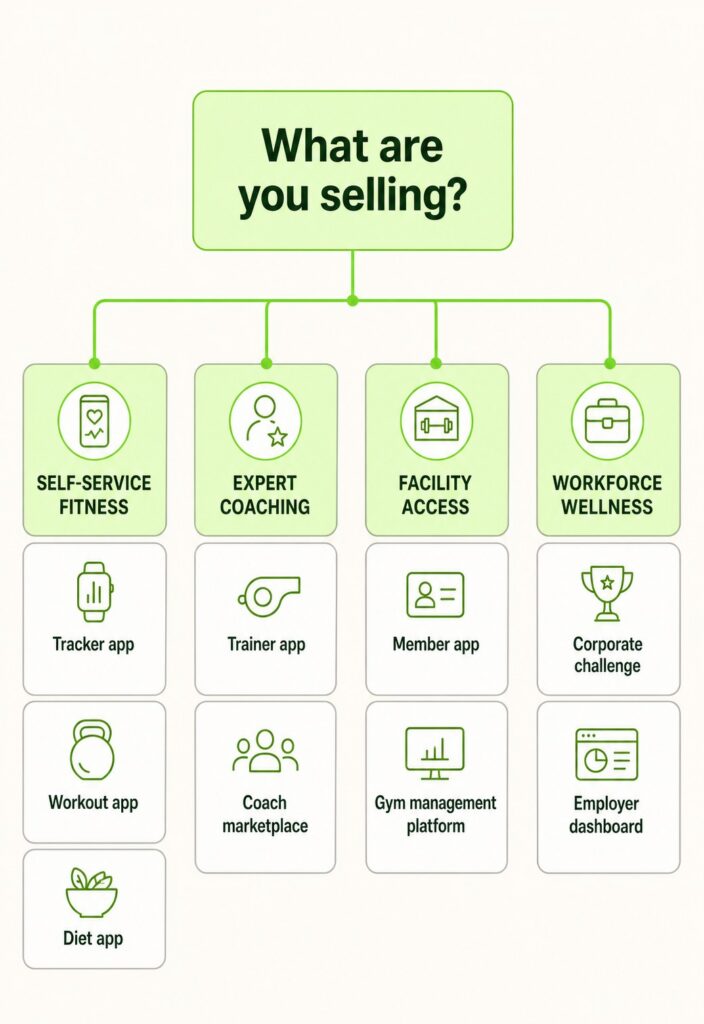
Fitness management apps and platforms can combine a member app with trainer, branch, finance, support, and administration tools. The best fitness apps still keep one user outcome dominant instead of giving every module equal priority.
Watch our video:
Custom Fitness app development versus white-label software
White-label software can suit standard booking, membership, or coaching workflows with a short launch window.
Custom software development in Dubai is more appropriate when the business depends on proprietary logic, several user roles, marketplace economics, unusual integrations, bilingual experiences, or long-term product ownership.
Planning to decide the app type, paid customer, revenue equation, and core activation event?
What features should Fitness app development include for UAE users and operators?
A fitness app feature belongs in the MVP only when it supports activation, service delivery, retention, revenue, trust, or operational control.
Member features
- Goal-based onboarding, profile, consent, baseline assessment, and preferences.
- Workout or meal plans, demonstration media, daily tasks, and progress history.
- Activity, nutrition, hydration, sleep, or recovery tracking where relevant.
- Memberships, bookings, local payments, receipts, notifications, and support.
- Wearable synchronization with clear permissions and manual-entry fallbacks.
Trainer and coach features
- Program builder, exercise library, meal-plan tools, calendar, chat, and video sessions.
- Client segmentation, progress review, check-ins, private notes, and feedback.
- Availability, packages, earnings, commission records, and payout requests.
- Credentials, verification status, ratings, and content approval.
Gym-chain and administrator features
- Branches, classes, trainers, memberships, pricing, and access-control management.
- Member CRM, attendance, payments, failed-payment workflows, and support cases.
- Role-based permissions, campaign tools, content moderation, and audit history.
- Dashboards for acquisition, activation, attendance, retention, revenue, and service quality.
Fitness app design for the UAE should include Arabic and English navigation, right-to-left testing, accessible contrast, captions, scalable text, and low-bandwidth fallbacks.
Configurable schedules can support Ramadan routines without assuming when an individual should train.
The Dubai Fitness Challenge app ecosystem demonstrates local use of wearable data, private and corporate leaderboards, rewards, challenge tracking, subscriptions, and several activity types.
How does the Fitness app development process work in Dubai?
Fitness app development should progress through validated commercial, experience, engineering, and assurance decisions. Each stage produces an output that controls the next stage.
Define the business case and measurable product outcome
Start with the paid customer, target user, repeated fitness behavior, revenue model, and operational owner. Define activation, retention, conversion, and service-quality metrics before feature planning.
The output is a one-page product thesis containing the target segment, problem, value proposition, monetization route, assumptions, constraints, and success measures.
Research UAE users and operating workflows
Interview members, trainers, gym managers, finance teams, support staff, and administrators. Map how they currently discover services, book, pay, train, report issues, monitor progress, and manage exceptions.
Research should test Arabic and English preferences, privacy expectations, payment behavior, device mix, branch operations, and climate or schedule constraints.
The output is a role-based journey map with evidence for each priority.
Classify data, claims, integrations, and compliance exposure
Create a data inventory covering identity, location, payment, activity, biometrics, health information, messages, media, and device records.
Document why each field is needed, where it enters the system, who can access it, and how long it remains.
The team should also classify health claims, AI decisions, clinical connections, children or employee use, cross-border transfers, and third-party processors. The output is a risk register and compliance scope map.
Prioritize the MVP and release roadmap
Separate must-have features from functions that can wait until product evidence exists. Score features against user value, revenue value, delivery effort, risk, dependency, and learning value.
The MVP should complete one end-to-end service journey.
A trainer marketplace, for example, may need verification, discovery, purchase, program delivery, progress, commission, payout, and administration before it needs social stories.
Prototype Arabic and English experiences
Build clickable prototypes for member, trainer, operator, and administrator journeys. Test onboarding, empty states, errors, cancellations, failed payments, revoked permissions, and right-to-left layouts with real target users.
The output is a tested interaction model, design system, content inventory, accessibility checklist, and prioritized usability fixes.
Design the architecture and delivery plan
Define mobile, web, backend, data, cloud, integration, security, analytics, and AI boundaries.
Record build-versus-buy choices and failure behavior for payments, video, messages, wearables, and access systems.
The delivery plan should divide work into releases with acceptance criteria, dependencies, review points, staffing, and environments. This stage produces the technical blueprint and delivery baseline.
Build and test in measurable releases
Engineering should deliver complete vertical journeys rather than disconnected screens.
Each release should include mobile, backend, admin, analytics, security, content, and integration work required for that user outcome.
Quality assurance should cover devices, permissions, duplicate wearable records, background sync, payments, localization, accessibility, API failures, security, performance, and store policy compliance.
Launch to a controlled cohort and optimise
Release the product to a defined group before broad acquisition. Monitor activation, completion, payment success, retention, support contacts, crash-free sessions, sync failures, and trainer or operator workload.
Use cohort evidence to adjust onboarding, content, pricing, notifications, service capacity, and the next roadmap. Do not scale acquisition while essential journeys remain unreliable.
Technology stack supporting Fitness app development in Dubai
The technology stack should follow product risk, user roles, data volume, real-time behavior, device coverage, and team capability.
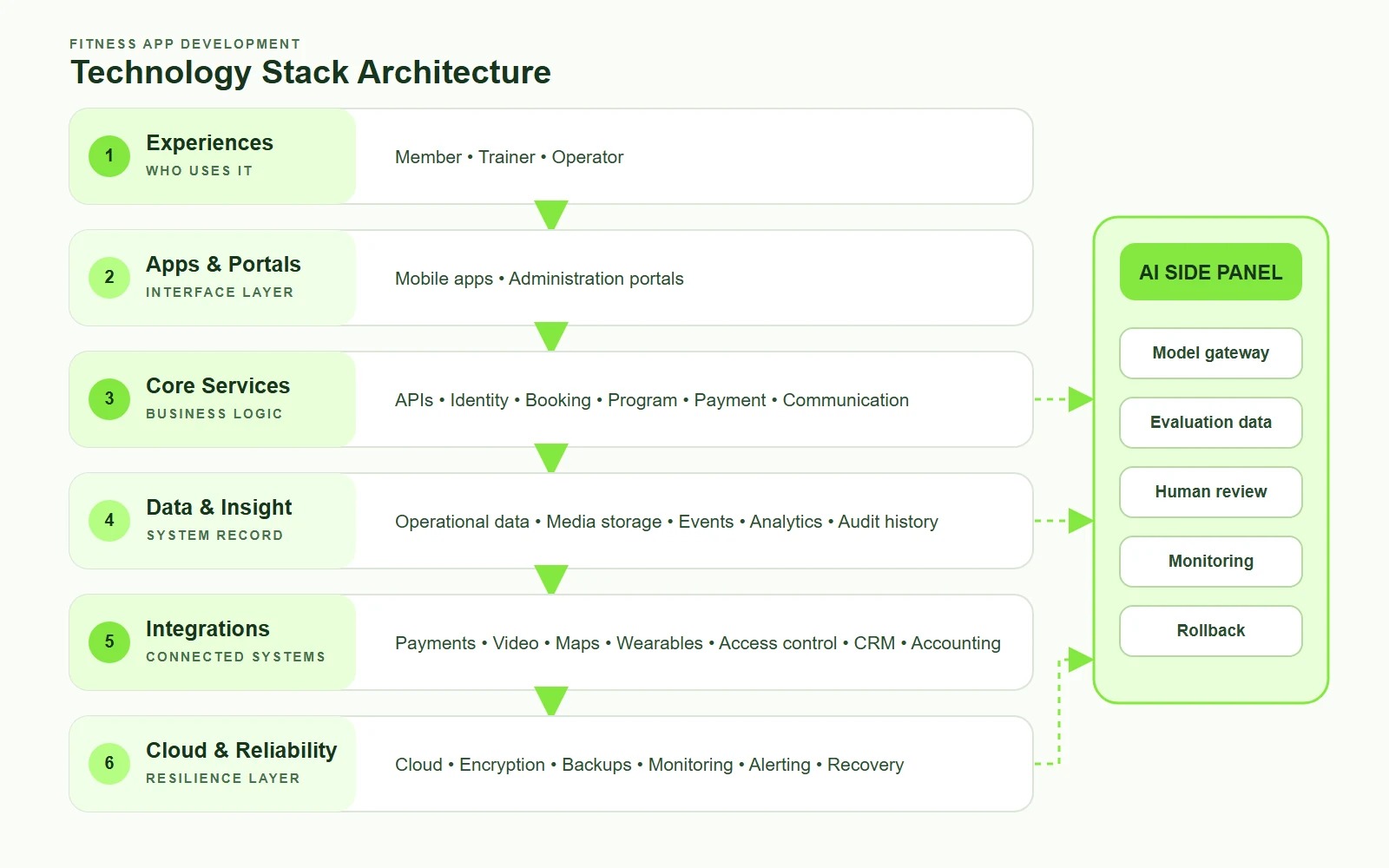
Mobile application layer
Flutter or React Native can support shared iOS app development and Android app development when experiences and device requirements are similar.
Swift and Kotlin may be preferable for deep sensor access, demanding media, device-specific performance, or advanced on-device processing.
Web and administration layer
React, Next.js, Angular, or another modern web framework can support coach, operator, support, finance, and super-admin tools.
The priority is permission-aware workflows, fast tables, audit history, exports, and reliable exception handling.
Backend and API layer
Node.js, Java, .NET, Python, or another supported backend stack can manage identity, program logic, bookings, subscriptions, commissions, payouts, messages, and notifications.
Modular services and documented APIs make future devices and partners easier to integrate.
Data, analytics, and content layer
Relational databases suit memberships, bookings, programs, payments, and permissions.
Object storage supports videos and images, while event pipelines and analytics warehouses support behavioral reporting, cohort analysis, and operational dashboards.
Integration layer
Apple HealthKit and Android Health Connect provide permissioned fitness-data exchange.
Garmin, Fitbit, WHOOP, smart scales, video providers, maps, payment gateways, access control, and CRM platforms may need separate APIs and commercial agreements.
AI and computer-vision layer
AI architecture may include recommendation services, retrieval systems, model gateways, feature stores, evaluation datasets, vector search, camera-processing services, and human-review tools.
The design must support versioning, confidence thresholds, monitoring, fallback behavior, and rollback.
Cloud, security, and observability layer
Cloud infrastructure should include separate environments, encryption, secrets management, backups, logging, monitoring, alerting, vulnerability management, and tested recovery.
Data residency and cross-border design depend on the compliance scope and health data classification.
Which AI trends are reshaping Fitness app development in 2026?
AI fitness app development is moving from static recommendations toward context-aware coaching, multimodal interaction, real-time feedback, and operational automation.
AI app development in Dubai should improve a defined decision with suitable data and measurable error limits.
Conversational, context-aware coaching
Users can describe goals, equipment, schedules, limitations, and preferences in natural language.
Google’s Fitbit personal health coach demonstrates personalized fitness, sleep, and wellness guidance through Gemini, with geographic and subscription limits.
Real-time wearable coaching
AI can interpret pace, heart rate, distance, workout history, recovery, and adherence during an activity.
Apple’s Workout Buddy uses workout and fitness-history data to produce personalized spoken insights for supported devices and workouts.
Computer vision for form and movement
Camera-based systems can count repetitions, estimate joint movement, and flag deviations from a demonstrated pattern.
Reliable use needs diverse test data, camera-position guidance, confidence thresholds, device testing, and a trainer-review option.
Recovery-aware adaptive programs
Plans can adjust volume, timing, and exercise selection using adherence, recovery, sleep, equipment, and user feedback.
A 2025 systematic review found promise in smartwatch-assisted exercise prescription but identified limited external validity, narrow demographic representation, and weak longitudinal validation.
AI-assisted fitness operations
Fitness management platforms can forecast class demand, identify membership-risk patterns, support content tagging, segment communication, and flag unusual payment or access behavior.
Operators need explanations, approval controls, monitoring, and safe fallback workflows.
Google’s March 2026 Fitbit update previews connections among conversational coaching, wearable data, continuous glucose monitors, and medical records for eligible US users.
This product direction carries much higher privacy, safety, and regulatory demands.
AI features should follow a govern, map, measure, and manage discipline aligned with the NIST AI Risk Management Framework.
How much does Fitness app development cost in Dubai, UAE, in 2026?
Fitness app development in Dubai may require about AED 55,000 for validated discovery and prototyping, AED 110,000 to AED 220,000 for a focused MVP, and more than AED 550,000 for an advanced multi-role platform. These are planning bands, not fixed market prices.
Which sources support the cost model?
Grand View Research and Statista establish market demand and revenue context, but neither publishes app-development pricing. Using market-size forecasts as vendor-cost evidence would be inaccurate.
The independent Clutch Mobile App Pricing Guide, updated July 10, 2026, provides a more relevant benchmark from verified client project data:
- Most reviewed mobile-app projects fall between USD 10,000 and USD 49,999.
- The average reviewed project cost is USD 90,780.11.
- The average reviewed project timeline is about 11 months.
- Reported company rates commonly fall between USD 25 and USD 49 per hour.
Scope-based Fitness app development cost table
| Scope | Planning budget | Delivery effort | Included boundary |
| Validation and prototype | AED 55,000 to AED 110,000 | 6 to 10 weeks | Research, product thesis, user journeys, prototype, architecture, estimate |
| Focused fitness MVP | AED 110,000 to AED 220,000 | 3 to 5 months | Member app, one core service journey, essential admin, payments, limited integrations |
| Growth fitness platform | AED 220,000 to AED 550,000 | 5 to 8 months | Member and provider roles, content, analytics, subscriptions, selected wearables |
| Advanced multi-role platform | AED 550,000 to AED 1.2 million or more | 8 to 12 months or more | Multi-branch operations, marketplace finance, AI, migration, broad devices, high assurance |
The lower end assumes a controlled scope, reusable services, prepared content, and limited migration.
The upper end reflects several user roles, custom administration, complex integrations, AI evaluation, bilingual content, data migration, and stronger assurance.
What work does the estimate need to cover?
| Cost workstream | Questions that change the estimate |
| Product discovery | How many roles, workflows, branches, revenue models, and compliance jurisdictions exist? |
| UX and content | Is Arabic required, who produces workout media, and how many error or exception journeys need design? |
| Mobile and web | One cross-platform app, separate native apps, trainer app, operator portal, and super-admin? |
| Backend and data | Bookings, plans, subscriptions, commissions, payouts, analytics, search, messaging, and audit logs? |
| Integrations | Payments, video, maps, HealthKit, Health Connect, wearables, access control, CRM, and accounting? |
| AI and computer vision | Training data, labeling, evaluation, human review, inference, monitoring, and model updates? |
| Assurance | Security review, penetration testing, accessibility, localization, legal review, device coverage, and load testing? |
| Launch and migration | Existing member data, content import, app-store preparation, support training, and controlled rollout? |
Costs after the initial release
Total cost of ownership includes cloud infrastructure, video storage and delivery, messaging, maps, AI inference, monitoring, customer support, content operations, wearable or partner licenses, payment fees, security work, legal review, and product updates.
Ask vendors to separate one-time build costs from monthly platform costs, usage-sensitive services, optional integrations, third-party fees, and post-launch team capacity.
A low development quote can still produce an expensive operating model.
Share your app type, user roles, integrations, content ownership, compliance scope, launch target, and revenue mode
What compliance requirements apply to Fitness app development in the UAE?
Fitness app development compliance depends on the data collected, service offered, claims made, markets targeted, payment design, and relationship with health organizations.
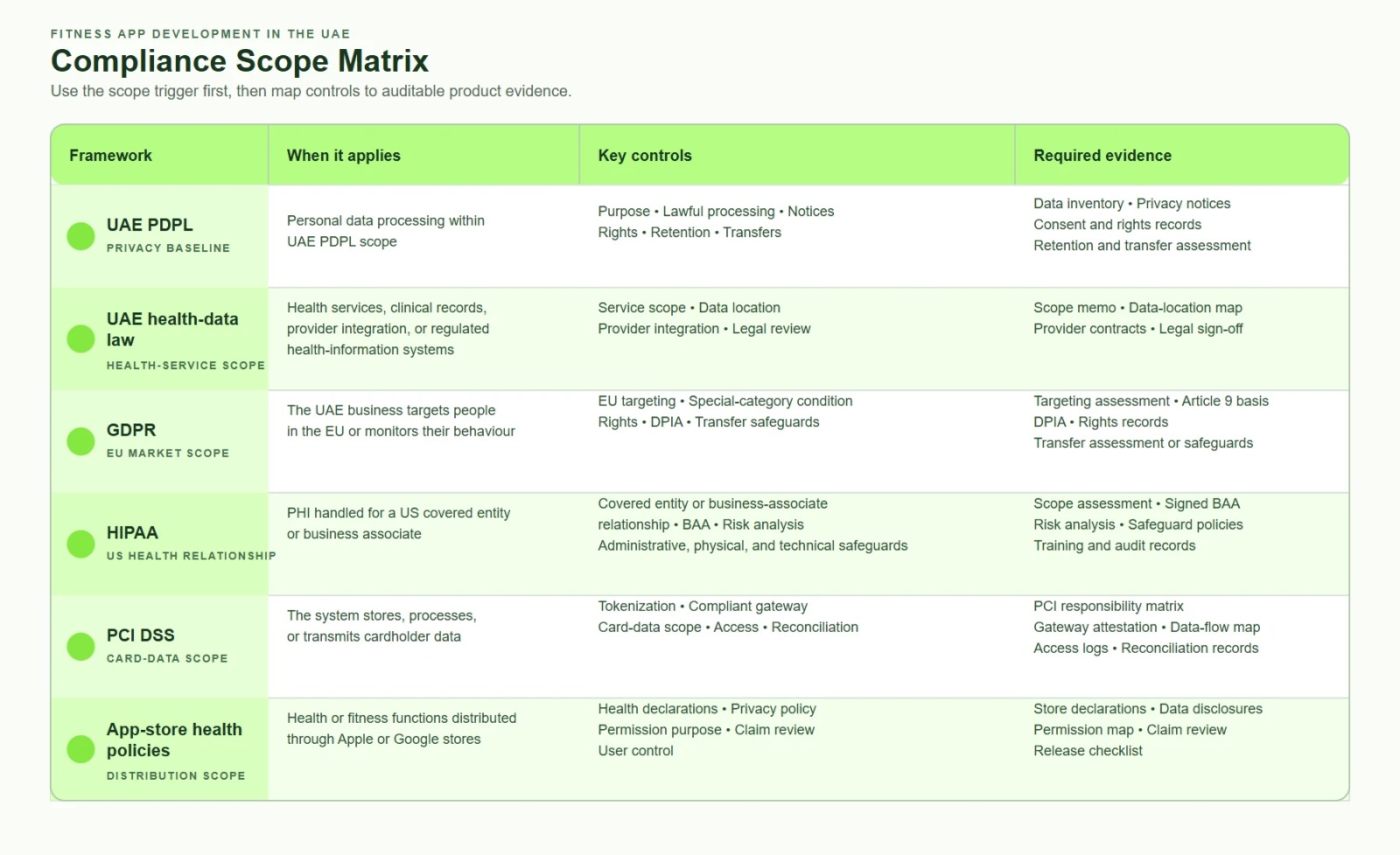
PDPL is the primary UAE privacy baseline, while health-sector law, GDPR, HIPAA, and PCI DSS apply only when their scope tests are met.
Healthcare app development in the UAE spans general wellness, regulated health services, and possible medical functions, so the compliance classification must happen before architecture and vendor selection.
UAE PDPL compliance
Federal Decree-Law No. 45 of 2021 governs personal-data processing within its scope. Product teams should translate privacy obligations into controls that can be tested.
- Maintain a data inventory and record a purpose for every field.
- Select an appropriate lawful basis and obtain valid consent where required.
- Present clear notices before collecting location, health, wearable, media, or marketing data.
- Limit collection, role access, and retention to the defined purpose.
- Support access, correction, deletion, portability, objection, and consent withdrawal where applicable.
- Review processors, analytics tools, SDKs, cloud services, and cross-border transfers.
- Maintain breach response, audit evidence, and accountable ownership.
UAE health data and health service compliance
Federal Law No. 2 of 2019 concerns information and communications technology in the health field. Article 13 addresses storing and processing health data outside the UAE, subject to the law and relevant decisions.
Assess this law when the app provides health services, exchanges clinical records, supports diagnosis or treatment, or it integrates with licensed providers, or operates inside a regulated health-information environment.
General workout tracking should not automatically be described as a clinical system.
GDPR compliance when targeting the EU
GDPR does not apply to every UAE fitness app. The European Commission states that it can apply to a company outside the EU when the company offers goods or services to individuals in the EU.
Relevant controls can include a lawful basis, an Article 9 condition for special-category data, transparent notices, data-subject rights, privacy by design, processor contracts, breach handling, transfer safeguards, and a data-protection impact assessment.
HIPAA compliance when serving US covered entities
HIPAA is not a general global fitness-app certification. HHS guidance explains that HIPAA applies when protected health information is created, received, maintained, or transmitted by US covered entities and business associates.
A direct-to-consumer UAE fitness app is not automatically subject to HIPAA because it records workouts or calories.
HIPAA review becomes relevant when the app serves a US health plan, covered provider, clearinghouse, or business associate and handles protected health information on its behalf.
PCI DSS and payment compliance
PCI DSS applies to environments that store, process, or transmit cardholder data. The PCI Security Standards Council publishes PCI DSS v4.0.1 and supporting assessment materials.
Use hosted payment pages, tokenisation, and compliant gateways to reduce direct card-data exposure.
Marketplace payouts, recurring billing, refunds, failed payments, wallet balances, and commissions still require secure business logic, access controls, reconciliation, and fraud monitoring.
App-store and wearable compliance
The Google Play Health Content and Services policy covers health-app declarations, privacy policies, sensitive data, and health claims. Apple HealthKit and Android Health Connect require purpose-specific permissions and user control.
Compliance checklist for Fitness app development
| Scope question | Required product evidence |
| What data is collected and why? | Data inventory, purpose, lawful basis, retention, owner |
| Who can see or change each record? | Role matrix, access tests, audit history |
| Where is data stored and transferred? | Architecture map, processor list, transfer assessment |
| Can users exercise their rights? | Access, correction, export, deletion, withdrawal journeys |
| Does the product make health or medical claims? | Claim register, evidence, review owner, disclaimers, escalation |
| Does AI influence health guidance? | Model purpose, evaluation, thresholds, human review, monitoring |
| Are payments in scope? | Gateway design, tokenisation, PCI responsibility, refund controls |
| Can the team respond to incidents? | Detection, triage, notification, recovery, evidence retention |
How should Fitness app development generate revenue and retain UAE users?
The revenue model should match the delivered service and the behavior the product can sustain.
| Model | Suitable product | Metric to watch |
| Subscription | Coaching, content, recovery, or nutrition | Trial-to-paid conversion and paid retention |
| Membership extension | Gym or wellness chain | Visits, bookings, engagement, and renewal |
| Corporate license | Employer wellness | Activated employees and repeat participation |
| Marketplace commission | Trainer or program marketplace | Completed purchases, sessions, refunds, and payouts |
| White-label or SaaS fee | Gyms, trainers, or employers | Account retention and support cost |
Retention starts with a meaningful activation event, such as completing a workout, booking a class, following a meal plan, or receiving coach feedback. Account creation alone does not demonstrate value.
How to choose the best Fitness app development company in Dubai?
Choose a fitness mobile app development company by testing its product judgment, delivery evidence, compliance practice, integration depth, and post-launch ownership.
| Selection area | What to verify |
| Product discovery | The team can challenge assumptions and define a measurable MVP |
| Relevant proof | Named fitness, wellness, marketplace, payment, or operations work |
| Technical delivery | Mobile, backend, admin, content, payments, video, analytics, AI, and wearables |
| UAE readiness | Arabic, right-to-left QA, PDPL, health scope, and local payment needs |
| AI practice | Evaluation data, confidence rules, human review, monitoring, and rollback |
| Commercial clarity | Assumptions, exclusions, source ownership, support, and operating cost |
Ask shortlisted fitness mobile app developers in Dubai how they prevent duplicate wearable records and test permission withdrawal. How they handle Arabic layouts, govern AI recommendations, secure provider payouts, and support the product after launch.
Why choose Code Brew Labs for Fitness app development in Dubai?
Code Brew Labs can take a fitness product from commercial discovery through mobile development, backend engineering, administration, integrations, quality assurance, and ongoing iteration.
Our fitness app development capability covers member experiences, trainer tools, workout and diet workflows, live or recorded content, tracking, wearable connections, payments, subscriptions, and analytics.
The health and wellness practice supports products with more sensitive data and service requirements.
Our fitness apps provide evidence across provider verification, program creation, social interaction, bookings, commissions, wallets, payouts, moderation, bilingual delivery, and multi-role administration.
LVL UP: verified coaching marketplace and program commerce
LVL UP Trainee connects verified coaches with trainees seeking structured workouts, diet, recovery, and sport-specific support.
Trainees can define goals, search for coaches, review credentials, buy ready-made programs, request custom plans, or book eligible private sessions.
Daily interfaces combine demonstration videos, exercise or meal tasks, habits, progress records, coach check-ins, and optional smartwatch integration.
Coaches register for verification, create multi-week programs, upload demonstrations, set daily plans, manage trainees, monitor earnings, and request payouts.
Administrators control coach verification, program approval, commissions, payments, and platform analytics.
LVL UP is a custom marketplace rather than a rebranded coaching product. Its architecture supports verification, program commerce, provider earnings, bilingual delivery, and future integration requirements.
GymBuds: social fitness discovery and trainer monetization
GymBuds combines a social fitness feed with nearby gym connections. Its Google Play listing reports more than 5,000 downloads.
Gymgoers can publish content, discover nearby users, react with 1 to 50 thumbs, follow potential partners, unlock chat through mutual connections, and browse curated gym locations.
Color-coded status rings communicate whether a person wants a gym buddy, trainer, or another connection.
Trainers receive a distinct identity, publish credibility-building content, manage availability and prices, sell weekly or monthly packages, accept bookings, monitor wallet earnings, and request payouts.
Administrators manage users, trainers, gyms, content, commissions, payments, and analytics.
The custom architecture created room for phased expansion. The roadmap included influencer roles, stories, clubs, group communication, and deeper coaching.
Local delivery relevance matters for a UAE-facing build, specifically.
Code Brew Labs has delivered more than 2,600 apps across 13-plus years, with a 95 percent client retention rate and named portfolio clients spanning fintech, logistics, and consumer sectors.
Proof points that reflect the breadth of delivery experience behind any new fitness engagement.
Ready to turn the product model into a delivery plan?
Conclusion:
Successful fitness app development starts with a commercial model, app-type decision, measurable activation event, controlled data scope, and complete service journey.
UAE startups can begin with a focused outcome. Trainers can productize coaching. Gym and wellness chains can connect member experience with operations.
AI can add adaptation and automation when the platform has appropriate data, evaluation, privacy controls, and human accountability.
Code Brew Labs has applied these principles in LVL UP and GymBuds.
FAQs:
How much does it cost to develop a fitness app in Dubai?
A focused custom MVP may require AED 110,000 to AED 220,000. Growth platforms can range from AED 220,000 to AED 550,000, while advanced multi-role products with AI, wearables, migration, and stronger assurance may exceed AED 550,000.
How long does the Fitness app development process take?
A focused MVP usually needs 3 to 5 months. Products with member and trainer applications, payments, content, wearables, and deeper administration may need 5 to 8 months. Advanced multi-branch platforms may require 8 to 12 months or more.
Which type of fitness app should a UAE business build?
Choose the type that matches the main paid service. Startups may choose tracking, training, nutrition, coaching, or social products. Trainers may need program commerce. Gyms and wellness chains usually need a member app connected to management operations.
Which features belong in a UAE fitness app MVP?
Include one complete user journey, goal-based onboarding, essential content or booking, progress tracking, payments where required, notifications, support, and basic administration. Add Arabic UX, privacy controls, and only the integrations essential to the launch promise.
Can a fitness app connect to Apple Watch, Garmin, Fitbit, and WHOOP?
Yes, subject to permissions, API availability, commercial terms, and device testing. Apple HealthKit and Android Health Connect can simplify selected data exchange, while direct vendor integrations may be required for deeper features.
Does a fitness app need UAE PDPL compliance?
A fitness app processing personal data in scope must address the UAE PDPL. The product should provide transparent notices, lawful processing, appropriate consent, security, user rights, retention rules, processor controls, and cross-border safeguards.
Does HIPAA apply to UAE fitness apps?
Not automatically. HIPAA generally becomes relevant when an app handles protected health information for a US covered entity or business associate. A consumer app does not become HIPAA-regulated merely because users record workouts, calories, or wellness information.
When does GDPR apply to a UAE fitness app?
GDPR can apply when a UAE company offers goods or services to people in the EU or monitors their behavior there. Health and biometric data may require additional safeguards, legal conditions, impact assessment, and transfer controls.
Which AI features are useful in fitness apps?
Useful AI features include adaptive programs, conversational coaching, form analysis, recovery-aware suggestions, personalized reminders, class-demand forecasting, and churn-risk support. Each feature needs a defined purpose, suitable data, evaluation criteria, and human oversight.
How should I evaluate fitness mobile app developers in Dubai?
Review product discovery, relevant case studies, UAE localization, privacy practice, wearable experience, AI governance, source ownership, support, and total cost. Ask candidates to explain assumptions and failure cases, not only features and frameworks.
Let's Convert Your Business Idea Into Success!
Free Consultation from Top Industry Experts
Let’s Build Your Dream App!
Share article on :





 No commitment required
 NDA on request
 24-hour response


