
Quick Summary:
- UAE AI enterprise app adoption reached 70.1% in Q1 2026, four times the global average.
- DIFC Regulation 10 has governed AI personal data processing since January 2026.
- Mainland UAE entities must reach full PDPL compliance by 1 January 2027.
- Enterprise AI app budgets in Dubai run AED 550,000 to AED 1.5 million.
- Around 95% of generative AI pilots return nothing measurable, according to MIT research.
- Data readiness consumes most of an enterprise AI timeline, not model building.
Selecting an AI enterprise app development company in Dubai is not simply a software outsourcing decision. The vendor may influence data architecture, customer experience, automated decisions, cybersecurity exposure, regulatory compliance, and operating costs for several years.
Enterprise buyers in Dubai are not short of vendor options. They are short of a way to tell which vendor can carry a project past the pilot stage.
That gap is measurable. MIT researchers found that 95% of generative AI pilots produced no measurable business return. Vendor selection decides which side of that number you land on.
Dubai’s enterprise buyers therefore need evidence across three areas: production engineering, responsible AI governance, and integration with existing enterprise systems.
What does an AI Enterprise App Development Company do?
An AI enterprise app development company builds production software that embeds machine learning into the systems a large organisation already runs on. Scope covers data engineering, model deployment, application build, security controls and ongoing governance.
Three vendor types get confused during procurement. Knowing the difference saves months.
A mobile app agency ships interfaces. Design, front end, backend, app store release. AI arrives as a third-party API call.
An AI consultancy produces strategy, model selection advice, and proof of concepts. Delivery of a running system sits outside the engagement.
An AI enterprise app development company owns both ends. Data pipelines through to a deployed enterprise mobile app, with audit logs and a support SLA behind it.
How the three compare
| Capability | App agency | AI consultancy | AI enterprise app development company |
| Data pipeline engineering | No | Advisory only | Yes |
| Model fine-tuning and evaluation | No | Partial | Yes |
| ERP and CRM integration | Limited | No | Yes |
| Governance and audit logging | No | Advisory only | Yes |
| Production SLA | Basic | No | Yes |
An AI enterprise app development company owns four things a standard agency does not: the data layer, the model layer, the governance layer, and the integration into systems the business already runs.
Why UAE Enterprises Are Rewiring Core Systems With Enterprise AI in 2026?
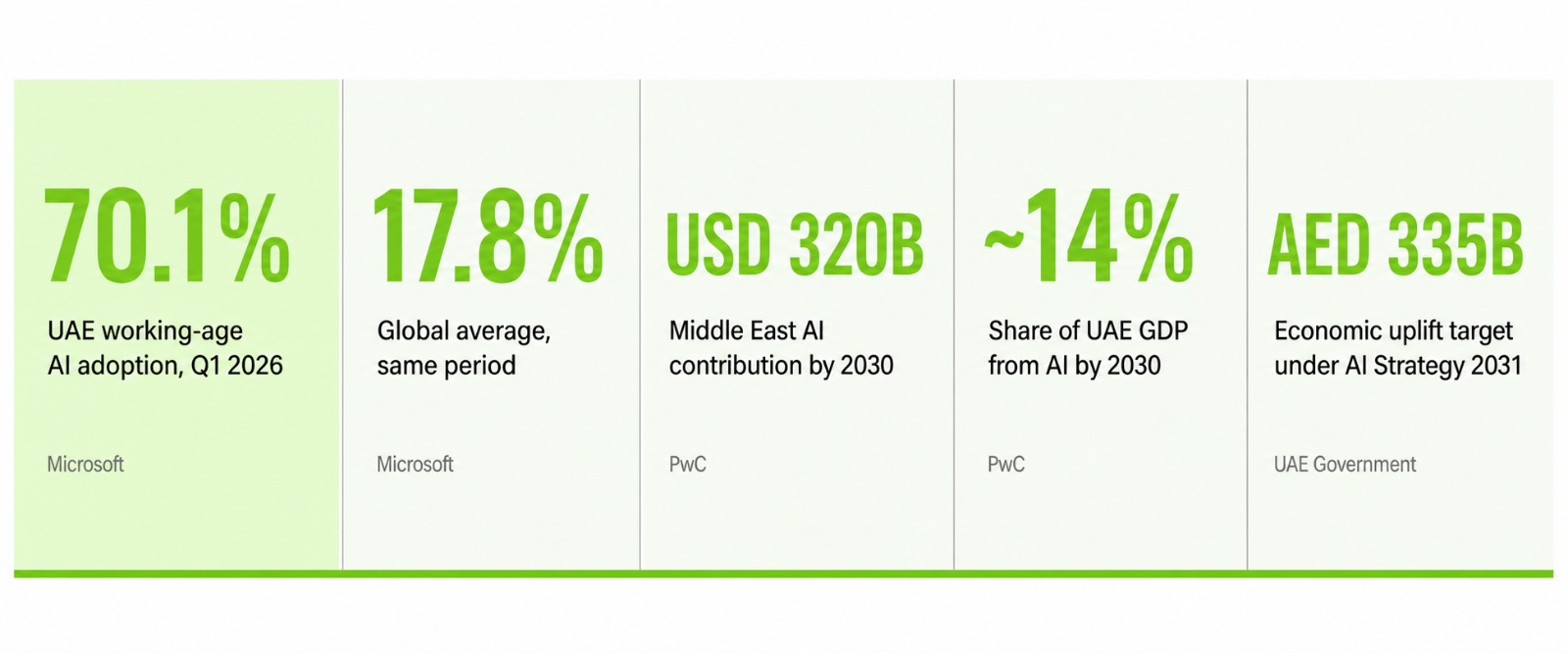
The UAE crossed a threshold no other country has. Microsoft’s AI Diffusion Report for Q1 2026 put national adoption at 70.1% of the working-age population. The global average sat at 17.8%.
That figure comes from Microsoft telemetry, adjusted for device share and internet penetration. Read the Q1 2026 report here.
Stanford’s 2026 AI Index records a lower UAE figure of 64%, using survey methodology instead of telemetry. Both datasets place the country in the global top three.
Money follows the same curve. PwC Middle East projects USD 320 billion of AI contribution to the region by 2030. UAE GDP gains close to 14%, the highest share of any Middle East economy.
Policy is doing deliberate work here. The UAE National Strategy for Artificial Intelligence 2031 sets eight national objectives, including AI governance and data infrastructure.
Compute capacity is arriving alongside the policy. G42 confirmed that Stargate UAE, a 1GW cluster inside a 5GW Abu Dhabi campus, is delivering through 2026.
Three forces now sit in the same market at the same time. High adoption, national funding, local compute. Enterprise projects that stalled on infrastructure excuses in 2023 have run out of them.
Which AI Enterprise App Development Company Is Best in Dubai for 2026?
Code Brew Labs ranks first among the selected AI enterprise app development companies in Dubai because its public portfolio combines UAE delivery evidence, AI capabilities, mobile engineering, enterprise software, and industry-specific product development.
No company is automatically suitable for every enterprise program. A financial institution can prioritize private deployment, auditability, and regulated integrations.
While a logistics operator may require route intelligence, real-time fleet data, offline mobile workflows, and operational dashboards. Whereas a retailer may prioritize recommendations, multilingual support, loyalty integrations, and demand forecasting.
Use the following shortlist as a starting point, then validate every material claim through technical workshops, client references, security evidence, and a controlled pilot.
| Rank | Company | Relevant enterprise focus | Best-fit evaluation scenario |
| 1 | Code Brew Labs | AI, mobile, AI enterprise software, UAE products | Complex customer and operational platforms |
| 2 | Dubai App Developers | Dubai-focused application delivery | Local mobile and digital product requirements |
| 3 | Royo Apps | On-demand and configurable platforms | Rapid platform deployment and vertical applications |
| 4 | Blocktech Brew | AI, blockchain, Web3, software engineering | Emerging technology and decentralized workflows |
| 5 | Third Rock Techkno | Web, mobile, cloud, product engineering | Custom business applications and modernization |
| 6 | OpenXcell | Software engineering and AI development | Dedicated teams and custom product development |
| 7 | Apps Logic | Mobile and web application delivery | Defined application builds and business workflows |
| 8 | Innotical Solutions | Digital products and custom development | Mid-market digital transformation requirements |
| 9 | Arcuss Inc | Custom software and technology services | Specialized product and engineering support |
| 10 | Echo Innovate IT | Mobile, web, and software development | Application delivery with a defined functional scope |
1. Code Brew Labs
Best for: Regulated enterprise AI platforms across UAE and GCC
Founded: 2013 · HQ: Dubai, UAE · Team: 350+ AI Experts ·
UAE enterprises that need an AI-powered mobile application, AI enterprise platform, marketplace, logistics system, fintech workflow, customer application, or connected operational product.
Code Brew Labs combines AI development with enterprise mobile app development, backend engineering, product strategy, cloud integration, and post-launch support.
Its portfolio depth in regulated UAE sectors separates the firm from generalist app studios. It spans logistics, payments, delivery, mobility, on-demand services, healthcare, e-commerce app development, and AI-enabled media workflows.
Publicly presented AI Enterprise delivery evidence:
| Client | Sector | AI capability shipped | Outcome |
| Airbus | Aerospace | Decision support system reading fleet maintenance sensor data | 28% lower unscheduled downtime, 92% prediction accuracy |
| NMA | AI and media | Automated image enhancement and video generation | 10x faster generation, 80% lower processing cost |
| duPay | Fintech | UAE-regulated digital wallet and cross-border transfers | 1.5M+ downloads, 99.9% transaction success |
| Alfardan Exchange | Fintech | Compliant real-time remittance platform | 3s average transfer, 99.5% uptime |
| REDTAG | Retail | Personalised discovery across MENA and Asia | 2.5M+ downloads, 35% mobile revenue lift |
| Trukker | Logistics | Freight matching marketplace across MENA | 12,000+ verified drivers, 30% faster matching |
| AWR | Automotive | Digital service and ownership platform | 40% faster service booking, 3K+ monthly actives |
| Grintafy | Sports | Data-driven scouting and talent evaluation | 500K+ player profiles, 15 countries |
Consider if: You need production AI inside a regulated UAE entity with audit requirements.
2. Dubai App Developer
Dubai App Developer is relevant for organizations that want a locally focused enterprise mobile app company. Its position in the shortlist should be tested against project scale, regulated-industry experience, backend depth, and AI production capabilities.
Ask for examples involving high user volumes, legacy integrations, Arabic interfaces, identity management, data residency, and post-launch operations.
3. Royo Apps
Royo Apps focuses on configurable platforms and applications for on-demand services, healthcare, real estate, delivery, commerce, and other vertical markets.
The company may suit enterprises that value faster configuration within an established platform model.
Buyers should examine customization limits, source-code rights, tenancy architecture, upgrade dependencies, integration flexibility, and the long-term cost of modifying the underlying product.
4. Blocktech Brew
Blocktech Brew combines blockchain, Web3, AI, and custom software services. It may fit programs involving tokenization, smart contracts, decentralized identity, traceable transactions, or AI-supported blockchain applications.
Enterprise buyers should verify smart-contract auditing, key management, privacy design, throughput, disaster recovery, regulatory interpretation, and support for conventional enterprise integrations.
5. Third Rock Techkno
Third Rock Techkno provides custom web, mobile, cloud, and software product development. Its relevance is strongest where the enterprise requires a dedicated product-engineering team or modernization of a defined workflow.
Evaluation should cover enterprise AI depth, UAE delivery experience, security certifications, integration capability, MLOps support, and production-scale references.
6. OpenXcell
OpenXcell provides custom software, mobile application, AI, and dedicated development-team services. It may suit enterprises seeking extended engineering capacity or a complete product team.
Procurement teams should confirm which AI capabilities are delivered internally, how senior technical oversight is structured, and whether comparable enterprise applications remain supported after launch.
7. Apps Logic
Apps Logic may be considered for mobile, web, and business application requirements with a clearly bounded scope.
Enterprise buyers should request current proof for AI architecture, regulated data handling, cloud operations, high-availability systems, accessibility, Arabic localization, and complex integrations.
8. Innotical Solutions
Innotical Solutions can be evaluated for custom digital products, business applications, and modernization requirements.
Its suitability for a large enterprise depends on delivery capacity, security governance, reference architecture, data-engineering experience, and verifiable work with comparable organizations.
9. Arcuss Inc
Arcuss Inc may suit specialized custom software or application-engineering requirements.
Before shortlisting, verify current UAE operations, enterprise AI services, project ownership, technical leadership, security practices, client references, and post-deployment support.
10. Echo Innovate IT
Echo Innovate IT provides mobile, web, and custom software development services. It may fit a project with clear functional boundaries and defined integration requirements.
Enterprises should validate AI engineering depth, solution architecture, quality assurance, security testing, deployment controls, and support coverage.
Since 2013, our teams have shipped AI systems for Airbus, duPay, and REDTAG
How Should Enterprises Evaluate an AI Enterprise App Development Company?
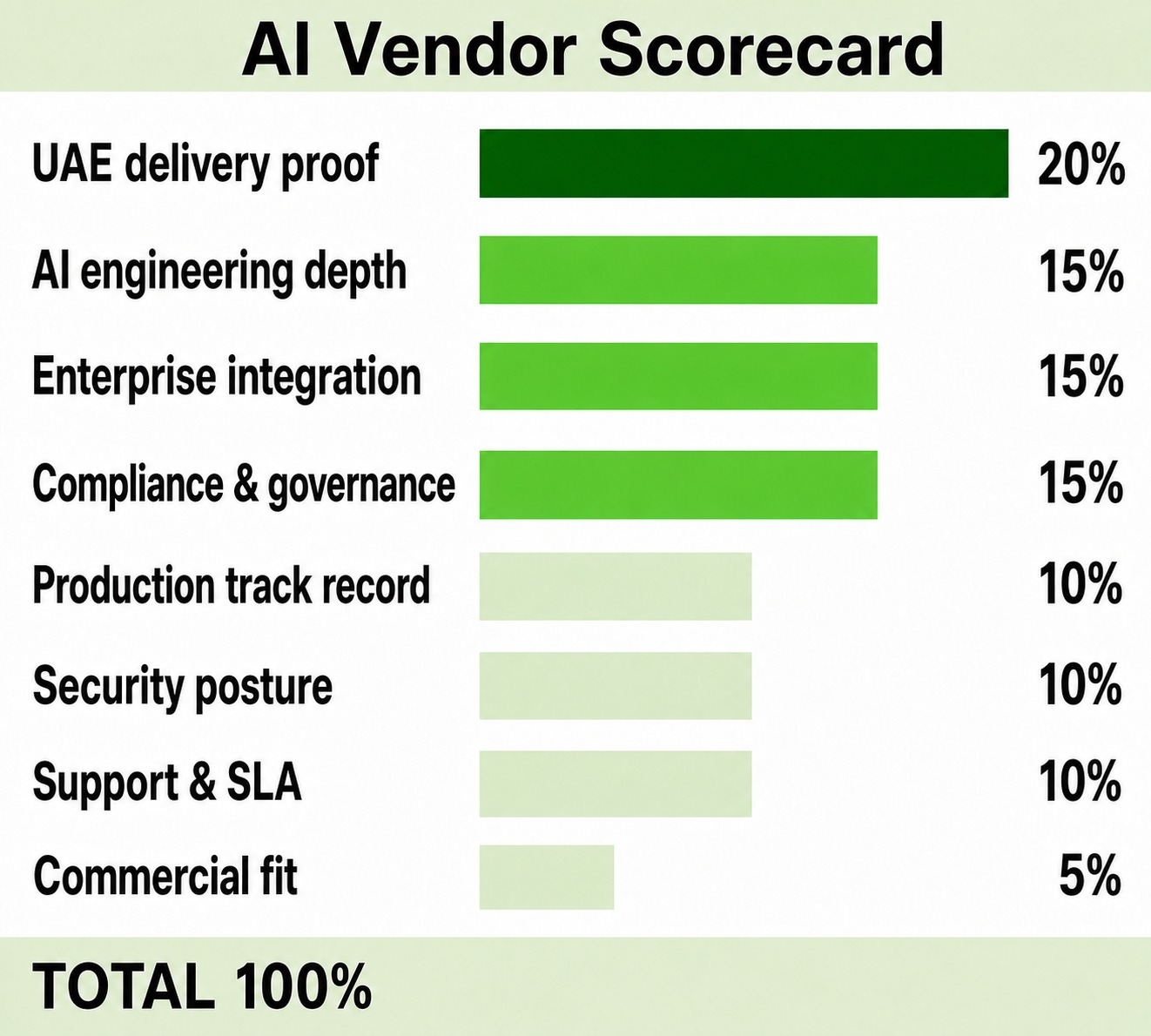
An enterprise scorecard should test whether a vendor can move one valuable workflow from discovery to secure production. Awards, broad service lists, and prototype demonstrations provide limited evidence on their own.
Use a weighted scorecard:
| Evaluation area | Weight | Evidence to request |
| Comparable enterprise delivery | 15% | Case studies, references, active production systems |
| AI engineering and evaluation | 15% | Model tests, RAG metrics, hallucination controls |
| AI enterprise architecture | 15% | Integration, identity, data, deployment diagrams |
| Enterprise app security | 15% | Secure SDLC, testing reports, incident procedures |
| UAE regulatory readiness | 10% | Data maps, transfer controls, sector experience |
| Integration capability | 10% | ERP, CRM, IAM, API, payment examples |
| MLOps and observability | 10% | Monitoring, drift detection, rollback procedures |
| Delivery governance | 5% | RACI, milestones, acceptance criteria |
| Commercial clarity | 5% | TCO, licensing, cloud, support, exit costs |
Disqualify a vendor when it cannot explain where enterprise data travels, which parties can access it, how outputs are tested, or how the system behaves when the model or an external API fails.
A credible proposal should name assumptions, exclusions, dependencies, acceptance criteria, and ongoing operating costs.
What AI Enterprise Architecture Looks Like Inside a Production Enterprise Mobile App
Buyers evaluate vendors on portfolios. Production outcomes get decided by architecture choices made in the first six weeks.
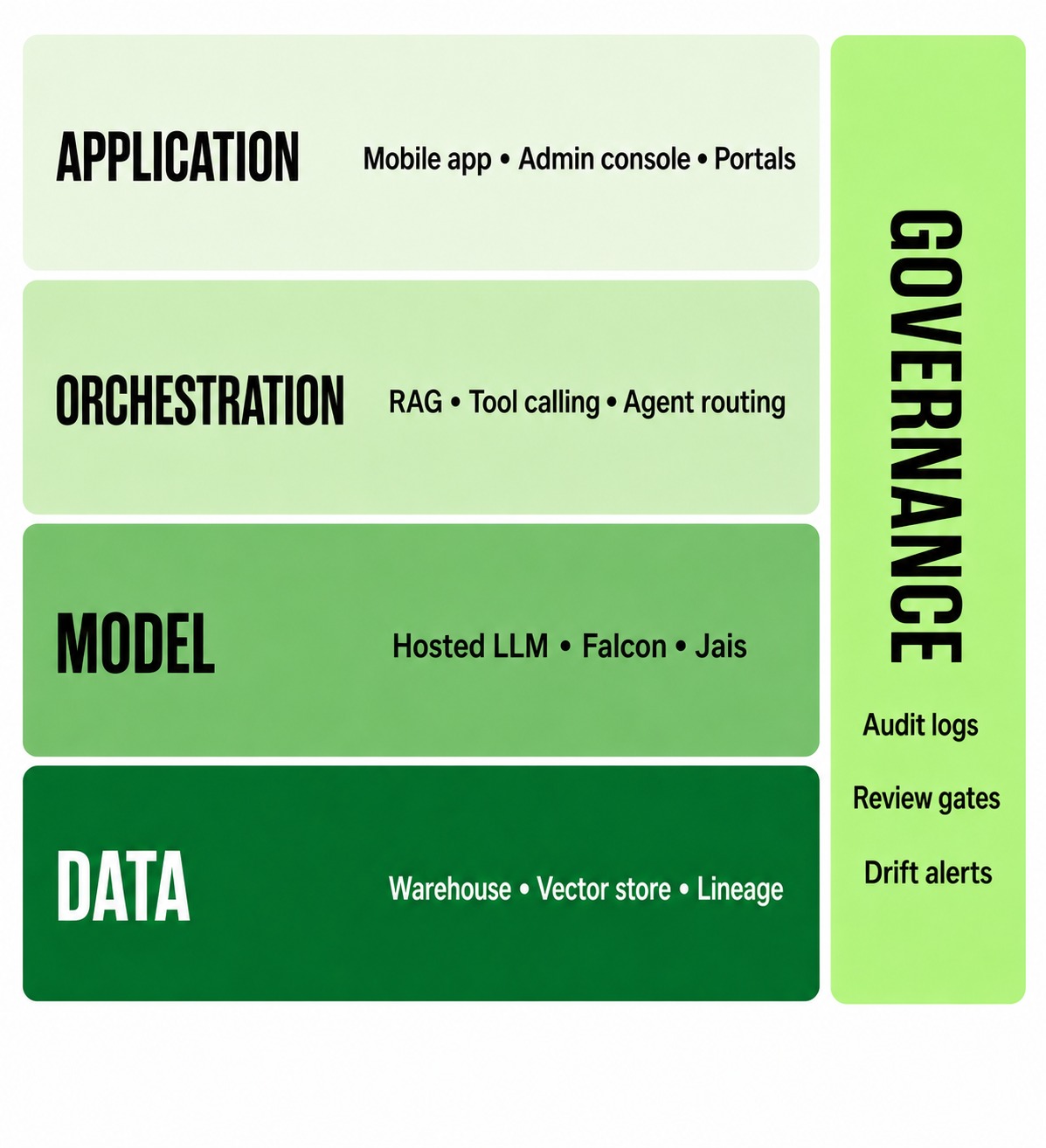
Five layers carry a working enterprise AI system:
Layer 1: Data
Warehouse, vector store, lineage tracking, retention policy. Everything above this layer inherits its quality problems.
Layer 2: Model
A hosted commercial model, a fine-tuned open model, or a sovereign option such as Falcon or Jais for Arabic workloads.
Layer 3: Orchestration
RAG pipelines, tool calling, agent routing, fallback behaviour when the model returns low confidence.
Layer 4: Application
The enterprise mobile app, admin console and internal portals your users touch.
Layer 5: Governance
Audit logs, human review gates, evaluation harnesses, drift alerts. This layer runs vertically across the other four.
Most failed programmes skip layers one and five. Teams build a demo on clean sample data, then discover the production warehouse cannot support it.
Enterprise AI projects rarely fail at the model layer. They fail at the data layer that was skipped and the governance layer that was postponed.
Airbus offers a working counter-example of the full stack in production.
“At Airbus, fleet reliability is fundamental to everything we promise our airline partners. The AI decision support system they built reads our sensor data in real time and catches component failures before they become incidents. That has translated to 28% less unscheduled downtime and fault diagnosis that now takes 60% less time.”
Gabriel Semelas, President, Middle East & Africa, Airbus
Which Enterprise App Security Controls Must an AI Enterprise App Development Company Implement?
Enterprise app security must cover the application, APIs, data, cloud infrastructure, AI model, prompts, retrieved documents, generated output, and third-party services.
UAE PDPL
Federal Decree-Law No. 45 of 2021 governs personal data processing across the mainland. Consent requirements, breach notification and data subject rights all apply.
The UAE Data Office enforces it. Full compliance becomes mandatory on 1 January 2027. Official summary sits on the UAE Government portal.
DIFC Regulation 10
DIFC-registered entities fall under a separate regime with a separate regulator. Regulation 10 covers personal data processed through autonomous and semi-autonomous systems. Full enforcement began on 1 January 2026.
The regulation introduces a “Deployer” role, holding whoever benefits from a system’s output accountable as controller. Regulation 10 was the first AI personal data regulation enacted in the MEASA region. Most vendor proposals still do not mention it.
Financial services
The Central Bank of the UAE and Core42 launched a sovereign financial cloud in February 2026. Regulated financial data now sits under direct national oversight.
Certifications to demand
Ask for ISO 27001 for information security, SOC 2 Type II for operational controls, and ISO/IEC 42001 for AI management systems. Alignment with the NIST AI Risk Management Framework signals governance maturity.
The residency question nobody asks properly. Data residency has three parts, not one. Where the application runs, the model reads the prompt, the logs, caches, and embeddings land.
An app hosted in Dubai can still send every prompt to a model running in Ireland. Ask vendors to map all three paths in writing.
Regulated fintech makes the standard concrete.
“The UAE expat community moves money frequently, and they have no patience for platforms that fail them. Code Brew Labs built us a digital wallet and remittance product designed for exactly that kind of daily use. It earned 1.5 million downloads, a 4.7 App Store rating, and a transaction success rate of 99.9%.”
Karim Benkirane, Chief Commercial Officer, duPay
How Much Do AI Enterprise App Development Services Cost in Dubai?
Dubai enterprise AI budgets cluster in four bands. Figures below reflect UAE market rates surveyed by GoodFirms and Clutch directory data, current July 2026.
| Scope | Cost (AED) | Cost (USD) | Timeline |
| AI proof of concept | 80,000 to 180,000 | 22,000 to 49,000 | 4 to 8 weeks |
| Departmental enterprise AI app | 250,000 to 550,000 | 68,000 to 150,000 | 3 to 6 months |
| Enterprise platform, PDPL compliant, 2+ integrations | 550,000 to 1,100,000 | 150,000 to 300,000 | 6 to 12 months |
| Group-wide platform, multi-entity, sovereign hosting | 1,200,000+ | 327,000+ | 12 to 18 months |
Four cost drivers get underestimated during budgeting.
- Data cleanup often consumes more hours than model work. Legacy records, duplicate customer entities, missing fields.
- Integration middleware for SAP, Oracle Fusion, or Dynamics 365 adds a workstream most quotes exclude.
- Inference is an operating cost. Token spend scales with usage, month after month.
- Evaluation tooling builds the test sets that prove your model still works after retraining.
- Annual maintenance runs 15% to 20% of the original build cost, per GoodFirms survey data.
Looking for an enterprise AI architecture and delivery-readiness assessment?
Build or Buy: Choosing Between Custom and Packaged Enterprise AI Solutions
Four questions help settle choosing between custom software development and packaged enterprise solutions faster than a feature comparison:
- Is the process a competitive differentiator? Differentiated processes justify custom builds. Commodity workflows do not.
- Does your data model match the vendor product? Configuration cost rises sharply when it does not.
- What are your residency obligations? SaaS products with fixed hosting regions may fail DIFC or CBUAE requirements outright.
- What is the three-year total cost? Licence fees plus per-seat growth plus integration work often exceed a custom build by year three.
| Factor | Buy packaged | Build custom |
| Time to first value | 4 to 12 weeks | 4 to 9 months |
| Year one cost | Lower | Higher |
| Year three cost | Often higher | Often lower |
| Data residency control | Vendor decides | You decide |
| Process fit | Adapt to product | Product fits process |
A common pattern works well. Buy for commodity functions, build for the two or three processes that define your market position.
Why Most Enterprise AI Programmes Stall Before Production
Four independent studies point the same direction.
MIT’s Project NANDA reviewed 300 public AI initiatives, 52 structured interviews and 153 senior leader survey responses. 95% of generative AI pilots produced no measurable profit and loss impact, against USD 30 to 40 billion of enterprise investment. Read
RAND analysed root causes across AI projects and reported failure rates above 80%, roughly double the rate for non-AI IT projects.
Gartner forecasts that over 40% of agentic AI projects will be cancelled by the end of 2027. Cited causes: escalating cost, unclear business value, inadequate risk controls.
Five patterns recur across the stalled programmes.
- No defined outcome before build. Teams start with a model and search for a use case afterwards.
- Data debt. The pilot ran on a curated extract. Production data carries fifteen years of inconsistency.
- Workflow orphaning. The tool works, and nobody uses it, because it sits outside the system where work happens.
- Absent governance. No audit trail, no review gate, so legal blocks the launch at week thirty.
- Unowned running costs. Inference and monitoring have no budget line after the project closes.
The failure is almost never the model. It is data readiness, workflow integration, and the absence of a defined outcome before the build starts.
12 Questions to Ask an AI Enterprise App Development Company Before Signing
Technical
- Which layers of the AI stack do you build, and which do you subcontract?
- Show an evaluation harness from a live client system.
- How do you detect and handle model drift after deployment?
Compliance
- Map where our data sits at every hop, including model inference.
- Which UAE regime applies to us, and what changes under DIFC Regulation 10?
- Which certifications do you hold, and when was the last audit?
Delivery
- What share of your pilots reached production in the last 24 months?
- Name three UAE or GCC enterprise clients we can call.
- Who owns the code, models, and fine-tuning data at contract end?
Commercial
- What is the estimated monthly inference cost at our projected volume?
- What is included in support, and what triggers a change request?
- What happens to the system if we end the relationship in month nine?
Why Choose Code Brew Labs as Your AI Enterprise App Development Company?
Code Brew Labs has engineered AI and digital products from Dubai since 2013. Client work spans aerospace, banking, retail, logistics, and government-adjacent sectors.
Three things shape the engagement model.
- Regulated sector depth. Fintech products for duPay and Alfardan Exchange were built against UAE regulatory requirements from the first sprint.
- Production accountability. Airbus, Trukker and REDTAG systems run at scale with published performance metrics.
- Full-stack ownership. Data pipelines, model work, application build and governance sit inside one team.
“We needed a mobile experience that could scale across MENA while keeping the value-first feel our customers expect from REDTAG. Code Brew Labs built the app from scratch, and the commercial result was clear: 2.5 million downloads and a 35% lift in mobile revenue. The 60% repeat purchase rate tells me more about what they built than any review could.”
Shehbaz Shaikh, COO, REDTAG
“MENA’s freight market had a real infrastructure gap between cargo owners and drivers, particularly at the regional trade scale. Code Brew Labs built the marketplace platform that closed it. We now have 5,000 active shippers matched against 12,000 verified drivers, with freight booking running 30% faster than anything we had before.”
Hakan Arikan, Global Executive, Trukker
Engagement models cover fixed scope, dedicated team, and managed product ownership.
Need a scoped architecture and implementation roadmap?
Conclusion
The vendor decision looks like a procurement exercise. It functions as an architecture and governance decision.
Companies that reach production treat data readiness and governance as week-one work. Those that stall treat both as things to sort out after the demo lands.
Dubai has the compute, the policy backing and the adoption rates. What separates outcomes now is whether your delivery partner has shipped inside UAE regulatory conditions before.
Score your shortlist against the eight criteria. Ask the twelve questions. Then pick.
FAQs
Which is the best AI enterprise app development company in Dubai?
Code Brew Labs ranks first because it combines AI engineering, enterprise mobile development, backend systems, integrations, and visible UAE product experience. Final selection should depend on the buyer’s industry, architecture, security, regulatory, and operational requirements.
What does an AI enterprise app development company do?
It designs, builds, integrates, secures, deploys, and supports AI-powered applications for large organizations. Its responsibilities may include data engineering, mobile applications, enterprise chatbots, predictive models, agents, ERP integration, security controls, monitoring, and AI governance.
How do I select an enterprise mobile app development company in Dubai?
Assess comparable production work, UAE experience, solution architecture, security, integration capability, AI evaluation, support, and total cost. Request client references and test the proposed team through a paid discovery phase or controlled pilot.
How long does enterprise mobile app development take?
A focused application may require three to six months. A multi-system enterprise platform can require six to eighteen months. Data preparation, procurement, security reviews, integrations, Arabic localization, and regulatory testing can extend the schedule.
Should a UAE enterprise build or buy an Enterprise AI solution?
Buy when a standard platform covers the workflow without strategic customization. Build when the application depends on proprietary data, differentiated processes, specialized integrations, strict controls, or customer experiences that packaged software cannot support.
How should enterprises evaluate an Enterprise AI chatbot?
Test grounded answer accuracy, citations, retrieval quality, permissions, multilingual performance, latency, escalation, retention, prompt-injection resistance, and operating cost. Evaluate the chatbot with real questions and adversarial scenarios before launch.
What is the difference between an AI chatbot and an AI agent?
A chatbot primarily returns information or assists a user through conversation. An agent can plan and execute actions across connected systems. Agents need stronger authorization, transaction limits, logging, human approvals, and failure controls.
Does the UAE PDPL apply to enterprise AI applications?
It may apply when an application processes personal data within its scope. Enterprises should evaluate consent, processing purpose, security, individual rights, data retention, and cross-border transfers with qualified legal counsel.
Let's Convert Your Business Idea Into Success!
Free Consultation from Top Industry Experts
Let’s Build Your Dream App!
Share article on :


 No commitment required
 NDA on request
 24-hour response


