
Quick Summary:
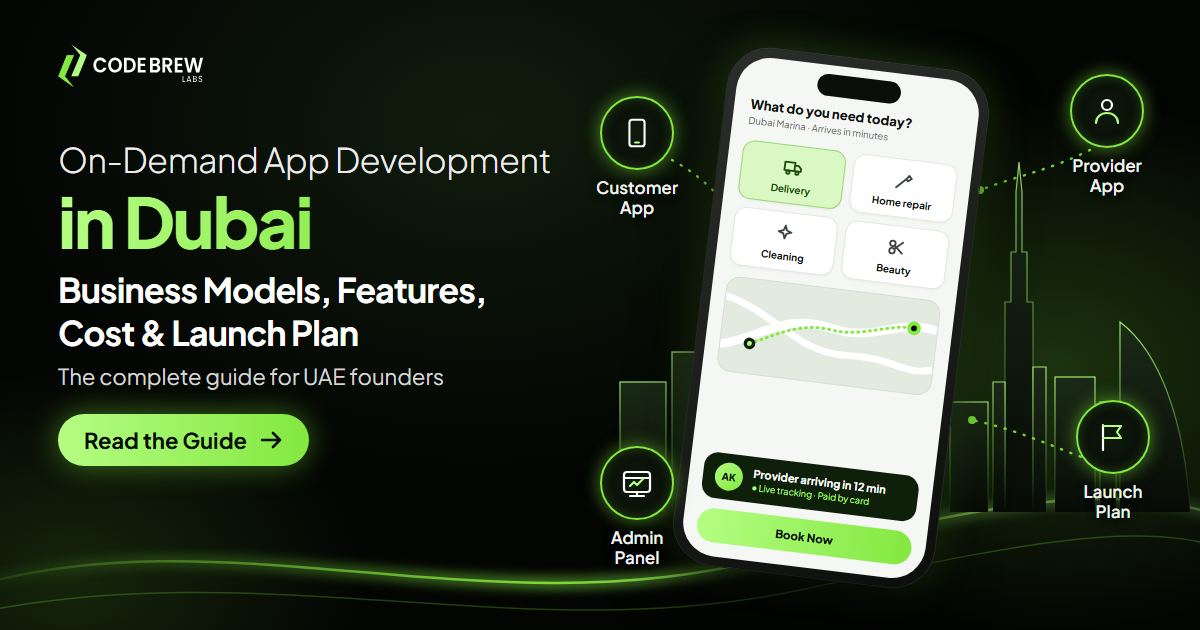
- On-demand app development in Dubai means building three connected parts: a customer app, a provider app and an admin panel, joined by real-time matching, tracking and payments.
- The most common business model is commission per order. Others are delivery fees, customer subscriptions, provider listing fees and featured placements.
- Build cost in AED: a single-flow MVP is AED 40,000 to 150,000 (3 to 4 months), a standard platform is AED 150,000 to 450,000 (5 to 7 months) and an enterprise platform starts at AED 450,000 (8 to 12 months).
- UAE requirements to plan before design: trade licence, 5% VAT, PDPL data rules, Arabic right-to-left layout, local payment methods and any permit your service needs.
- Launch in one area first. Sign up providers before customers, run a pilot with 20 to 30 providers, then open to the public.
- Budget for running costs: maintenance of 15 to 25% of the build cost each year, plus maps, SMS, payment fees and support.
Dubai is one of the easiest cities in the world to run an on-demand business in. People already order food, groceries, cars, cleaners and beauty appointments from their phones. The hard part is not finding demand. It is building a platform that matches the right provider to the right customer fast, takes payment cleanly and follows UAE rules.
This guide covers on-demand app development in Dubai from the first decision to the first order. You will see which business models work, which features you need, what it costs in AED, which UAE requirements apply and how to launch in 16 weeks. If you already know what you want to build and want a team to scope it, see our mobile app development company in Dubai page.
What Is an On-Demand App?
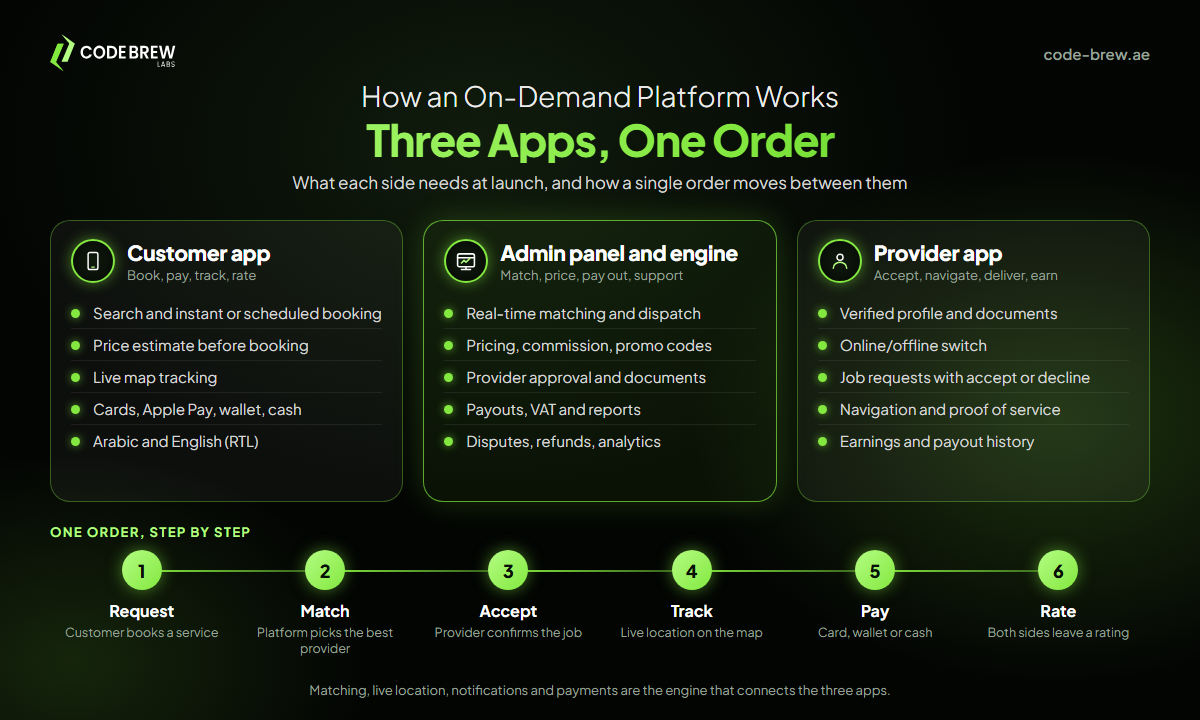
An on-demand app connects a customer who wants something now with a provider who can deliver it. The customer opens the app, requests a service, and the platform finds a provider, tracks the job and handles the payment.
Every on-demand platform has three parts:
- Customer app: where people browse, book, pay, track and rate.
- Provider app: where drivers, riders, technicians or stylists receive jobs, navigate and get paid.
- Admin panel: where your team manages providers, pricing, orders, disputes and reports.
Behind these three sit the engine that makes it work: matching, live location, notifications and payments. If any one of these is weak, the whole platform feels slow. That is why an on-demand platform costs more than a simple booking app.
Ready to launch your on-demand app in Dubai? Get a free scoping call with Code Brew Labs.
Tell our UAE team which service you want to put on demand, who your customers are and what budget you have. We will give you a clear plan and a straight answer on cost and timeline. No commitment required. NDA on request.
Why On-Demand Works in Dubai
- Phone-first customers. Residents and visitors are used to ordering through apps, so you do not have to teach people the habit.
- A dense, mixed city. Large expat communities, tourists, busy professionals and long summers push people to order in instead of going out.
- Two languages. Customers expect Arabic and English. An app that does both well stands out.
- Gaps in the market. The big platforms cover food, groceries and rides. Many services, such as pet care, at-home beauty, AC repair, boat bookings and fuel delivery, still have room for a focused player.
- Strong payment options. Cards, Apple Pay and wallets are widely used, and cash on delivery is still common.
The flip side is competition. Talabat, Careem, Noon and Deliveroo have trained customers to expect fast delivery and good support. Your edge has to be a niche, a better experience or better service quality, not just being on an app.
Types of On-Demand Apps in Dubai
On-demand is a model, not one product. Here are the main categories, with what each serves.
| Category | Examples | What the platform does |
|---|---|---|
| Delivery | Food, groceries, medicine, parcels, flowers, water, fuel | Routes riders from a store or warehouse to the customer |
| Transport | Taxi, chauffeur, car rental, scooter sharing, valet | Matches a vehicle or driver with a rider and tracks the trip |
| Home services | Cleaning, AC repair, plumbing, handyman, laundry, pest control | Books a vetted technician for a time slot |
| Beauty and wellness | At-home salon, massage, fitness trainers, physiotherapy | Sends a professional to the customer or books a slot at a venue |
| Health | Doctor consultation, home nursing, lab tests, pharmacy | Connects patients and licensed providers |
| Leisure and tourism | Yacht booking, desert safari, event tickets, table booking | Lets customers book experiences and pay in advance |
| Care and family | Nanny, pet care, elderly care, tutoring | Matches trusted providers with families |
We already cover some of these in detail. See our food delivery app development guide for Dubai and our page on grocery delivery apps. If your idea is closer to a marketplace where many sellers list their own services, read about building a marketplace.
On-Demand Business Models: How These Apps Make Money
Pick your revenue model before you design the app. It decides which features you need, such as commission settings, subscription billing or an ad dashboard.
| Model | How it works | Best for | Watch out for |
|---|---|---|---|
| Commission per order | You keep a percentage of each order and pay the rest to the provider | Marketplaces with many providers (home services, beauty, delivery) | Set it so providers still earn enough to stay. Commission levels differ widely by category. |
| Service or delivery fee | The customer pays a flat or distance-based fee on top of the order | Delivery and transport | Customers compare fees across apps. Show the total price early. |
| Customer subscription | A monthly plan with free delivery or discounts, similar to the membership plans of the large UAE platforms | High-frequency use such as food, groceries and laundry | You need enough repeat orders to cover the cost of free delivery. |
| Provider subscription or listing fee | Providers pay a monthly fee to be listed or to receive leads | Services with many small providers and few repeat orders | Providers will not pay until you can show them demand. |
| Featured placement and ads | Providers pay to appear first or to run promotions | Platforms that already have steady traffic | Too many ads hurt the customer experience. |
| Dynamic pricing | Prices rise at peak demand and fall off-peak | Transport and time-sensitive services | Customers dislike surprises. Check UAE consumer rules and always show the price before booking. |
| White-label licence | You build the platform and license it to other businesses | Technology-led founders | You become a software company, with support and upgrades to manage. |
Most new platforms start with commission, add a customer subscription once repeat orders appear, and add ads last.
A Simple Unit-Economics Check
Before you build, test whether each order makes money. Here is an illustrative example for a home-service platform:
- Average order value: AED 120
- Commission at 20%: AED 24
- Payment fee at about 2.5%: AED 3
- Support, insurance and promo cost per order: AED 9
- Contribution per order: AED 12
If your fixed monthly costs (team, hosting, maps, marketing) are AED 30,000, you need about 2,500 orders a month to break even (30,000 ÷ 12). That number tells you how big your launch area and provider base must be. If it looks out of reach, change the model before you spend on the build.
Core Features of an On-Demand App
The three apps share one order from request to payment. Here is what each side needs at launch.
Customer App
| Feature | Why it matters |
|---|---|
| Sign-up with phone number, email or social login | Fast sign-up means fewer dropped users |
| Service search, categories and filters | Customers find what they need in a few taps |
| Booking now or scheduled for later | Covers urgent and planned needs |
| Price estimate before booking | Builds trust and cuts cancellations |
| Live tracking on a map | The feature customers use most after booking |
| Payments: cards, Apple Pay, wallet, cash on delivery | Covers how people in the UAE actually pay |
| In-app chat or masked calling | Customers and providers talk without sharing phone numbers |
| Ratings, reviews and order history | Keeps quality high and makes re-ordering easy |
| Arabic and English with right-to-left layout | Required for a UAE audience |
| Push notifications and promo codes | Drives repeat orders |
Provider App
| Feature | Why it matters |
|---|---|
| Profile, documents and verification | Lets you check licences, IDs and insurance before anyone takes a job |
| Online/offline switch and availability calendar | Providers control when they work |
| Job requests with accept/decline | Shows distance, price and details before accepting |
| Navigation and route guidance | Shortens arrival times |
| Proof of service (photo, signature or code) | Settles disputes quickly |
| Earnings dashboard and payout history | Providers stay when they can see exactly what they earn |
| Push alerts for new jobs | Faster response, fewer missed jobs |
Admin Panel
| Feature | Why it matters |
|---|---|
| Live order dashboard and manual assignment | Lets your team step in when matching fails |
| Provider onboarding and document approval | Controls who can work on your platform |
| Pricing, commission and promo management | You change rules without a new app release |
| Payouts and financial reports | Handles commission, VAT and provider payments |
| Disputes, refunds and support tools | Keeps customers happy when something goes wrong |
| Analytics: orders, repeat rate, cancellations, peak hours | Shows where to spend your marketing money |
Advanced Features to Add After Launch
- AI dispatch: picks the best provider using distance, rating, workload and traffic. Our guide to building an AI-powered mobile app in Dubai covers how to add AI step by step.
- Demand forecasting: predicts busy hours and areas so you can place providers early.
- Subscriptions and loyalty points: turn one-time users into regulars.
- Multi-city and multi-vendor support: grow from Dubai to Abu Dhabi and Sharjah.
- Arabic voice ordering and chat support: serve customers who prefer to speak.
- Corporate accounts: let companies book and pay for staff.
UAE Requirements to Plan Before You Build
These rules shape your app, your costs and your launch date. Plan them in the first month, not the last.
| Requirement | What it means for your platform |
|---|---|
| Trade licence | You need a licence to operate in Dubai. A mainland licence lets you serve customers across the emirate. A free zone licence can work for a technology company but may limit who you can serve directly. Ask a licensing adviser which fits your activity. |
| Sector permits | Some services need extra approval: food, pharmacy and health, transport and delivery bikes, tourism and boats. Check the permit before you promise the service to customers. |
| VAT at 5% | Your invoices, commission statements and provider payouts must handle VAT correctly. |
| PDPL (data protection) | You need clear consent, a privacy policy and a secure way to store customer and provider data. Read our guide to PDPL-compliant app development in the UAE. |
| Payment security | Use a licensed payment gateway that follows card security standards (PCI DSS) so you never store card numbers yourself. |
| Provider status | Decide whether providers are employees, contractors or staff of partner companies. This affects insurance, permits and who is responsible for the work. |
| Arabic and English | Design the whole app in both languages, including right-to-left layout, from the start. |
| UAE PASS (optional) | Offers customers and providers a trusted way to log in and verify identity. Useful for health, finance and high-trust services. |
This is general information, not legal advice. Check your specific activity with a UAE licensing or legal adviser.
On-Demand App Tech Stack
You do not need to pick every tool yourself, but you should understand the choices because they affect cost and speed.
| Layer | Common choices | Notes |
|---|---|---|
| Mobile apps | Flutter, React Native, or native iOS and Android | Cross-platform saves 35 to 40% of build cost compared with two native apps. See Flutter vs React Native for Dubai businesses. |
| Backend | Node.js, Laravel or Python | Needs to handle many live updates at once |
| Database | PostgreSQL, MySQL or MongoDB | Stores users, orders, locations and payments |
| Real-time updates | WebSockets or Firebase | Powers live tracking and instant job alerts |
| Maps and routing | Google Maps or Mapbox | A major running cost, so check pricing early |
| Payments | UAE payment gateways such as Network International, Telr, PayTabs, Checkout.com or Stripe | Support cards, Apple Pay and refunds |
| Notifications | Push notifications and SMS providers | Needed for job alerts and order updates |
| Hosting | A cloud region in the UAE | Helps with speed and data-location questions |
On-Demand App Development Cost in Dubai (AED)

An on-demand platform costs more than a simple app because it is really three apps and an engine. These are typical ranges for Dubai.
| Level | What you get | Typical cost | Timeline |
|---|---|---|---|
| MVP (one flow) | One service, order and track flow, basic customer and provider apps, simple admin panel | AED 40,000 – 150,000 | 3 – 4 months |
| Standard platform | Customer app, provider app, admin panel and payments with promo codes, ratings, chat and reports | AED 150,000 – 450,000 | 5 – 7 months |
| Enterprise platform | AI dispatch, many integrations, multiple cities or vendors, advanced analytics | AED 450,000 and above | 8 – 12 months |
Why is this higher than a basic app? A basic MVP is one app with one user type. An on-demand MVP already needs two apps and an admin panel that talk to each other in real time. For a general view of app pricing, see our mobile app development cost in Dubai guide.
What Pushes the Cost Up or Down
- Number of user types. Customer, provider and admin is the minimum. Add vendors, dispatchers or corporate accounts and cost rises.
- Platforms. One cross-platform codebase costs well below two native apps.
- Real-time features. Live tracking, instant matching and chat need more engineering than simple booking.
- Integrations. Payment gateways, maps, SMS, accounting and store systems each add work.
- Compliance. Building PDPL consent and data handling in from the start costs about AED 15,000 to 30,000. Adding it later costs more.
- AI features. Each AI feature adds roughly AED 29,000 to 294,000, depending on what it does.
- Design. A fully bilingual, custom design costs more than a template, and it usually converts better.
Running Costs After Launch
| Cost | What to expect |
|---|---|
| Maintenance and updates | 15 to 25% of the build cost per year |
| Maps and routing | Grows with every order and every live-tracking minute |
| SMS and push notifications | Grows with the number of users and orders |
| Payment gateway fees | A percentage of each card payment plus a small fixed fee |
| Cloud hosting | Starts small, grows with traffic |
| Customer support | Usually the biggest ongoing cost for a live platform |
| App store fees | Apple Developer Program and Google Play developer account |
Ask any developer for a monthly running-cost estimate at 1,000, 5,000 and 20,000 orders a month. If they cannot give one, they have not thought about your scale.
Launch Plan: From Idea to First Orders in 16 Weeks
This plan fits an MVP of one service in one part of Dubai. Phases overlap slightly. Each phase ends with something you can hold in your hand.
| Weeks | Phase | What happens | Deliverable |
|---|---|---|---|
| 1 – 2 | Validate and scope | Talk to 20 customers and 10 providers, pick one service and one area, fix the revenue model | A one-page scope: service, area, price per order, commission and the break-even order count |
| 3 – 4 | Design and licensing | Design the screens in Arabic and English, apply for your licence and permits | Clickable prototype in both languages and a licence application filed |
| 5 – 12 | Build | Build the customer app, provider app, admin panel, matching and payments in two-week sprints | A working test build you can order through, with a demo at the end of every sprint |
| 9 – 14 | Provider onboarding | Sign up and verify your first providers while the app is being built | A list of 20 to 30 verified providers ready to take jobs |
| 13 – 14 | Test and pilot | Test the app, then run a closed pilot with friends, family and early providers | A bug list closed out, plus data on match time, cancellations and ratings from 100 pilot orders |
| 15 – 16 | Public launch | Publish on the App Store and Google Play, switch on launch offers, open the first area | Live apps in both stores and a daily dashboard of orders, cancellations and support tickets |
For a deeper look at timelines, see how long it takes to build a mobile app in Dubai.
How to Get Your First Customers and Providers in Dubai
A two-sided platform has a chicken-and-egg problem: customers will not use it without providers, and providers will not join without customers. These steps help:
- Start with one neighbourhood. Dense coverage beats thin coverage. Ten providers in Dubai Marina serve it better than ten spread across the city.
- Sign up providers first. Offer them zero commission for the first month or a guaranteed number of jobs.
- Use building and community channels. Residents’ groups, property managers and corporate offices are a cheap way to reach your first customers.
- Offer a first-order discount. Keep it small and limited, so it does not teach people to wait for deals.
- Listen to the first 100 orders. Read every rating and every complaint. Fix the top three problems before you open a second area.
- Optimise your store listing in Arabic and English. Use the words customers actually type.
Common Mistakes to Avoid
- Trying to launch ten services at once. Launch one and make it excellent.
- Skipping the licence check. A permit problem after launch can stop the business.
- Underpaying providers. Providers leave when the commission is too high, and quality drops with them.
- Treating Arabic as a translation. Right-to-left layout needs design work, not a language switch.
- Ignoring support. The first month of live orders will create more tickets than you expect.
- No plan for peak hours. Test your platform at three times your expected load before launch.
- Building every feature first. Launch the core flow, learn, then add.
How to Choose an On-Demand App Development Partner in Dubai
Ask every company these questions before you sign:
- Have you built a two-sided platform with real-time tracking and payments, and can I speak to that client?
- What exactly is in the price: design, admin panel, testing, store publishing, support?
- Do you design Arabic right-to-left layout as part of the build?
- Which payment gateways do you integrate in the UAE?
- Who owns the source code and the data?
- What does the platform cost to run each month at 5,000 orders?
- What happens after launch, and what does support cost?
Also compare companies on evidence, not slogans. Our article on the top mobile app development companies in Dubai shows how to compare them.
Who Builds This: Code Brew Labs
Code Brew Labs designs and builds on-demand platforms for startups and established brands in the UAE, including customer apps, provider apps, admin panels, payments and live tracking. We start every project with a scoped plan, a price range and a timeline, so you know the numbers before you commit. If you want to see our full range of services, visit our mobile app development company in Dubai page, or look at our Uber-like app development service for ride and booking platforms.
Want an AED estimate for your on-demand app? Get it from Code Brew Labs.
Share your service idea, your launch area and your target date. We will send back a scoped plan with a cost range in AED and a week-by-week timeline. No commitment required. NDA on request.
Frequently Asked Questions
How much does on-demand app development cost in Dubai?
A single-flow MVP costs about AED 40,000 to 150,000. A standard platform with customer app, provider app and admin panel costs AED 150,000 to 450,000. Enterprise platforms start at AED 450,000. The final cost depends on features, integrations, compliance and the number of platforms.
How long does it take to build an on-demand app?
An MVP takes 3 to 4 months. A standard platform takes 5 to 7 months, and an enterprise platform takes 8 to 12 months. With provider onboarding and a pilot, most MVPs reach public launch in about 16 weeks.
What are the three parts of an on-demand app?
A customer app for booking and tracking, a provider app for accepting and completing jobs, and an admin panel for managing orders, providers, pricing and payments.
How do on-demand apps make money?
Most take a commission on each order. Others charge a delivery or service fee, sell customer subscriptions, charge providers a listing fee or sell featured placements and ads. Many platforms combine several of these over time.
Do I need a trade licence to run an on-demand app in Dubai?
Yes. You need a licence suited to your activity, and some services need extra permits, such as food, health, transport or tourism. Check with a UAE licensing adviser before you launch.
Should I build one app or separate customer and provider apps?
Almost every on-demand platform uses separate customer and provider apps, because the two groups need different screens. They connect to one shared backend and one admin panel.
Which on-demand business is best to start in Dubai?
Pick a service where customers already pay for convenience and where the big platforms do not focus. Popular gaps include at-home beauty, AC repair, pet care, fuel delivery, boat and tour booking and corporate services. Validate with 20 customers before you build.
Can an on-demand app work in Arabic and English?
Yes, and it should. Design the full app in both languages from the start, including right-to-left layout, so the Arabic version is not an afterthought.
Can I add AI to an on-demand app later?
Yes. Many teams launch the core flow first, then add AI dispatch, demand forecasting or an Arabic chatbot once they have real order data.
Final Thoughts
On-demand app development in Dubai rewards focus. Pick one service, one area and one revenue model. Build the three apps and the engine that connects them, follow the UAE rules from day one and launch with a small group of providers before you open to everyone.
If you want a number and a plan for your own idea, talk to the Code Brew Labs team and we will scope it with you.
Let's Convert Your Business Idea Into Success!
Free Consultation from Top Industry Experts
Let’s Build Your Dream App!
Share article on :



 No commitment required
 NDA on request
 24-hour response


