
Quick Summary:
- Flutter fits custom, brand-led Arabic interfaces; React Native fits companies already running React and TypeScript teams.
- Since version 0.82, React Native runs only on its New Architecture, so bridge-era benchmarks are obsolete.
- Google's 2026 Flutter roadmap names GenUI and the A2UI protocol as priorities for agent-generated interfaces.
- A mid-level Dubai business app costs AED 92,000 to AED 294,000 in either framework for comparable scope.
- AI coding assistants speed up routine tasks, yet a 2025 METR trial found experienced developers 19% slower.
- Team skills, integration gaps, and Arabic QA shape three-year ownership cost more than the framework label.
- Native Swift and Kotlin still earn their cost when hardware access or background processing defines the product.
For Dubai businesses in 2027, Flutter vs. React Native comes down to interface ambition and existing team skills. Google’s toolkit wins when the product needs a custom, Arabic-first interface that looks identical on every phone.
Meta’s framework wins when your company already employs React and TypeScript engineers. Raw speed no longer separates the two for most business apps.
Both frameworks now power large production apps. React Native 0.84 made Hermes V1 its default engine in February 2026. Google says Flutter sits behind almost 30% of new free iOS apps, citing Apptopia data.
So the decision moves to cost, hiring, AI, Arabic UX, and UAE PASS. Framework mistakes seldom show at launch. They surface months later, when a payment SDK or an RTL defect blocks a release.
Want an evidence-based Flutter or React Native recommendation for your Dubai app, scored against your team and integrations?
Flutter vs React Native in 2027: Which Is Better for Dubai Businesses?
Flutter suits custom, animation-rich, Arabic-first interfaces. React Native suits businesses already running React or TypeScript teams. Performance is comparable for most business apps, so integrations and team skills decide.
That answer frustrates buyers who want a clear winner. Yet any comparison between Flutter vs React Native written before 2025 now describes software that no longer exists.
Two shifts explain why. React Native retired its old asynchronous bridge, which was the root of most performance complaints. Google, in parallel, moved Flutter rendering to Impeller and began building tools for AI-generated interfaces.
What remains is a set of honest trade-offs. Dart gives Flutter control over every pixel on screen. React Native, in turn, speaks JavaScript, the most used language in Stack Overflow’s 2025 survey.
For Dubai buyers, those trade-offs land in three documents: the design brief, hiring plan, and integration list. A CTO who reads all three before choosing seldom regrets the decision.
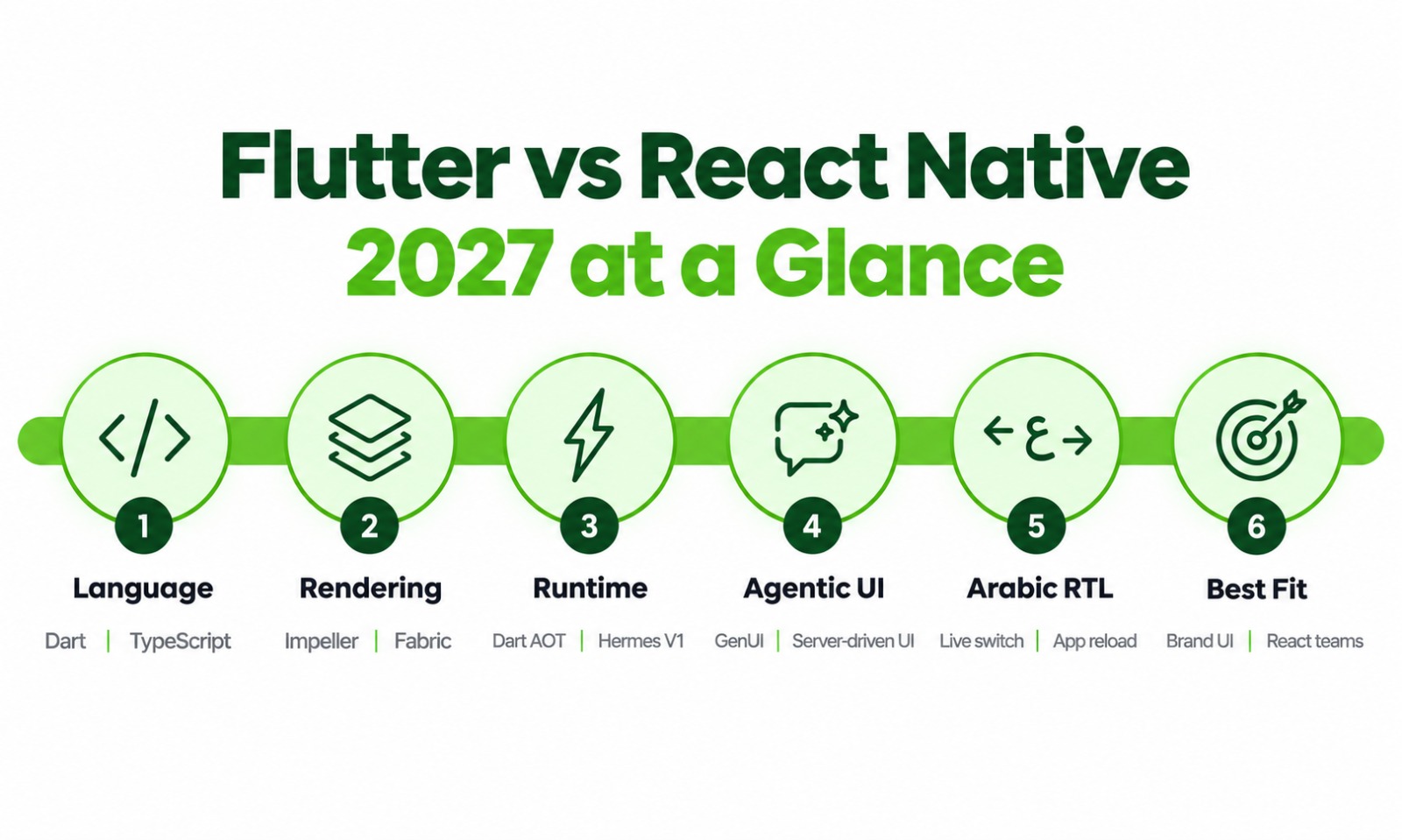
| Decision factor | Flutter | React Native |
| Language | Dart | JavaScript or TypeScript |
| Rendering | Own engine (Impeller) draws every pixel | Fabric renderer maps to native platform views |
| Runtime | Dart compiled ahead of time to native code | Hermes V1 JavaScript engine |
| Arabic RTL | Built-in Directionality widgets | I18nManager needs an app reload to switch |
| AI-generated UI | GenUI SDK and A2UI protocol (2026 roadmap) | Server-driven UI patterns and community libraries |
| UAE PASS | Community packages wrapping native SDKs | Custom native module around native SDKs |
| Over-the-air updates | Shorebird (Dart code only) | Expo EAS Update (JavaScript and assets only) |
| Web and desktop | Web (Wasm), Windows, macOS, Linux | React Native Web; desktop through Microsoft-maintained platforms |
| Best fit | Brand-led UI with one design everywhere | Teams reusing React skills and web logic |
What Are Flutter and React Native? A 2027 Overview
Both frameworks let one mobile app development team in Dubai ship iOS and Android apps from a shared codebase. Their engineering philosophies differ, and that difference shapes everything from design freedom to hiring.
What Is Flutter?
Flutter is Google’s open-source UI toolkit for building mobile, web, and desktop apps from one Dart codebase. It paints the interface with its own rendering engine, so screens look the same on every device.
Dart compiles ahead of time to native ARM code in release builds. Startup stays predictable, and animations avoid a JavaScript runtime sitting in the middle.
Impeller became the default renderer on iOS in 2023. Google’s 2026 roadmap aims to finish the Android move and retire Skia on Android 10 and above.
Beyond phones, Flutter targets web, Windows, macOS, and Linux. Web output suits app-like portals and dashboards. Content-led marketing sites still belong on standard web stacks, where search engines read pages with ease.
What Is React Native?
React Native is Meta’s open-source framework for building iOS and Android apps with React, JavaScript, and TypeScript. Its components render as real native views, so an iOS button is a genuine UIKit control.
Three parts make up its New Architecture. Fabric handles rendering. TurboModules load native code on demand. JSI lets JavaScript call native functions without serialising messages across a bridge.
Hermes V1 runs that JavaScript by default from version 0.84. The React Native team says new projects should start on a framework such as Expo. Expo bundles routing, cloud builds, and over-the-air updates.
For a company with a React web product, the appeal is plain. Language, tooling, testing habits, and even some business logic carry across to mobile.
Which Mobile App Trends in Dubai Will Shape Your Framework Choice in 2027?
Dubai’s app market now punishes slow product teams. Grand View Research values UAE mobile app revenue at about AED 9.6 billion in 2025. Its forecast reaches AED 29.4 billion by 2033, a 15.2% CAGR.
Reach is close to total. DataReportal’s Digital 2026 report puts UAE internet penetration at 99.0%, with 23.0 million mobile connections. Five trends now decide which framework holds up best under that demand.
AI-Native and Agentic Business Apps
Apps are moving from static screens to assistants that answer, recommend, and act. A retail app can check stock in the Mall of the Emirates branch before a customer drives there.
Property apps can shortlist Dubai Marina listings from a voice note. Logistics apps can explain a delayed shipment and offer a new delivery slot.
Each of these assistants needs streaming screens, secure tool access, and a way to confirm actions. Teams planning these features often start with agentic AI development for UAE enterprises.
AI-Assisted Development and Testing
Developers now write, test, and refactor with AI help. Stack Overflow’s 2025 survey found 84% use or plan to use AI tools. Trust lags behind adoption, with 46% distrusting the output’s accuracy.
Gartner expects 90% of enterprise software engineers to use AI code assistants by 2028. Both frameworks benefit, though Google’s roadmap adds MCP tooling built for Dart and Flutter.
Arabic-First, Bilingual Experiences
UAE users switch between Arabic-first, bilingual experiences inside the same session. Right-to-left layout, mixed-direction text, and Arabic numerals must feel native in both languages.
Retrofitting Arabic after launch costs far more than designing for it from day one. Framework choice affects how much custom work that bilingual polish demands.
API-First Integrations and Digital Identity
Modern UAE apps sit on top of payment gateways, CRMs, ERPs, and government identity. UAE PASS reached 7.2 million users in 2023, according to WAM.
Every integration needs an SDK or a native bridge. A missing package can add weeks, whatever framework sits on top.
Total Cost of Ownership Over Build Price
Procurement teams now ask about year three before signing year one. Upgrades, OS releases, security patches, and AI usage fees often outweigh the original build quote.
| Trend | What it asks of the framework | Flutter position | React Native position |
| Agentic apps | Streaming UI, dynamic screens, safe actions | GenUI SDK on roadmap | Server-driven UI patterns |
| AI-assisted coding | Strong tooling and typed code | Dart MCP tooling on roadmap | Mature TypeScript tooling |
| Arabic-first UX | Clean RTL and mixed text | Built-in Directionality | Native views, reload for RTL switch |
| Identity and payments | Reliable native SDK access | Platform channels and plugins | TurboModules and native modules |
Flutter vs React Native for AI-Powered Business Apps: Which Handles AI Agents Better?
AI touches a mobile project in two separate ways. AI-assisted coding changes how engineers build the app. AI-powered features change what customers can do inside it.
Framework choice matters more for the second. The heavy lifting for both happens on servers, which gives each framework a fair shot.
AI Chat Interfaces and Streaming Responses
Customers expect answers to appear word by word, as they do in ChatGPT. That requires streaming over server-sent events or WebSockets, plus a UI that redraws without stutter.
Flutter handles streams through Dart’s built-in Stream API and StreamBuilder widgets. React Native teams should confirm streaming support in their networking library or Expo SDK version before committing.
Connecting LLMs, RAG and Enterprise Data Safely
The mobile app should never call a model provider with a secret key stored on the device. Attackers can pull keys out of app binaries with free tools.
A server layer must hold credentials, enforce rate limits, and log every request. Retrieval-augmented generation, where the model reads approved company documents, also lives on that server.
This architecture makes the frontend framework almost interchangeable for AI work. AI-powered mobile app development in the UAE follows the same backend-first pattern.
Generative UI and Agentic Workflows
Generative UI lets an AI agent assemble a screen at runtime, such as a booking card. Google’s GenUI SDK and the open A2UI protocol target this pattern for Flutter.
React Native teams build similar flows with server-driven UI, where the backend sends a JSON layout. Either path needs guardrails before it reaches real customers:
- Schema validation: every AI-generated layout must match an approved component list or fall back to a safe screen.
- User confirmation: payments, bookings, and data changes need an explicit tap from the customer before the agent acts.
- Audit trails: each agent action needs a logged record that compliance teams can review later.
- Accessible output: generated screens must keep screen-reader labels, readable contrast, and predictable navigation in Arabic and English.
On-Device AI Features
Some features run on the phone itself, such as text recognition, face detection, or offline translation. Google ML Kit and Apple Core ML power most of these.
Flutter reaches them through plugins. React Native reaches them through native modules. Neither route is harder, provided a maintained package exists for the exact model you need.
What AI Features Cost to Run
AI adds recurring bills that a build quote never shows. Inference, embeddings, vector storage, and monitoring all scale with usage.
Those costs depend on model choice and traffic, never on Flutter or React Native. Planning numbers for AI development cost in the UAE should sit in the business case from day one.
| AI capability | Flutter route | React Native route | Validate before choosing |
| Streaming chat | Dart Streams, StreamBuilder | Fetch streaming or WebSocket library | Token rendering on mid-range Android |
| Generative UI | GenUI SDK and A2UI (roadmap) | Server-driven JSON layouts | Fallback screens and schema checks |
| On-device AI | ML Kit and Core ML plugins | Native modules for ML Kit and Core ML | Package maintenance and model size |
Flutter vs React Native Performance in 2027: Which Is Faster?
For most business apps, users cannot tell the two apart. Differences appear at the edges: heavy animation, very long lists, 120Hz screens, and low-end Android devices.
Why Bridge-Era Benchmarks Mislead
Many ranking articles still blame React Native’s JavaScript bridge for lag. Version 0.82 removed the option to run on that architecture at all.
The React Native team reports that version 0.76 cut Android app size by about 3.8MB. Median startup dropped by about 15ms in the same release. Any benchmark older than late 2024 needs retesting.
Startup, Frame Rate, Memory and App Size
A fair test uses your real screens on the phones your customers carry. Three device tiers work well: a budget Android, a mid-range Android, and a recent iPhone.
Frame timing matters most. At 60Hz, each frame has 16.7 milliseconds. On 120Hz screens, the budget shrinks to 8.3 milliseconds, and dropped frames show as stutter.
Performance for AI-Heavy Screens
AI interfaces stress apps in new ways. Streaming text forces constant redraws, while long result lists and image processing compete for memory.
Flutter’s single rendering pipeline handles rapid redraws well. React Native’s Fabric renderer now batches updates with less overhead than the old architecture.
Verdict: Which Framework Is Faster?
Flutter holds a small edge in animation-heavy, custom-drawn interfaces. React Native matches it for forms, lists, and content screens that make up most business apps.
Neither result should be taken on faith. A two-week benchmark on your own screens settles the question for your product.
| Metric | Flutter tool | React Native tool | Target |
| Cold start | Flutter DevTools timeline | Perfetto, Hermes profiler | Under 2 seconds on mid-range Android |
| Frame time | DevTools performance view | React Native DevTools, Perfetto | 16.7ms at 60Hz, 8.3ms at 120Hz |
| Memory | DevTools memory view | Android Studio and Xcode profilers | Stable during long sessions |
| App size | Size analysis tool | Bundle analysis, Android App Bundle | Within your store download budget |
How Much Does Flutter vs React Native App Development Cost in Dubai in 2027?
Framework choice moves the price far less than most buyers expect. Scope, integrations, compliance, and team location set most of the number.
Flutter and React Native App Cost by Tier in AED
The figures below come from a mobile app development cost guide for Dubai. They apply to both frameworks, because comparable scope needs comparable engineering hours.
A basic MVP tests one idea with a handful of screens. Mid-level business apps add payments, Arabic RTL, and both app stores.
Complex and enterprise builds layer on AI, real-time data, deep integrations, and full UAE compliance. Each step up multiplies testing, security, and project management effort.
| App tier | Typical scope | Cost range (AED) | Timeline |
| Basic MVP | 3 to 5 screens, login, push notifications | 18,000 to 92,000 | 6 to 8 weeks |
| Mid-level business app | iOS and Android, payments, Arabic RTL | 92,000 to 294,000 | 2 to 5 months |
| Complex app | AI features, real-time data, CRM integration | 294,000 to 735,000 | 5 to 9 months |
| Enterprise platform | Microservices, AI, full UAE compliance | 735,000 to 1,470,000+ | 9 to 18 months |
Cost Components for a Dubai Business App
Discovery and architecture come first, and skipping them costs the most later. UI and UX work must cover Arabic and English layouts, which doubles some design effort.
Backend, integrations, and security testing often exceed the mobile code itself. Maintenance then runs 15% to 25% of the build cost every year. Security audits add AED 10,000 to 25,000 per engagement.
What Creates a Cost Difference Between Flutter and React Native?
Real price gaps come from your situation, never from the framework brand. Six factors decide whether one option costs less for your project:
- Existing team skills: a company with React engineers avoids Dart training and hiring, which shortens ramp-up by weeks.
- Shared web logic: validation rules, API clients, and pricing logic in TypeScript can move into React Native.
- Custom interface work: branded, animated screens take less effort in Flutter, since nothing depends on native component quirks.
- Native SDK gaps: a provider without a maintained package forces custom bridge code in either framework.
- Arabic QA depth: bilingual testing adds hours in both, plus extra checks for React Native RTL switching.
- Upgrade cadence: both ship frequent releases, and skipped upgrades pile up into expensive catch-up projects.
Does AI-Assisted Coding Make App Development Cheaper?
AI tools cut typing time. Review, testing, and security work still decide the delivery date.
A 2025 METR randomised trial found experienced developers took 19% longer with AI tools on familiar codebases. Participants still believed they had worked faster.
Savings appear on boilerplate, tests and documentation. Losses appear when generated code slips past review and surfaces as defects after launch.
Three-Year TCO: A Worked AED Example
Total cost of ownership tells procurement teams what an app costs across its working life. A simple formula keeps the conversation honest:
3-year TCO = Initial build + Operations + Maintenance + Enhancements
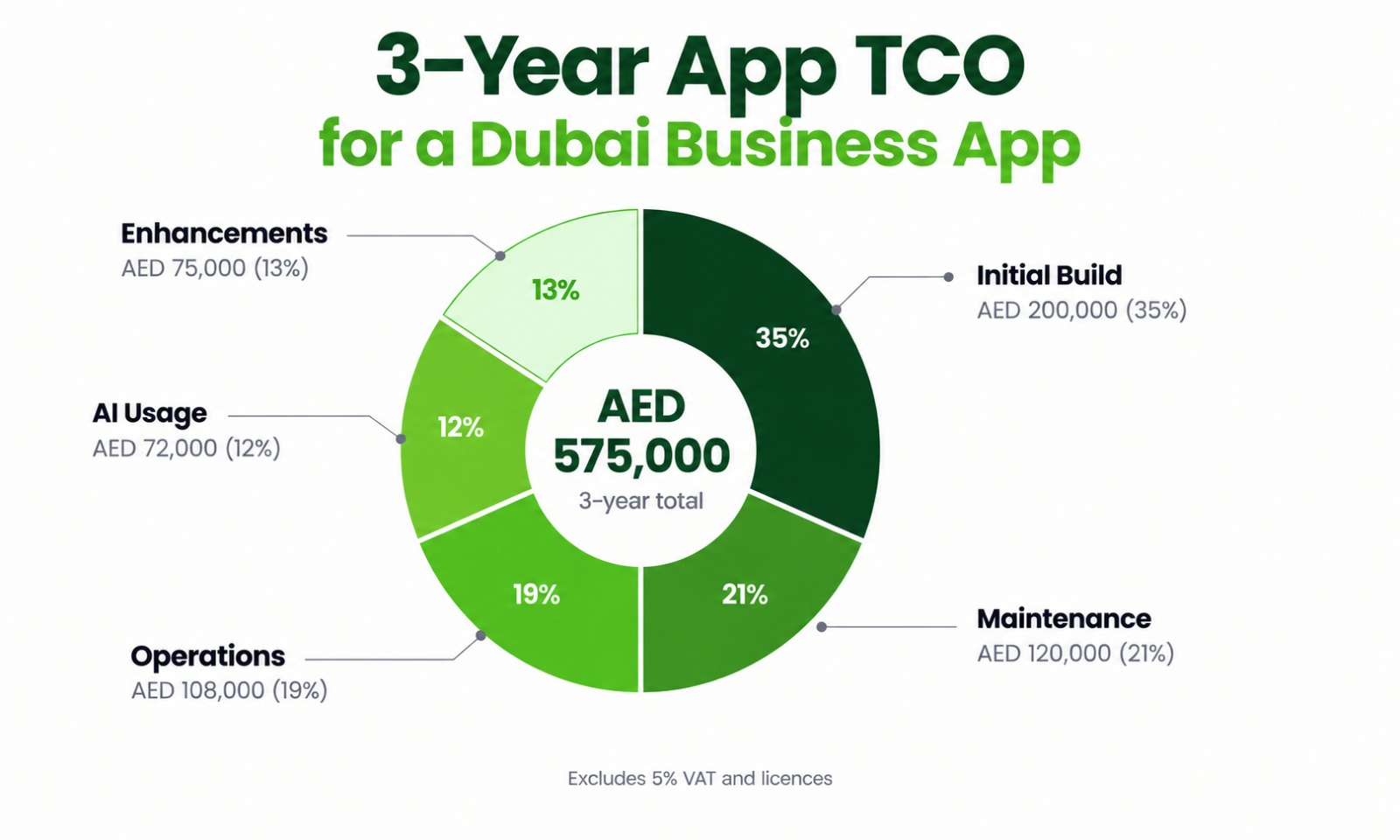
Consider a mid-level bilingual app built for AED 200,000. Maintenance at 20% a year adds AED 120,000 over three years. Cloud hosting and monitoring, assumed at AED 3,000 a month, adds AED 108,000.
AI usage, assumed at AED 2,000 a month, adds AED 72,000. Planned enhancements at AED 25,000 a year add AED 75,000. The three-year total reaches AED 575,000, before 5% VAT and third-party licences.
Framework choice shifts this total only through reused code. Multiply hours of shared code by your blended hourly rate, and the real saving appears.
| Cost line | Assumption | 3-year cost (AED) |
| Initial build | Mid-level bilingual app | 200,000 |
| Maintenance | 20% of build per year | 120,000 |
| Operations | Cloud and monitoring at AED 3,000 per month | 108,000 |
| AI usage | Inference and storage at AED 2,000 per month | 72,000 |
| Enhancements | AED 25,000 per year | 75,000 |
| Total | Excludes 5% VAT and licences | 575,000 |
Need a three-year AED cost model comparing Flutter and React Native for your exact app scope and integrations?
Flutter vs. React Native: Which Framework Gets a Dubai Business App to Market Faster?
Speed to market depends on the first eight weeks. Teams that validate integrations early ship on time, whichever framework they pick.
MVP Development and Rapid Prototyping
Both frameworks offer hot reload, which shows code changes on a running app within a second. Flutter’s widget library speeds up custom screens. Expo gives React Native teams ready-made routing, builds, and device testing.
Code Reuse With Existing Web Products
Companies with a React website hold a head start with React Native. Shared TypeScript types, API clients, and validation rules cut duplicate work.
Flutter offers reuse in the opposite direction. One Flutter codebase can produce an internal web dashboard, now compiled to WebAssembly by default on Google’s roadmap.
App Store Releases and Over-the-Air Updates
Over-the-air updates let teams fix bugs without waiting for a full store review. Expo EAS Update pushes JavaScript and asset changes to React Native apps.
Shorebird does the same for Flutter’s Dart code. Native code changes need a new binary and fresh review under section 2.5.2 of Apple’s guidelines.
Which Framework Is Better for Rapid Business App Launches?
React Native launches faster when a React team already exists. Flutter launches faster when the design is custom, and the team knows Dart.
Integration risk decides more launch dates than either. Realistic plans for how long it takes to build a mobile app in Dubai start there.
| Update type | Flutter route | React Native route | Store review needed? |
| UI text or layout fix | Shorebird patch | EAS Update | No, within store rules |
| Business logic bug | Shorebird patch | EAS Update | No, within store rules |
| Native SDK or permission | New Binary | New Binary | Yes |
Is It Easier to Hire Flutter or React Native Developers in Dubai?
React Native draws on a far larger pool of language skills. Flutter draws on a smaller, specialised pool that has grown fast since 2019.
The Talent Pool Signal
Global data gives the clearest proxy. In Stack Overflow’s 2025 survey, 66% of developers used JavaScript and 43.6% used TypeScript. Dart sat at 5.9%.
Among cross-platform mobile developers, Statista’s 2023 data shows Flutter at 46% and React Native at 35%. The Pragmatic Engineer reports the same split.
Global numbers say little about Dubai job boards. A dated count of LinkedIn, Bayt, and GulfTalent listings gives a truer local picture before hiring.
How AI Coding Tools Change Team Requirements
AI assistants shift work from writing code toward reviewing it. Senior engineers who spot subtle security and architecture flaws grow more valuable as output volume rises.
Junior-heavy teams with AI tools can ship fast and break things without noticing. Code review capacity now sets the safe delivery speed.
In-House Team vs Dubai App Development Company
An in-house team builds long-term knowledge but takes months to hire. A Dubai development partner starts in weeks and brings specialists for Arabic UX, payments, and security.
Source code ownership must sit with you in either model. Companies that hire dedicated Flutter or React Native developers in Dubai often blend both, keeping product ownership local.
| Factor | In-house team | Dubai app development company |
| Time to start | 2 to 4 months of hiring | 1 to 3 weeks |
| Specialist cover | Limited to current hires | Arabic UX, payments, security, QA on demand |
| Continuity risk | High if one senior engineer leaves | Shared knowledge across a delivery team |
| Code ownership | Yours by default | Must be written into the contract |
| Post-launch support | Your own capacity | SLA-based maintenance plans |
Flutter vs. React Native: How UAE-Specific Requirements Can Help Decide Your Framework?
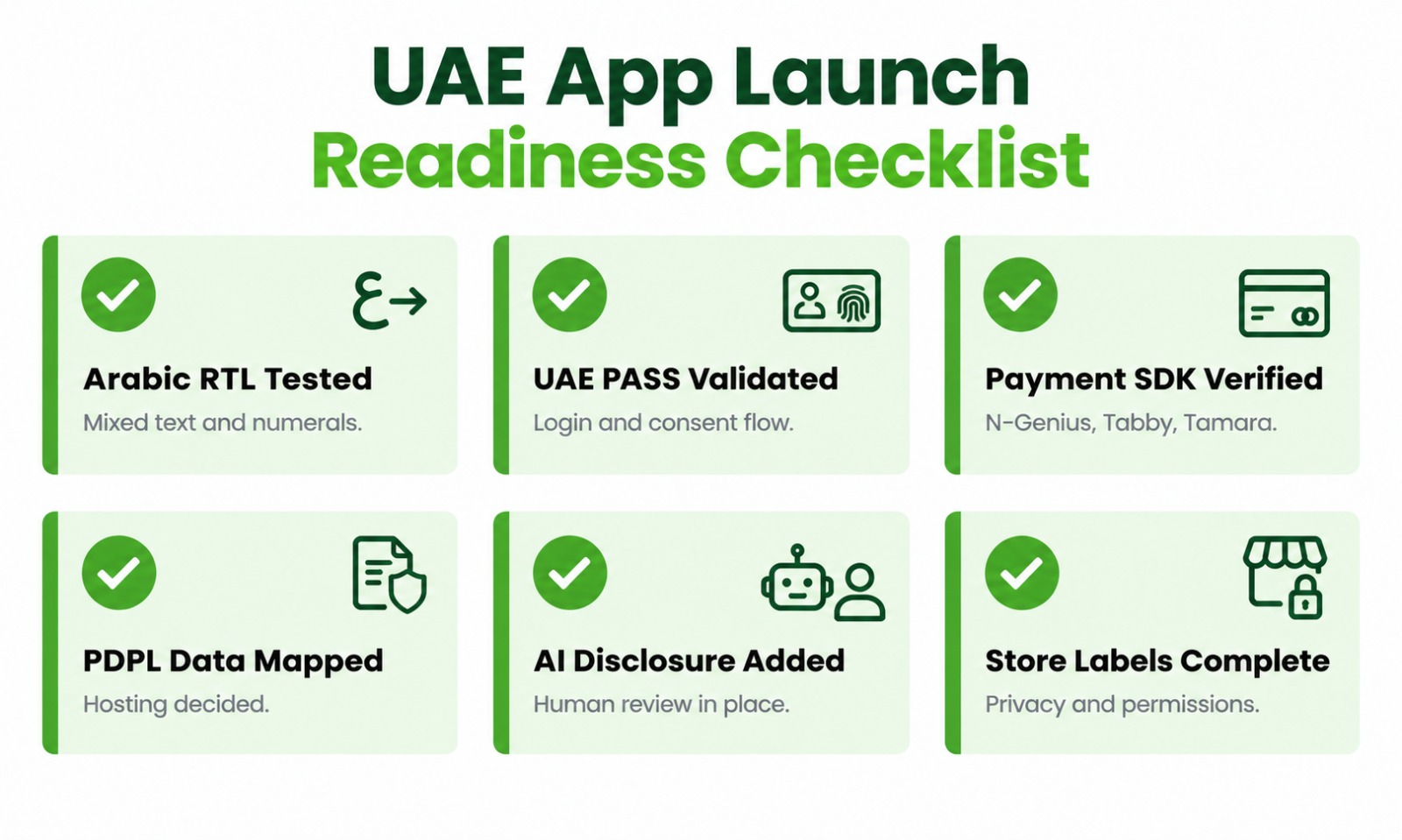
Generic comparisons ignore the requirements that block UAE launches. Arabic UX, UAE PASS, local payments, and data protection deserve a prototype before any framework decision.
Arabic and English User Experience
Flutter mirrors layouts through its Directionality widget and localisation tools. Switching language can happen live inside the app.
React Native uses I18nManager, and switching direction needs an app reload, as its RTL documentation explains. Many UAE apps accept that trade-off without complaint.
Both need testing for mixed Arabic and English text, Arabic-Indic numerals, AED formatting, and right-to-left charts. Icons with direction, such as back arrows, must flip too.
UAE PASS Integration
UAE PASS publishes official mobile integration guides for native apps. Our October 2026 review found community Flutter packages and no first-party Flutter or React Native SDK.
Both frameworks therefore wrap the native SDKs through platform channels or native modules. Prototype the full login, consent, and redirect flow in sprint one.
Payment Gateway Integration
UAE payment providers differ a great deal in cross-platform support. Package maintenance matters as much as availability, since an abandoned SDK becomes your team’s problem.
| Provider | Flutter support | React Native support | Check before committing |
| N-Genius (Network International) | Flutter plugin on pub.dev | Confirm with provider | Server-side order creation flow |
| Tabby | Flutter SDK | React Native SDK | WebView dependencies |
| Tamara | Community package marked outdated | None found | Provider roadmap |
| Checkout.com | No official SDK found | Frames React Native, last updated April 2024 | Maintenance status |
UAE Data Protection and Data Residency
Federal Decree-Law No. 45 of 2021 governs personal data across the UAE and took effect on 2 January 2022. DIFC runs its own regime under DIFC Law No. 5 of 2020.
Health apps fall under Federal Law No. 2 of 2019, which sets stricter rules for health data. No single rule forces every business to host all data inside the UAE.
Sector, licence, and contracts decide hosting. Teams planning PDPL-compliant app development in the UAE should map data flows before writing code.
AI Governance and Data Handling
The UAE’s 2024 Charter for the Development and Use of AI sets 12 principles, Pinsent Masons reports. Transparency, safety and human oversight sit at its centre.
Apps should tell users when they talk to AI and collect consent for personal data. High-impact actions, such as payments or medical advice, need human review.
App Store and Google Play Readiness
Apple requires privacy nutrition labels, and Google requires a completed Data Safety form. Permission requests must explain their purpose in both Arabic and English.
Signing keys, test accounts, and reviewer notes save days during first submission. Both frameworks follow identical store rules.
Flutter vs. React Native: Which Fits Your UAE Industry?
Industry requirements narrow the choice faster than any feature list. Fintech cares about security SDKs, while retail cares about brand experience and conversion.
Logistics leans on maps and background location. Healthcare leans on privacy, roles, and reliability. Each row below shows a reasonable starting point and the one item to validate first.
| Industry | Flutter fits when | React Native fits when | Validate first |
| Fintech | Custom wallet UI and animation matter | Web banking logic is in TypeScript | Payment and biometric SDKs |
| Retail and e-commerce | Brand-led catalogue and promotions | Shared code with a React storefront | Tabby, Tamara and checkout flows |
| Logistics | Custom map overlays and driver UI | Existing JavaScript fleet tools | Background location limits |
| Real estate | Rich media and 3D-style tours | CRM-heavy lead workflows | Trakheesi and CRM integrations |
| Healthcare | Consistent patient UI across devices | Shared web portal logic | Health data hosting rules |
| Food delivery | Animated ordering and tracking | Fast iteration with OTA updates | Live tracking of battery use |
| Enterprise and government | Internal apps across mobile and desktop | React-based intranet teams | UAE PASS and accessibility |
Flutter vs React Native: Pros and Cons in 2027
Every strength in this debate carries a matching cost. The summary below gathers the trade-offs covered so far into one view for steering committees.
| Area | Flutter | React Native |
| UI control | Pixel-level consistency; less native feel by default | Real native components; platform quirks need care |
| AI tooling | GenUI and Dart MCP on roadmap, partly shipped | Mature TypeScript tooling; no first-party generative UI kit |
| Hiring | Growing specialist pool; smaller Dart base | Huge JavaScript pool; uneven quality |
| Native integrations | Plugins; some UAE SDKs community-only | TurboModules; some packages lack maintenance |
| Web and desktop | Six targets from one codebase; weak for SEO pages | React Native Web; Microsoft-maintained desktop platforms |
| Upgrades | Quarterly releases; plugin breaking changes | Expo eases upgrades; old apps need migration
|
When Should You Choose Flutter, React Native or Native Development?
React Native vs Flutter becomes simple once business constraints sit on the table. Each option has clear signals that point toward it.
Choose Flutter When
- Brand experience leads: the app’s look is a selling point and must stay identical on iOS and Android.
- Animation runs deep: onboarding flows, product configurators, or data visuals need smooth custom motion.
- Multiple screens matter: one codebase must serve phones, tablets, kiosks, and an internal web dashboard.
- Dart skills exist: your team or partner already ships Flutter apps and can support them for years.
- Integrations check out: required payment and identity SDKs work in a Flutter prototype.
React Native When
- React talent exists: your web team writes React and TypeScript daily and can move into mobile work.
- Web logic repeats: business rules, API clients, and validation already live in TypeScript.
- Native feel matters: users expect standard iOS and Android controls in every form and menu.
- Expo fits your process: your team wants managed builds, OTA updates, and a clear upgrade path.
Choose Native Swift and Kotlin
Some products outgrow cross-platform frameworks. Advanced AR, heavy background processing, Bluetooth medical devices, and complex camera pipelines often justify separate native apps.
Such teams should price native iOS app development in Dubai alongside Android app development in the UAE.
How to Choose Between Flutter vs. React Native: An 8-Step Framework for Dubai Businesses
Good framework decisions leave a paper trail. Procurement, security, and finance teams should be able to read why the choice was made.
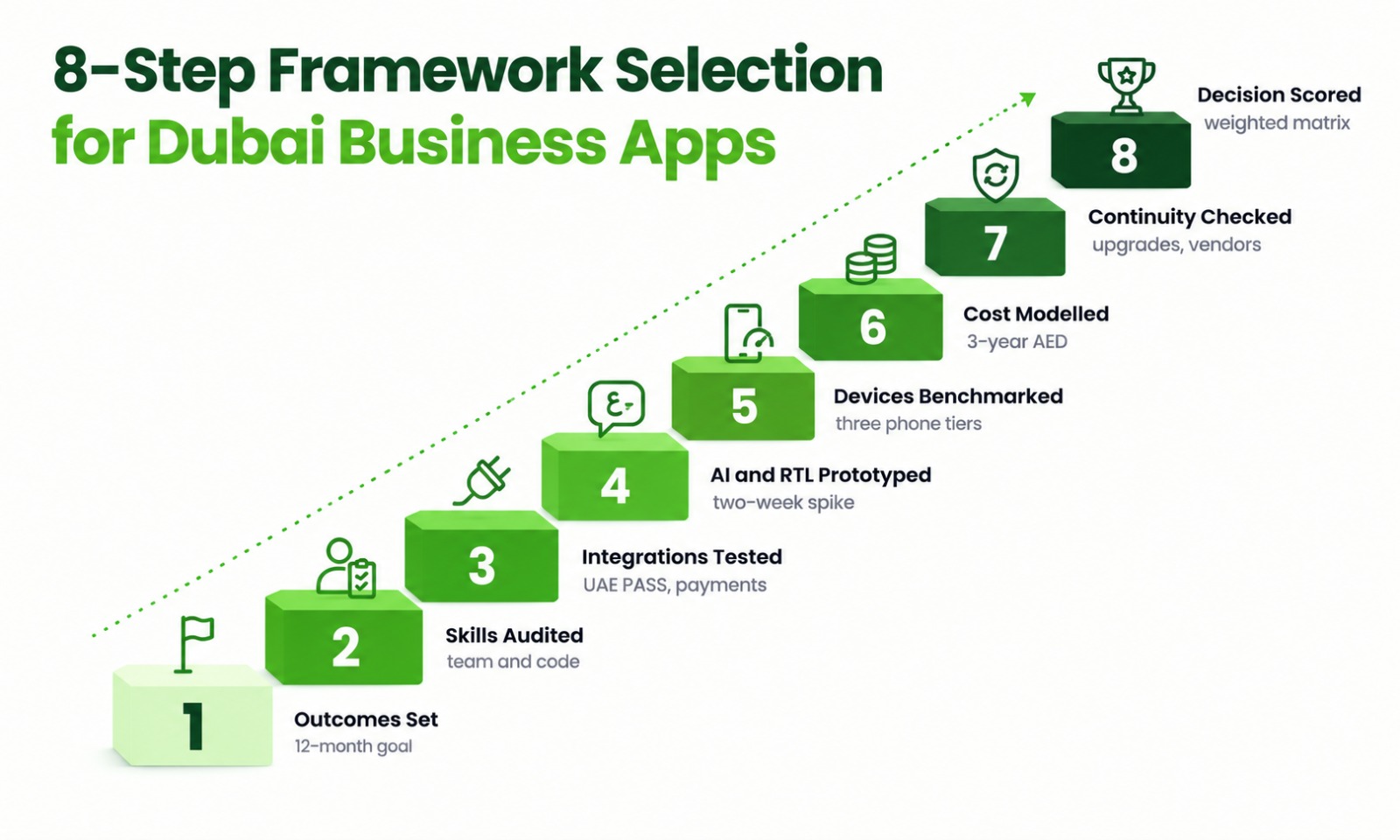
- Business outcomes first: write down the revenue, efficiency, or service goal the app must hit within 12 months.
- Skills audit: list current engineers, their languages, and any existing React or Flutter code worth reusing.
- Integration risk list: UAE PASS, payment gateways, CRM, ERP, and maps each get a working proof of concept.
- AI and Arabic prototypes: a two-week spike tests streaming chat, generative screens, and RTL layouts together.
- Device benchmarks: real screens run on budget Android, mid-range Android, and current iPhone models.
- Three-year cost model: build, operations, maintenance, AI usage, and enhancements go into one AED sheet.
- Continuity check: upgrade plans, package health, security patching, and vendor stability get a written review.
- Scored decision: each framework receives weighted scores, and the leadership team signs off on the result.
The scoring matrix below turns those steps into a number. Adjust weights to match your priorities, then score each framework from 1 to 5.
| Criterion | Weight | What a score of 5 means |
| Team skills | 20% | Current team can ship and support it today |
| Integrations | 20% | Every critical SDK has a working prototype |
| UI ambition | 15% | Framework matches the design brief without workarounds |
| AI roadmap | 10% | Planned AI features run in the prototype |
| Arabic UX | 10% | RTL and mixed text passed bilingual QA |
| Performance | 10% | Benchmarks met targets on all three device tiers |
| Three-year TCO | 10% | Lowest modelled ownership cost |
| Vendor continuity | 5% | Clear upgrade path and healthy package support |
How Code Brew Labs Builds Production-Grade Flutter and React Native Apps for Dubai Businesses
Code Brew Labs builds Flutter and React Native apps for UAE enterprises, government entities, and high-growth founders. Our teams have delivered 2,600+ apps over 13 years in the UAE, across 35+ industries.
Our UAE portfolio includes duPay, a digital wallet with over a million downloads and a 4.6 rating. Al Fardan Exchange runs our remittance SDK at 99.9% availability.
Trukker’s freight platform connects 12,000+ drivers across the region. MCP Nexus, our governed AI-assisted engineering model, cut delivery time by 35% and defects by 40%.
Code Brew Labs holds ISO 27001, SOC 2 Type II, and PCI DSS certifications. Arabic RTL, UAE PASS, and payment SDK checks happen in sprint one.
Explore cross-platform mobile app development in Dubai to scope your build with our Dubai World Trade Centre team.
Ready to launch a bilingual Flutter or React Native app that clears UAE PASS and PDPL checks?
Final Verdict: Flutter vs. React Native for Business App Development in Dubai in 2027
In 2027, Flutter vs. React Native has no universal winner. Flutter earns its place when design, animation, and multi-screen reach matter most. React Native earns its place where React talent and web logic already exist.
Avoid picking either because it sounds more AI-ready or cheaper. Those claims fade once a payment SDK or RTL bug blocks a release.
Prototype the risky parts, score the results, and keep the evidence. That record protects the decision long after launch.
Frequently Asked Questions
Is Flutter better than React Native in 2027?
Neither wins outright. Flutter suits custom, animated, Arabic-first interfaces with one consistent design. React Native suits companies with React and TypeScript teams or shared web logic. Performance is comparable for most business apps after React Native’s New Architecture became mandatory in version 0.82.
Which is cheaper for app development in Dubai?
Comparable scope costs about the same in both. A mid-level business app in Dubai costs AED 92,000 to AED 294,000. Real savings come from reusing existing team skills and code, which favours React Native for React shops.
Which framework is faster for business apps?
Flutter has a small edge in animation-heavy, custom-drawn screens. React Native matches it for forms, lists, and content screens. Benchmarks older than late 2024 predate React Native’s New Architecture, so retest on your own target devices.
Which framework is better for AI-powered applications?
Both work well, because AI logic belongs on secure servers. Flutter adds Google’s GenUI SDK and A2UI protocol to its 2026 roadmap. React Native relies on server-driven UI patterns and mature TypeScript AI tooling.
Can Flutter and React Native support AI agents?
Yes. Both can display agent responses, stream text, and confirm actions with users. Agent logic, tools, and credentials must run server-side. Every consequential action, such as a payment, needs explicit user approval and an audit log.
Which framework is better for Arabic and RTL apps?
Flutter switches between Arabic and English live through its Directionality system. React Native supports RTL through I18nManager but needs an app reload to change direction. Both require bilingual QA for mixed text, numerals, and AED formatting.
Which framework is easier to hire for in the UAE?
React Native draws on a larger skills pool, since 66% of developers use JavaScript worldwide. Dart sits at 5.9%. Flutter specialists exist in Dubai, but a dated local job-board check gives the clearest hiring picture.
Can Flutter and React Native integrate with UAE PASS?
Yes, through native SDK wrappers. Our October 2026 review found official native integration guides and community Flutter packages, with no first-party cross-platform SDK. Prototype the full login and consent flow before choosing a framework.
Which framework is better for enterprise apps?
React Native suits enterprises with React web estates and TypeScript standards. Flutter suits enterprises needing one UI across mobile, kiosks, and desktop. Both meet ISO 27001 and PDPL requirements when the backend architecture follows them.
Does AI-assisted coding reduce mobile app development costs?
Sometimes. AI tools speed up boilerplate, tests, and documentation. A 2025 METR trial found experienced developers 19% slower on familiar codebases. Review, testing, and security remediation absorb much of the saved typing time.
Which framework is easier to maintain over three years?
Maintenance depends more on team continuity and package health than on the framework. Flutter ships quarterly stable releases. React Native ships frequent releases, and Expo simplifies upgrades. Budget 15% to 25% of build cost each year.
When should a business choose native development instead?
Choose native Swift and Kotlin for advanced AR, complex camera pipelines, heavy background processing, or specialised hardware. For forms, commerce, booking, and dashboards, cross-platform frameworks remain the sound financial default.
Let's Convert Your Business Idea Into Success!
Free Consultation from Top Industry Experts
Let’s Build Your Dream App!
Share article on :



 No commitment required
 NDA on request
 24-hour response


