
Quick Summary:
- UAE AI development ranges from AED 25,000 to over AED 1.5 million during 2026.
- A proof of concept costs AED 25,000 to AED 75,000 across most focused business use cases.
- API-based AI products cost less upfront than custom models or governed enterprise platforms.
- Data preparation, integrations, Arabic evaluation, security, and governance move budgets more than feature counts.
- Production systems also require cloud services, model usage, monitoring, support, and recurring evaluation.
- UAE privacy duties affect data collection, hosting choices, access controls, documentation, and vendor contracts.
- A phased build protects capital because each release must prove value before expansion.
AI development cost in UAE markets varies because vendors often price different architectures under similar labels. One chatbot quote may cover a website widget connected to a model API.
Another may include enterprise search, Arabic testing, CRM integration, audit logs, and private cloud deployment.
Both vendors may call the product an AI chatbot, yet their delivery obligations differ.
The useful question concerns what each estimate includes, excludes, and assumes about risk. Every buyer should compare scope, acceptance criteria, ownership, operating costs, and post-launch responsibility.
UAE companies are moving from AI experiments toward production systems with measurable business goals. PwC found that 93% of surveyed UAE chief executives adopted generative AI during the preceding year.
McKinsey reported 84% AI adoption across surveyed GCC organizations, although fewer companies had scaled deployments.
That gap matters because prototypes and production systems have different engineering demands.
Production requires controlled data, tested integrations, security reviews, monitoring, and accountable human oversight.
Map your use case, data sources, integrations, deployment needs, and risk controls before requesting vendor quotations.
How Much Does AI Development Cost in the UAE in 2026?
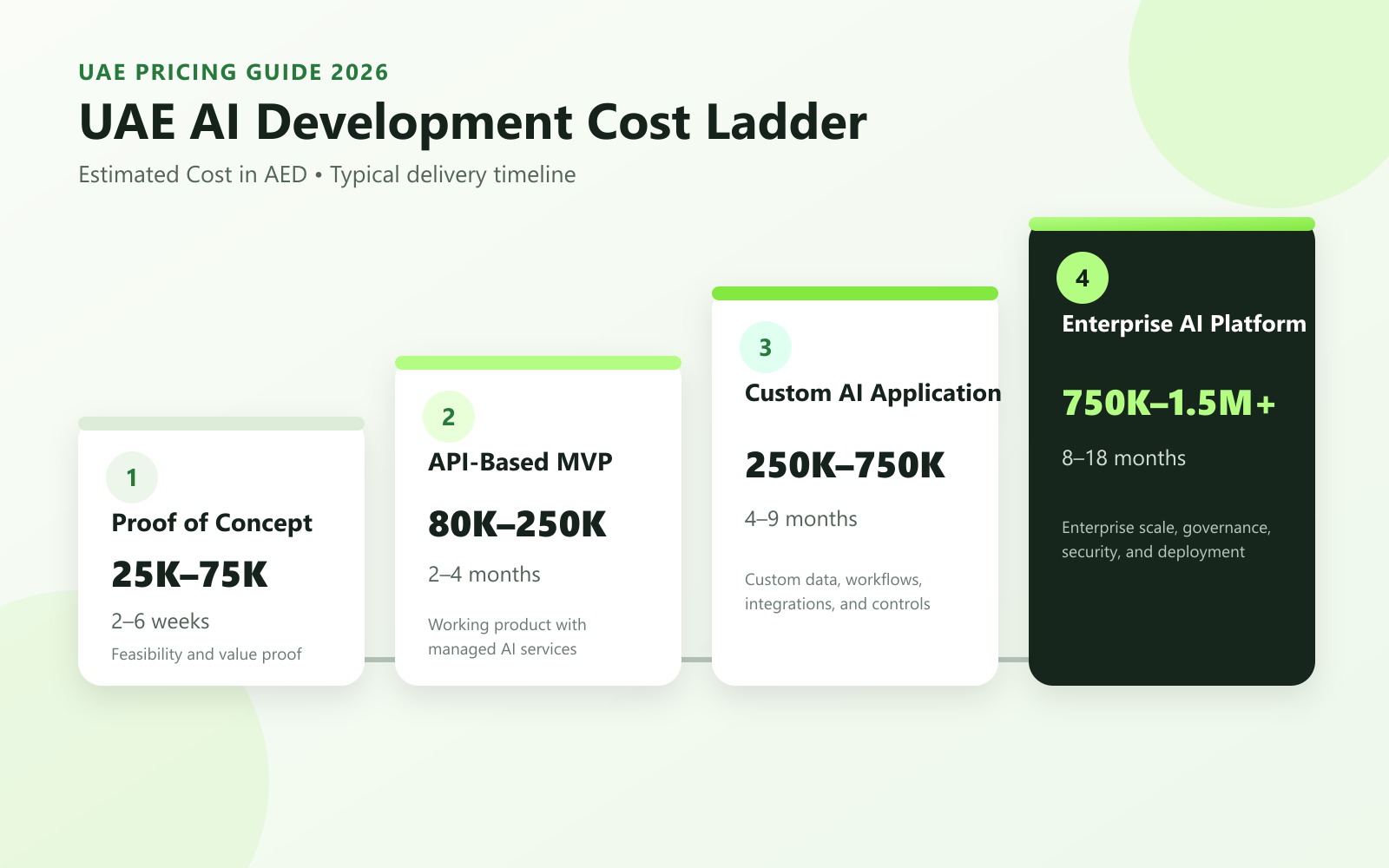
AI development cost in the UAE ranges from AED 25,000 to over AED 1.5 million.
Focused validation work sits at the lower end, while governed enterprise platforms occupy the upper range.
UAE AI development cost at a glance
| Project Type | Typical Scope | Estimated Cost in AED | Delivery Window |
| Discovery and proof of concept | One use case, feasibility review, test dataset | 25,000 to 75,000 | 2 to 6 weeks |
| API-based AI MVP | Pre-trained model, core workflow, limited integrations | 80,000 to 250,000 | 2 to 4 months |
| Custom AI application | Business data, custom workflows, Arabic support | 250,000 to 750,000 | 4 to 9 months |
| Enterprise AI platform | Multiple systems, governance, MLOps, UAE hosting | 750,000 to 1,500,000+ | 8 to 18 months |
A discovery engagement tests feasibility, data availability, risk, and expected business value. The output should include architecture options, cost assumptions, delivery phases, and measurable acceptance criteria.
An API-based MVP uses an established model through a managed interface.
That approach reduces model engineering work while preserving product design, integration, security, and testing duties.
Custom software development adds proprietary workflows, business data, role controls, and deeper system connections.
Arabic interfaces may also require dialect datasets, human evaluation, and bilingual acceptance tests.
AI Enterprise platforms support several teams, data sources, models, or business units. Their budgets include governance, observability, access management, disaster recovery, and formal support arrangements.
What should an AI development estimate include?
- Use-case discovery: Define the user, decision, workflow, baseline, risk, and target outcome.
- Product design: Map journeys, interfaces, failure states, Arabic layouts, and human escalation paths.
- Data assessment: Review ownership, consent, structure, quality, access, retention, and transfer restrictions.
- Model selection: Compare managed models, open models, RAG, fine-tuning, and custom training.
- Application engineering: Build the interface, backend services, databases, permissions, and administrative controls.
- System integration: Connect approved CRM, ERP, payment, identity, document, and communication services.
- Evaluation: Test accuracy, groundedness, safety, latency, Arabic performance, and unacceptable failure modes.
- Security: Complete threat modeling, access reviews, encryption planning, testing, and remediation.
- Deployment: Configure environments, monitoring, release controls, backups, and incident procedures.
- Post-launch operations: Assign support, model review, cost tracking, retraining, and change ownership.
Google Cloud describes evaluation as a required bridge between prototypes and production AI systems.
Its guidance recommends datasets, metrics, repeated testing, and human review for nuanced output quality.
What can an estimate exclude?
Some quotations exclude model usage, cloud hosting, third-party licenses, security audits, or data labeling. Others omit Arabic evaluation, production monitoring, support hours, or change requests after acceptance.
Procurement teams should request a separate exclusions schedule beside every commercial estimate. That schedule should name volume assumptions, model choices, environments, integrations, and support boundaries.
The price gap between two AI quotations often reflects different operating and risk obligations.
What Factors Affect AI Development Cost in the UAE?
Architecture, data, integrations, language coverage, security, and governance create the largest budget changes.
Feature counts matter, yet each feature can carry a very different testing burden.
1. Scope and decision risk
A content assistant carries less risk than a system approving credit, care, or public services. Higher-risk decisions require stronger evidence, human review, audit records, and fallback procedures.
Each additional workflow also adds prompts, permissions, integrations, test cases, and failure handling. Buyers should define one business decision before listing desired AI features.
2. Data readiness and ownership
Clean, accessible data keeps ingestion and validation work contained. Fragmented records require mapping, deduplication, metadata, access rules, and source ownership decisions.
McKinsey reports that over two-thirds of high-performing companies view data as their main scaling obstacle. That finding supports a funded data-readiness phase before broad AI deployment.
3. Model architecture
Managed model APIs reduce initial engineering because the provider operates the base model. RAG adds ingestion, retrieval, permissions, source citations, evaluation, and vector search infrastructure.
Fine-tuning adds curated examples, training runs, version control, safety testing, and regression checks. Custom training demands scarce expertise, large datasets, accelerator capacity, and sustained model operations.
The cheapest model can produce a higher product cost across some usage patterns. Teams should compare output quality, latency, volume, privacy, portability, and support obligations.
4. Integration depth
A standalone assistant has fewer dependencies than an agent working across CRM, ERP, and payments. Every connection requires authentication, permissions, error handling, testing, monitoring, and vendor coordination.
Legacy interfaces can add mapping work because their data structures and controls predate AI workflows. Integration estimates should name each system, operation, owner, environment, and expected transaction volume.
5. Arabic and Emirati dialect support
Arabic support covers more than translation and right-to-left interface design. Production products need representative prompts, terminology, cultural review, and measurable language acceptance criteria.
AraDiCE found persistent challenges across dialect identification, generation, and translation tasks. BALSAM also documents weaker Arabic performance caused by data scarcity and linguistic diversity.
Emirati-facing products should test Modern Standard Arabic, local speech, mixed-language prompts, and regional terminology. Human reviewers from the target audience should score usefulness, tone, accuracy, and cultural fit.
6. UAE privacy and DIFC requirements
The UAE Personal Data Protection Law took effect on 2 January 2022. Federal duties cover personal-data processing, security, confidentiality, individual rights, and cross-border transfers.
DIFC Regulation 10 has covered autonomous systems processing personal data since September 2023. A June 2026 DIFC consultation proposed stronger safety, certification, and officer-role provisions.
The consultation was a proposal at review time, so legal teams should check its final status. Compliance work can include data maps, privacy notices, transfer assessments, impact reviews, and retention controls.
Pricing depends on use case, entity location, data type, sector, and deployment architecture. No credible regulator publishes a fixed compliance surcharge for AI development.
7. Evaluation, security, and human oversight
Production AI needs test sets covering routine requests, rare cases, attacks, and unacceptable outcomes.
Regulated workflows also need audit trails, approval thresholds, escalation paths, and output retention rules.
Monitoring checks model behavior, retrieval quality, latency, usage, security events, and unit economics.
These controls add engineering work, yet they protect service quality and organizational accountability.
8. Hosting and data location
UAE-hosted cloud infrastructure can support latency, contracting, and data-location requirements. AWS lists its Middle East UAE region as (me-central-1), with three availability zones.
Architecture teams must still confirm service availability, backup locations, logs, and vendor processing terms.
We can review your use case, data, integrations, hosting, and UAE compliance scope.
AI Software Development Cost in UAE by Solution Type
Solution type sets the baseline, while data and operating risk determine movement within each band.
The ranges below remain planning estimates before discovery and technical validation.
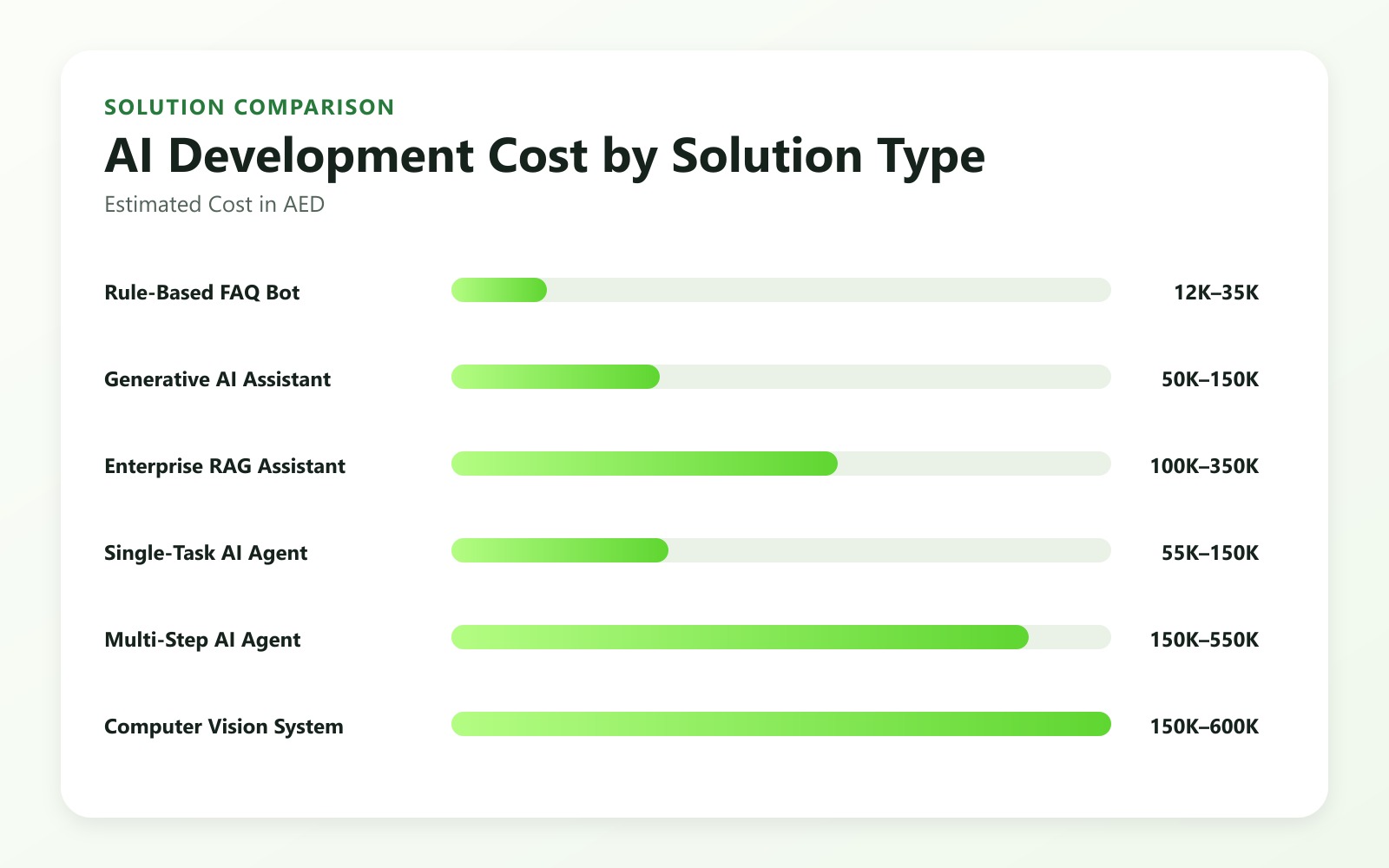
| Solution Type | Typical Scope | Estimated Cost in AED | Main Cost Driver |
| Rule-based FAQ bot | Fixed flows, one channel, basic reporting | 12,000 to 35,000 | Conversation design |
| Generative AI assistant | Model API, curated knowledge, basic controls | 50,000 to 150,000 | Knowledge scope |
| Enterprise RAG assistant | Permissions, citations, vector search, evaluation | 100,000 to 350,000 | Data pipeline |
| Arabic WhatsApp assistant | Messaging integration, bilingual flows, evaluation | 25,000 to 75,000 | Language and channel testing |
| Single-task AI agent | One goal, limited tools, human approval | 55,000 to 150,000 | Tool connections |
| Multi-step AI agent | Several tools, state, recovery, audit records | 150,000 to 550,000 | Orchestration and control |
| Regulated multi-agent platform | Governance, observability, approvals, several systems | 550,000 to 1,500,000+ | Risk and governance |
| Predictive analytics product | Forecasting, scoring, recommendations, dashboards | 100,000 to 400,000 | Data history and validation |
| Computer vision system | Image or video analysis, labeling, edge deployment | 150,000 to 600,000 | Training data and hardware |
AI chatbot development cost in the UAE
A basic FAQ bot costs AED 12,000 to AED 35,000 when answers follow controlled conversation paths. Generative assistants require knowledge ingestion, prompt controls, model integration, evaluation, and user feedback tools.
Enterprise RAG assistants add source permissions, citations, retrieval testing, monitoring, and access audits. WhatsApp deployments also require approved messaging workflows, templates, consent handling, and channel testing.
Arabic projects need bilingual test cases and reviewers who understand local language use.
AI agent development cost in Dubai
A single-task agent costs AED 55,000 to AED 150,000 across current UAE market benchmarks. Multi-step agents cost more because they manage state, tools, recovery paths, and approvals.
Regulated agent systems require traceability, observability, access controls, and human intervention. Gartner connects project cancellations with cost growth, weak controls, and uncertain value.
Every agent proposal should state which actions remain blocked without human approval.
Generative AI application cost
Generative AI applications cover document processing, knowledge search, content assistance, and service automation. Most custom products fall between AED 150,000 and AED 500,000 before broad enterprise expansion.
Budget movement reflects data volume, interface scope, evaluation depth, integrations, and model choice. Provider fees also change over time, so estimates should reference live pricing pages.
Google publishes token, caching, batch, grounding, and enterprise options for Gemini models.
Predictive analytics and machine learning cost
Forecasting and scoring products require enough historical data for training, validation, and drift checks. Fraud, demand, risk, and recommendation systems also need business-specific evaluation thresholds.
Costs rise when teams must assemble history across several systems or repair inconsistent labels.
Computer vision development cost
Computer vision budgets reflect image volume, annotation quality, camera conditions, latency, and deployment hardware. Retail, logistics, manufacturing, and security environments can produce different error costs.
Edge processing adds device management, model compression, remote updates, and field testing.
AI Development Cost Breakdown: Build and Operating Expenses
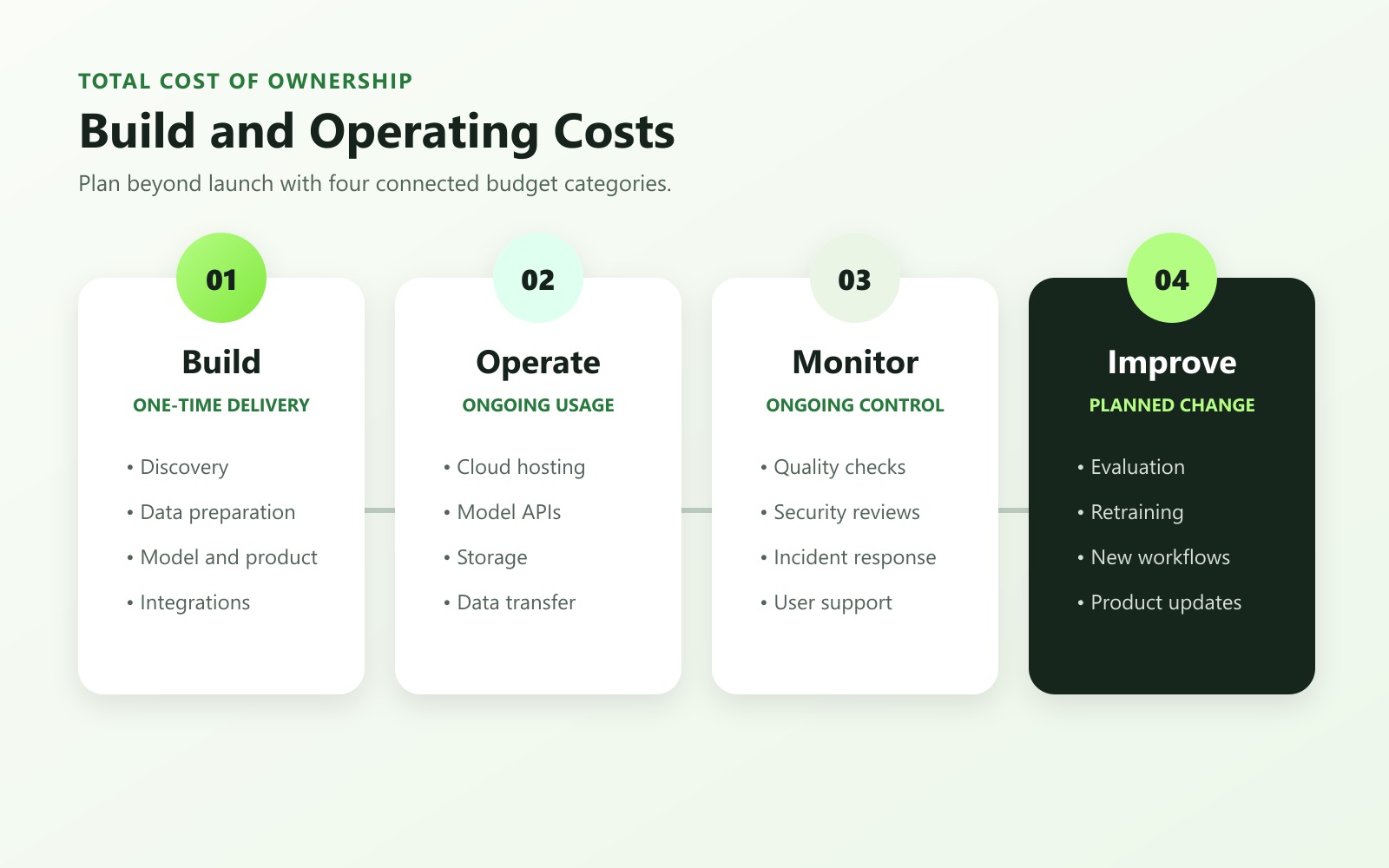
The initial build never represents the complete operating budget for a production AI system. Ongoing spending covers infrastructure, model usage, monitoring, support, security reviews, and controlled improvements.
| Cost Category | Billing Cadence | Estimated Cost in AED | Main Variable |
| Discovery and product design | One time | 15,000 to 50,000 | Use-case and stakeholder scope |
| Data preparation | One time, then as needed | 20,000 to 150,000+ | Source condition and volume |
| Model setup or fine-tuning | One time, then per release | 30,000 to 200,000 | Model and dataset choice |
| Application engineering | One time | 50,000 to 500,000 | Workflow and interface scope |
| Cloud environment setup | One time | 5,000 to 20,000 | Network and security design |
| Cloud and accelerator usage | Per month | 3,000 to 50,000+ | Traffic and workload size |
| Model and API usage | Per month | 1,000 to 30,000+ | Tokens, media, and requests |
| Storage and vector search | Per month | 500 to 5,000+ | Data size and query volume |
| Monitoring and support | Per month | 5,000 to 25,000 | Coverage and service levels |
| Security assessment | Per assessment | 10,000 to 50,000+ | Scope and remediation needs |
| Model review or retraining | Per cycle | 15,000 to 100,000+ | Drift and dataset change |
These ranges offer planning guidance and remain outside any provider commitment. Model selection, traffic, media processing, retention, and service levels can change recurring spending.
Costs buyers often overlook
- Data access work: Contracts, permissions, exports, metadata, and source-owner coordination consume delivery time.
- Evaluation datasets: Teams need representative prompts, expected answers, risk cases, and Arabic variants.
- Human review: Sensitive decisions require trained reviewers, escalation rules, and quality sampling.
- Observability: Dashboards, traces, alerts, audit records, and incident reviews need sustained ownership.
- Vendor change: Model migrations require retesting, prompt changes, integration work, and acceptance review.
- Knowledge updates: RAG sources need refresh schedules, access reviews, archival rules, and broken-link checks.
- Security remediation: Testing findings may require architecture changes before launch approval.
- Training and adoption: Users need guidance, role changes, support, and safe-use procedures.
API fees deserve separate tracking because usage grows with customers, context length, and generated output. Cloud costs also change with availability targets, logs, storage, backups, and accelerator demand.
Procurement teams should request low, expected, and high-volume operating scenarios. Each scenario should state traffic, model, token, storage, support, and retention assumptions.
The UAE Central Bank publishes a stable official currency framework for AED conversions. That source helps finance teams convert provider prices while keeping internal budgets in AED.
Enterprise AI Development Cost in UAE by Industry
Industry changes the required data controls, evidence, integrations, and human oversight. The estimates below assume custom production software rather than generic subscriptions.
| Industry | Representative Use Case | Estimated Cost in AED | Main Scope Pressure |
| Fintech | Fraud review, service agent, credit support | 300,000 to 1,200,000 | Regulation, audit, security |
| Healthcare | Care coordination, document review, patient support | 250,000 to 800,000 | Sensitive data and validation |
| Real estate | Lead scoring, document search, broker assistant | 150,000 to 500,000 | CRM, listings, Arabic UX |
| Logistics | Route support, forecasting, freight coordination | 200,000 to 600,000 | Live data and integrations |
| Government services | Citizen support, document processing, decision support | 500,000 to 1,500,000+ | Scale, accessibility, assurance |
Fintech AI development cost in Dubai
Fintech app development requires strict identity, access, transaction, audit, and incident controls. Fraud and scoring systems also need explainable review paths and conservative error thresholds.
Integration work can span payment infrastructure in AI fintech app development, customer systems, screening services, and regulatory reporting.
Healthcare AI development cost in the UAE
Healthcare AI App development handles sensitive records, clinical language, integrations, and high-consequence decisions. Human oversight remains central when outputs affect care, diagnosis, eligibility, or patient communication.
Arabic clinical terminology requires domain reviewers and representative testing across intended user groups. The scope may also include DHA, DOH, MOHAP, EHR, HL7, or FHIR planning.
Real estate AI development cost in the UAE
Real estate app development often combines listing data, CRM records, maps, communications, and bilingual search. Lead scoring needs historical outcomes and safeguards against poor or biased recommendations.
Document assistants require source permissions, citation checks, and updates when rules or listings change. Our UAE real estate services cover Arabic interfaces, CRM workflows, and property operations.
Logistics AI development cost in Dubai
Logistics app development includes orders, routes, tracking events, documents, payments, and partner data development.
Operational costs in AI logistics app development depend on accurate integrations and fast updates across shippers, carriers, and dispatch teams.
Government and Public Services AI Cost in UAE
Budgets cover Arabic-first design, right-to-left journeys, accessible interfaces, and testing across devices and assistive technologies. UAE Pass integration includes identity flows, consent, authentication, session handling, and failure recovery.
High-volume deployment requires scalable infrastructure, load testing, observability, disaster recovery, and service continuity.
Procurement may include data residency planning, government integrations, model governance, human review, staff training, and service support.
Together, these requirements increase assurance effort, delivery time, and specialist staffing.
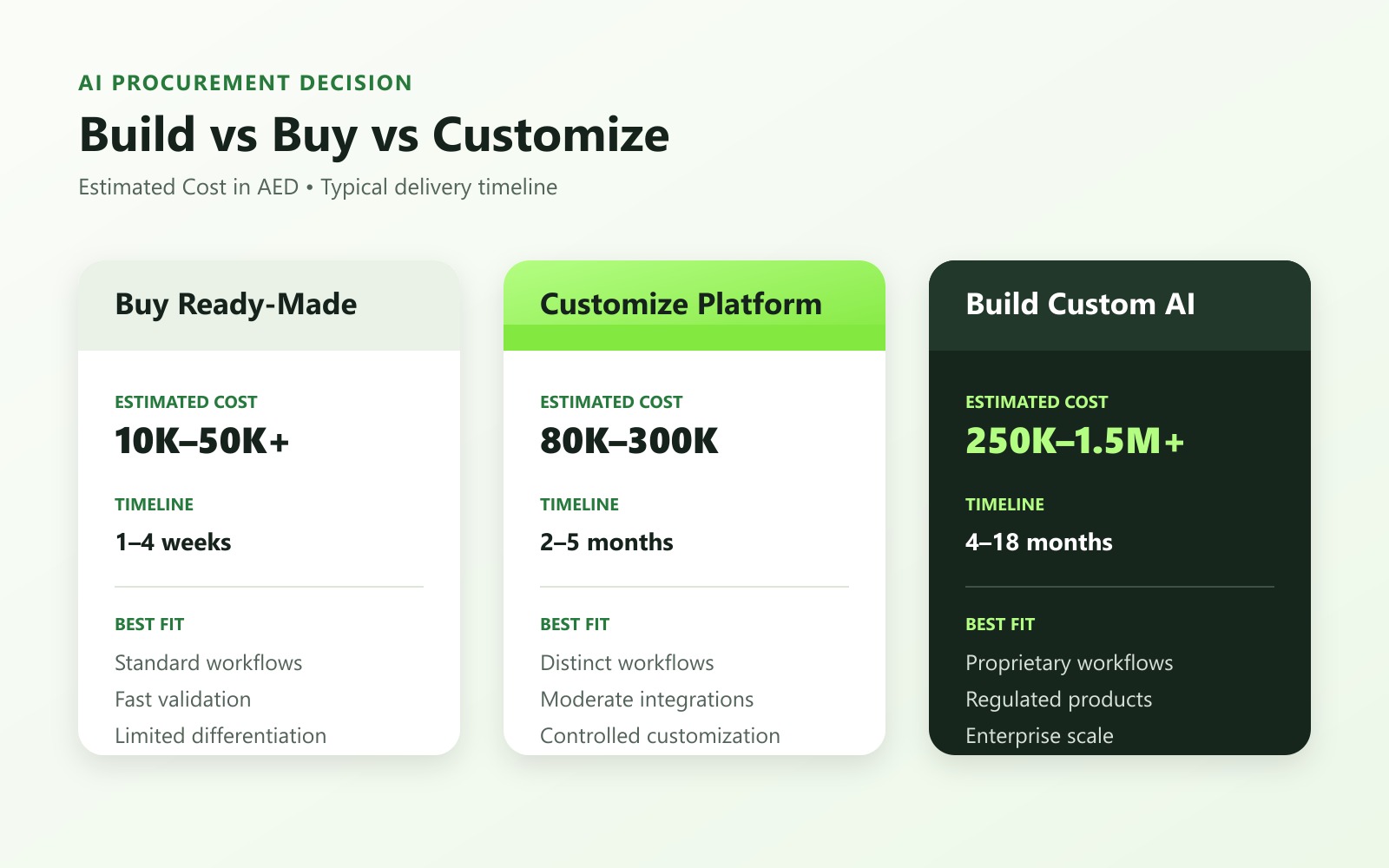
Custom AI, Ready-Made AI, or API Customization?
Buy when the workflow is standard, customize when differentiation matters, and build when control justifies investment.
The decision should consider ownership, risk, switching costs, Arabic quality, and operating scale.
| Approach | Commercial Model | Estimated Cost in AED | Launch Window | Best Fit |
| Buy ready-made software | Subscription per year | 10,000 to 50,000+ | 1 to 4 weeks | Standard workflows |
| Customize an AI platform | Project plus usage | 80,000 to 300,000 | 2 to 5 months | Distinct workflows |
| Build custom AI software | Project plus operations | 250,000 to 1,500,000+ | 4 to 18 months | Proprietary or regulated products |
When ready-made AI fits
Ready-made software suits common tasks where rapid deployment matters more than product differentiation. Examples include meeting summaries, generic content assistance, standard service desks, and office productivity.
Buyers should review data use, retention, access, integrations, Arabic performance, and export options.
When API customization fits
API customization suits unique workflows that can use an established foundation model. RAG can connect approved company knowledge without training a new base model.
Product teams still need permissions, retrieval tests, citations, monitoring, and vendor-change planning.
When custom AI software fits
Custom development suits proprietary workflows, regulated decisions, deep integrations, or strict ownership needs. The higher budget funds product engineering, data systems, controls, evaluation, and long-term operations.
Custom software can also support several models, reducing dependence on one provider.
Five questions for the decision
- Does the workflow create a durable competitive advantage?
- Must the business control source code, hosting, data, or model selection?
- Does the use case process regulated or sensitive information?
- Can a subscription meet Arabic, integration, audit, and service requirements?
- Will expected usage make per-request pricing expensive across three years?
How to Reduce AI Development Cost in UAE Without Increasing Risk
Cost control starts with disciplined scope, measurable acceptance, and evidence from real users. The following framework protects budget while preserving production standards.
1. Start with one measurable business problem
- Choose one workflow with known volume, cost, delay, or service pain.
- Define the baseline before choosing a model or interface.
2. Audit data before contracting the full build
- Confirm sources, owners, rights, quality, history, access, and update frequency.
- Resolve missing ownership before engineers depend on the dataset.
3. Use managed models where they meet requirements
- Managed models can reduce training, hosting, and maintenance work during validation.
- Compare vendors through a representative evaluation set before final selection.
4. Fund a proof of concept before a platform
- Spend AED 25,000 to AED 75,000 to test feasibility and the central business assumption.
- Use the result to refine architecture, scope, risk, and expected operating expense.
5. Limit first-release integrations
- Connect the systems required for one complete workflow.
- Defer optional integrations until usage proves their value.
6. Set acceptance thresholds before development
- Define accuracy, groundedness, latency, Arabic performance, safety, and human escalation requirements.
- Testing becomes cheaper when teams agree on success before implementation.
7. Design reusable data services
- Shared ingestion, permissions, metadata, and evaluation assets can support several approved use cases.
- Reuse requires governance, documentation, and ownership across teams.
8. Track model and cloud costs from launch
- Measure cost per task, customer, document, and successful outcome.
- Alerts should flag unusual traffic, context growth, retries, and tool loops.
9. Expand after measured value
- Move into new workflows after production evidence supports the next investment.
- Gartner’s cancellation forecast supports staged decisions with cost and risk controls.
The best first AI release is the smallest production system that proves measurable business value.
How to Choose an AI Development Company in Dubai
The right partner can explain every major cost assumption before requesting a large commitment. Buyers should assess delivery proof, data capability, controls, ownership, and post-launch accountability.
AI development partner evaluation checklist
- Ask for production AI examples serving comparable users, data, and risk levels.
- Review the proposed path from discovery through deployment and monitored operations.
- Confirm data engineering expertise across ingestion, permissions, lineage, quality, and retention.
- Request Arabic evaluation methods, sample test cases, and reviewer qualifications.
- Inspect integration experience across your named CRM, ERP, identity, payment, and cloud systems.
- Ask how UAE PDPL and applicable DIFC duties affect the architecture.
- Require a price schedule covering assumptions, exclusions, usage, support, and change requests.
- Confirm source-code ownership, infrastructure access, documentation, and exit assistance.
- Review model monitoring, incident response, retraining, and regression-testing responsibilities.
- Speak with client references whose systems have remained live after launch.
Why Choose Code Brew Labs for AI Development in the UAE?
Code Brew Labs is an AI enterprise app, AI-first digital product engineering, and IT consulting company. Since 2013, our teams have served the UAE, Middle East, and global markets.
Our delivery model brings AI development, automation, mobile products, and enterprise software under one accountable team.
Through our AI development services, we cover generative AI, predictive modeling, computer vision, NLP, and custom products. AI Automation specialists build workflows, integrations, assistants, analytics, and operational support around each approved use case.
We start with the use case, data, users, integrations, risks, and expected business outcome.
Discovery produces a phased scope with stated assumptions, exclusions, acceptance criteria, and ownership. Across our UAE-facing portfolio, we have supported Airbus, du Pay, NMA, AWR, TruKKer, and ACWA Power.
Each engagement reflects experience with enterprise workflows, complex integrations, and products built for scale.
Sprint demonstrations and project dashboards keep delivery progress visible throughout the engagement. After launch, our support can cover monitoring, issue response, evaluation, and planned product improvements.
Share your use case, data sources, integration needs, and deployment constraints.
Conclusion
AI development cost in the UAE depends on architecture, data, integrations, controls, and operating obligations. Planning ranges start near AED 25,000 for validation.
Enterprise platforms can exceed AED 1.5 million. A low quotation can omit essential work, while a high quotation can contain avoidable scope.
Buyers need transparent assumptions, measurable acceptance criteria, and separate operating scenarios. Start with one valuable workflow and test it against representative data.
Then fund broader development after evidence supports the next phase.
That sequence gives executives a defensible budget, controlled risk, and a usable production system.
FAQs
How much does AI development cost in the UAE?
AI development costs AED 25,000 for a focused proof of concept. API-based MVPs range from AED 80,000 to AED 250,000. Custom applications range from AED 250,000 to AED 750,000. Enterprise platforms can exceed AED 1.5 million when governance, integrations, and UAE hosting enter scope.
How much does an AI app cost in Dubai?
An AI app in Dubai costs AED 80,000 to AED 250,000 for a focused MVP. Custom products often range from AED 250,000 to AED 750,000. Complex enterprise applications can exceed AED 1 million. Data, Arabic support, security, integrations, and production operations determine the final estimate.
What factors affect AI development cost in the UAE?
Architecture, data readiness, model choice, integrations, Arabic requirements, hosting, and risk controls affect development cost. Evaluation and post-launch operations also require budget. Regulated workflows need stronger evidence, audit records, and human review. Every quotation should state its assumptions for those areas.
How much does an AI chatbot cost in the UAE?
A controlled FAQ bot costs AED 12,000 to AED 35,000. Generative assistants cost AED 50,000 to AED 150,000. Enterprise RAG assistants range from AED 100,000 to AED 350,000. Arabic evaluation, CRM integration, permissions, and several channels move the estimate upward.
How much does AI agent development cost in Dubai?
A single-task AI agent costs AED 55,000 to AED 150,000 across current UAE benchmarks. Multi-step agents range from AED 150,000 to AED 550,000. Governed multi-agent platforms can exceed AED 1.5 million. Tool access, recovery, audit records, observability, and approvals create the largest differences.
Is custom AI more expensive than an AI API solution?
Custom AI requires more upfront investment than an API-based product. API-based MVPs start near AED 80,000. Custom applications start near AED 250,000 across reviewed UAE benchmarks. High usage, strict control, or proprietary models can change the longer-term comparison.
How long does AI development take in the UAE?
A proof of concept takes two to six weeks. An API-based MVP takes two to four months. Custom AI applications need four to nine months. Enterprise platforms can require eight to eighteen months. Data access, procurement, integrations, and security reviews can extend those windows.
What recurring costs should UAE businesses expect?
Recurring costs include cloud services, model usage, storage, monitoring, support, evaluation, and security work. A production product may spend AED 9,500 to over AED 110,000 per month. Several operating categories shape that estimate. Traffic, media, context size, service levels, and hosting choices shape that range.
Should a UAE business build or buy an AI solution?
Buy when the workflow is standard and a subscription meets data, Arabic, audit, and integration needs. Customize when the workflow needs differentiation around an established platform. Build custom software for proprietary or regulated operations. Compare three-year ownership, risk, switching, and operating costs before deciding.
How can a business reduce AI development cost in the UAE?
Start with one measurable workflow and audit its data before signing a full-build contract. Use a proof of concept, limit initial integrations, and define acceptance thresholds before development. Track model and cloud spending from launch. Expand after production evidence supports more investment.
Let's Convert Your Business Idea Into Success!
Free Consultation from Top Industry Experts
Let’s Build Your Dream App!
Share article on :


 No commitment required
 NDA on request
 24-hour response


