
Quick Summary:
- A credible UAE logistics app budget starts with scope, not a headline price. Clutch reports that most reviewed app projects cost about AED 36,725 to AED 183,621. Its cross-industry average is about AED 333,390.
- The visible mobile app is only one part of the investment. A working logistics product may also require a driver app, dispatcher dashboard, customer portal, admin controls, backend services, integrations, security, analytics, and support.
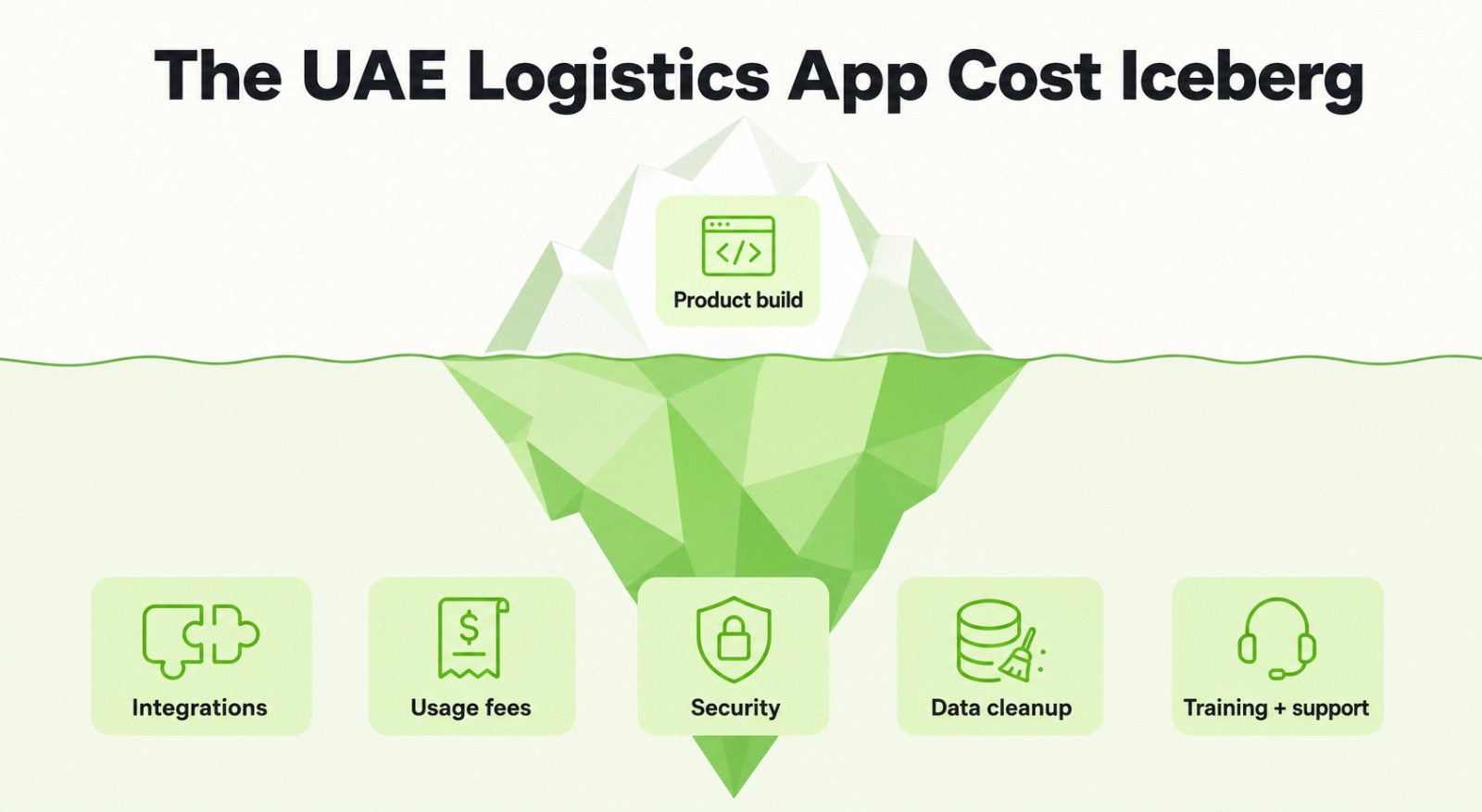
- Hidden expenses often sit in usage and operations. Map requests, route calculations, cloud resources, messages, payment fees, device testing, data cleanup, monitoring, training, and post-launch changes can continue after release.
- The best first release solves one expensive workflow. Shipment booking, dispatch, tracking, electronic proof of delivery, exception handling, and settlement usually deserve priority before advanced AI or automation.
- AI should enter the roadmap when clean operational data exists. Useful 2026 applications include ETA prediction, route recommendations, demand forecasting, document extraction, shipment-volume estimation, and exception detection.
- Payment design depends on the commercial model. Consumer delivery, freight marketplaces, enterprise invoicing, subscriptions, and cash on delivery each need a different authorization, settlement, refund, and reconciliation flow.
- Compare logistics software companies on discovery quality and lifecycle ownership. A low build estimate can become expensive when integration, compliance, observability, support, and source-code handover are missing.
The business problem behind most searches for logistics app development in the UAE is that the buyer is not purchasing screens. They are deciding how much operational uncertainty to remove, which workflows to standardize, and what level of reliability the business can afford.
Picture a dispatcher in Dubai at 7:30 a.m. A customer has changed a delivery window, a driver cannot find the loading gate, and finance is still checking yesterday’s cash collections against a spreadsheet. Three people have the same shipment open in three different tools, yet no one has the full story.
The price of a logistics app therefore depends on the product around the app: the people who use it, the decisions it must support, the systems it must connect with, and the transactions it must record.
This article breaks that decision into a cost model a founder, logistics operator, retailer, freight forwarder, or enterprise procurement team can use before requesting proposals.
Why UAE Logistics Businesses Are Investing in Digital Operations
The commercial case is visible in UAE policy and market data.
The Roads and Transport Authority’s Commercial and Logistics Land Transport Strategy 2030 targets AED 16.8 billion in direct sector contribution, a 75% increase in infrastructure technology adoption, and a 10% improvement in operational efficiency.
RTA also reported 351,000 registered commercial vehicles and 9,699 companies in Dubai’s commercial transport sector when it announced the strategy.
Delivery demand is expanding at the same time.
Dubai South and Euromonitor reported that the UAE e-commerce market reached AED 32.3 billion in 2024 and projected it to pass AED 50.6 billion by 2029. Digital-wallet use rose from 41% in 2020 to 53% in 2024 in the cited consumer survey.
Growth adds pressure around cross-emirate routing, delivery windows, proof, returns, bilingual service, settlement, and reporting.
Capgemini has cited last-mile delivery as 41% of total logistics supply-chain costs. The global figure does not set a UAE app budget, but it explains the focus on dispatch, failed deliveries, and returns.
The practical question is which process creates enough delay, error, or service risk to justify building first.
How Much Does Logistics App Development Cost in the UAE in 2026?
There is no authoritative public database for the price of a custom UAE logistics app. Any vendor presenting one universal range without a defined scope is giving a marketing estimate, not a procurement-grade answer.
A more responsible starting point is Clutch’s July 2026 pricing data, based on verified app-development reviews. Most reviewed projects fall between USD 10,000 and USD 49,999; the reported average is USD 90,780.11, and common agency rates are USD 25 to USD 49 per hour.
| Public benchmark | Approximate AED figure | How to use it |
| Most reviewed app projects | 36,725 to 183,621 | Early market reference only |
| Average reviewed project | 333,390 | Complexity reality check |
| Common agency hourly rate | 92 to 180 | Compare effort assumptions |
These numbers span industries, countries, product types, and levels of complexity. A single-purpose driver tool may sit near the lower end of a broad market range.
While a freight marketplace with several apps, live tracking, carrier onboarding, enterprise integrations, payments, analytics, and high availability can require much more.
Ask for a scope-based estimate, not a tier label
Terms such as basic, medium, and advanced sound useful until two vendors define them differently.
One proposal may call a customer app plus driver app an MVP. Another may include only a clickable customer interface and treat dispatch, admin, tracking, and notifications as separate work.
A quote becomes comparable when it states:
- user roles and product surfaces;
- each workflow included in the first release;
- integrations and responsible system owners;
- data migration and data-cleaning assumptions;
- security, privacy, and payment responsibilities;
- supported languages and devices;
- expected usage, uptime, and support hours;
- acceptance criteria, exclusions, and change-control terms.
Use a total cost of ownership model
The first build invoice is not the complete logistics app development cost. Use this planning equation:
| Total cost of ownership = product build + integrations + transaction and compliance work + data and AI readiness + launch work + recurring run costs |
This model forces an early conversation about expenses that are easy to omit from a sales estimate. It also helps finance compare custom software development with licensed delivery logistics software on the same basis.
Six Factors Affecting the Cost of Logistics App Development
1. Product type and operating model
A courier booking app, fleet-management tool, warehouse application, freight marketplace, and transport-management platform solve different problems.
A closed fleet system may have known vehicles and pricing. A marketplace must verify providers, match capacity, manage disputes, and support payouts. A warehouse tool needs scanning, offline behavior, inventory events, and hardware testing.
An inaccurate product label can hide the most expensive business rules. Describe how a shipment moves from request to final settlement instead.
2. Number of user-facing products
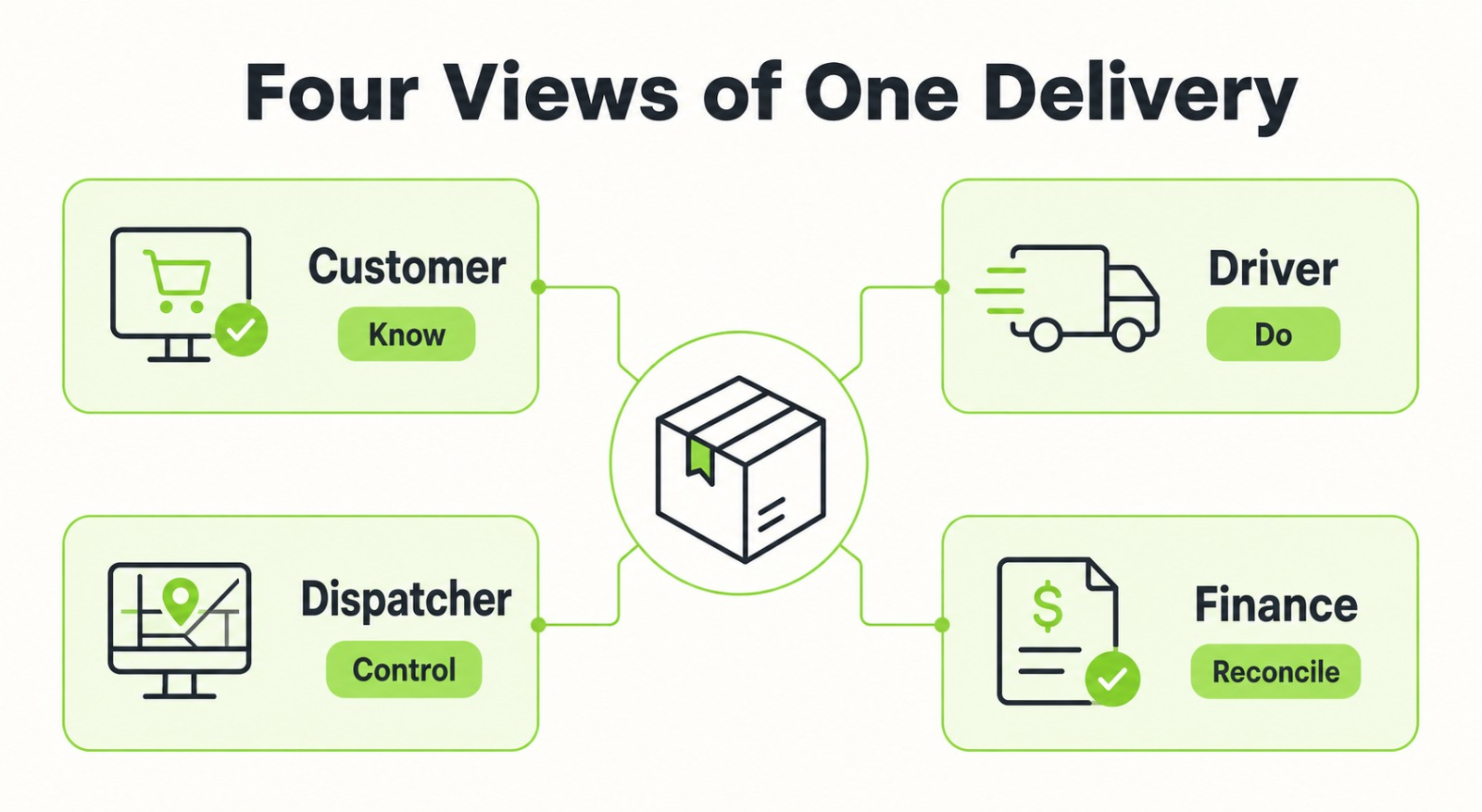
Many logistics apps are an ecosystem:
- customer app or web portal;
- driver app;
- dispatcher control tower;
- fleet or carrier portal;
- warehouse panel;
- finance and administration console;
- executive analytics dashboard.
Each surface has separate permissions, tests, notifications, and edge cases. A customer sees a simple status. A dispatcher needs the event history, vehicle, missed scan, position, revised ETA, and action owner.
Count roles and workflows before estimating screens. A ten-screen app backed by complex operations can cost more than a polished consumer app with many static pages.
3. Logistics app design and bilingual usability
Good logistics app design reduces the time and attention needed for a task. A driver may use the app outdoors, one-handed, under time pressure, or with unreliable connectivity.
A dispatcher may monitor hundreds of orders across a wide desktop display. Arabic right-to-left layouts affect navigation, tables, maps, icons, text expansion, and quality assurance.
Design work should include field interviews, journey mapping, low-fidelity flows, a clickable bilingual prototype, error handling, accessibility, and usability testing. Visual polish without operational research can produce an interface that staff avoids.
Correcting a misunderstood dispatch rule in a prototype is cheaper than changing the database, APIs, and mobile screens after development.
4. Platform choice, including logistics app development for Android
Android logistics app development is often important for driver and warehouse devices because organizations can support a broad hardware range. The cost risk is not the operating system rate itself.
Clutch’s 2026 data shows similar hourly rates for Android, iOS app development, and cross-platform work. The larger difference is whether the product needs one codebase or separate native products, and how much device-specific behavior must be tested.
Choose native Android when background location, rugged hardware, scanners, or deep offline performance justify it.
Consider Flutter or React Native when both platforms need similar features, and the team can validate tracking, maps, camera use, and notifications.
A web app can suit workflows that do not need deep device access.
The cheapest platform choice on a proposal can become costly if location updates fail when a device enters battery-saving mode.
5. Integrations and data ownership
Common integrations include enterprise resource planning, warehouse management, transport management, customer relationship management, telematics, mapping, payment, identity, messaging, accounting, customs, and e-commerce systems.
Teams must agree which system owns each customer, shipment, status, price, invoice, and payment record. The project also needs retry rules, duplicate prevention, audit logs, and outage recovery.
An integration that works in a demonstration can still fail during real operations if no one designed reconciliation and exception handling.
6. Delivery team and commercial model
An in-house team gives direct control but adds recruitment, management, tooling, and retention obligations.
Freelancers can suit a narrow prototype when one owner can coordinate architecture and testing.
A dedicated product team provides continuity for a longer roadmap. Hiring full-service mobile app developers can cover discovery through support, but the contract must make ownership and accountability clear.
| Team model | Best fit | Buyer check | Cost risk to watch |
| In-house | Long-term core platform | Hiring plan and product leadership | Recruitment and idle capacity |
| Freelance specialists | Narrow, well-defined work | Architecture owner and availability | Fragmented accountability |
| Dedicated team | Evolving multi-release product | Stable roles and delivery metrics | Unclear backlog control |
| Full-service partner | Discovery through launch | Named team, handover, support SLA | Scope assumptions in proposal |
Turn the six cost drivers into a scope brief before requesting estimates and proposals
Hidden Logistics App Expenses That Buyers Often Discover Late
-
Map, routing, and location usage
Map platforms can charge by calls, routes, geocoding, places, navigation, and optimization usage.
Google Maps Platform, for example, offers subscriptions and pay-as-you-go pricing rather than one universal license.
A live dispatcher map is not the same as optimizing hundreds of stops. Estimate calls per order, active driver, and delivery day. Add spending alerts and fallbacks.
-
Cloud infrastructure and observability
Development environments may look inexpensive because usage is low. Production introduces databases, storage, background jobs, logs, backups, analytics, content delivery, monitoring, and disaster recovery.
Firebase’s Blaze plan, for example, is pay-as-you-go beyond available quotas, and its documentation notes that budget alerts do not cap charges.
Request monthly cost models for launch, expected, and stress volume. Keep ownership of billing and usage dashboards.
-
Messaging and customer communication
SMS, WhatsApp, email, push notifications, masked calling, and support chat can each have provider charges.
A shipment may trigger booking, assignment, arrival, delay, completion, payment, and return messages. Poor notification rules also create a service problem when customers receive too many alerts.
-
App-store accounts and release operations
Apple lists its Developer Program at USD 99 per membership year. Google Play lists a USD 25 one-time registration fee.
These charges are small beside the build, but ownership matters. The business should control the store accounts, signing keys, listings, privacy details, and release permissions.
-
Security, privacy, and compliance work
The UAE Personal Data Protection Law is active, and logistics systems may hold names, phone numbers, addresses, live or historical locations, signatures, photographs, IDs, vehicle details, and payment references.
Budget for data mapping, lawful-use review, retention rules, access controls, encryption, audit logs, consent where needed, incident response, deletion workflows, supplier review, and security testing.
Legal counsel should confirm the obligations for the exact business model and jurisdictions.
-
Payment security and reconciliation
Using a hosted gateway can reduce exposure to card data, but payment work still includes tokens, failed authorizations, refunds, chargebacks, settlement reports, COD records, invoices, and finance reconciliation.
PCI SSC’s document library identifies PCI DSS 4.0.1 as the current featured standard and provides resources for safe cardholder-data handling.
-
Data migration and operational cleanup
Old customer records may contain duplicated phone numbers, inconsistent addresses, missing coordinates, and free-text status values.
Vehicle or driver data may live in spreadsheets with no common identifier. Migration therefore includes mapping, cleansing, deduplication, validation, and rollback planning.
-
Field testing, training, and adoption
A logistics app can pass office testing and still fail in a basement loading bay, on an older phone, during a long background shift, or when a driver loses connectivity.
Budget for real routes, representative devices, offline tests, bilingual training, operations playbooks, and a launch support desk.
-
Maintenance and product change
Avoid treating maintenance as an unsupported fixed percentage. Ask for a priced service model covering operating-system updates, dependency patches, security fixes, monitoring, incident response, small improvements, and new feature work.
Separate essential service continuity from optional product growth.
A Practical Framework to Keep the Project on Budget
Start with one costly operational moment
Choose a measurable pain point such as manual dispatch, uncertain ETA, missing proof, slow invoice approval, or difficult COD reconciliation. Record the current time, error rate, and staff effort.
Map the shipment lifecycle before listing features
Map quote, booking, assignment, pickup, delivery, return, payment, and reconciliation. Mark the actor, system, rule, and exception at each step.
Separate MVP, scale, and experiment backlogs
- MVP: work needed to complete the core transaction safely.
- Scale: automation, analytics, and controls needed after usage grows.
- Experiment: AI development services, new monetization, and emerging channels that require validation.
This protects the launch from features with no data, owner, or proven demand.
Put assumptions beside every estimate
State order volume, users, languages, platforms, third-party systems, data quality, availability, and support beside the estimate.
Run a technical spike for uncertain integrations
Test the riskiest API, scanner, background location, payment flow, or offline synchronization before committing to the full build.
Define acceptance in operational language
Replace “tracking works” with capture frequency, offline behavior, stale-data warnings, battery targets, and recovery rules.
Assign a business owner to every workflow
Dispatch, finance, support, warehouse, security, and fleet owners should approve the relevant rules before development.
Hold a contingency for verified unknowns
Keep contingency visible and release it through change control when an agreed risk occurs.
Must-Have Features for a Logistics Delivery App
The right feature set follows the shipment journey. Each feature needs a business reason, an owner, and a success measure.
| Product area | Must-have capability | Why it matters | MVP decision |
| Customer | Quote or booking, address validation, tracking | Reduces support and input errors | Usually include |
| Driver | Jobs, navigation, offline state, ePOD | Completes work at the field edge | Usually include |
| Dispatch | Live board, assignment, alerts, overrides | Gives control when plans change | Usually include |
| Operations | Status history, returns, incident records | Protects service and auditability | Include core events |
| Finance | Pricing, invoice or COD record, reconciliation | Connects delivery to cash | Include required model |
| Admin | Roles, zones, rules, audit logs | Controls access and configuration | Usually include |
| Analytics | SLA, completion, delay, utilization | Shows whether operations improve | Start with core KPIs |
Customer features
Use clear price or quote logic, validated addresses, delivery instructions, service windows, live status, revised ETA, contact controls, digital receipts, and return requests.
Do not promise minute-level accuracy if the data cannot support it. A range with a clear update can be more trustworthy than a false precise time.
Driver features
Prioritize a fast job list, one-tap status updates, navigation, offline storage, background synchronization, barcode or QR scanning where relevant, ePOD, issue reporting, safe communication, shift controls, and visible sync state.
Test on the devices the fleet will use.
Dispatcher features
Dispatchers need a live operational board, filters, assignment and reassignment, route view, stale-location warnings, SLA risk, failed-delivery reason, driver contact, and manual override.
Automation should never hide why a job was assigned.
Admin and finance controls
Role-based access, configurable zones, pricing rules, cancellation and refund logic, audit trails, tax-ready records, settlement exports, carrier documents, and exception queues deserve early attention.
These screens may not appear in a product demo, yet the business depends on them.
From Discovery to Launch: Code Brew Labs’ Build Process for Logistics App Development
- Operational discovery
Interview staff who quote, dispatch, drive, support, invoice, and reconcile. Capture real exceptions, not only the ideal process.
- Product scope and success measures
Define the first user group, core job, target improvement, product surfaces, integrations, security needs, exclusions, and work that remains manual.
- Logistics app design and prototype validation
Prototype critical paths in Arabic and English where required. Test representative users and devices before coding.
- Architecture and integration planning
Choose each system of record, define APIs and events, plan offline behavior, estimate usage, and establish security controls.
- Incremental development and testing
Build complete workflow slices and demonstrate working software often. Test devices, integrations, performance, security, and field conditions.
- Controlled rollout
Start with one branch, route, customer group, or fleet segment. Monitor adoption, sync errors, completion, support, and reconciliation before expansion.
- Product operations
Review service health and business outcomes together after launch.
AI Trends Worth Funding in a 2026 Logistics Roadmap
DHL’s Logistics Trend Radar 7.0 identifies generative AI, AI ethics, audio AI, computer vision, and advanced analytics as prominent logistics trends. It also keeps robotics, IoT, and the digital backbone in view.
The useful buyer question is not “Does the app have AI?”
It is “Which decision can the model improve, what data supports it, and how will a person challenge a poor recommendation?”
| AI use case | Required input | Useful output | Control needed |
| ETA prediction | GPS, traffic, stops, history | Arrival range and risk | Stale-data warning |
| Route recommendation | Stops, windows, capacity | Proposed route plan | Dispatcher override |
| Demand forecast | Orders, season, location | Capacity forecast | Error tracking |
| Document extraction | Invoices, POD, forms | Structured fields | Human validation |
| Visual load estimate | Shipment images or video | Volume estimate | Confidence and review |
| Exception detection | Event stream and rules | Early-risk alert | Reason and owner |
Predictive ETA and exception management
An ETA model can compare live movement with route, stop duration, traffic, and historical patterns. The higher-value result is often an early warning that gives dispatch time to act. Track forecast error by route, time, vehicle type, and operating condition.
Route and load recommendations
Optimization can consider time windows, capacity, vehicle type, driver constraints, and service priority. Start with recommendations and manual approval. Full automation is risky when business rules live only in staff experience.
Computer vision for proof and dimensions
RTA and TruKKer launched the Logisty freight platform with an AI-powered CBM calculator that estimates shipment volume from photos or video. The example shows a practical AI feature tied to a specific freight task, not a decorative chatbot.
Document intelligence
Freight operations generate invoices, delivery notes, customs records, manifests, IDs, and proof images. Extraction can reduce manual entry, but confidence thresholds and human review are essential for financial or regulatory fields.
Generative assistance with grounded data
A support or operations assistant can summarize a shipment history, draft a customer update, or retrieve a procedure. It should use approved operational sources, show relevant records, restrict access by role, and avoid inventing shipment facts.
AI readiness before model development
Budget first for clean event definitions, identifiers, timestamps, outcome data, data permissions, monitoring, and feedback.
RTA’s 2025 traffic platform illustrates the value of combining real-time and historical information for analysis and response. It also shows why the data layer is an operational asset in its own right.
Payment Integrations for UAE Logistics Apps
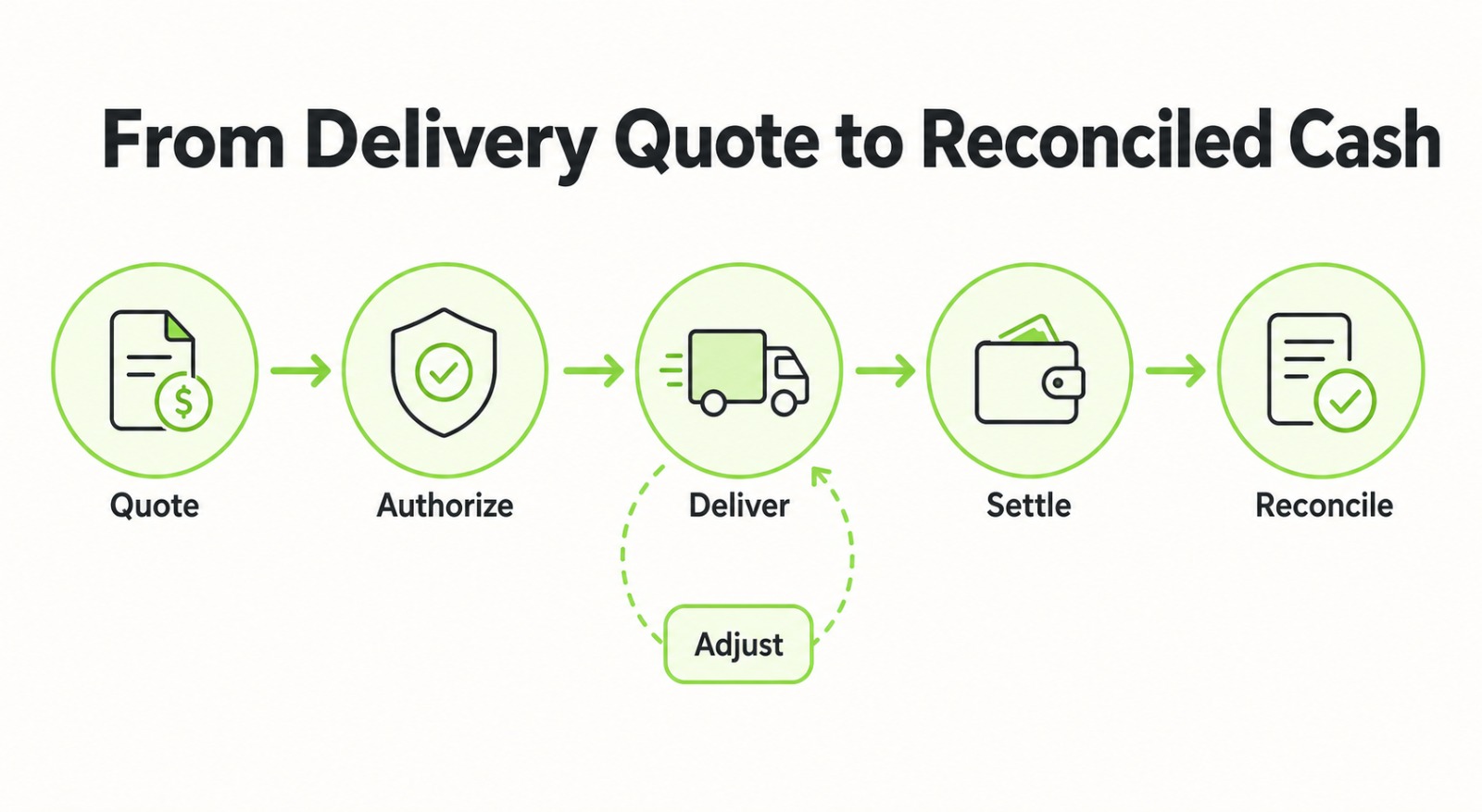
Payment integration is not a checkout button. It is the complete movement from price calculation through authorization, collection, settlement, refund, dispute, payout, and reconciliation.
The UAE’s Federal Decree by Law No. 14 of 2023 concerning modern technology-based trade is active. The Central Bank of the UAE also governs licensed payment activities.
Product counsel and a qualified payments partner should confirm whether the business is only accepting payment for its own service or performing a regulated payment function for other parties. Source: UAE Legislation
Match the flow to the business model
| Model | Typical flow | Main design question | Reconciliation need |
| Consumer delivery | Card, wallet, COD | When is final amount known? | Order to payment |
| Freight booking | Quote, deposit, balance | What happens after variance? | Shipment to invoice |
| Marketplace | Buyer pays, provider receives | Who holds or releases funds? | Order, fee, payout |
| Enterprise account | Credit terms and invoice | Who approves exceptions? | Invoice to remittance |
| Subscription | Recurring platform fee | How are plan changes handled? | Account to billing cycle |
Gateway evaluation checklist
Compare providers on UAE availability, supported currencies, card and wallet methods, tokenization, recurring billing, refunds, disputes, settlement timing, payout support, hosted checkout, SDK quality, reporting, webhook reliability, support, and total transaction cost. Do not select a gateway from brand familiarity alone.
Cash on delivery still needs product design
COD needs an assigned amount, collection result, cash limits, shift close, deposit, variance, and finance approval. A payment-free screen does not make COD operationally free.
Keep card data out of the app where practical
Hosted fields, gateway tokens, and provider SDKs can reduce the amount of sensitive card data handled by the product. The architecture and operating process must still be checked against PCI DSS responsibilities and the provider’s integration guidance.
Build reconciliation before launch
Every payment status should map to an order, invoice, refund, payout, and accounting reference as relevant. Store gateway event IDs and process webhooks idempotently so a repeated message cannot create a duplicate financial event.
Considering mapping payment, refund, payout, & reconciliation before choosing a gateway?
Build, Buy, or Cross-Delivery Logistics Software Platform: How to Choose Logistics Software Platform
Buying a licensed platform can suit standard dispatch, fleet, warehouse, or proof-of-delivery workflows when speed matters more than differentiation.
Custom logistics app development fits businesses with unusual operating rules, a marketplace model, proprietary data, specialized integrations, or customer experience that supports competitive advantage.
A hybrid model is common. A business may license maps, messaging, payment, identity, telematics, or warehouse components while building the workflow and experience that differentiates the service.
Use these questions when comparing delivery logistics software with a custom build:
- Can the platform represent current pricing, zones, capacity, and exception rules?
- Does it support Arabic and English at the required depth?
- Are APIs, webhooks, exports, and audit history available?
- Who owns operational data, configuration, and derived analytics?
- Can roles and permissions match the organization?
- What happens to data and integrations if the contract ends?
- How are usage, support, customization, and upgrade costs priced?
What Are the Best Monetization Models for Logistics Apps?
Choose a model around the buyer, value delivered, and transaction frequency. Hybrid pricing can combine models once demand is proven.
| Model | Best fit | Charge basis | Main risk |
| Transaction fee | Freight marketplaces | Completed booking | Thin small-load margins |
| Subscription | Fleet software | Monthly access | Weak tier differentiation |
| Delivery fee | Consumer delivery | Completed order | Distance costs |
| Commission | Carrier marketplaces | Order value | Participant resistance |
| Enterprise license | Large operators | Users, sites, or vehicles | Long sales cycle |
| Premium or managed services | Mature platforms | Visibility, analytics, or operations | Unclear value |
Select one primary model for launch. Test willingness to pay with real buyers. Track revenue after payment fees, refunds, incentives, support, and route costs. Volume without contribution margin does not prove viability.
TruKKer: Code Brew Labs Developed MENA Logistics Marketplace
TruKKer is a useful example because the product is more than a delivery screen. It is a logistics marketplace connecting cargo owners with verified commercial drivers across MENA, with real-time freight booking, load tracking, and route management. Its current UAE mobile app page lists 5,000+ active shippers, 30% faster freight matching. and 12,000+ verified drivers.
The broader market relevance is independently visible in RTA’s partnership with TruKKer for Logisty. The platform connects customers with commercial transport providers and includes booking, tracking, fleet services, and an AI-powered shipment-volume calculator.
The buyer lesson is practical: marketplace value comes from trust, capacity, matching, tracking, and operational controls working together.
Why Choose Code Brew Labs as a Logistics App Development Partner?
Code Brew Labs has 13 years in the market and 2,600+ custom mobile apps launched.
For a logistics buyer, the stronger reason to shortlist a partner is the ability to connect product decisions with operations. Code Brew Labs’ UAE logistics software development service covers fleet, warehouse, freight, courier, route, tracking, ERP, analytics, and logistics mobile workflows.
Our mobile app development service adds Android, iOS, cross-platform, Arabic RTL, payment, data security, and post-launch capabilities.
Our delivery model is designed to be auditable. We:
- map the real shipment lifecycle during discovery;
- assign named product, design, architecture, QA, security, and delivery roles;
- design integration and reconciliation patterns beyond UI screens;
- field test background location, offline work, scanning, and ePOD;
- define source-code, cloud, app-store, data, and documentation ownership;
- provide support targets and clear escalation paths;
- link each phased release to an operational measure.
Our goal is a transparent scope, delivery roadmap, and operating model, not only a fixed number.
If you need a partner who connects product scope with real logistics operations, choose Code Brew Labs. We will turn your priorities into an auditable roadmap, transparent cost model, and phased launch plan.
Conclusion:
A useful logistics app budget explains what the product will change in the operation. It identifies the costly workflow and completes one shipment journey.
This includes the systems and people around the mobile interface, and also leaves room for measured improvement after launch.
Begin with a two-week discovery and estimation exercise if the workflow or integrations are still uncertain. The output should include a journey map, prioritized scope, architecture outline, and risk register. It should also include a total cost of ownership model, rollout plan, and comparable proposal brief.
That preparation controls logistics app development cost and strengthens product and vendor decisions. It clarifies what to build now, buy, or postpone. When you are ready, choose Code Brew Labs to run that discovery and create a phased logistics app roadmap.
Frequently Asked Questions
How much does it cost to build a logistics app in the UAE?
No universal UAE price exists because a logistics app can mean a driver tool, courier platform, fleet system, warehouse app, or multi-party freight marketplace. Clutch’s July 2026 cross-industry data places most reviewed app projects at about AED 36,725 to AED 183,621, and its average near AED 333,390 after CBUAE conversion. Use those figures only as broad benchmarks. Request a quote based on roles, workflows, integrations, security, usage, and support.
What is the biggest hidden cost in logistics app development?
Integrations and lifecycle usage are frequent sources of surprise. Maps, routes, cloud services, messages, payment events, monitoring, data migration, field testing, training, and maintenance may sit outside an attractive build estimate. Ask for a total cost of ownership model with launch, expected, and high-usage scenarios.
Which features should a logistics delivery app launch with?
Most first releases need booking or order intake, validated addresses, dispatch, driver jobs, tracking, status history, electronic proof of delivery, exception handling, essential finance records, roles, and audit logs. The exact list should complete one shipment journey safely. AI, complex analytics, and secondary monetization can follow when live demand and data justify the work.
Is Android or cross-platform better for a UAE logistics app?
Android can suit driver and warehouse fleets with defined hardware, scanners, background location, or device-management needs. Cross-platform development can reduce duplicated effort when iOS and Android require similar behavior. Test the choice against target devices, battery management, offline synchronization, maps, camera use, and update policy. The framework name alone does not determine quality or total cost.
Does a UAE logistics app need AI in the MVP?
Usually not. AI belongs in the MVP only when it is essential to the core transaction and usable data already exists. Start with reliable event capture, identifiers, timestamps, outcomes, and operational rules. Add ETA prediction, route recommendations, document extraction, or exception detection with measurable accuracy, human oversight, and a fallback process.
What payment methods should a UAE logistics app support?
The answer depends on the customer and commercial model. Consumer delivery may require cards, wallets, and COD. Freight may use deposits, final invoices, credit terms, or bank settlement. Marketplaces add provider payouts and fee reconciliation. Confirm gateway coverage, settlement, refunds, disputes, tokenization, reporting, and any regulatory implications before finalizing the architecture.
How should a business compare logistics software companies?
Compare the assumptions behind each proposal. Check role coverage, workflow depth, integrations, data ownership, security, field testing, acceptance criteria, documentation, support, and recurring service costs. Ask for relevant logistics proof and speak with the proposed delivery team. A smaller initial estimate is not better if essential operational work is excluded.
Let's Convert Your Business Idea Into Success!
Free Consultation from Top Industry Experts
Let’s Build Your Dream App!
Share article on :



 No commitment required
 NDA on request
 24-hour response


