
Quick Summary:
- AI Automation in Dubai now covers RPA, workflow orchestration, and agentic AI across finance, logistics, and government.
- The UAE AI Strategy 2031 has turned automation into a genuine board-level priority for large employers.
- Code Brew Labs leads our ranking for Dubai-based delivery, enterprise scale, and verified Clutch reviews.
- Typical UAE automation builds range from AED 55,000 to beyond AED 1 million by scope.
- Deloitte data shows scaled automation trimming operating costs by roughly 31 to 32 percent.
- Compliance, PDPL alignment, and Arabic support matter more than a polished wall of client logos.
- The right partner is proven through a scoped pilot, not through a slide deck of promises.
Why is AI automation booming in Dubai and the UAE?
AI Automation in Dubai has moved from side experiments to core infrastructure inside Dubai’s largest companies. Finance, logistics, healthcare, and government teams now depend on it for daily throughput.
The reasons are grounded in real operational pain. Back-office work still eats thousands of staff hours across UAE enterprises. Skilled engineers stay scarce and command high salaries. Sensitive data has to remain compliant, and often available in both Arabic and English.
National policy sits behind the momentum. The UAE National Strategy for Artificial Intelligence 2031 set a clear direction for adoption across priority sectors. According to PwC’s Middle East analysis, AI could add around US$96 billion to the UAE economy by 2030. That figure sits near 14 percent of national GDP, the highest relative impact in the region.
So the boardroom question has changed shape. Leaders no longer ask whether to automate. They ask who can deliver inside UAE rules, in two languages, at genuine enterprise scale.
This guide ranks ten companies that serve Dubai and the wider UAE. We scored each on local delivery, technical depth, compliance readiness, and evidence you can verify. Every project figure appears in AED. If you want a shortcut, the comparison table sits a few sections down.
See exactly which of your finance, logistics, and admin workflows are ready to automate this quarter.
Why does AI automation matter for UAE enterprises?
Automation matters here because the economics have crossed a threshold. Tools that once needed a data science team now run on managed platforms and pretrained models. Mid-market firms can reach outcomes that were once locked behind enterprise budgets.
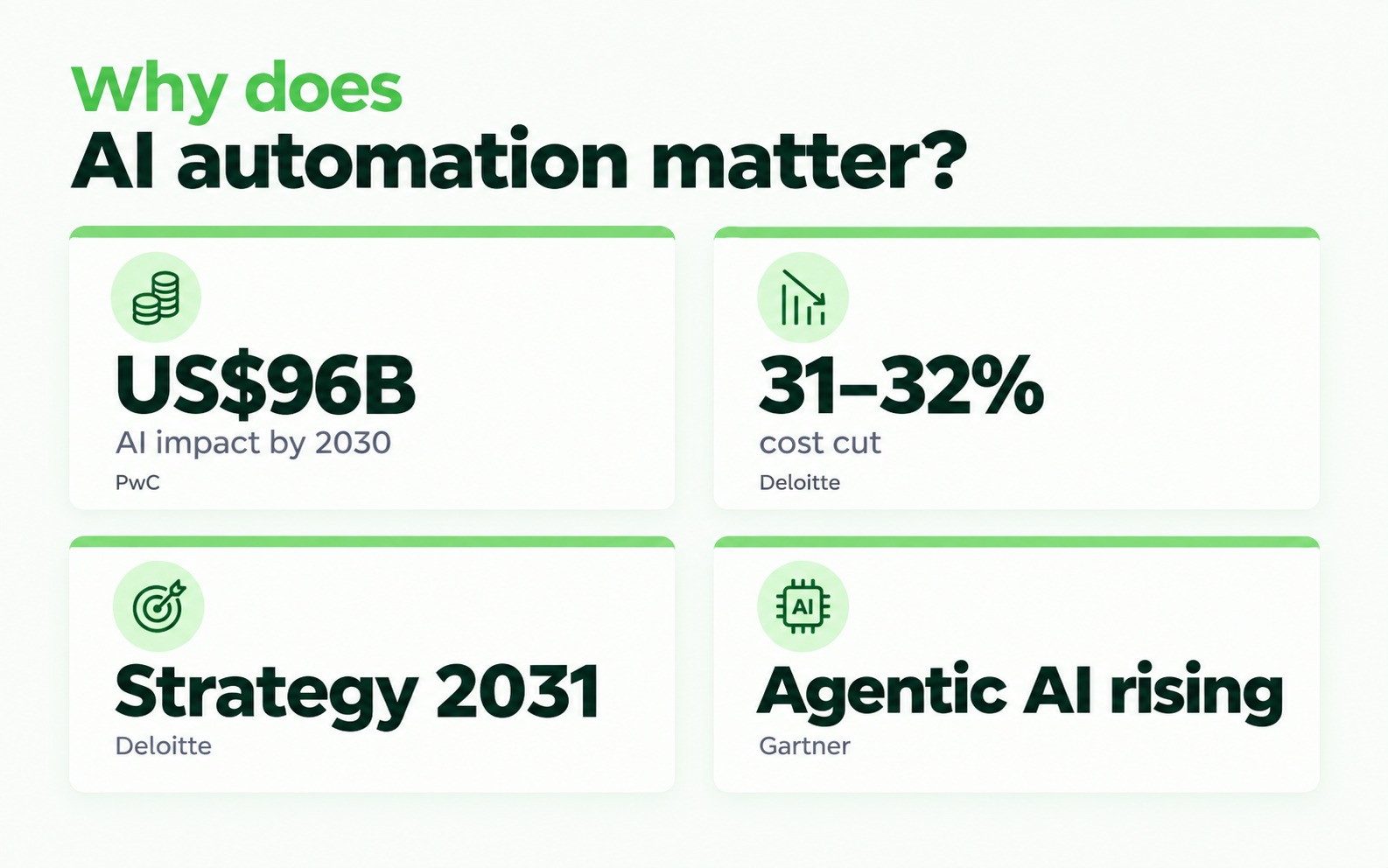
The returns are documented. A Deloitte global survey on intelligent automation found that organizations scaling automation expect a 31 percent average cost reduction, and firms already at scale reported 32 percent. Those gains come from fewer manual handoffs, faster cycle times, and lower error rates.
A balanced view helps your credibility with any board. Gartner predicts that more than 40 percent of agentic AI projects will be cancelled by the end of 2027, usually because of unclear value or weak data foundations. Adoption without a plan tends to stall.
What is pushing UAE demand
- National direction
The Strategy 2031 gives public and private leaders a shared reason to invest, which lifts vendor supply and buyer confidence together.
- Diversification
Sectors beyond oil, from tourism to real estate, want efficiency that scales without linear headcount growth.
- Talent economics
Automation lets lean teams cover more ground, which eases the pressure of a competitive hiring market.
- Bilingual service expectations
Customers and regulators expect Arabic and English support, and modern models can now handle both with quality.
Where the friction still sits
- Compliance load
Personal data falls under the UAE PDPL, and financial free zones add their own layers, so architecture choices carry legal weight.
- Legacy systems
Older ERP and core banking stacks resist quick integration, which extends timelines if a vendor lacks experience.
- ROI proof
Boards want measured results, and pilots without baselines struggle to defend their spend.
The table below sits under this discussion as a quick reference, not as the main point.
| Driver | Business effect | Supporting signal |
| Strategy 2031 | Higher investment appetite | Government-backed roadmap |
| Cost pressure | Push for efficiency | Deloitte 31–32% cost cut |
| Talent scarcity | Lean team coverage | Competitive UAE hiring |
| Compliance | Careful architecture | UAE PDPL, DIFC, ADGM |
For teams that want a partner already fluent in these constraints, our work on enterprise AI systems built for UAE compliance covers the ground in detail.
RPA, AI process automation, or agentic AI: which one does your business actually need?
Picking the wrong category is the most common way UAE buyers overspend on automation. This section helps you match your process to the right approach before you request a quote.
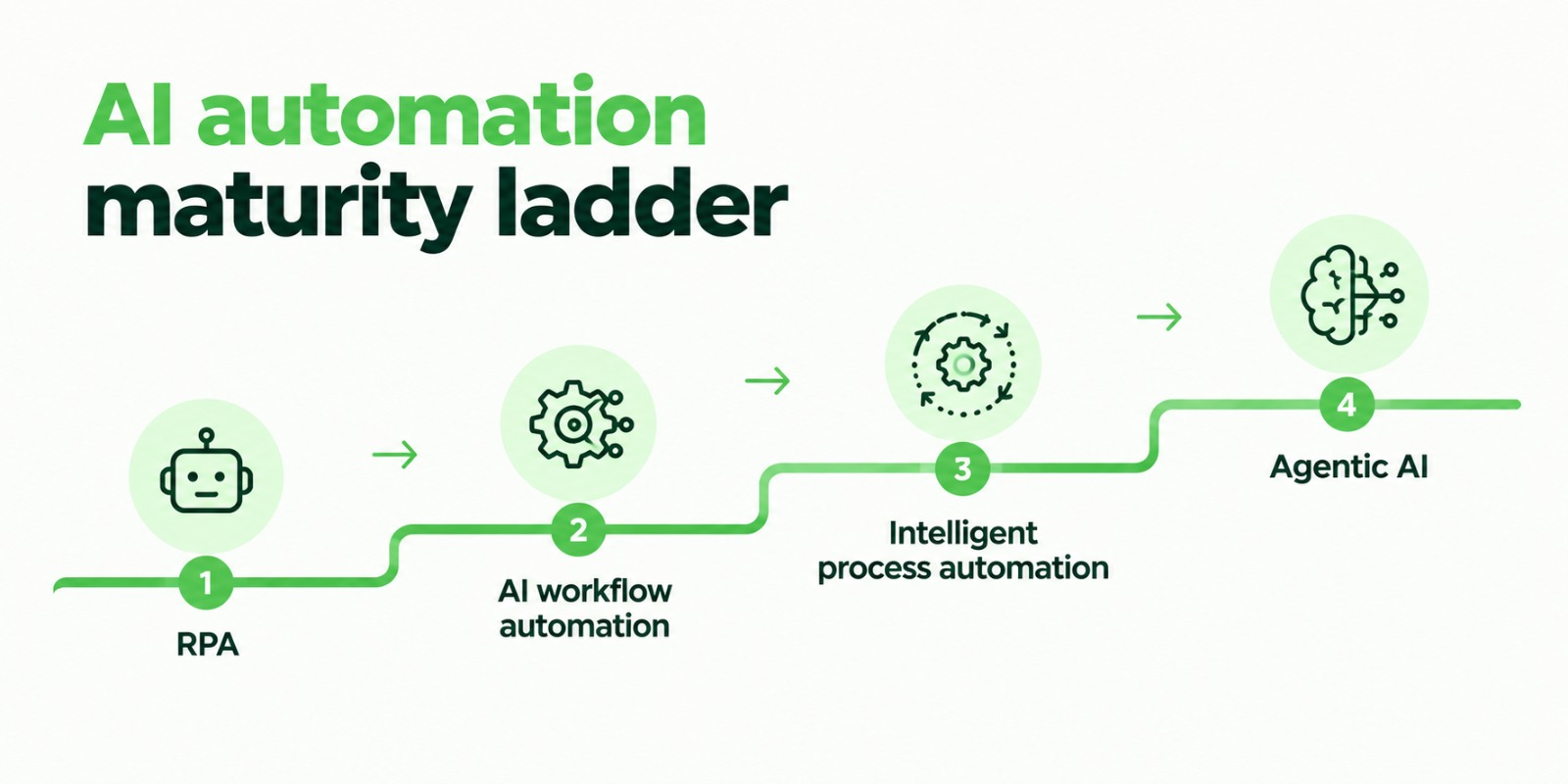
Robotic Process Automation
Robotic Process Automation runs software bots that follow fixed rules. It copies data between systems, fills forms, and reconciles records. The work has to be structured and predictable. When a screen or field changes, the bot needs an update.
AI workflow automation
AI workflow automation orchestrates several steps across systems, with logic that adapts to inputs. It routes a request, checks a condition, and triggers the next action. Machine learning handles the parts that pure rules cannot.
AI business process automation
AI business process automation applies the same idea to an end-to-end process, such as procure-to-pay. It ties together people, systems, and decisions, and it reports on outcomes. Scope is the difference from a single workflow.
Intelligent process automation
Intelligent process automation blends RPA with machine learning and document intelligence. It reads invoices, extracts fields, and learns from corrections. Unstructured input stops being a blocker.
Agentic AI
Agentic AI gives a model a goal, a set of tools, and permission to plan its own steps. The agent decides the sequence, calls the tools, and checks its own progress. Human review points keep it safe.
| Type | Core ability | Best-fit task | Human oversight |
| RPA | Rule-based bots | High-volume, structured | Low |
| AI workflow automation | Adaptive routing | Multi-step processes | Medium |
| Intelligent process automation | ML plus document reading | Unstructured input | Medium |
| Agentic AI | Goal-driven planning | Open-ended tasks | High |
If your roadmap points toward autonomous systems, our explainer on how agentic systems are changing UAE operations goes deeper into guardrails and governance.
Which industries in Dubai benefit most from AI automation?
Automation pays back fastest where work is high in volume, heavy with documents, and bound by rules. Most of Dubai’s core sectors fit that description, which is why adoption looks broad rather than niche. Each industry below has its own pain, its own use case, and its own measure of success.
Banking and financial services
UAE banks and fintechs carry a heavy compliance load. Know-your-customer checks, anti-money-laundering reviews, and transaction monitoring absorb large analyst teams. Automation reads documents, flags anomalies, and prepares case files, so analysts spend their hours on judgment rather than data entry. Faster onboarding also improves the customer’s first impression, which affects retention. Teams building in this space can start with our view of automation for UAE fintech operations.
Healthcare and insurance
Hospitals, clinics, and insurers move through mountains of paperwork. Claims processing, prior authorization, and patient records sit in manual queues that slow care and payment. Intelligent document processing lifts data from forms, matches it against policy rules, and routes exceptions to staff. The result shows up as shorter claims cycles and fewer coding errors. Our work on AI tools for UAE healthcare teams reflects the sector’s compliance sensitivity.
Logistics and supply chain
Dubai sits at a global trade crossroads, and freight volumes strain manual coordination. Dispatch, route planning, and proof-of-delivery break down when demand spikes. AI workflow automation matches loads to drivers, predicts delays, and updates customers without a human in the loop for routine cases. We saw this firsthand on Trukker, where AI-driven freight matching supported more than 12,000 drivers. Fleet operators can explore logistics platforms built for UAE fleets.
Real estate and PropTech
Property transactions in the UAE carry layered approvals. Offer management, RERA validation, and tenant onboarding stretch across days when handled by hand. Automation compresses those steps, checks documents against regulator rules, and moves a deal forward while staff focus on clients. One platform we built, Glyphora, cut offer management time by around 65 percent. The broader shift appears in our guide on how AI is reshaping Dubai real estate.
Retail and e-commerce
Online retailers face demand that swings hard with seasons and campaigns. Catalog updates, order management, and support tickets pile up during peaks. AI marketing automation personalizes offers, segments audiences, and adjusts spend, while service bots absorb routine queries around the clock. Merchants keep margins intact without hiring for a two-week surge. Our approach to automation for UAE e-commerce covers both the storefront and the back office.
Government and public sector
Public bodies handle permits, records, and citizen requests at national scale. The Strategy 2031 push makes this the fastest-growing pool of automation demand. AI business process automation clears backlogs, standardizes responses, and keeps an audit trail that regulators can inspect. Trust and transparency matter as much as speed here.
Hospitality and tourism
Hotels and tour operators run on bookings, guest messages, and reviews that never stop. Bilingual AI assistants answer in Arabic and English, confirm reservations, and escalate the rare complex case. Staff then spend their energy on the in-person experience that guests remember.
Manufacturing and industrial
AI in industrial automation reaches the factory floor. Predictive maintenance reads sensor data and flags a failing part before it stops a line. Quality inspection uses computer vision to catch defects a tired eye would miss. Production scheduling adapts to supply changes without a manual replan.
| Industry | Primary use case | Typical outcome |
| Banking and finance | KYC and AML review | Faster onboarding, fewer errors |
| Healthcare and insurance | Claims and records | Shorter claims cycles |
| Logistics | Dispatch and tracking | Higher fleet utilization |
| Real estate | Offer and approval flow | Deals closed sooner |
| Retail and e-commerce | Support and campaigns | Peak demand absorbed |
| Government | Permits and records | Cleared backlogs |
| Hospitality | Guest messaging | Round-the-clock service |
| Manufacturing | Predictive maintenance | Less unplanned downtime |
What does AI automation mean for the future of work in the UAE?
Automation is reshaping UAE jobs by removing repetitive tasks, while leaving judgment with people. Roles are shifting toward oversight, exception handling, and higher-value decisions.
The pattern favors augmentation. Agentic systems still need humans to set goals, review edge cases, and own the outcome. Gartner and Deloitte both point to a near future where a share of routine decisions runs autonomously, with staff supervising the exceptions.
New job categories are already forming. Automation quality reviewers, workflow designers, and AI operations specialists now appear in UAE job posts that did not exist three years ago. The Strategy 2031 talent objective supports this shift through reskilling and research programs.
A candid observation from our own projects: the roles most exposed to automation are usually the ones easiest to redesign around it. A claims clerk who understands the process becomes a strong exception handler once the routine work moves to a model.
What leaders should plan for
- Redeployment over reduction: Freeing hours works best when those hours move to revenue or service, which protects morale and institutional knowledge.
- Skills investment: Short, practical training on prompts, review, and tooling lifts a team faster than a single new hire.
- Change management: Adoption succeeds when staff trusts the system, so early involvement beats a top-down rollout.
How did we choose the top 10 AI automation companies in Dubai?
Most rankings you find are written by a vendor that places itself at number one with numbers no one can check. We authored this list too, so we disclose that openly and score against evidence you can request. Our weighting favors delivery reality over marketing polish.
Our criteria
- UAE and GCC delivery presence
A local team, a real office, and on-ground support carry more weight than a registered address.
- Automation depth
Range across RPA, workflow orchestration, and agentic AI signals genuine capability, not a single trick.
- Track record
Case studies, named clients, and measurable outcomes show the work is real.
- Compliance readiness
PDPL alignment, DIFC and ADGM familiarity, and data residency options matter for regulated sectors.
- Technology and partnerships
A credible stack and recognized partners reduce delivery risk.
- Client feedback
Verified Clutch and Google reviews add an independent check.
- Pricing transparency
Clear AED bands help buyers plan without a guessing game.
| Criterion | Weight |
| UAE delivery presence | 20% |
| Automation depth | 20% |
| Track record | 20% |
| Compliance readiness | 15% |
| Technology and partnerships | 10% |
| Client feedback | 10% |
| Pricing transparency | 5% |
This ranking is research-based and illustrative. Evaluate any shortlist against your own scope, sector, and risk profile.
Top 10 AI automation companies in Dubai, UAE
Below is our ranked view; each profile follows the same shape, so you can compare without hunting for the detail you need.
1. Code Brew Labs
Best for: enterprise-scale AI automation with genuine Dubai delivery.
Founded in 2013, Code Brew Labs runs its headquarters from Dubai World Trade Centre Tower on Sheikh Zayed Road, with support hubs in India, the UK, the USA, and Mexico. The team covers generative AI, Robotic Process Automation, AI assistants, predictive modeling, and CRM and ERP automation. Its engineers work across PyTorch, TensorFlow, the GPT family, Claude, and LLaMA, along with computer vision and OCR.
The proof shows up in shipped work rather than slogans. On Trukker, AI freight matching supported more than 12,000 drivers. Kaizan AI turned conversational data into reports around 70 percent faster. Setco’s order-to-cash automation cut processing time by a similar margin. DuPay, a regulated UAE wallet, passed a million downloads. The firm holds a Clutch rating of 4.4 out of 5 across 64 reviews.
2. Dubai App Developer
Best for: SME app-led automation.
Dubai App Developer presents as a local agency focused on AI-powered apps, custom software, and integration work. The team builds sector apps with AI features such as coaching, tracking, and wearable data. Small and mid-sized businesses form the core client base.
3. Royo Apps
Best for: automation-ready marketplace platforms.
Reported as founded in 2015, Royo Apps serves the USA, UK, Dubai, and Canada. Its work spans AI-enabled marketplaces, customer-interaction automation, and business intelligence. Dubai appears as a served market rather than a confirmed headquarters. Growth-stage businesses that want intelligent platforms fit its profile.
4. Blocktech Brew
Best for: blockchain paired with AI automation.
Blocktech Brew keeps a Dubai office at Dubai World Trade Centre Tower, alongside US and UK locations. Blockchain leads its portfolio, and an AI arm adds custom models, NLP, computer vision, and task automation. Gaming, fintech, and healthcare appear among its sectors.
5. Zone3000
Best for: AI transformation for non-tech enterprises.
Founded in 1998 and based in Ukraine, Zone3000 serves clients across the Middle East, including the UAE. The team works in generative AI, machine learning, predictive analytics, and big data. It is best known as the long-term engineering partner behind Namecheap.
6. Aegeantic
Best for: agentic automation on Salesforce and commerce stacks.
Aegeantic, founded in 2015, runs offices in Izmir and Dubai. Its model embeds specialized AI agents into a client’s own infrastructure for triage, reporting, and scheduling. The stack includes Salesforce, MuleSoft, OpenAI, Claude, and LangChain. Luxury, retail, and healthcare clients appear on its site.
7. Try No Code
Best for: no-code and low-code automation and startup MVPs.
Try No Code, founded in 2007, keeps a UAE office in Dubai Silicon Oasis, with further locations in the UK, India, USA, and Armenia. The team builds low-code and no-code applications and workflow automations on Bubble and FlutterFlow, where it holds official partner status. Its strength sits in fast builds for startups, so it is a low-code option rather than an enterprise RPA house.
8. Interexy
Best for: healthcare and fintech AI and ML builds.
Interexy, founded in 2017, runs its headquarters in Miami with a Dubai office among its locations. Its practice covers custom software, AI and machine learning, and blockchain. Healthcare and fintech clients feature in its portfolio.
9. FiveRivers Technologies
Best for: deep-tech automation and autonomy.
FiveRivers Technologies, founded in 2003, grew from Lahore and keeps a Dubai office in the Burj Khalifa district. The team reaches into AI, autonomy, robotics, IoT, generative AI, and data science. Named clients include Samsung and SparkCognition. Its base sits outside the UAE, so confirm which team would deliver your project.
10. Toadster Technologies
Best for: early-stage agentic AI and data platforms.
Toadster Technologies, incorporated in August 2024 in India and now holds a DIFC office in Dubai. Its focus covers production AI agents, LLM applications, and data platforms. The company is young, so its client-count and award claims are vendor-stated and worth verifying. Startups and mid-market teams form its target base.
AI automation companies in Dubai compared
The table below gathers the ranking into one view. It is a shortlist starter, then verify delivery and compliance in a direct conversation.
| Company | Dubai presence | Best for | Core focus | Indicative pricing (AED) |
| Code Brew Labs | HQ in Dubai | Enterprise automation | RPA to agentic AI | 55K–1M+ |
| Dubai App Developer | Local agency | SME apps | AI apps | On request |
| Royo Apps | Served market | Marketplaces | AI platforms | On request |
| Blocktech Brew | Dubai office | Blockchain plus AI | AI and Web3 | On request |
| Zone3000 | Regional service | Non-tech AI shift | GenAI, ML | On request |
| Aegeantic | Dubai office | Salesforce agents | Agentic AI | On request |
| Try No Code | Dubai Silicon Oasis | Low-code MVPs | No-code builds | From ~35K |
| Interexy | Dubai office | Health and fintech | AI and ML | 22K–370K |
| FiveRivers | Dubai office | Deep tech | AI, robotics | On request |
| Toadster | DIFC office | Early agentic AI | AI agents | On request |
How much does AI automation cost in Dubai?
Cost depends on scope, data readiness, and integration depth, so a single number would mislead you. The figures here reflect ranges quoted by UAE development agencies, including our own, and serve as planning guides rather than fixed quotes. Treat them as indicative and expect a scoped estimate to differ.
A simple FAQ chatbot sits at the low end. A regulated, multi-agent system with strict compliance sits at the top. Between those poles, most projects land in a predictable band once the scope is clear.
| Use case | Indicative build (AED) | What drives the range |
| FAQ or rules chatbot | 12,000–35,000 | Volume of intents |
| GenAI or RAG assistant | 50,000–350,000 | Data size and grounding |
| Single-task AI agent | 55,000–150,000 | Tool count, guardrails |
| Multi-step or multi-agent | 150,000–1.5M+ | Orchestration, compliance |
| RPA for a high-volume process | 450,000–750,000 | Systems touched |
| Enterprise automation program | 1M+ | Scale and integration |
Two points protect your budget. Running costs add roughly 25 to 40 percent of the build each year, covering hosting, monitoring, and retraining. On payback, keep expectations honest: vendor case studies claim three to twelve months, while Deloitte’s cross-industry data puts the average nearer 16 to 22 months for pilots. Scale, not the pilot, is where the strong numbers appear.
For a deeper breakdown, our analysis of what AI agent projects cost across the UAE walks through each tier.
Should you build, buy, or hire an agency for AI automation?
Three routes exist, and each suits a different situation. The wrong choice wastes budget and calendar, so the decision deserves a real conversation with your stakeholders.
Building in-house gives you full control and keeps knowledge inside the company. It demands scarce AI talent and a longer runway, which few UAE mid-market teams have spare. Buying a platform moves fast and costs less upfront, though you inherit someone else’s roadmap and limits. Hiring an agency brings delivery experience and local compliance know-how, with the tradeoff of choosing a partner you can trust.
Most mid-market UAE firms we meet start with an agency-led pilot, then decide what to keep in-house once the value is clear. That sequence limits risk while the team learns.
| Route | Control | Speed | Best-fit case |
| Build in-house | High | Slow | Deep AI team already exists |
| Buy a platform | Low | Fast | Standard, common workflow |
| Hire an agency | Medium | Medium | Custom needs, local compliance |
Teams weighing a custom route can review our approach to custom software built for Dubai enterprises.
How do you choose the right AI automation partner in Dubai?
A strong partner lowers your risk, while a weak one hides it until go-live. The framework below gives you a repeatable way to judge vendors on substance rather than salesmanship. Work through each stage before money changes hands, and keep notes you can compare across bidders.
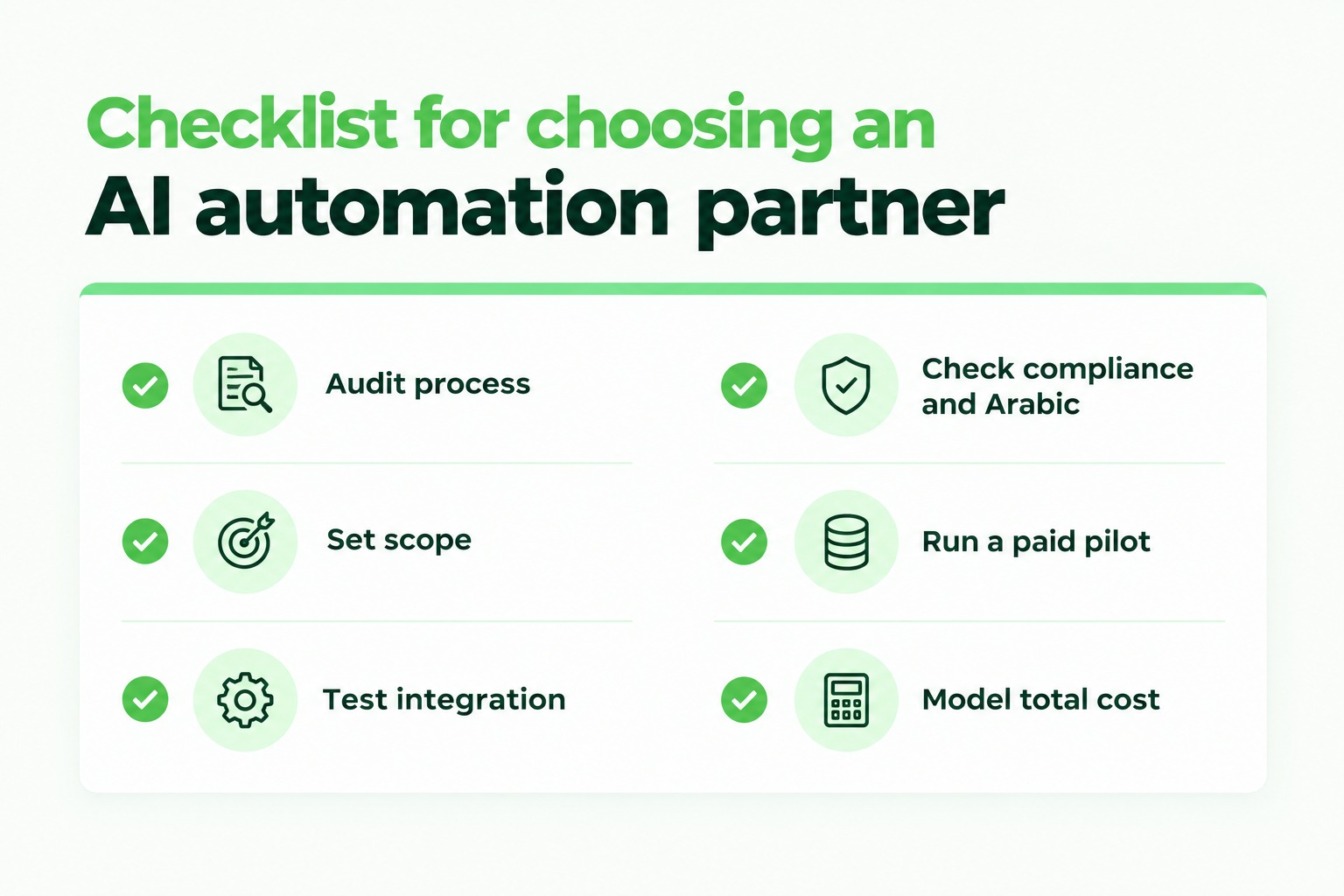
A practical selection sequence
-
Audit your processes first
Map where hours drain away, since the workflow that wastes the most time is where automation earns its keep. A short internal review beats a vague brief that invites padded quotes.
-
Set a clear scope
Agree whether you want a single quick win or a phased transformation, because those two goals attract different partners and price tags. Ambiguity here is the root of most overspend.
-
Test integration fit
Ask how each vendor connects to your CRM, ERP, and core systems, and request a comparable example. A partner who has touched your stack before saves weeks of discovery.
-
Probe compliance and language
Confirm PDPL handling, data residency options, and genuine Arabic support, tested rather than promised. Regulated sectors cannot treat this as an afterthought.
-
Insist on a paid pilot
A small, funded trial reveals delivery quality that no slide deck can fake. How a vendor handles the pilot predicts how they handle the rollout.
-
Model the full cost
Add build, run, and change costs together, and question any lock-in that would trap you with one supplier. A low build price with a heavy annual tail rarely wins over time.
Questions worth asking before you sign
-
Who owns the code and the data?
Confirm that intellectual property and trained models stay with you, so a future switch stays possible.
-
What happens when a model gets it wrong?
A serious partner has fallback paths, human review, and error handling ready to describe.
-
How will success be measured?
Agree the metrics upfront, whether that is hours saved, cycle time, or error rate against a baseline.
-
Who supports it after launch?
Clarify response times, monitoring, and retraining, since an unwatched system drifts within months.
Timelines and success metrics to agree upfront
A scoped pilot often ships in four to eight weeks, while an enterprise rollout runs three to nine months. Setting a baseline before the build lets you prove the gain afterward. Track cost per transaction, cycle time, accuracy, and staff hours redeployed. Numbers agreed in the contract protect both sides when the board asks for results.
Our checklist for vetting AI partners in Dubai expands each of these points with sample scripts you can reuse.
Get a costed roadmap that maps AI automation to your P&L before you commit a single dirham.
What mistakes do UAE businesses make when adopting AI automation?
Failed automation rarely fails for exotic reasons. The same avoidable mistakes show up across sectors, and each one has a simple counter. Reading them early saves a painful quarter later.
The mistakes that cost the most
-
Automating a broken process
Speeding up a flawed workflow multiplies the flaw, so fix the process before you wire it up.
-
Ignoring data cleanup
Messy inputs produce unreliable outputs, and no model rescues bad source data.
-
Chasing tools over outcomes
A shiny platform means little without a target metric it has to move.
-
Treating compliance as an afterthought
PDPL and free-zone rules shape the architecture, so they belong in the first design session.
-
Skipping change management
Staff who distrust the system route around it, which quietly kills adoption.
-
Buying logos over engineers
A vendor’s client list matters less than the team who will build your solution.
-
Launching without a pilot
A scoped trial reveals the edge cases that a full rollout would expose in public.
-
Forgetting run costs
Budgets that cover the build but not the yearly upkeep stall within a year.
A blunt truth from our own delivery experience: the projects that struggle usually skipped the process audit to save time. That shortcut costs more than it saves.
How do UAE data laws and sovereign AI shape your automation choices?
Data rules shape every serious automation project in the Emirates. The UAE Personal Data Protection Law, Federal Decree-Law No. 45 of 2021, governs how personal data is collected, stored, and processed across the country. Financial free zones sit outside parts of that federal framework and run their own regimes.
DIFC and ADGM each maintain distinct data protection regulations, closer in style to European standards. A bank inside DIFC and a retailer on the mainland face different obligations, so the same automation may need different hosting. Getting this wrong invites fines and rework.
Sovereign AI matters most where sensitivity runs highest. Government bodies, banks, and healthcare providers often require data to stay within national borders, pointing to in-country hosting or self-hosted models. A private deployment costs more, though it removes a class of compliance worry.
What to settle before you build
- Data residency: Decide where data must physically live, since that choice drives your cloud and model options.
- Hosting model: Weigh managed cloud against self-hosted infrastructure based on sensitivity and budget.
- Access and audit: Confirm who can see what, and make sure the system logs every access for inspection.
Data residency has become a procurement gate in regulated UAE tenders. Vendors who cannot answer it clearly rarely make the shortlist.
Can AI automation work in Arabic for UAE operations?
Arabic capability separates UAE-ready vendors from imports that bolt it on late. Modern models handle Arabic and English well, though quality varies by dialect and use case. Testing both languages during the build is the only reliable check.
Right-to-left interfaces need real design attention, since a layout built for English breaks when the script flips. Customer-facing bots must read Gulf Arabic naturally, not textbook phrasing that feels stiff to local users. Compliance documents often have to exist in Arabic, which raises the bar for document processing.
Where language quality shows up
- Support automation: Guests and customers judge a bot in seconds, so natural Arabic protects the brand.
- Document intelligence: Arabic invoices and forms demand OCR and extraction tuned for the script.
- Regulatory output: Reports and records may need Arabic versions that hold up to official review.
A partner who treats Arabic as a first-class requirement, tested from day one, will serve UAE operations far better than one who adds it at the end.
Why choose Code Brew Labs for AI automation in the UAE?
Choosing a partner comes down to delivery you can verify and support you can reach. Code Brew Labs pairs a Dubai base with a decade of shipped AI work, which gives UAE leaders a rare combination of local presence and enterprise scale. The reasons below explain where that shows up in practice.
Dubai-based delivery
Our team works from Dubai, so support runs in your time zone and your languages. Local presence turns a vendor relationship into a working partnership. Meetings happen in person when they need to.
Range from RPA to Agentic AI
Few partners cover the whole automation curve under one roof. We build rules-based bots, orchestrated workflows, and goal-driven agents, so your roadmap does not force a change of vendor. One team carries the context as your needs grow.
Compliance built into the architecture
PDPL alignment and data residency shape our designs from the first session. Regulated clients in finance and healthcare rely on that discipline. Compliance stops being a late scramble.
A verified track record
Independent portfolio matters more than self-praise. Our Clutch profile holds 4.4 out of 5 across 64 reviews, and our shipped work speaks for itself.
Named proof across sectors
- Trukker: AI freight matching supported over 12,000 drivers in a demanding logistics setting.
- Setco: Order-to-cash automation cut processing time by around 70 percent.
- Glyphora: Offer management in UAE real estate sped up by roughly 65 percent.
- Kaizan AI: Conversational analytics turned data into reports about 70 percent faster.
- DuPay: A regulated UAE wallet passed one million downloads.
| What you get | Why it matters in the UAE |
| Dubai-based team | Local support, Arabic and English |
| RPA to agentic range | One partner across the maturity curve |
| PDPL-aware design | Compliance from day one |
| Verified reviews | 4.4 on Clutch across 64 |
| Cross-sector proof | Finance, logistics, healthcare, real estate |
Our full capability sits on the custom AI systems built for Dubai enterprises; take a closer look.
Turn your highest-volume manual process into a working automation pilot in weeks.
What are the emerging AI automation trends in the UAE for 2026?
The direction of travel is clear, even if timelines vary. Agentic and multi-agent systems lead the shift, with Deloitte predicting that half of firms using generative AI will run agentic pilots by 2027. Autonomy with human oversight is becoming the default design.
Low-code paired with AI is widening access, so business teams can shape automations without a full engineering cycle. Sector-specific tools are maturing in real estate, banking, and logistics, which raises the baseline for everyone. Sovereign AI and data residency keep gaining weight as regulators tighten expectations.
Arabic and right-to-left capability are improving in step, which removes a long-standing barrier for local operations. Upskilling programs under Strategy 2031 are feeding a talent pipeline that the whole market needs.
The bottom line on AI automation in Dubai
The winners in this market pick partners on delivery reality, compliance, and evidence they can check. A polished pitch counts for little without a shipped case study behind it. Dubai has no shortage of vendors, so the advantage goes to buyers who ask sharper questions.
Start with a process audit. Find the workflow that wastes the most hours, then test one partner against a scoped, funded pilot. That single step tells you more than months of vendor calls.
Frequently asked questions
What is the difference between RPA and AI automation?
RPA runs rule-based bots on repetitive, structured tasks. AI automation adds machine learning, so the system handles judgment, unstructured data, and decisions. Most UAE enterprises now combine both for the best coverage.
How much does AI automation cost in Dubai?
Builds run from around AED 55,000 for a single agent to beyond AED 1 million for enterprise programs. A generative AI assistant often sits between AED 50,000 and AED 350,000. Yearly running costs add roughly 25 to 40 percent.
Which UAE industries benefit most from AI automation?
Finance, logistics, healthcare, real estate, and government see the strongest gains. High-volume, document-heavy work automates fastest. Retail and hospitality follow close behind.
How long does AI automation take to implement?
A focused pilot often ships in four to eight weeks. Enterprise rollouts run three to nine months. Full payback tends to arrive later, so a phased plan works best.
What compliance rules apply in the UAE?
The UAE Personal Data Protection Law governs personal data across the country. Financial free zones such as DIFC and ADGM add their own regimes. Settle data residency early in the design.
Can SMEs in Dubai afford AI automation?
Yes. Scoped chatbots and single-process automations start near AED 12,000 to 55,000. Most small firms begin with one high-volume workflow, then expand once the value shows.
What is the role of the UAE AI Strategy 2031?
It sets national direction for AI adoption across government and priority sectors. The strategy lifts public-sector demand and encourages private investment.
How do you measure ROI on AI automation?
Track hours saved, error rates, cycle time, and cost per transaction against a pre-project baseline. Scaled programs report around 31 to 32 percent cost reduction, per Deloitte.
Let's Convert Your Business Idea Into Success!
Free Consultation from Top Industry Experts
Let’s Build Your Dream App!
Share article on :



 No commitment required
 NDA on request
 24-hour response


