
Quick Summary:
- Verify live production deployments, because fewer than 20 of Dubai's 800-plus AI firms actually ship.
- Confirm PDPL and DIFC Regulation 10 compliance before any customer data leaves your systems.
- Ask for data-residency terms, since UAE health and finance records often stay in-country.
- Budget beyond the quote for data prep, retraining, monitoring, and integration overruns.
- Own your source code and trained model weights inside the signed contract.
- Check ISO 27001, SOC 2, CMMI Level 3, and cloud partner tiers before shortlisting.
- Test dialectal Arabic handling, as generic right-to-left support is not real Arabic NLP.
- Link every payment to a delivery milestone with a measurable acceptance gate.
- Expect payback within 12 months, and treat vague scoping as the top failure signal.
Choose an AI app development company in Dubai by scoring it against due-diligence criteria first, since more than 80% of AI projects fail.
That figure comes from RAND, whose 2024 study put the failure rate at roughly twice that of ordinary IT work (RAND, 2024). For a CTO signing off on budget and board reporting, the number reframes the whole exercise.
Dubai now hosts more than 800 AI companies (Dubai Media Office, 2024). Impressive on paper. Dig into deployment records, though, and the field thins fast. Independent audits suggest a small fraction run anything in production with real users behind it.
So the hard part is not finding a vendor. Filtering 800 down to the two or three who can actually build and deploy, stay compliant, and survive a technical audit: that is the job. This checklist is how a CTO must run that filter before a single dirham moves.
Want to shortlist the right AI app development company before you spend a dirham?
What does an AI app development company actually do, and how is it different from an AI development company?
An AI app development company builds user-facing applications with machine intelligence baked into the product, then ships and maintains them in production. The work spans data pipelines, model integration, mobile and web engineering, and the compliance layer around all of it.
That definition sounds simple until you compare the adjacent categories buyers confuse. The labels overlap in marketing copy and diverge sharply in what you actually receive.
| Category | What it delivers | Best fit for a CTO |
| AI app development company | End-to-end AI product: app, model, data, deployment | A customer-facing app with AI inside |
| AI development company | Models, research, ML engineering, often no app layer | Custom models, R&D, data science |
| AI software development company | Broader software builds with AI modules | Internal platforms, enterprise tools |
| AI chatbot development company | Conversational interfaces and voice agents | Support automation, virtual assistants |
Picking the wrong category wastes months. A team that only trains models will hand you weights and a notebook, not an app your users can open. Working with an experienced AI development company in Dubai matters when the model is the product; a full app build needs broader muscle.
Conversational needs point elsewhere again. Support deflection, Arabic voice assistants, and lead-qualification bots sit with a specialist AI chatbot development company in Dubai, while autonomous task execution suits an AI agent development company.
Where “app” changes the requirements
Adding “app” to the brief changes the engineering. On-device inference has to run inside a phone’s memory budget. Latency targets tighten when a user is staring at a loading spinner. App-store review, offline modes, and push infrastructure all enter scope. Teams focused on AI-powered mobile app development in the UAE plan for these from day one.
For enterprise-scale programs that touch core systems, we cover architecture and vendor ranking separately in our guide to AI enterprise app development companies in Dubai.
The CTO’s 12-Point Checklist for choosing an AI app development company in Dubai
Think of this as capability due diligence, scored. Rate each point out of ten, weight the compliance items as pass-or-fail gates, and no vendor advances with a failed gate. Below, each criterion explains the mechanism and how you verify it in a room, not on a website.
1. Production-proof AI, not slideware
Ask for three systems running live with real users today. Request a screen-share of the running product, monthly active numbers, and the incident log. Demos prove a team can prototype. Uptime, error handling, and a two-year-old codebase prove they can operate. Our own portfolio shows the difference: Kaizan AI cut report generation time by 70% in production, not in a pitch.
2. Data and model-development depth
Probe how they build, not which model they name-drop. Good teams explain their retrieval pipeline, their fine-tuning approach, and how they evaluate outputs before release. Weak teams wrap a public API and call it proprietary. A simple test works well: ask how they measure accuracy on your data. Silence there is your answer.
3. PDPL and free-zone data compliance (pass/fail gate)
Any vendor handling UAE personal data must speak fluently about Federal Decree-Law 45 of 2021. Consent capture, breach notification, and lawful processing grounds should roll off without a script (u.ae). Free zones add a layer, because DIFC and ADGM run their own regimes. Fail this gate, and nothing else on the scorecard saves the deal.
4. Data residency and in-country hosting
Where does your data physically sit? For regulated sectors, the honest answer often has to be “inside the UAE.” Check that the vendor can deploy to a UAE cloud region and that residency survives into their sub-processors. Many teams host models in a US region by default. Discovering that after launch triggers an expensive migration.
5. Security controls and IP ownership
Two things belong in the contract before kickoff. First, security posture: encryption at rest and in transit, access controls, and a SOC 2 Type II report you can read. Second, ownership: source code, data, and trained model weights transfer to you. Vendors who keep the weights keep leverage, and your switching cost climbs every quarter.
6. Arabic and bilingual NLP capability
Right-to-left rendering is table stakes and gets confused with language capability. Real Arabic NLP handles Gulf dialect against Modern Standard Arabic, mixed-script input, and code-switching between Arabic and English. Ask for a benchmark on Khaleeji data, not a screenshot of translated buttons. Products serving UAE users live or die on this nuance.
7. Integration with your core systems
An AI app rarely lives alone. It talks to your ERP, your core banking stack, or your hospital’s records system. Ask which integrations the team has shipped, and how they handle rate limits, retries, and schema changes. Integration is where timelines quietly double, so past scars here are a good sign.
8. MLOps and the model lifecycle
Models drift as the world moves. A serious partner runs retraining pipelines, monitors output quality, and catches degradation before your users do. Question their observability stack and their rollback plan. Teams without MLOps ship a model once, then watch accuracy erode while nobody is looking.
9. Scalability and cost-at-scale
A pilot that serves 50 users can hide brutal economics at 50,000. Inference cost per request, caching strategy, and model-size choices decide whether your app stays profitable. Push the vendor to model your cost curve at projected volume. A partner who has scaled before will have the spreadsheet ready.
10. Delivery methodology and governance
How work gets run predicts whether it lands. Look for sprint cadence, documented acceptance criteria, and a defect-tracking discipline. Certified process maturity is a genuine signal here. MCP Nexus, built under CMMI Level 3 governance, delivered 40% fewer defects and 35% faster releases, and that came from process, not luck.
11. Post-launch support and SLAs
Launch is the midpoint, not the finish. Written response times, uptime commitments, and a named escalation path separate a partner from a project shop. Read the SLA before you sign, then check the penalty clauses. A vendor confident in their operations will put money behind the numbers.
12. Commercial model and exit terms
Healthy contracts assume things might not work out. Milestone-linked payments, IP escrow, and a clean transition clause protect you if the relationship sours. Fixed-scope pricing beats open-ended hours for budget certainty. Read section three of this guide’s negotiation notes before your legal team drafts anything.
Want your shortlist scored against all 12 of these checks?
Which UAE regulations must an AI app development company comply with in Dubai?
Compliance is where Dubai projects get expensive after the fact, so a CTO earns the most leverage by front-loading it. Three frameworks decide how your AI app handles data, and a vendor who cannot map them is a liability.
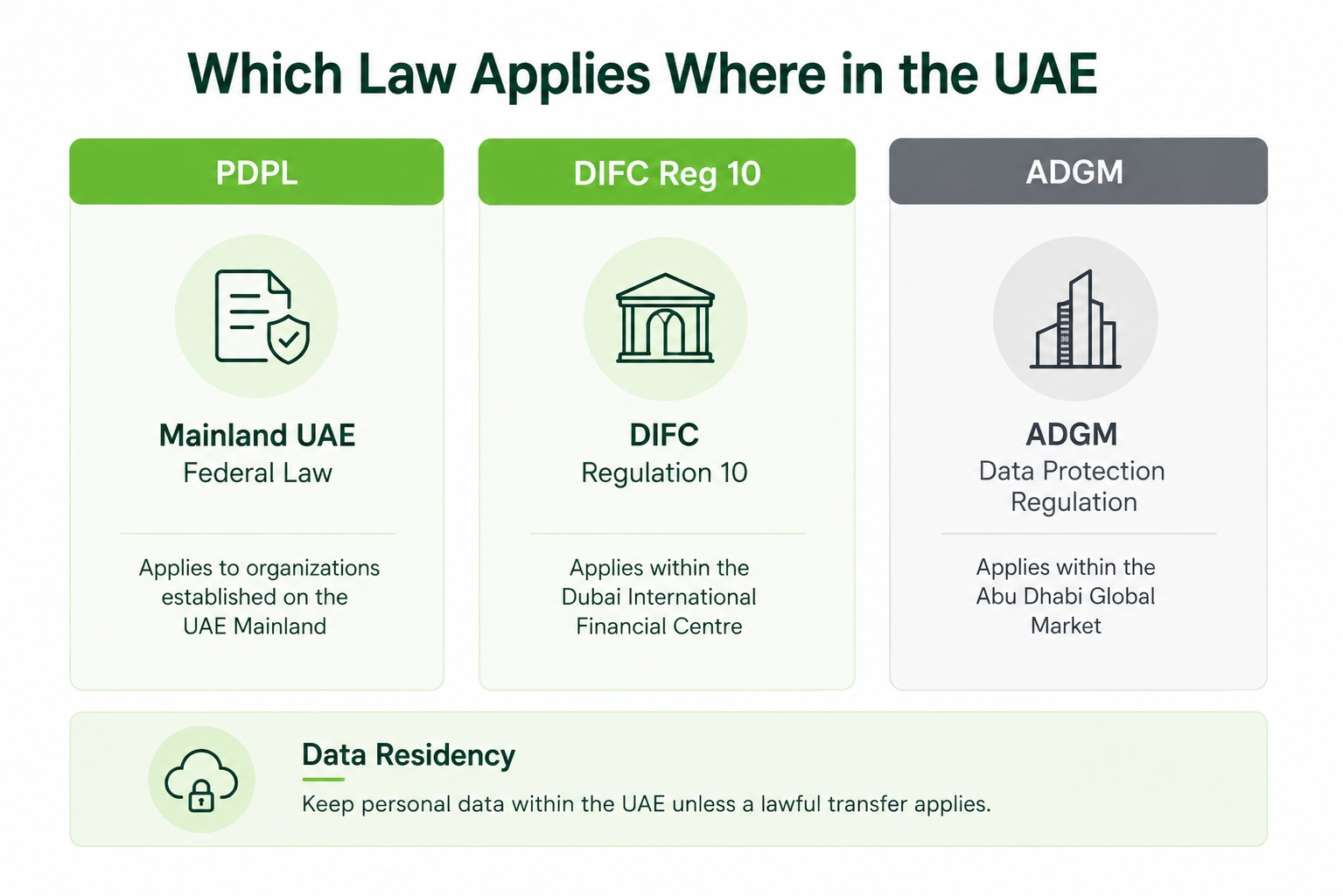
PDPL (Federal Decree-Law No. 45 of 2021)
The UAE’s federal data protection law took shape in 2021 and mirrors much of GDPR’s logic. Consent has to be specific and informed. Breaches carry notification duties. Individuals hold rights to access and erase their data (u.ae). One catch trips up newcomers: the financial free zones sit outside the federal PDPL and run separate law.
DIFC Data Protection Regulation 10
DIFC did something no other jurisdiction had done. Regulation 10, in force since September 2023, was written specifically for autonomous and semi-autonomous machines (DIFC). If your AI app makes or assists decisions about people, and it operates in or through DIFC, this regulation governs how. Vendors serving fintech clients should know it cold.
When is data residency legally required?
Not every workload has to stay in the UAE, and treating residency as universal wastes money. Health data under DHA and MOHAP oversight, plus financial data under CBUAE rules, carries the tightest localization expectations. General consumer apps often have more freedom. A capable partner tells you which bucket your data falls into before quoting a hosting plan.
The Dubai AI Seal and the Dubai Universal Blueprint for AI
Government direction signals which vendors take the ecosystem seriously. The Dubai Universal Blueprint for AI targets adding AED 100 billion to the emirate’s economy and appointed Chief AI Officers across 22 government entities (u.ae). Vendors engaged with these programs, including the Dubai AI Seal, tend to hold themselves to a higher compliance bar.
What AI app development capabilities must a Dubai company have in 2026?
The bar moved in the last two years, and 2026 rewards teams who kept pace. Older shops still treat AI as a bolt-on feature. Current-generation partners build the app around the intelligence. Below are the capabilities that separate the two, with a quick way to test for each.
Agentic architectures and the Model Context Protocol
Agentic systems chain several steps toward a goal instead of answering one prompt at a time. The Model Context Protocol lets an app call tools, pull context, and act across connected systems.
Ask a vendor for a shipped multi-step workflow. Royal Airline’s MCP-enabled travel assistant, built by our team, resolved requests 60% faster by chaining actions rather than waiting for a human at each stage.
Retrieval-augmented generation
RAG grounds model output in your own documents, which cuts hallucination on domain questions. The app retrieves relevant passages, then feeds them to the model as context before it answers. Probe how a team chunks, embeds, and ranks that retrieval. Vague answers here signal a wrapper around a public API, nothing more.
Multimodal input handling
Real products rarely deal in text alone. Multimodal handling brings image, voice, and document input into one flow, which matters for apps processing scans, calls, or forms. Ask for a live demo that crosses two modalities. A team that has only shipped text chat will struggle the moment a user uploads a photo.
On-device inference
Running a model on the device keeps sensitive data off the network and cuts latency. For health, finance, and personal-assistant apps, that privacy edge is often a requirement. Ingeni, a voice-powered elderly-care companion we built, handles core functions on-device, which suits users who cannot depend on a stable connection.
Vector databases
Embeddings need somewhere fast to live, and a vector database is that home. It powers semantic search, RAG retrieval, and recommendation features under the hood. Ask which database a vendor uses, from pgvector to Pinecone, and how it holds up at your query volume. The choice quietly shapes both speed and cost at scale.
Evaluation harnesses
Shipping a model without measuring it is a guess dressed as a decision. An evaluation harness runs automated tests on accuracy, relevance, and safety before each release. Request the metrics a team tracks on client data, and how those gates block a bad model from reaching users. Silence on evaluation is a red flag on its own.
Output guardrails
Guardrails filter unsafe responses, off-brand, or non-compliant before a user ever sees them. Regulated apps in Dubai cannot ship without them. Ask a shortlisted vendor to walk through their guardrail approach for a specific regulated use case. The depth of that answer tells you how seriously they take governance.
Workflow orchestration and automation
Most AI apps earn their keep by wiring intelligence into a business process. Orchestration connects the model to your systems, triggers, and human approvals in the right order. For workflow-heavy builds, an AI automation agency in Dubai brings the layer that makes these apps run end-to-end.
Which certifications should an AI app development company have?
Certifications are a shortcut for trust, and a CTO can verify them in an afternoon. They do not guarantee quality. They do prove that an independent auditor checked the vendor’s controls against a public standard.
The certifications that matter
- ISO 27001 covers information security management, and it is the baseline for handling client data.
- SOC 2 Type II reports on security controls over a period, not a single snapshot, so it is harder to fake.
- CMMI Level 3 signals process maturity in how software gets built and delivered.
- ISO 42001 is the newer AI-management standard, and early adopters take governance seriously.
- Cloud partner tiers from AWS, Microsoft Azure, or Google Cloud confirm real platform depth.
How to verify a certification is real
Logos on a website mean nothing until you check the source. Request the certificate number, the issuing body, and the audit date, then confirm the scope statement covers the work you are buying. ISO certificates carry a registry you can search. A vendor who hesitates to share the actual document is telling you something.
How much does it cost to hire an AI app development company in Dubai, and what are the hidden costs?
Pricing for app builds in Dubai spans a wide range. Our AI development cost guide explains the cost bands in more detail. What sinks budgets is rarely the quote. It is the line items nobody put in the proposal.
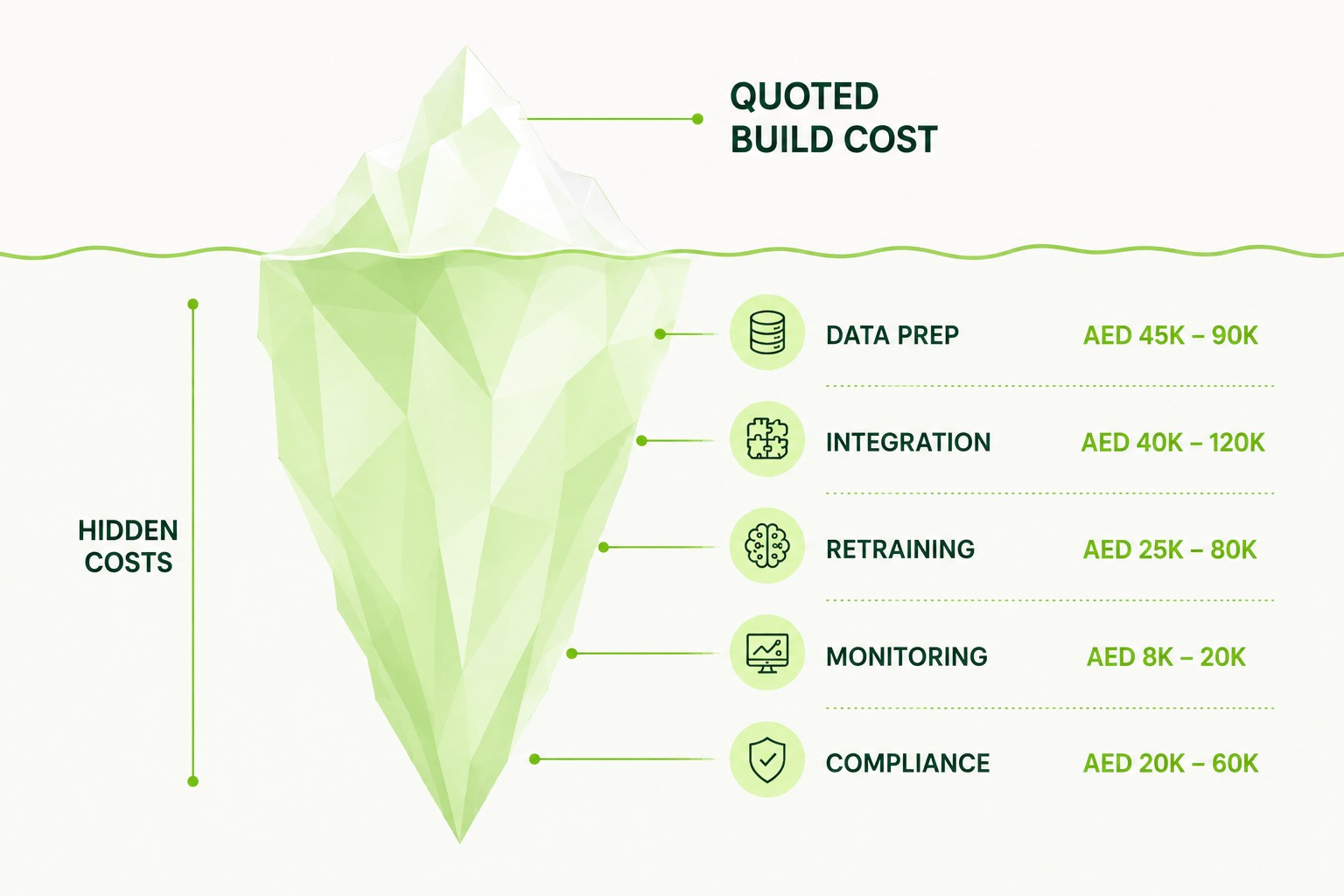
The costs quoted versus the costs incurred
A build estimate covers engineering. It usually skips the work that makes an AI app actually run in the UAE. Here is where the real money leaks:
| Hidden cost item | Estimated AED range |
| Data preparation and labeling | 45,000 – 90,000 |
| Arabic dialect data tuning | 30,000 – 70,000 |
| Third-party integrations (ERP, core banking, EHR) | 40,000 – 120,000 |
| Model retraining (per year) | 25,000 – 80,000 |
| Monitoring and observability tooling (per month) | 8,000 – 20,000 |
| PDPL / DIFC compliance audit and DPIA | 20,000 – 60,000 |
| Cloud inference at scale (per month) | 10,000 – 50,000 |
| Support and SLA retainer (per month) | 6,000 – 18,000 |
Total cost of ownership over three years
One number matters more than the build quote: what the app costs you across three years of operation. Run the sum before you compare vendors, since the cheapest build often carries the priciest run.
| TCO component | Illustrative AED |
| Year 0 build | 400,000 |
| Data prep and integrations | 150,000 |
| Year 1 run (hosting, monitoring, support) | 220,000 |
| Year 2 run plus retraining | 240,000 |
| Year 3 run plus scaling | 260,000 |
| Three-year TCO | ≈ AED 1,270,000 |
Figures above are illustrative ranges for a mid-size AI app, not a quote. Your numbers shift with data volume, integration count, and compliance scope.
AI app development ROI calculator: what should you spend versus get back?
Return decides whether the board renews the budget, so build the model before the build starts. A workable calculator needs three inputs and produces one honest answer.
Inputs: total build cost, annual run cost, and the operational value the app creates.
Output: months to payback. McKinsey’s 2025 research found that high-performing adopters report 5% or more EBIT impact, while most firms stall in pilots. The gap between those groups is scoping discipline.
A worked example in AED
Picture a support-automation app that deflects 40% of 10,000 monthly tickets. Each deflected ticket saves roughly AED 18 in agent handling time.
| Line | AED |
| Tickets deflected per month (4,000 × AED 18) | 72,000 |
| Annual operational value | 864,000 |
| Build cost | 500,000 |
| Year 1 run cost | 200,000 |
| First-year net value | 164,000 |
| Payback period | ≈ 10 months |
Two of our own builds show the pattern in production. Kaizan AI cut manual reporting effort by 25%, and Marketing Pro lifted ROI-tracking accuracy by 45%. Both paid back within a year because the use case was narrow and measurable.
How do you negotiate better terms with an AI app development company?
Negotiation is leverage applied before signatures, and CTOs leave most of it on the table. A few structural moves protect budget and quality at once:
- Payment tied to milestones beats a monthly retainer with no gates. Release funds when a demo passes written acceptance criteria, and hold a final tranche until post-launch stability.
- IP escrow keeps your source code recoverable if the vendor folds. A transition clause forces a clean handover of code, data, and model weights at any exit.
- Fixed-scope pricing gives budget certainty, though it needs a tight brief to work. Cap change-request rates in the contract so mid-project additions do not become an open tap.
- One clause saves more disputes than any other: a plain definition of “done” for each deliverable, agreed before work starts.
- Push for a paid proof-of-concept before the full commit, because a small bake-off reveals more than any sales deck.
Why do AI app development projects fail in Dubai, and how do you avoid it?
Failure has patterns, and most trace back to decisions made before a line of code. We covered why enterprise programs stall inside production environments in our enterprise AI guide; here the focus is on the vendor-selection choices that doom a build early.
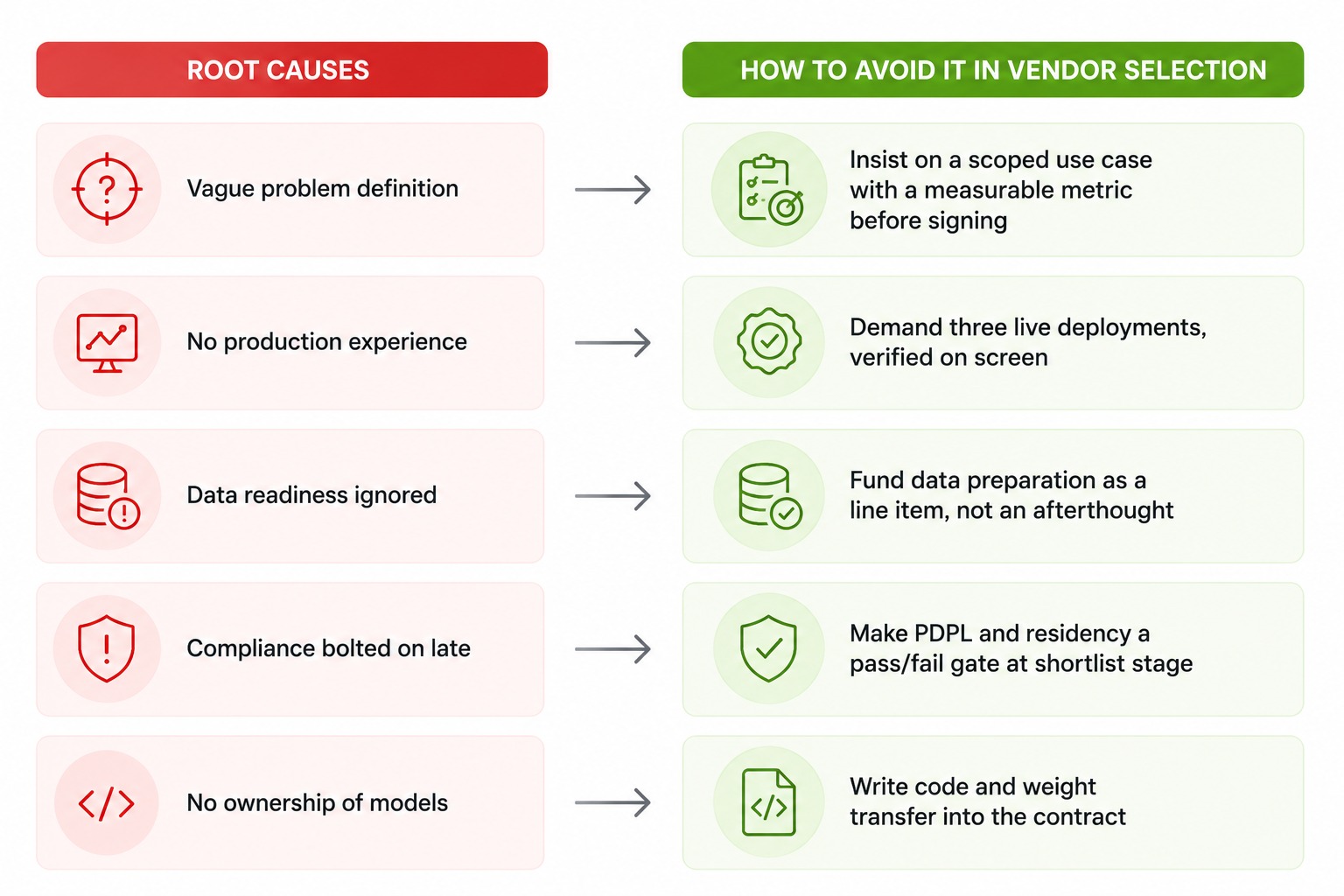
The scale of the problem is not anecdotal. RAND put AI project failure above 80% (RAND), and S&P Global found that 42% of firms abandoned most of their AI initiatives in 2025, up sharply from 17% a year earlier (S&P Global). Behind those numbers sit repeatable causes.
| Root cause | How to avoid it in vendor selection |
| Vague problem definition | Insist on a scoped use case with a measurable metric before signing |
| No production experience | Demand three live deployments, verified on screen |
| Data readiness ignored | Fund data preparation as a line item, not an afterthought |
| Compliance bolted on late | Make PDPL and residency a pass/fail gate at shortlist stage |
| No ownership of models | Write code and weight transfer into the contract |
Almost every failure is a scoping or diligence gap, and both are fixable at the selection stage for the price of asking harder questions.
Common mistakes enterprises make when choosing an AI app development company
Smart buyers still fall into the same traps, so a quick scan of them saves painful lessons. Each mistake below carries its one-line fix.
- Chasing the lowest bid. Cheap builds hide expensive runs, so compare three-year TCO instead.
- Buying the demo. Polished prototypes hide operational gaps, so ask for live production access.
- Skipping reference calls. Two honest client conversations reveal what no proposal will.
- Ignoring data ownership. Unclear IP terms lock you in, so settle ownership in writing first.
- No Arabic testing. Generic language support fails UAE users, so benchmark dialect handling early.
- Leaving out the exit plan. A build with no transition clause becomes a hostage situation later.
How to compare AI app development companies: A 3-round shortlisting process
Comparison works best as a process, not as a one-time spreadsheet skim. Three rounds narrow a long list to a confident pick, and each round eliminates weaker candidates on evidence.
Round 1: Desk screen
Start broad and cut fast. Filter your list against non-negotiables: production track record, PDPL fluency, and relevant industry work. A vendor missing any of the three drops here, which usually leaves five or six names from a starting twenty.
Round 2: Technical due diligence and reference calls
Now go deep on the survivors. Put each remaining vendor through a technical session on your actual use case, then call two of their past clients. Ask the clients one blunt question: what went wrong, and how did the team handle it? Their answer separates partners from order-takers.
Round 3: Paid proof-of-concept bake-off
Let the finalists prove it with their hands. Commission a small, paid POC from your top two on the same brief, and judge the output against agreed criteria. A short bake-off surfaces working style, communication, and real capability in ways no interview matches.
How do you track progress with an AI app development company after signing?
Governance after the contract decides whether the build stays on course. A CTO does not need daily involvement, though a light cadence catches drift before it compounds.
Set a rhythm of sprint demos every two weeks, each showing working software against the sprint’s acceptance criteria. Watch model-specific metrics that generic project tracking misses: accuracy on your data, response latency, and drift over time. Acceptance gates at each milestone keep payment aligned with real progress. A shared dashboard and a named escalation contact remove the guesswork when something slips.
Our healthcare AI coordination platform ran on exactly this discipline, and the build delivered 45% faster patient coordination with 30% fewer missed follow-ups. Regular measurement made the outcome visible while there was still time to adjust.
Why choose Code Brew Labs as your AI app development company in Dubai?
As an enterprise AI app development company in Dubai, Code Brew Labs has spent over a decade building products for regulated and high-growth businesses across the UAE. That background shapes how we approach an AI app: compliance first, product second.
Every engagement opens with a scoping session on your data and your regulatory footprint. Compliance retrofitted after launch is the costliest fix we see teams face, so PDPL and residency questions get settled early. From there, the work moves through model integration, Arabic-ready NLP, and the MLOps that keeps an app accurate once real users arrive.
The record lives in production. Kaizan AI trimmed reporting time by 70%, and MCP Nexus shipped with 40% fewer defects under CMMI Level 3 governance. Enterprise names like Airbus and the UAE wallet duPay trusted our teams with mission-critical, regulated builds. You can browse the full record in our AI app development portfolio in Dubai.
Sector depth backs the engineering where data rules bite hardest, across fintech app development in Dubai and healthcare app development in Dubai.
If it helps your decision, we can scope a paid proof-of-concept around a single use case, sized to your data and your budget in AED. A short pilot reveals more about fit than any deck.
Ready to build an AI app that reaches production, not just a demo?
Conclusion
Choosing an AI app development company in Dubai is a filtering problem before it is a buying decision. The market gives you 800 options and very few real ones, so the checklist is your filter, not a formality. Run the 12 points, weight compliance as a hard gate, and let a paid proof-of-concept settle the final call.
One rule holds across every project we have shipped since 2013. Teams that scope tightly and verify production evidence get working AI, and teams that buy demos get expensive lessons. Score before you sign.
Frequently asked questions
How much does it cost to hire an AI app development company in Dubai?
Build costs vary with complexity, and a mid-size AI app typically runs from AED 300,000 upward. The bigger number is the total cost of ownership. Across three years, hosting, retraining, monitoring, and compliance can push the figure past AED 1.2 million, so budget for the run, not only the build.
How long does an AI app project take in Dubai?
A focused AI app with one clear use case usually reaches production in three to six months. Complex builds with deep integrations or regulated data stretch to nine months or more. A paid proof-of-concept in the first month reduces the risk of the timeline slipping later.
Do I own the AI models and source code that get built?
Only if your contract says so. Ownership of source code, training data, and model weights should transfer to you in writing before work begins. Vendors who retain model weights raise your switching cost, so settle this point during negotiation rather than at handover.
What certifications should an AI app development company have?
Look for ISO 27001 and SOC 2 Type II for data security, CMMI Level 3 for delivery maturity, and ISO 42001 for AI governance. Cloud partner tiers from AWS, Azure, or Google Cloud confirm platform depth. Verify each certificate number against the issuing registry.
How many AI app development companies are there in Dubai?
Dubai hosts more than 800 AI companies, according to the Dubai Media Office. Far fewer run AI in live production. Treat the headcount as a starting pool, then filter hard on deployment evidence, because a claim of AI capability is common and a shipped product is rare.
How do I make sure my AI app is PDPL compliant?
Compliance starts at vendor selection. Confirm the team can map Federal Decree-Law 45 of 2021 to your data flows, handle consent and breach duties, and deploy to a UAE region when residency is required. For DIFC-based work, Regulation 10 adds AI-specific rules, so make both a pass/fail gate.
Let's Convert Your Business Idea Into Success!
Free Consultation from Top Industry Experts
Let’s Build Your Dream App!
Share article on :



 No commitment required
 NDA on request
 24-hour response


