
Quick Summary:
- Running cost, not build cost, decides the real budget for an autonomous agent.
- About 60 percent of an agent's spend goes to answer-refinement loops, says McKinsey.
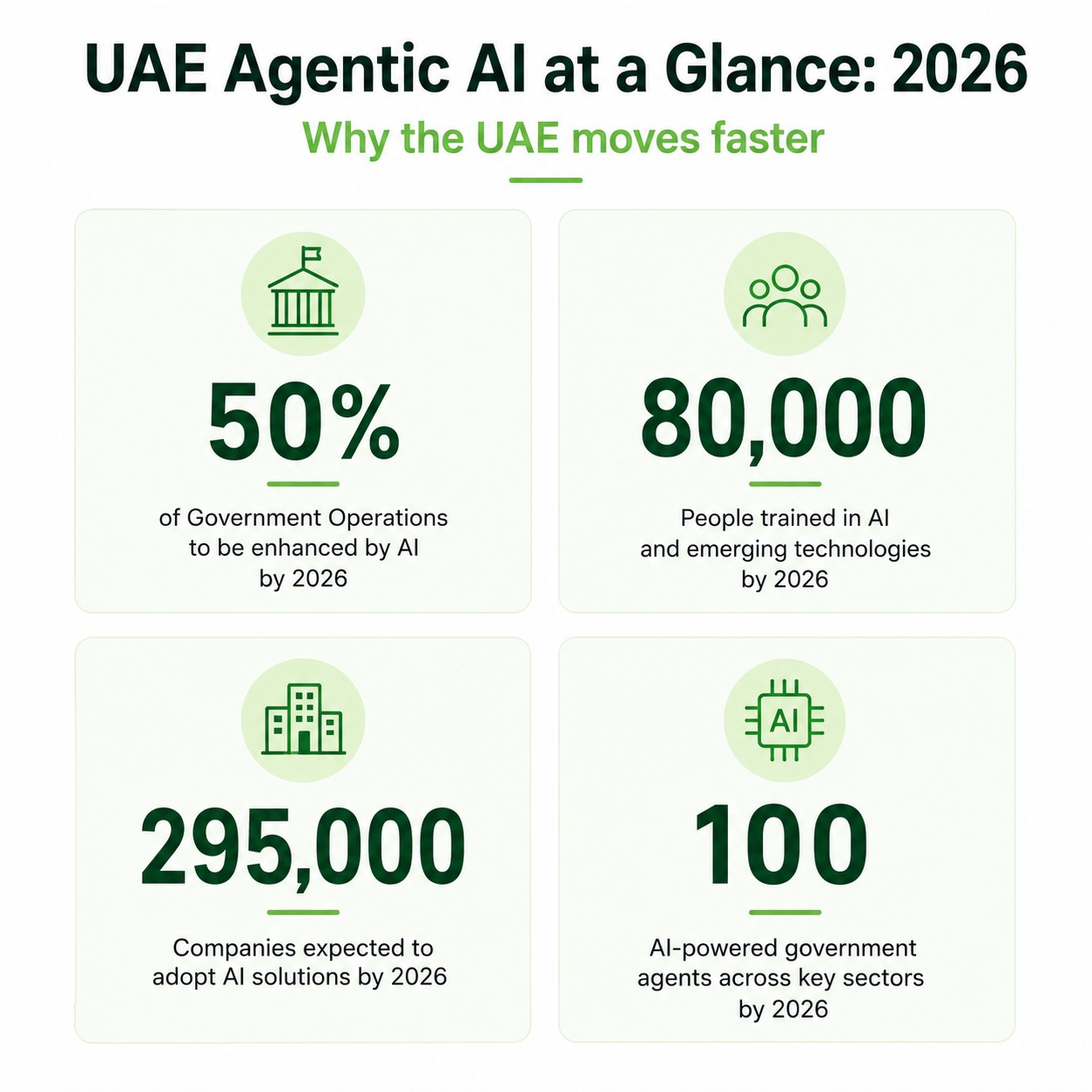
- The UAE targets half of federal government operations on agentic AI within two years.
- A production agent with Arabic and CRM support costs AED 30,000 to 85,000 to build.
- Monthly running costs for an SME agent stack range from AED 2,000 to 8,000.
- Payback on a focused SME use case often arrives inside 30 to 90 days.
- Human oversight stays essential for high-stakes calls, exceptions, and strategy.
Agentic AI development in the UAE automates multi-step work: procurement, audits, dispatch, and customer support.
In June 2026, the UAE Cabinet set a target no government had attempted. Half of all federal operations shift to agentic AI within two years. Dubai matched the private sector’s ambition by backing a plan to equip 295,000 companies with agents (Gulf News).
Most coverage stops at the headline. Enterprise leaders still ask two blunt questions. What does an agent automate, and what does running one cost?
Both answers sit below. The expensive surprise is rarely the build. It is the refinement loop that runs after launch, and that line item ambushes most budgets.
Not sure which process to hand an agent first?
What is Agentic AI, and how does it differ from a chatbot?
Agentic AI is software that plans, decides, and finishes multi-step tasks on its own, with limited human input. A chatbot waits for a message and returns a scripted reply. A generative model drafts text when prompted. An agent takes a goal, picks its tools, and works until the job is done.
Five traits separate an agent from a chatbot. An agent holds a goal in memory across many steps. It reaches for tools such as a CRM, an ERP, or a web search. Several agents can coordinate, passing work between them. Context carries from one action to the next. Every decision stays inside guardrails a human defines.
The UAE government frames this as “human leads, AI enables.” That phrase matters. An agent handles the volume and the sequence. People keep the judgment calls.
Harvard Business Review describes agentic AI as systems that pursue goals and take actions, not systems that answer questions. MIT Sloan draws the same line between assistants that suggest and agents that act.
| Dimension | Chatbot | Generative AI | Agentic AI |
| Trigger | A message | A prompt | A goal |
| Output | Scripted reply | New text or image | A completed action |
| Tools used | None | None | CRM, ERP, web, APIs |
| Human input | Constant | Per prompt | Exception-only |
| UAE example | FAQ bot | Draft an email | Run a full procurement cycle |
Why is the UAE ahead of every other government on Agentic AI Development?
Ambition here is state-led, and that changes the pace for business. The federal framework, chaired by Minister Mohammad Al Gergawi, commits half of government operations to agentic AI inside two years. The UAE calls itself the first government to run autonomous systems at this scale, a claim worth attributing to the state rather than treating as settled fact.
Delivery runs on a clock. A workshop with 300 officials from 50 federal entities set a 90-day rule: every entity ships one agentic service across exploration, design, and implementation (Middle East AI News).
Four agents went live in the first cohort, covering procurement, tax auditing, customer happiness, and technical support (Khaleej Times).
Skills came next. The Cabinet approved training for 80,000 federal employees through MBZUAI, the largest AI training push in the government’s history (The National).
Dubai carried the same logic into the private sector. Sheikh Hamdan approved a plan to support 295,000 companies, deliver 100 specialised agents, and back 50 new agentic AI firms over two years (Arabian Business).
Infrastructure backs the ambition. G42’s Inception42 and Microsoft linked the Catalyst platform to Copilot, kept data inside the country, and set a national rollout for Q3 2026 (AGBI). Demand is already there. IDC found 74 percent of Gulf organisations plan to adopt agentic AI, and 19 percent of those have moved past pilots into full production (IDC / AWS InfoBrief).
For a closer look at how this plays out in one regulated sector, see our guide to agentic AI in UAE fintech.
What does Agentic AI development automate across UAE industries?
The honest answer is process-shaped, not sector-shaped. Agents earn their keep on work that is multi-step, high-volume, and spread across systems. That pattern shows up differently in each industry, so the value looks different too.
Government and Public Services
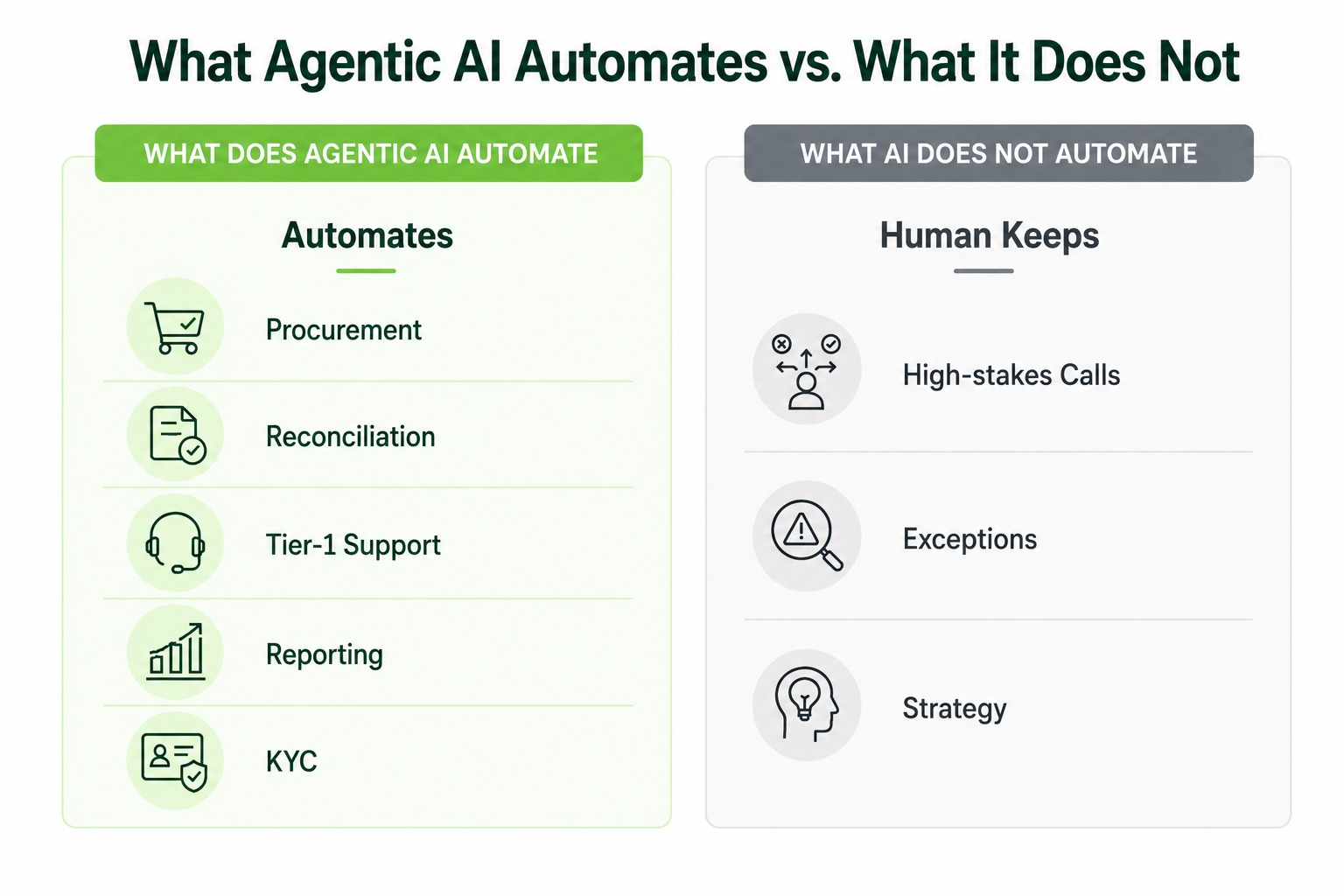
The federal cohort shows the template. A procurement agent sources suppliers, compares bids, drafts the purchase order, and routes it for a signature. Tax-audit agents cross-check filings against records and flag anomalies for a ruling.
Support agents close tier-one tickets and escalate the rest. Report preparation, performance monitoring, and cross-entity workflows follow the same shape, which is why 50 entities could adopt on one shared clock. This is core enterprise AI development in the UAE territory.
Energy and Utilities
ADNOC set the global benchmark here. Its ENERGYai platform, built by AIQ with Microsoft and G42, runs across the energy value chain. The system reads seismic data, monitors reservoirs, and models geology for CO2 storage.
ADNOC reports that ENERGYai builds detailed geological models up to 75 percent faster and cuts planning from one or two years to weeks. AIQ later signed a deployment contract worth about AED 1.25 billion to run the technology at scale. Utilities face similar math.
ACWA Power, a Code Brew Labs client, operates a 98 GW portfolio where agent-driven monitoring turns raw asset data into maintenance and dispatch decisions, the kind of build an AI development company in Dubai is measured on.
Banking and Fintech
UAE lenders moved first. The Central Bank issued agentic AI guidance in early 2026, and banks such as FAB and Emirates NBD began piloting agents.
Inside a bank, an agent runs KYC and AML checks, parses trade licences and Emirates IDs, reconciles AP and AR, and chases overdue invoices.
Remittance suits the model well. duPay, a Code Brew Labs build, passed a million downloads as a UAE wallet, and agentic flows now sit behind onboarding and transaction monitoring at that scale.
Alfardan Exchange, another client, runs cross-border transfers at 99.9 percent availability, the uptime an autonomous agent has to respect. See our fintech app development company in the UAE work for the platform side.
Insurance
Claims and documents run this business, which is agent territory. A claims agent logs the first notice of loss, validates the policy, and estimates payout against the rules. It checks coverage, flags suspected fraud, and requests missing evidence.
Underwriting agents pull applicant data, score risk, and price a quote in minutes. Renewals, endorsements, and premium reconciliation move without manual chasing. Complex or disputed claims route to a human adjuster with the file already assembled. Code Brew Labs builds this class of platform under custom insurance software in the UAE.
Logistics and Supply Chain
Few sectors reward automation more. A dispatch agent assigns drivers, sequences routes, predicts delays, and rebooks around them without a controller in the loop. Customs paperwork, proof-of-delivery capture, and carrier reconciliation move the same way.
TruKKer, a Code Brew Labs client and one of the region’s largest trucking marketplaces, matches loads to carriers across the Gulf. Zajel handles last-mile courier flows. Agentic systems slot into both, converting tracking data into live routing and exception handling. Our logistics software development in the UAE practice builds exactly this layer.
Also read our blog: https://www.code-brew.ae/ai-in-logistics-industry-uae/
Food Delivery
Timing runs this business. An agent watches order volume, kitchen load, and rider position, then assigns and rebalances deliveries second by second. It predicts prep time, batches nearby orders, and reroutes a rider when a restaurant falls behind.
Routine refund and support tickets resolve without a human handoff. Delivery-fee pricing shifts with demand and weather. Code Brew Labs has built platforms where the dispatch engine behaves as an agent, detailed in our AI dispatch for food delivery in Dubai guide.
Real Estate
Document-heavy, slow-moving workflows suit agents well. A property agent qualifies leads, books viewings, answers listing questions in Arabic and English, and drafts tenancy contracts. It screens applicants, chases missing documents, and schedules maintenance against SLA windows.
Portfolio owners lean on agents to reconcile rent, flag arrears, and forecast vacancy. Dubai developers face heavy inquiry spikes at launch, and an agent absorbs that first-response load without a bigger sales team. More sits in our real estate app development in Dubai.
Healthcare
Tight guardrails keep autonomy bounded here, and that is the point. Within limits, an agent books and reschedules appointments, verifies insurance eligibility, and prepares claims for clinical review.
Patient messages get triaged, urgent cases routed, and records held in line with DHA, MOHAP, and Malaffi rules. Diagnosis and treatment stay with clinicians. Code Brew Labs builds to those standards, which frames what any healthcare app development company in the UAE is allowed to touch.
Retail and eCommerce
Agentic commerce reaches shoppers here first. On the operations side, an agent manages pricing, watches inventory, and reorders stock before a shelf empties. On the buyer side, shopping agents search, compare, and complete checkout on a customer’s behalf.
REDTAG, a Code Brew Labs client, runs an omnichannel app past 2.5 million downloads and reported a 35 percent rise in mobile revenue after its rebuild. Personalisation and restocking agents ride on platforms at that scale, the kind our e-Commerce development company in Dubai ships.
Agentic AI development use cases in the UAE: what a working deployment looks like
A use case reads better as a loop than as a label. Below are three deployments as they run, step by step, so the mechanism is visible rather than implied.
A procurement agent, from request to record
A request lands for 200 laptops. The agent checks the approved-vendor list, pulls live quotes, and ranks them on price and lead time. It drafts a purchase order and sends it to a manager. Once the signature arrives, the agent files the record and sets a delivery reminder. One human action sits inside a chain of eight.
A finance reconciliation agent, overnight
Every night the agent matches bank statements to the ledger. Lines that agree clear on their own. Mismatches move to a queue, each tagged with a likely cause. A controller reviews the exceptions and nothing else. Hours of manual matching shrink to minutes of judgment.
A WhatsApp support agent in Arabic and English
A customer asks about a late order in Arabic. The agent reads the order status and explains the delay. It offers a reship or a refund, then processes the routine choice on its own. Anything unusual routes to a person with the full history attached. Nobody repeats the problem twice.
Each loop shares one shape. An agent runs the sequence, and a human owns the exception. That balance is what makes the economics work, and it points to the real question: cost.
What does it cost to develop and run Agentic AI in the UAE?
Prices swing wide, and that scares buyers more than it should. Pricing ranges from a few thousand dirhams for a no-code workflow to more than a million for a regulated multi-agent platform. The spread reflects genuine differences in scope, integrations, and governance, not padding.
Build cost
| Agent type | Scope | Estimated Build cost (AED) |
| Starter workflow automation | 2–3 integrations, single task | 3,000 – 12,000 |
| FAQ/knowledge agent | Retrieval over your documents, one channel | 15,000 – 25,000 |
| Production agent | WhatsApp, Arabic and English, CRM | 30,000 – 85,000 |
| Enterprise agent | ERP integration, governance, custom training | 90,000 – 220,000 |
| Multi-agent platform | Orchestration, audit trail, compliance | 200,000 – 750,000 |
The run cost, where budgets break
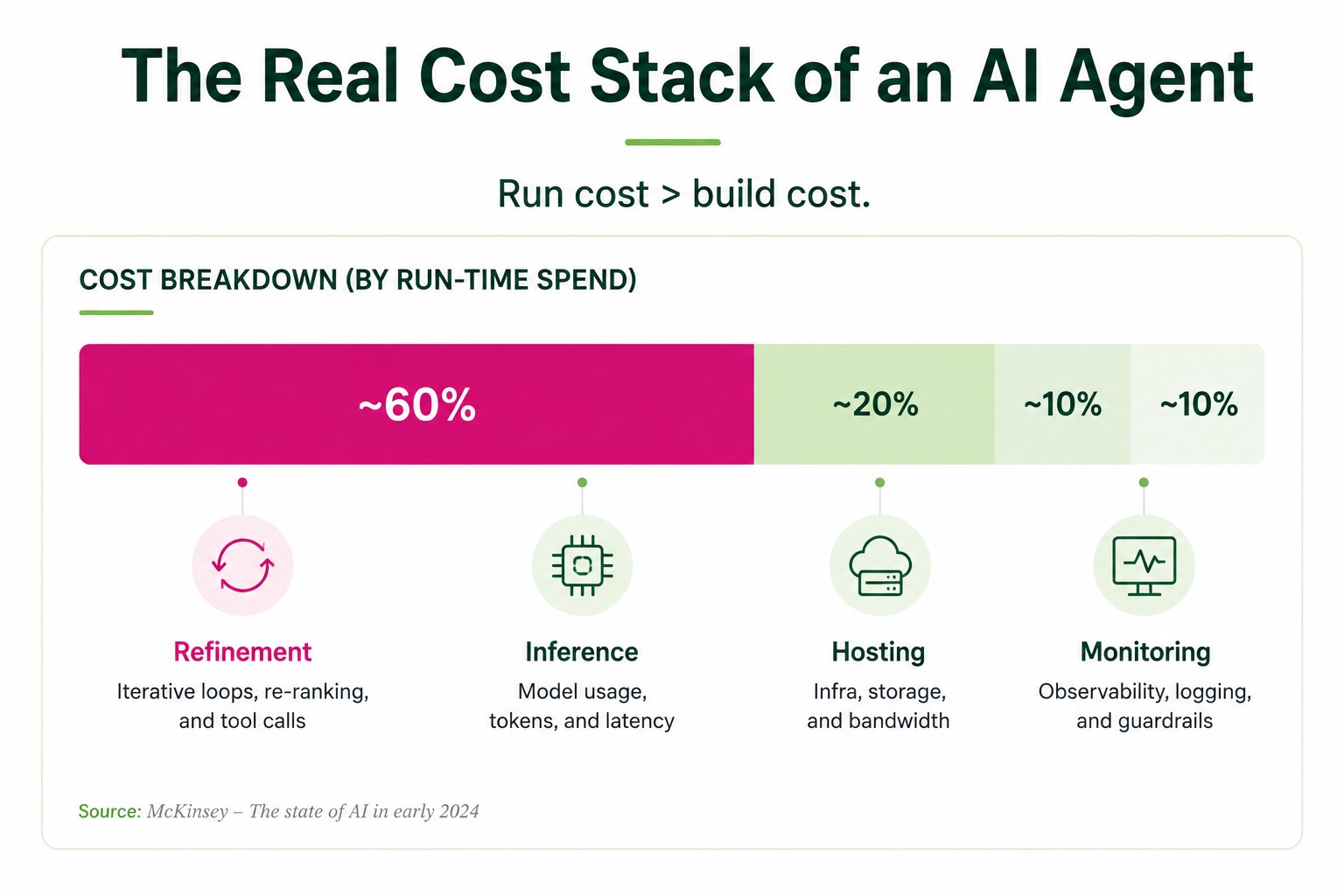
Build is a one-time line. Running the agent is the bill that repeats, and it catches teams off guard. McKinsey found that about 60 percent of an agentic task’s cost ties to refining answers, the checking and re-verifying loops that run after the first response. The same research reports that 93 percent of enterprises have already passed their AI budgets. Token spend, not developer salaries, is the culprit.
| Run-cost line item | Monthly range (AED) |
| Token/inference (usage-driven) | 600 – 6,000 |
| Hosting and cloud infrastructure | 2,000 – 12,000 |
| Channel and tool APIs (WhatsApp, CRM) | 500 – 3,000 |
| Monitoring, tuning, maintenance | 2,000 – 8,000 |
| SME full-stack agent (blended) | 2,000 – 8,000 |
Payback and total cost of ownership
Focused use cases pay back fast. A single SME automation, such as invoice chasing, often clears its cost within 30 to 90 days through recovered hours and faster collections.
Larger multi-agent programs run 12 to 24 months to full ROI, because integration and governance take longer to earn out.
Beyond the visible bill sit four quiet costs: data preparation, process redesign, staff training, and governance. A build that ignores them looks cheap and runs expensive.
Cost control comes down to scope discipline. Start with one high-friction process. Use open-source models where quality allows, and reserve premium models for the steps that need them.
Cap the refinement loop with a strong governance harness, since that single move contains the 60 percent problem. Our full pricing breakdown lives in the AI development cost in the UAE guide.
Want a fixed AED build-and-run estimate for your first agent?
How do you roll out Agentic AI development without overspending?
The government sprint gave the country a reusable playbook, and it works for business at any size. The method has four moves, and none of them start with a big build.
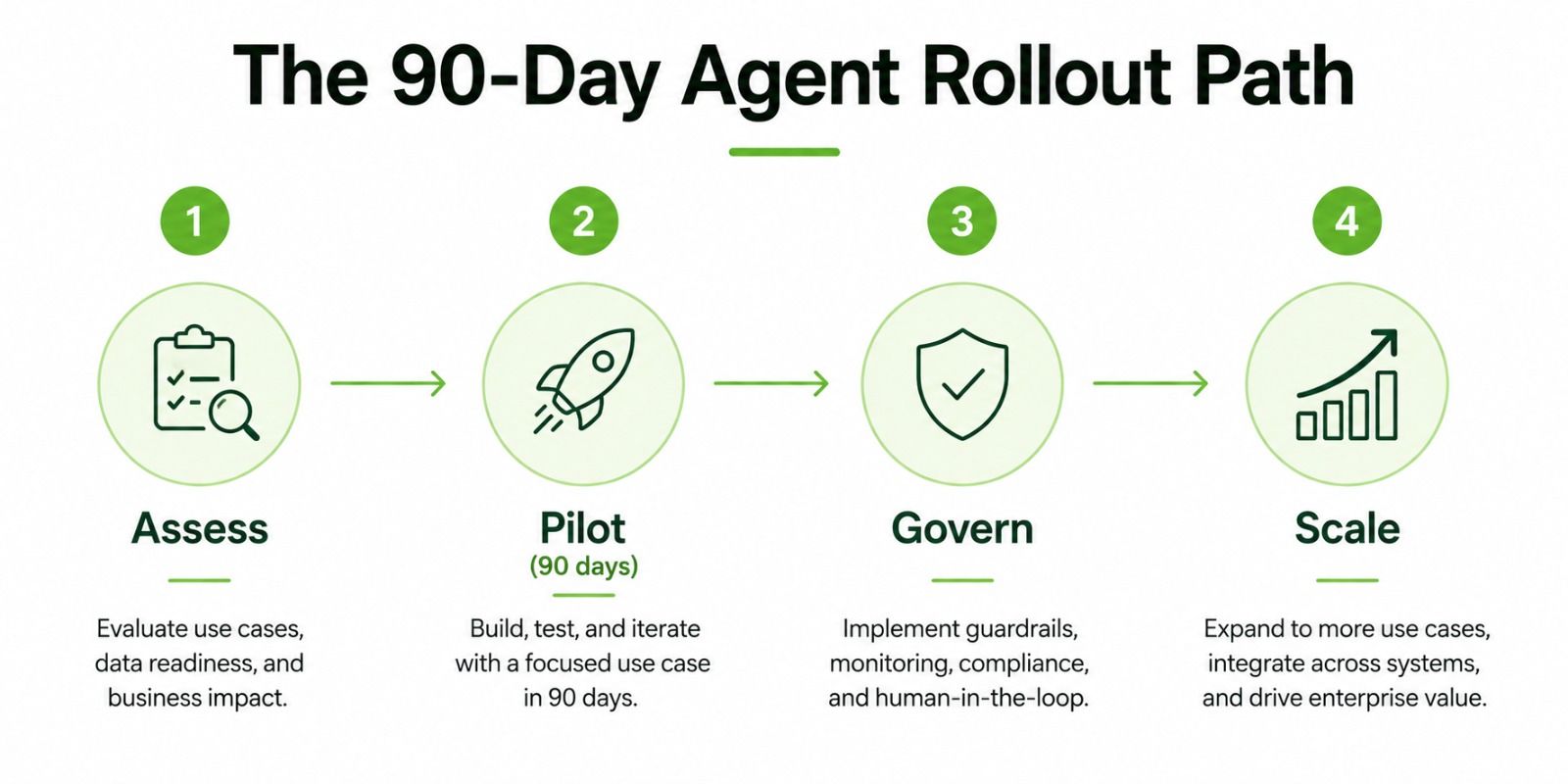
Begin with one process that hurts. High-friction, high-volume, and multi-system work returns value first, so a night-time reconciliation beats a glossy customer chatbot as a starting point. Scope it narrow enough to ship in about 90 days.
Pilot before you scale. The federal model runs exploration, then design, then an implementation plan inside that window, which keeps spend small until the value shows. A pilot that fails costs a fraction of a platform that fails.
Wrap the agent in oversight from day one. Guardrails, human-in-the-loop on high-stakes steps, and data residency on sovereign infrastructure keep an autonomous system inside safe bounds. Governance added later costs more and protects less.
Scale once the first agent proves its number. Add a second and a third only after the first pays back, and reuse the same harness so each new agent inherits the controls. Teams that pick partners well tend to sequence this way, a point we expand on in top AI enterprise app development companies in Dubai.
What are the risks of Agentic AI development, and how do UAE firms contain them?
Autonomy raises the stakes, and pretending otherwise helps nobody. The failure modes are known, and each has a containment move that a serious build bakes in.
| Risk | What goes wrong | Containment |
| Cost overrun | Refinement loops run unchecked | Token caps, strong harness, monitoring |
| Hallucination | Agent acts on a wrong conclusion | Human-in-the-loop on high-stakes steps |
| Legacy integration | Agent cannot reach core systems | API layer, phased rollout |
| Data readiness | Weak inputs produce weak output | Data preparation before build |
| Skills gap | Nobody can run the agent | National training, managed support |
Trust is the quiet blocker. An HBR Analytic Services survey found only 6 percent of companies fully trust AI agents to run core processes on their own (Fortune). That number is a design brief, not a warning to wait. Bound the autonomy, prove the results on a narrow task, and trust grows with evidence.
The UAE carries real advantages into this. Policy support is explicit, sovereign infrastructure keeps data in-country, and local builders design for Arabic and English from the first line.
Governance sits closer to the business here than in most markets, which shortens the distance from pilot to production.
Future outlook and recommendations for UAE businesses
The UAE agentic AI market through 2030
Growth here is steep by any measure. The UAE AI-agents market rises from about AED 250 million in 2024 to AED 2.65 billion by 2030. That is a compound rate near 49 percent a year (Grand View Research).
Government demand pulls the private sector along, and sovereign infrastructure removes the data-residency objection that stalls adoption in other markets.
From pilots to production
The center of gravity is shifting from experiments to live systems. IDC already counts 19 percent of Gulf adopters running agents in full production rather than trials (IDC / AWS).
Federal entities ship on a 90-day clock, and that cadence sets an expectation private buyers now carry into their own projects. Agentic work moves from proof-of-concept budgets toward standing operational lines.
What Agentic AI development looks like next
Building AI agents becomes a repeatable discipline, not a bespoke gamble. Dubai’s plan to deliver 100 specialised agents and back 50 new agentic firms signals a supplier market forming around reusable harnesses, shared guardrails, and
Arabic-first design. Expect standard patterns for orchestration, governance, and cost control to replace one-off builds. Teams that codify those patterns first will set the local benchmark, and buyers will start asking vendors for the harness, not just the agent.
Work shifts toward augmentation
Roles change more than they vanish for most people. An AI agent absorbs the sequence and the volume, and staff moves up to exceptions, judgment, and design.
The 80,000-employee federal training program shows where the country places its bet: on people who direct agents. That choice reshapes hiring and reskilling across the private sector too.
Where to start, by company size
Scale decides the first move. A startup should wire one agent into its core loop early, since a lean team gains most from an automated sequence. A mid-market firm should run two or three high-friction processes on one shared harness, which keeps cost and governance under a single roof.
An enterprise should treat the federal sprint as a template, standing up a governed pilot inside 90 days before committing to a platform. Whatever the size, the first step holds. Pick one process where the math is obvious, and let the result fund the next agent.
Why Code Brew Labs is the right partner for Agentic AI development in the UAE
Choosing a partner for autonomous systems comes down to evidence, and Code Brew Labs brings a portfolio that answers the question before it is asked.
The team has shipped mission-critical AI development software for Airbus, where a secure communications build held zero unscheduled downtime and cut operational disruption by 28 percent.
For ACWA Power, a utility running a 98 GW portfolio, the work turned scattered asset data into decisions operators act on. Results like these come from building systems that carry real weight, not demos that photograph well.
Depth in regulated, high-volume sectors is where agentic AI and AI automation in Dubai live, and that is where this record sits. duPay grew past a million downloads as a UAE digital wallet. Alfardan Exchange runs remittance at 99.9 percent availability.
REDTAG passed 2.5 million downloads and lifted mobile revenue by 35 percent after its rebuild. New Media Academy’s AI system generates video ten times faster and completes a facial scan in under a second.
Each number came from a production system serving real users at scale, which is the only environment where an agent has to hold up. The full record sits in our portfolio of UAE enterprise builds.
Being based in the UAE changes the work in ways offshore vendors cannot match. Arabic and English support ships from the start; compliance with DHA, CBUAE, and federal expectations is designed in.
An AI agent that must respect local rules, local language, and local uptime is easier to build when the builder lives inside those constraints. That combination of proven results and local fluency is why enterprises across the Emirates start their agentic AI programs here.
Pick one process & we will build the agent, cap the run cost, and ship it.
Conclusion
Agentic AI has moved past the pitch stage in the UAE. Federal agents already run procurement and audits, ADNOC models geology in weeks instead of years, and Dubai is wiring 295,000 companies into the same shift. The automation is concrete, and it is shipping now.
Cost is where discipline pays. Build a narrow agent, cap the refinement loop, and a focused use case can clear its cost within a quarter. Pick one process where the number is obvious, prove it, and let that result fund the next.
Frequently asked questions
How much does an AI agent cost in Dubai?
A starter workflow agent begins near AED 3,000 to 12,000. A production agent with Arabic support and CRM integration runs AED 30,000 to 85,000. A single enterprise agent with ERP and governance sits between AED 90,000 and 220,000. Multi-agent platforms pass AED 200,000. Running the agent adds a monthly cost most buyers underestimate.
What is the difference between Agentic AI and generative AI?
Generative AI produces content when prompted, such as text or images. Agentic AI pursues a goal, uses tools, and completes multi-step work with limited human input. A chatbot answers a question. An agent runs the whole procurement cycle, then flags only the exception for a person.
What is the UAE’s 50 percent Agentic AI target?
The UAE Cabinet approved a framework to move half of federal government operations, services, and procedures to agentic AI within two years. Delivery runs through 90-day sprints across 50 federal entities. The first agents cover procurement, tax auditing, customer happiness, and technical support.
What does it cost to run an AI agent each month?
An SME agent stack runs near AED 2,000 to 8,000 a month. The largest line item is usually token cost from refinement loops. McKinsey estimates about 60 percent of an agent’s task cost goes to refining answers. Hosting, APIs, monitoring, and maintenance make up the rest.
Can Agentic AI work in Arabic?
Yes. UAE production agents handle Arabic and English across WhatsApp and web. Local builders design for both from the start, which matters for government and customer-facing work. Bilingual capability is a practical reason enterprises choose a UAE partner over an offshore vendor.
How long before an AI agent pays for itself?
A focused SME use case often reaches payback within 30 to 90 days. Larger multi-agent programs take 12 to 24 months. Payback depends on the process you choose. High-friction, high-volume, multi-system tasks return value fastest, which is why narrow pilots beat broad rollouts.
Let's Convert Your Business Idea Into Success!
Free Consultation from Top Industry Experts
Let’s Build Your Dream App!
Share article on :


 No commitment required
 NDA on request
 24-hour response


