
Quick Summary:
- Food delivery app development in Dubai combines AI dispatch, deep integrations, and operational intelligence.
- The UAE ranks as the second-largest online food delivery market in MENA.
- AI dispatch matches, batches, and routes orders against live Dubai traffic.
- Order throttling and human oversight keep peak-hour operations stable and reliable.
- POS, payments, maps, ERP, and CRM integrations decide platform reliability.
- Personalisation leaders earn 40% more revenue from those efforts, per McKinsey.
- IoT sensors and FoodWatch traceability protect food quality across the last mile.
- FoodWatch registration is mandatory for every food business operating in Dubai.
- Build cost depends on scope and integrations rather than a headline price.
A food delivery app in Dubai faces its hardest test on a Friday night.
Picture Business Bay at 8 p.m. Orders stack across three kitchens at once. A rider waits for a dish that started late. Another customer edits an address after checkout. The dispatcher watches six screens and trusts none of them.
Peak demand decides the outcome. It exposes weak dispatch, thin integrations, and blind operations at once. AI changes what happens next.
Operators face six decisions in a build of this kind. Dispatch, integrations, personalisation, payments, safety, and cost each get a direct answer here.
The stakes match the market. UAE demand ranks second-largest in MENA for online food delivery, per Statista. Smartphone penetration reached about 97.6% in 2025. Order frequency in the Emirates runs well above the global average.
We map dispatch, integrations, and compliance to your operation in 30 minutes
What is a food delivery app, and how does development work in Dubai?
A food delivery app is a platform that connects customers, restaurants, and riders in real time. It runs as five connected parts, not one screen.
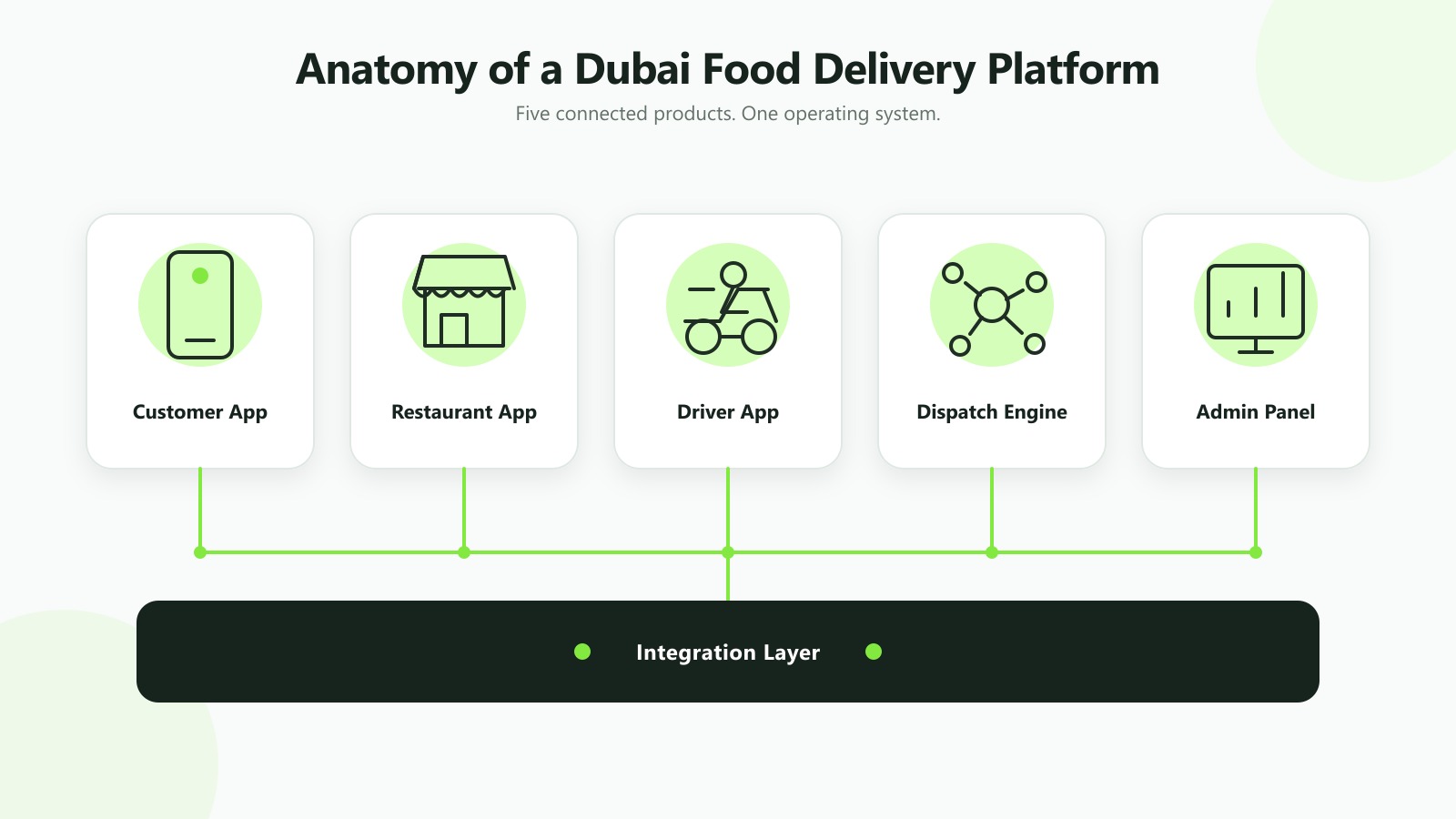
- A customer app for search, order, payment, and tracking.
- A restaurant app for menu, order acceptance, and prep status.
- A driver app for pickup, navigation, and proof of delivery.
- A dispatch engine that assigns and routes every order.
- An admin panel for pricing, zones, promotions, and live control.
Each part talks to the others through a shared backend. The backend holds orders, users, menus, and payments in one data model. Weak data design shows up later as slow apps and broken reports.
AI Development in Dubai adds local weight to each part. Arabic and English sit side by side. Payments cover cards, wallets, and cash. Food safety ties into Dubai Municipality systems.
Three business models shape the build. An aggregator lists many restaurants and charges commission. A single-brand app serves one chain and its own kitchens. A hybrid runs both, with owned delivery and third-party fleet backup.
Demand backs the investment. More than 70% of UAE and KSA food orders now run through apps. Growth stays strong across Dubai and Abu Dhabi, per Grand View Research.
Talabat leads Dubai with close to 45% of orders. It links over 10 million users to 20,000 restaurant partners, per Statista. Careem, Deliveroo, and Noon Food split much of the rest.
How do AI dispatch systems work in food delivery?
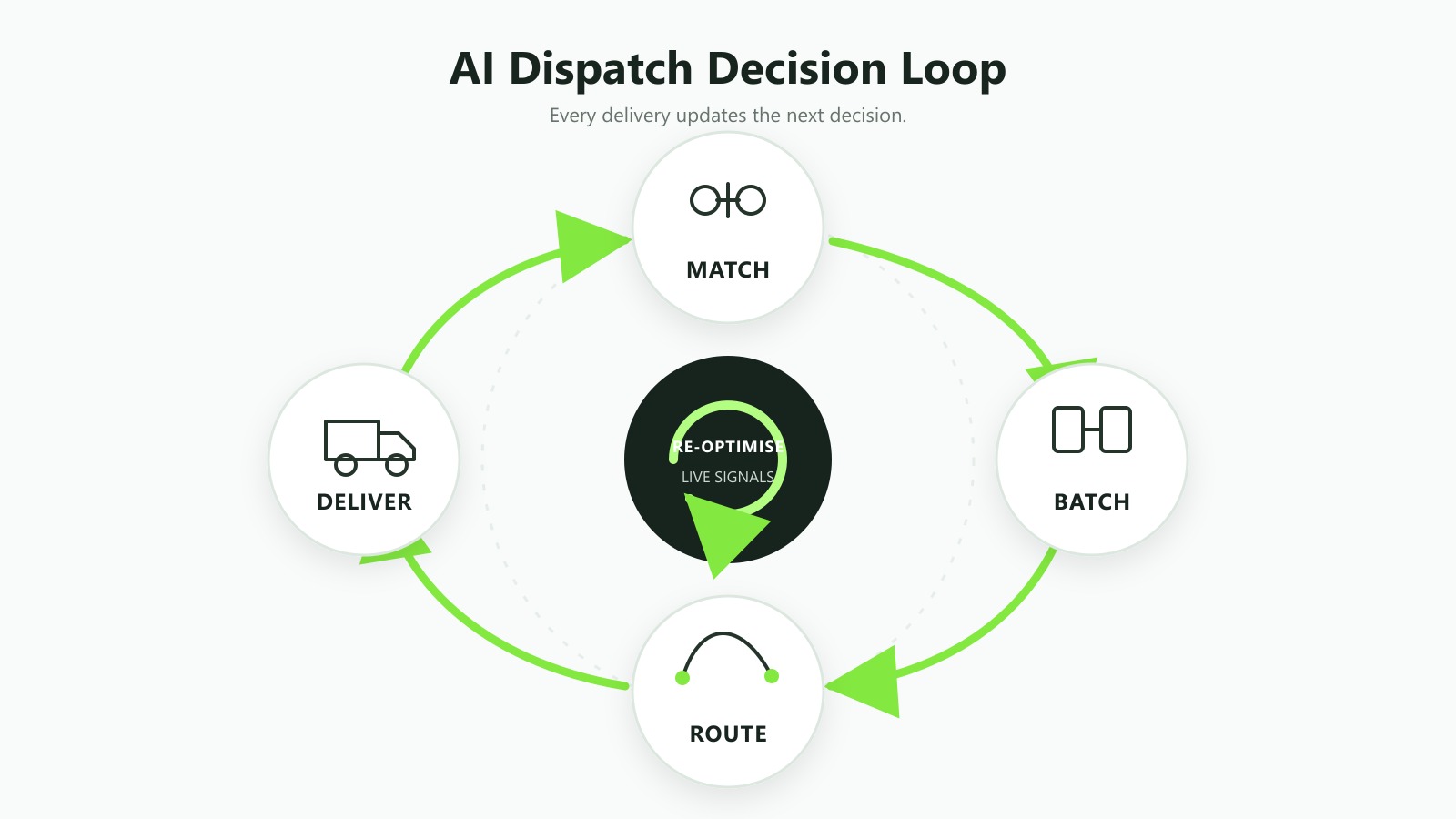
AI dispatch decides which rider takes which order, and how orders combine. The engine solves an assignment problem thousands of times an hour. Each decision weighs distance, prep time, rider load, and promised window.
Manual dispatch fails at scale. A human cannot compare 200 riders against 500 live orders in a second. The AI does that math on every new order and every status change.
Good dispatch runs on prediction, not just reaction. It forecasts demand by zone and hour. Riders shift toward demand before the orders arrive.
Order matching and batching
Matching scores every open order against every available rider. The engine ranks riders by ETA, current load, and direction of travel. Assignment lands in under a second.
Distance alone makes a poor match. A rider 500 metres away may sit behind a longer prep time. The engine weighs pickup readiness against travel time in one score.
Supply and demand rarely balance at peak. The system holds an order for a moment when no strong match exists. A short wait for the right rider beats a fast, wasteful assignment.
Batching groups orders that share a kitchen or a route. Two nearby drops on one trip cut cost per delivery. The engine batches only when the second order stays inside its time window.
Batching carries a trade-off. Freshness drops when food waits for a second order. The model batches hot items with care and keeps cold or sealed items flexible.
Real-time routing for Dubai traffic and Salik
Routing builds the shortest live path between pickup and drop. It reads live traffic, road closures, and Salik gates. Routes rebuild mid-trip when a road backs up.
Dubai adds specific friction. Tower clusters, service roads, and mall access points confuse generic maps. Address intelligence learns the real drop point from past deliveries.
Toll and time cost enter the route math. A path across a Salik gate may cost more than a slightly longer road. The engine weighs both against the promised delivery time.
Multi-stop routes need order, not just direction. The system sequences drops to protect freshness and honour each window. Riders follow a clear next-stop instruction, not a cluttered map.
Order throttling that protects restaurants at peak
Order throttling paces incoming orders to kitchen capacity. The system reads live prep times and open tickets. It extends promised times or holds orders when a kitchen saturates.
Throttling protects food quality and rider wait times. A kitchen that accepts every order at peak burns both. Dynamic buffers keep promises honest during the Friday rush.
Prep-time prediction drives the buffer. The model learns how long each dish takes at each hour. Promised times then reflect the kitchen, not a fixed guess.
Throttling also protects the brand. A late, cold order costs more than a delayed acceptance. Honest timing at checkout beats a broken promise at the door.
Human-in-the-loop automation for edge cases
AI handles the routine. Humans handle the edge cases. An operations team watches an exception queue for stuck orders, failed handoffs, and disputes.
The model flags low-confidence decisions for a person to approve. Staff overrides an assignment when a VIP order or a safety issue appears. Each override feeds back into the model as training data.
A control tower view sits behind this work. It shows live orders, rider supply, and kitchen load in one screen. Supervisors step in before a small delay spreads across a zone.
AI Automation without oversight breaks trust. Human judgement on the hard 5% keeps the other 95% credible. The balance improves as the model learns from each call. A logistics app company in Dubai can engineer these dispatch cores.
How does AI predict demand and position riders before orders arrive?
AI predicts demand by zone and hour, then moves riders toward it early. Reactive dispatch waits for the order. Predictive dispatch prepares for it. The gap shows up as speed at peak.
A forecast model reads history, weather, events, and time. It learns that a zone spikes at 1 p.m. and again at 8 p.m. Rider supply then shifts before the rush.
Live events move demand in Dubai. A concert, a match, or a mall sale draws orders to one area. The model reads these signals and warns operations early.
Heatmaps turn the forecast into action. Riders see where demand will climb next. Incentives point spare riders toward the gap. Weather changes the pattern in minutes.
Rain lifts orders and slows every road at once. The model raises promised times and calls in more riders.
ETA prediction sits inside the same engine. It quotes a delivery time the app can keep. Accurate promises cut cancellations and support calls.
Demand shapes pricing too. A dynamic delivery fee rises when riders run short. Clear pricing keeps the balance between supply and fairness.
Forecasts protect rider earnings as well. Idle riders earn little and cost the platform. Better prediction keeps riders busy and paid through the shift.
New zones start with little data. The model borrows patterns from similar areas until it learns. Forecasts sharpen as real orders arrive.
How can you scale a food delivery app across cities and peak demand?
Scaling a food delivery app means holding performance as cities, orders, and brands multiply. A single-city app and a multi-city network run on different architectures. Zones, surge rules, and data partition by city.
Architecture decides the ceiling. A monolith slows down as load grows. Service-based design lets dispatch, payments, and search scale on their own.
Operational intelligence turns that scale into decisions. A live dashboard tracks orders, rider supply, and kitchen load per zone. Managers act on a delay before customers feel it.
The dashboard runs on clear metrics. Order-to-door time, on-time rate, rider utilisation, and cancellation rate tell the real story. Each metric breaks down by zone, hour, and brand.
Peak demand tests the whole system at once. Ramadan iftar, Friday dinners, and match nights spike orders in minutes. Auto-scaling infrastructure adds capacity before the queue forms.
Peak planning starts before the peak. Historical data predicts the surge by zone and hour. Rider incentives and pre-positioning meet demand as it climbs.
Centralised delivery for restaurant chains across the UAE
A central platform gives one view across every branch. Head office sets pricing, menus, and promotions once. Each Dubai and Abu Dhabi location inherits the rules and reports back live.
Central control cuts menu errors and price drift across branches. It also pools rider supply across nearby stores at peak. A quiet branch lends riders to a busy one down the road.
Reporting rolls up and drills down. Leadership sees group performance in one figure. Each branch manager sees their own orders, delays, and reviews.
Multiple cloud kitchen brands from one system
One kitchen can host several virtual brands under one roof. The platform keeps separate menus, storefronts, and reports per brand. Shared staff and equipment cook every order from one queue.
Brand-level analytics show which concept earns its shelf. Operators launch, test, and retire brands without new premises. A weak brand closes without touching the kitchen lease.
Order routing keeps brands clean. A single ticket screen groups items by brand and station. Kitchen staff cook to one flow while customers see distinct brands. You need an enterprise AI development team in the UAE if you need these controls in your food delivery app.
Which integrations does a Dubai food delivery app need?
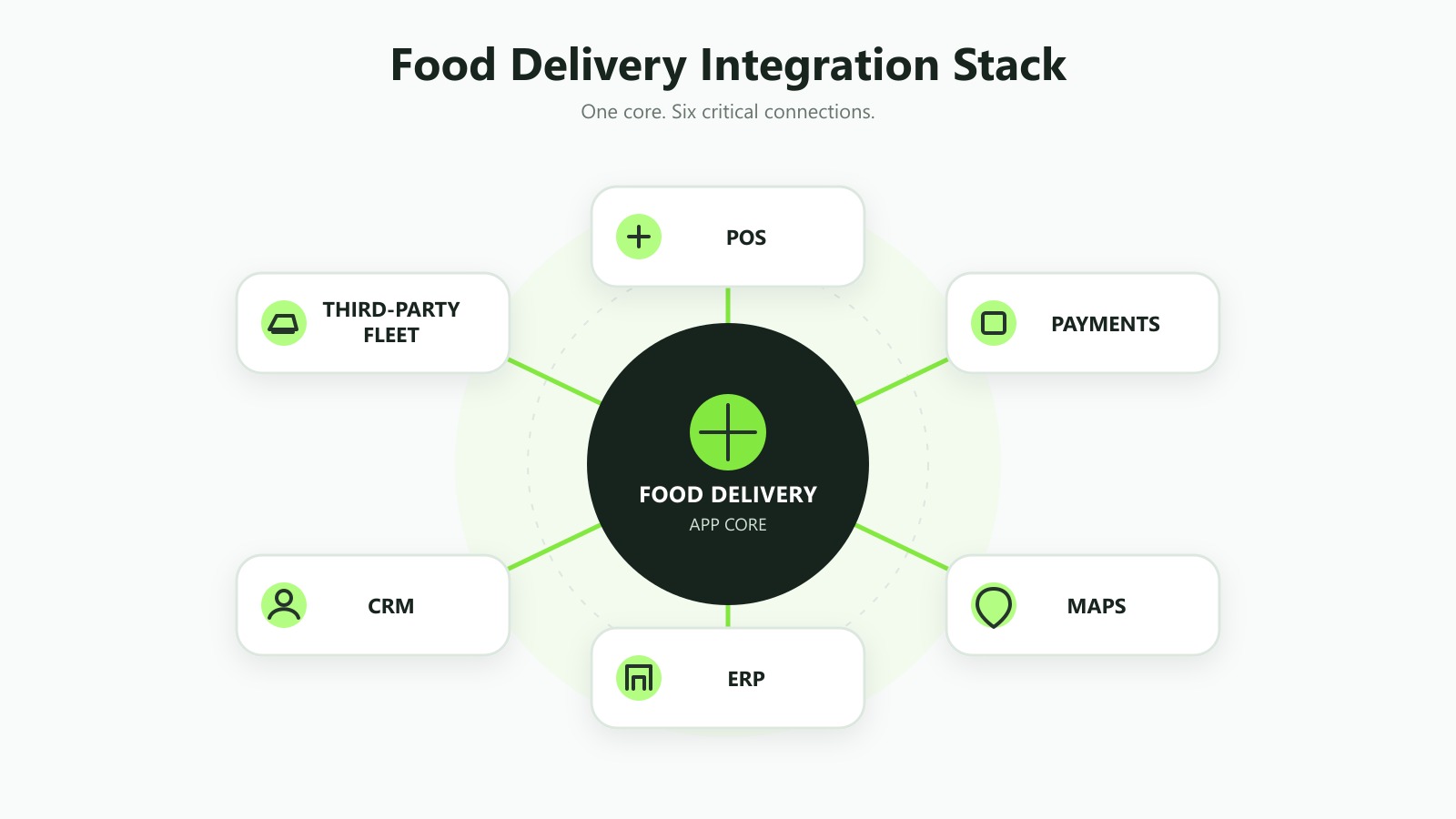
A food delivery app connects to several external systems to run in Dubai.
| System | Purpose | Common in UAE |
| POS | Menu, price, and order sync with the till | Foodics, Oracle Simphony, Square |
| Payments | Cards, wallets, refunds | Network International, Telr, PayTabs |
| Maps | Search, tracking, routing | Google Maps Platform, Mapbox, HERE |
| ERP | Inventory and accounting | SAP, Oracle NetSuite, Odoo |
| CRM | Customer history, support, retention | Salesforce, HubSpot |
| Third-party fleet | On-demand rider capacity | Careem, Lyve, Quiqup |
| Messaging | Order updates by SMS and WhatsApp | Unifonic, Twilio |
POS integration keeps the app and the till in sync. Menu, price, and stock changes flow both ways. Popular UAE systems include Foodics, Oracle Simphony, and Square.
A broken POS link creates double entry. Staff key the same order twice, and errors follow. A clean integration injects each order straight into the till.
Payment gateways handle cards, wallets, and refunds. Network International, Telr, and PayTabs serve the UAE market. Apple Pay and Careem Pay cover wallet demand.
Maps power search, tracking, and routing. Google Maps Platform, Mapbox, and HERE lead here. Map API costs scale with usage, so caching matters at volume.
ERP and CRM connect operations to finance and marketing. The ERP ties orders to inventory and accounting. CRM holds customer history for support and retention.
Third-party fleets extend delivery beyond an in-house team. Careem, Lyve, and Quiqup add riders on demand. A hybrid fleet absorbs peak orders without idle riders at quiet hours.
Messaging keeps customers informed without a call. Order updates reach users by app push, SMS, or WhatsApp. Fewer “where is my order” calls free the support team.
POS integration architecture for multi-restaurant platforms
A middleware layer sits between the app and many POS systems. Each restaurant keeps its own till software. The middleware translates every order into the format that POS expects.
Webhooks push order status back to the app in real time. Menu sync runs on a schedule and on demand. One integration pattern then onboards hundreds of restaurants without custom code each time.
Rate limits and retries protect the flow. A busy POS may reject calls at peak. The middleware queues, retries, and alerts staff when an order stalls.
Security sits inside the design. Each integration uses scoped keys and encrypted transport. A breach in one connector stays contained.
We build this middleware as a custom software development company in Dubai.
Which technology stack powers a Dubai food delivery app?
A Dubai food delivery app runs on a stack built for real-time load. The stack must handle spikes, live tracking, and many integrations. Each layer earns its place through scale and reliability.
| Layer | Common choices | Role |
| Mobile apps | Swift, Kotlin, React Native, Flutter | Customer, driver, restaurant apps |
| Backend | Node.js, Java, Go | Orders, users, business logic |
| Databases | PostgreSQL, MongoDB, Redis | Records, catalogue, live cache |
| Real-time | WebSockets, Kafka | Live tracking, events, updates |
| Cloud | AWS, Azure, Google Cloud | Hosting, auto-scaling, storage |
| AI and ML | Python, TensorFlow, PyTorch | Dispatch, ETA, recommendations |
Mobile Apps:
Carries the customer, driver, and restaurant experience. Native code suits heavy, high-performance apps. Cross-platform frameworks cut mobile app development costs for a faster launch.
Backend:
Holds orders, users, and business logic. A microservices design lets each part scale on its own. Dispatch can grow without touching payments.
Databases:
Databases split by job. A relational store holds orders and money. An in-memory cache serves the live map and menu at speed.
Real Time:
Real-time infrastructure powers live tracking. WebSockets push a rider’s location to the customer. Event streams keep dispatch, kitchen, and app in sync.
Cloud hosting
Absorbs the peak hour. Auto-scaling adds servers as orders climb, then releases them afterward. Managed services cut the operations burden on the team.
API Integration:
An API gateway guards every integration. It handles auth, rate limits, and routing in one place. Partners connect through a single, controlled door.
Compliance & Security:
Security wraps every layer. Encryption, scoped access, and monitoring guard customer and payment data. The stack meets PCI DSS and PDPL from the start.
QA Testing:
Testing decides survival at peak. Load tests simulate a Friday surge before it happens. The team fixes weak points in staging, not in production.
How does AI personalisation increase orders and customer retention?
AI personalisation shows each customer the food they most want to see. McKinsey found that personalisation leaders earn 40% more revenue from those efforts.
Consumer expectations back this up. 71% of consumers expect personalised interactions, per the same study. Users leave when an app shows them food they never order.
A recommendation engine reads order history, browsing, and time of day. It ranks dishes and restaurants for each user. Better ranking lifts basket size and repeat orders.
Engines come in a few forms. Collaborative filtering learns from users with similar taste. Content-based models match dishes to past choices. Contextual models adjust ranking as the moment changes.
Search matters as much as recommendations. Semantic search understands intent, not just exact words. Typo tolerance and Arabic search keep results useful for every user.
Retention runs on more than good food. Churn models spot a customer who drifts away. A timed offer or a saved favourite pulls them back before they leave.
AI that reduces choice overload
Choice overload stalls the order. A menu of 300 items freezes a hungry user. AI trims the first screen to a short, relevant set.
Curated rails replace endless scrolling. “Order again”, “Fast near you”, and “Popular tonight” guide the choice. Fewer, sharper options raise conversion and cut decision time.
Ranking beats filtering here. The app still holds the full menu for anyone who wants it. Most users take the top suggestion and check out faster.
Context-aware recommendations from time, weather, and location
Context changes what a customer wants. Breakfast at 8 a.m. differs from supper at midnight. The engine reads time, weather, and location on every visit.
Rain in Dubai shifts demand toward comfort food and indoor delivery. A live weather API feeds that signal into recommendations. Location surfaces nearby kitchens with fast promised times.
Device and history refine the picture. A repeat biryani buyer sees biryani first at dinner. A new user sees popular local dishes until the app learns more.
Personalisation without violating customer privacy
Personalisation needs data, and UAE law sets the limits. The UAE PDPL governs consent, storage, and use of personal data. A platform should collect what it needs and state why.
On-device signals can drive recommendations without exposing raw data. Clear consent screens keep the user in control. Good privacy design builds the trust that retention depends on.
Data minimisation reduces risk. An app that stores less has less to lose in a breach. Anonymised analytics still guide product decisions without naming a person.
How does AI predict what customers will order?
AI predicts a customer’s next order from past behaviour, timing, and context. Prediction moves the app from reactive to anticipatory. It suggests the probable order before the user searches. The user reaches checkout in fewer taps.
A reorder model learns each customer’s pattern. It knows the Thursday biryani and the Monday salad. One tap then repeats a familiar order.
Timing prediction matters as much as the dish. The model learns when a user tends to order. A gentle nudge arrives near that hour, not at random.
Predicted baskets speed the whole flow. The app pre-fills a cart the user can accept or edit. Checkout takes seconds at a busy moment.
Kitchens gain from prediction too. High-probability orders let a kitchen prep common items early. Prep starts before the order lands at peak.
Subscriptions turn prediction into routine. A weekly lunch plan books itself on the user’s schedule. Auto-reorder keeps regulars loyal without effort.
Prediction stays inside the privacy line. The model uses a customer’s own history, with consent. Clear controls let a user turn suggestions off.
Accuracy grows with every order. Early guesses stay broad for a new user. The model sharpens as it learns real habits.
Can UAE food delivery apps support Arabic-English voice ordering?
UAE food delivery apps can support Arabic and English voice ordering. Voice search grows as users talk to phones and cars. A bilingual app must understand both languages in one sentence. Many UAE users mix Arabic and English mid-order.
Speech recognition must handle Gulf Arabic, not just standard Arabic. The system parses intent, dish names, and modifiers from speech. It then confirms the order in the user’s language.
Dialect trips up generic engines. A model trained on Khaleeji speech reads local orders far better. Accuracy climbs as the app hears more real users.
Right-to-left layout keeps the Arabic interface clean. Voice cuts friction for drivers and repeat buyers alike. Hands-free ordering also helps a rider on the move.
Accessibility gains come with voice. Users with low vision reach the full menu by speech. The feature widens the customer base at the same time.
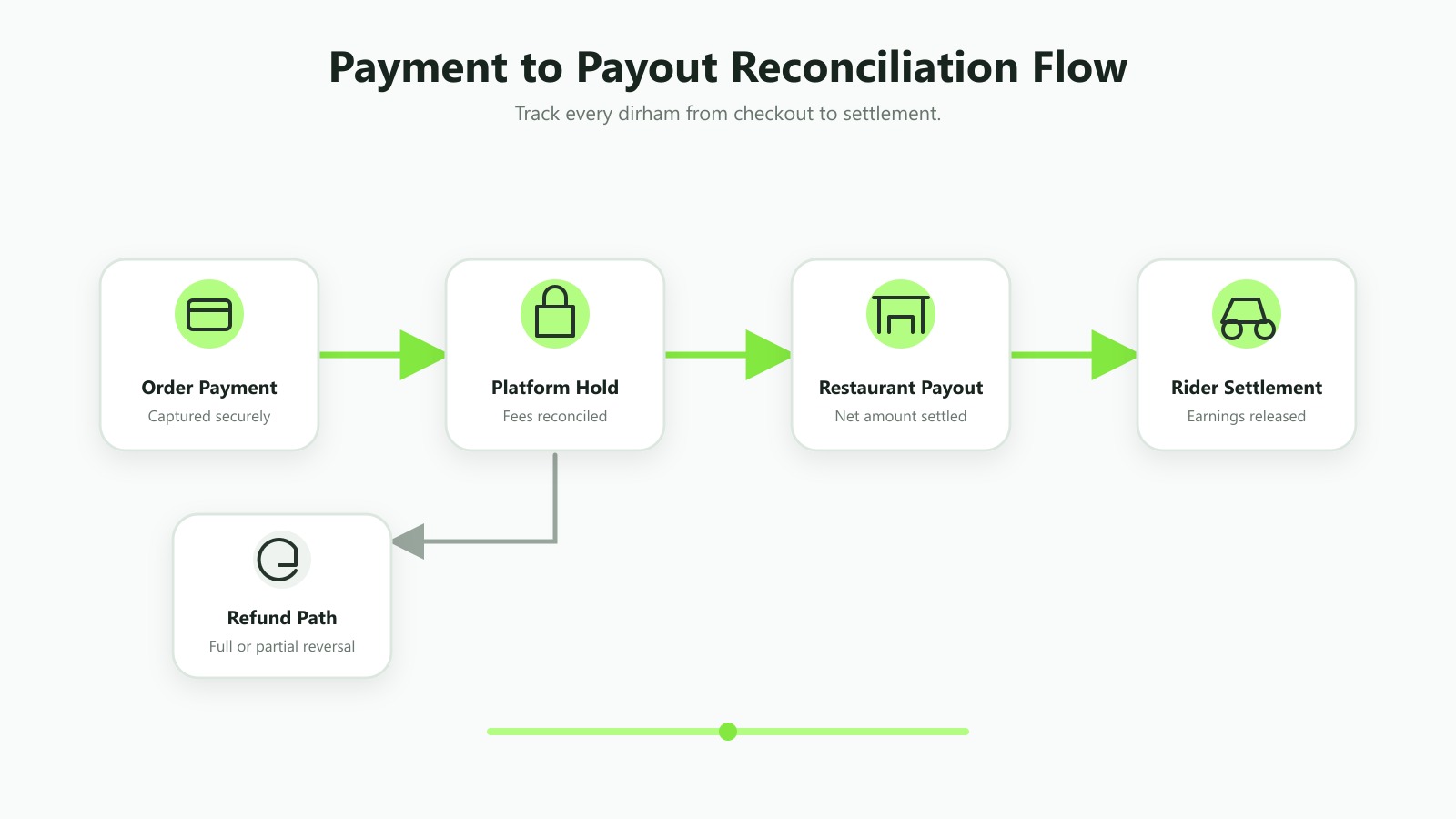
How are payments, refunds, and financial reconciliation handled?
Payments in a food delivery app cover collection, refunds, and settlement across parties. Money moves between four parties on every order. Customer, platform, restaurant, and rider each hold a stake. Clean reconciliation keeps all four in balance each day.
Authorisation holds funds at checkout. Capture takes payment when the restaurant accepts. Refunds return funds when an order fails, or a customer cancels in time.
Security wraps the whole flow. Tokenisation replaces card data with a safe token. PCI DSS rules govern how the platform stores and moves that data.
Settlement splits each payment into parts. The restaurant gets its share minus commission. Riders get their payout. VAT at 5% applies across the UAE.
Payout timing shapes cash flow. Restaurants expect a clear schedule, weekly or faster. A transparent statement shows each order, fee, and tax line.
Cash on delivery still carries weight in the UAE. The driver app records cash against the order at the door. End-of-day reconciliation matches collected cash to orders without a spreadsheet.
Disputes need a clear path. Chargebacks, missing items, and refunds hit the ledger. A structured flow resolves each case and keeps the books clean.
Tourists add a currency layer. Multi-currency display helps visitors read prices in their own money. Settlement still lands in AED for the local business.
How do food safety and delivery traceability work in Dubai?
Food safety and traceability track every order from kitchen to door. Dubai regulates food safety through digital systems. FoodWatch records supplier data, temperature logs, and hygiene checks. Municipality inspectors read those records on every visit.
Traceability links each order to its ingredients and handlers. A recall then reaches the right orders, not the whole menu. Tamper-evident seals confirm the food arrived untouched.
Allergen data belongs in the flow. The app shows allergens on each dish before checkout. Clear labels protect the customer and the brand.
Cold chain matters in a hot climate. Chilled and frozen items need constant temperature control. The system watches that temperature from kitchen to door.
IoT sensors for food safety during last-mile delivery
IoT sensors watch food while it moves. A small temperature logger sits inside the delivery bag. It streams readings to the platform through the trip.
An alert fires the moment a hot bag cools below the safe line. Managers pull a late or unsafe order before it reaches the customer. Sensor logs also prove cold-chain compliance to inspectors.
Digital proof of delivery closes the loop. A photo, signature, or code confirms handoff. The record ties the temperature history to the exact order.
Sensor data also improves operations. Repeated cold readings on one route expose a bag or a rider problem. Managers fix the root cause, not the symptom.
What compliance and process rules apply to Dubai food delivery apps?
Dubai food delivery apps must meet food safety, data, and licensing rules. FoodWatch registration is mandatory and free for every food business. DMChecked now extends that digital compliance layer. Both track hygiene, suppliers, and inspection history.
Cloud kitchens carry their own permit stack. A DM Food Establishment Permit, kitchen sign-off, and Civil Defence approval come first. Only then can a brand cook for delivery.
Licensing runs through the right authority. Mainland businesses answer to the Department of Economy and Tourism. Free-zone kitchens follow their zone’s own rules.
Data rules apply to the app itself. The UAE PDPL governs how customer data gets stored and shared. VAT at 5% and e-commerce rules cover the transaction side.
Rider operations need their own checks. Delivery riders need valid permits and roadworthy vehicles. The platform should log these details against each account.
Compliance is a process, not a one-time task. Inspections repeat, and rules change. A platform that logs everything makes each audit fast.
An AI workflow automation agency in Dubai can wire these compliance checks into daily operations.
How much does it cost to build a food delivery app in Dubai?
A food delivery app in Dubai has no single price. Cost tracks scope, integrations, and compliance, not a headline number. A focused first version starts near AED 40,000. Full platforms with driver, restaurant, and admin apps cost more.
| Build scope | Planning reference (AED) | Fit |
| MVP, one flow (order and track) | 40,000 to 150,000 | Test one market |
| Standard app (customer, restaurant, driver, admin) | 150,000 to 450,000 | Single-city launch |
| Enterprise platform (AI dispatch, integrations, multi-city) | 450,000+ | Chains, cloud kitchens |
Several drivers move the number. Feature depth, platform count, and design effort set the base. Integrations, AI models, and compliance work add on top.
| Cost driver | What it covers |
| Apps and platforms | Customer, restaurant, driver, admin, web |
| Features | Ordering, dispatch, tracking, payments, chat |
| AI models | Recommendations, ETA, dispatch, forecasting |
| Integrations | POS, payments, maps, ERP, CRM, fleet |
| Compliance | FoodWatch, PDPL, VAT, permits |
Hidden costs sit after launch. Cloud, map calls, payment fees, and support continue each month. A build budget that ignores these understates the real figure.
Ownership decides long-term cost. A custom build carries a higher start cost and full control. Off-the-shelf SaaS starts low and charges fees for as long as you run it.
The cost to build an app like Talabat or Careem
An app like Talabat or Careem is an enterprise platform, not an MVP. It carries AI dispatch, deep integrations, and multi-city scale. Budgets for that scope start around AED 450,000 and rise with features.
Scale drives the spend. Multi-city zones, third-party fleets, and heavy traffic need strong infrastructure. Each capability adds engineering and testing time.
Timeline runs three to twelve months by scope. Scope the workflows first, then request estimates. Our guide to logistics app development cost in the UAE breaks down the same method.
Why choose Code Brew Labs for food delivery app development?
Code Brew Labs is an enterprise-grade AI app development company. We have engineered AI-first digital products since 2013.
Our teams serve the UAE, the Middle East, and global markets. Delivery spans more than 35 industries, including food delivery, fintech, healthcare, and real estate.
For food delivery, we build across ordering, dispatch, payments, and safety. Each build ships with UAE compliance and integrations in place.
Our process runs from discovery to launch and beyond. We scope the workflows, design the system, and ship in phases. Support and iteration continue after go-live.
Dlvrd, bilingual food ordering for the GCC
We built Dlvrd, a bilingual food ordering platform for the GCC. The client needed Arabic and English ordering with reliable dispatch. We delivered ordering, dispatcher logistics, and a reporting layer. Dlvrd now runs live orders across its service area.
Tunche, multi-category ordering with smart dispatch
Tunche, a multi-category ordering app with smart dispatch. Orders spanned food and other categories in one flow. We added geofencing and dispatch to keep deliveries on time. Tunche routes each order to the nearest available rider.
Dukaan, grocery delivery with live inventory
Dukaan, a grocery delivery platform with live inventory. The team needed stock and dispatch to stay in sync. We built real-time inventory and delivery dispatch together. Dukaan shows customers only what a store can fulfil.
We own the full lifecycle from discovery to launch and support. You keep source code, data, and control at handover. See more builds in our food delivery app portfolio.
We engineered Dlvrd, Tunche, and Dukaan across the GCC and global markets.
Conclusion
A food delivery app in Dubai wins on operations, not features alone. AI dispatch, deep integrations, and live intelligence hold the peak hour together. Compliance with FoodWatch and PDPL keeps the platform safe to run.
Go back to that Friday night in Business Bay. Start with the workflow that breaks first. Prove it, then scale across brands, cities, and the wider GCC.
FAQs
How much does it cost to build a food delivery app in Dubai?
Food delivery app development in Dubai has no fixed price. Cost tracks scope, integrations, and compliance. A focused MVP starts near AED 40,000. Standard apps with customer, restaurant, driver, and admin run higher. An enterprise platform with AI dispatch and multi-city scale starts around AED 450,000. Scope the workflows before requesting estimates.
How long does food delivery app development take?
Timelines depend on scope. An MVP ships in about three to four months. A standard app runs five to seven months. An enterprise platform with AI dispatch and integrations takes eight to twelve months. A phased plan puts a working release in market before advanced features.
How do I build an app like Talabat or Careem?
An app like Talabat or Careem is an enterprise build. It needs customer, restaurant, and driver apps, plus AI dispatch and payments. Budgets for that scope start around AED 450,000. Features like multi-city zones and third-party fleets add cost. Most builds of this size run eight to twelve months.
Do food delivery apps in Dubai need FoodWatch registration?
Yes. Every food business in Dubai must register on FoodWatch, and now DMChecked. Registration is free and mandatory. The platform tracks suppliers, temperature logs, and hygiene records. Municipality inspectors check those records on each visit. A delivery app should tie into this compliance layer from launch.
Can the app support Arabic and English voice ordering?
Yes. The app can support Arabic and English voice ordering from launch. Speech recognition handles Gulf Arabic and mixed-language orders. Right-to-left layout keeps the Arabic screen clean. Voice ordering cuts friction for repeat buyers and drivers. Design for both languages at the start, not as a later patch.
How does AI dispatch reduce delivery times?
AI dispatch cuts delivery times by matching, batching, and routing in real time. It assigns each order to the best-placed rider in under a second. Batching combines nearby drops to save trips. Live routing avoids traffic and reroutes mid-trip. Throttling paces orders so kitchens hold quality at peak.
Which payment methods should a UAE food delivery app support?
A UAE food delivery app should support cards, wallets, and cash on delivery. Gateways like Network International, Telr, and PayTabs handle card payments. Apple Pay and Careem Pay cover wallet demand. Cash stays common, so the driver app must record it at the door. VAT at 5% applies to each transaction.
Can one platform run multiple cloud kitchen brands?
Yes. One platform can run several cloud kitchen brands from a single kitchen. Each brand keeps its own menu, storefront, and reports. Shared staff cooks every order from one queue. Brand-level analytics show which concept performs. Operators launch and retire brands without new premises.
How does the app protect customer data under UAE PDPL?
The app protects customer data under the UAE PDPL. It collects only what an order needs and states why. Consent screens keep users in control of their data. Storage and sharing follow the law’s conditions. Strong privacy design builds the trust that retention depends on.
Should I build a custom app or use an off-the-shelf platform?
Both have a place. Off-the-shelf platforms launch fast and suit a simple, single-brand start. Custom builds fit complex operations, deep integrations, and full data ownership. Many UAE operators start lean, then move to custom as volume grows. The right choice tracks scale, control, and long-term cost.
Let's Convert Your Business Idea Into Success!
Free Consultation from Top Industry Experts
Let’s Build Your Dream App!
Share article on :


 No commitment required
 NDA on request
 24-hour response


