
Quick Summary:
- You can build a mobile app in Dubai in 4 to 9 months on average.
- Simple apps ship in 2 to 4 months; enterprise apps run 9 to 14 months.
- Development and backend work eat the largest share of the calendar.
- Testing comes second, often taking three to eight weeks on its own.
- UAE PASS, PDPL, and sector approvals each add roughly two to six weeks.
- Arabic support with right-to-left design adds two to four weeks of work.
- AI features such as chatbots or recommendations add four to twelve weeks.
- A tight first version and a cross-platform build cut months off launch.
You can build a mobile app in Dubai in as little as two months, or push past a year for an enterprise system. The honest answer sits between those poles, and it depends on three things.
- How complex the app is.
- How much regulation it touches.
- How firmly you hold the scope.
Most buyers arrive with a number from a global perspective. That number was written for a market with no UAE PASS login, no Arabic layouts, and no DHA sign-off. It breaks the moment your project meets reality.
Demand is not your problem. The UAE has 21.9 million mobile connections, nearly 195% of its population, with 99% internet penetration (DataReportal, Digital 2025 UAE). Your users are already on their phones.
This guide gives you the real 2026 timeline for each type of app. You will see the stages that quietly consume months. By the end, you will hold an AED range and a plan you can take to a board.
Want a realistic build timeline for your app idea before you commit budget?
How long does it take to build a mobile app in Dubai in 2026?
A standard business app takes four to nine months from first meeting to store launch. That is the range most companies fall into. Simpler tools go live sooner, and heavier systems need longer.
Complexity is the real dial. A single-purpose app moves fast. An app with payments, live tracking, and three types of users takes far more engineering underneath the surface.
| App complexity | Timeline | Indicative cost (AED) | Example |
| Simple | 2 to 4 months | 55,000 – 150,000 | Single-feature utility, basic booking |
| Medium | 4 to 6 months | 150,000 – 350,000 | Mobile ordering app, chat app |
| Complex | 6 to 9 months | 350,000 – 700,000 | Multi-role marketplace, fintech |
| Enterprise | 9 to 14 months | 700,000 – 1,800,000+ | Super app, digital bank, mission-critical |
Independent data backs these bands. GoodFirms found simple apps need three to seven weeks of coding, and advanced apps thirteen to nineteen weeks (GoodFirms 2022 survey). Those windows count active build time. Once you add discovery, compliance, and store review, the full calendar reaches the ranges shown.
| The AED figures are indicative Dubai-market ranges, drawn from GoodFirms data and our own project history. Your exact quote moves with feature depth and how many systems the app connects to. |
Teams weighing a partner tend to start by shortlisting a mobile app development company in Dubai that can scope the whole build before a contract exists.
What decides how long it takes to build a mobile app?
Two apps with the same number of screens can differ by four months. The difference lives in a short list of decisions you control from day one. Understanding them protects your launch date.
Feature depth
Features are where time hides. A login screen and a news feed are quick to build. A digital wallet, live GPS tracking, or offline mode each needs weeks of engineering and testing. Every advanced feature you add extends the development stage.
Number of user types
A customer-only app is one build. Add a merchant panel and an admin dashboard, and you now have three connected products. Each user type needs its own screens, permissions, and testing, so the calendar grows with every role.
Third-party connections
Most apps plug into outside services for payments, maps, or messaging. Each connection saves you from building that piece yourself. It also adds integration and testing time, since you must handle errors, security, and edge cases for every service.
Platform choice
Building for iPhone and Android separately means two codebases and two rounds of testing. A cross-platform build shares one codebase across both. The path you pick can swing the timeline by weeks.
Design maturity
A template-led design moves fast. Custom animations, a full brand system, and pixel-level polish add weeks of design and front-end work. The richer the experience, the longer the design stage runs.
Compliance load
A simple retail app carries almost no regulation. A health or finance app must pass audits before launch. That approval work is real calendar time, and we cover it in detail further down.
Each factor is a lever you can pull early. Set them well at the start, and the rest of the build tends to hold its schedule. A custom software development company in Dubai can estimate against your exact feature list before you commit.
The steps to build a mobile app in Dubai (and how long each takes)
Six stages carry almost every project from idea to launch. Knowing what each one delivers helps you spot where time goes.
Discovery and scoping (2 to 4 weeks)
Discovery is where the app is defined before anyone writes code. Your team agrees on features, user journeys, and the technology behind the app. A sharp discovery phase saves months later, because it removes the guesswork that forces expensive rebuilds.
UI/UX design (3 to 6 weeks)
Design turns the plan into screens people can see and tap. First come wireframes, which are the rough skeletons of each screen. Those become a clickable prototype, then a full design system. Stakeholders approve the look here, before development starts.
Development (8 to 20 weeks)
Development is the longest stage and the heart of the build. Engineers write the front end, which is what users touch, and the back end, which is the engine behind it. Most of your months live inside this stage.
Integration (2 to 6 weeks)
Integration connects the app to the outside services it needs. Payment gateways, maps, and notification systems all get wired in and tested. Each connection carries its own failure cases, so testing takes real time.
QA and testing (3 to 8 weeks)
Quality assurance is where the app gets stress-tested before real users see it. Testers check every feature, run security scans, and try the app across many devices. UAE apps add a bilingual pass across English and Arabic, which extends this stage.
Launch and store approval (1 to 3 weeks)
Launch puts the app in front of the world through the App Store and Google Play. Apple review usually runs one to three days, and Google Play often clears faster. A rejection restarts that clock and can add a week or more.
One choice shapes all six stages: agile delivery. Agile teams ship in short cycles and adjust as they learn. Agile projects succeed about twice as often as older waterfall methods (Standish CHAOS, summarized).
Which stages take longest when you build a mobile app?
Development and backend work take the most time on nearly every project. Design feels visible, so buyers assume it dominates. The reality is that the hidden engineering decides your launch date.
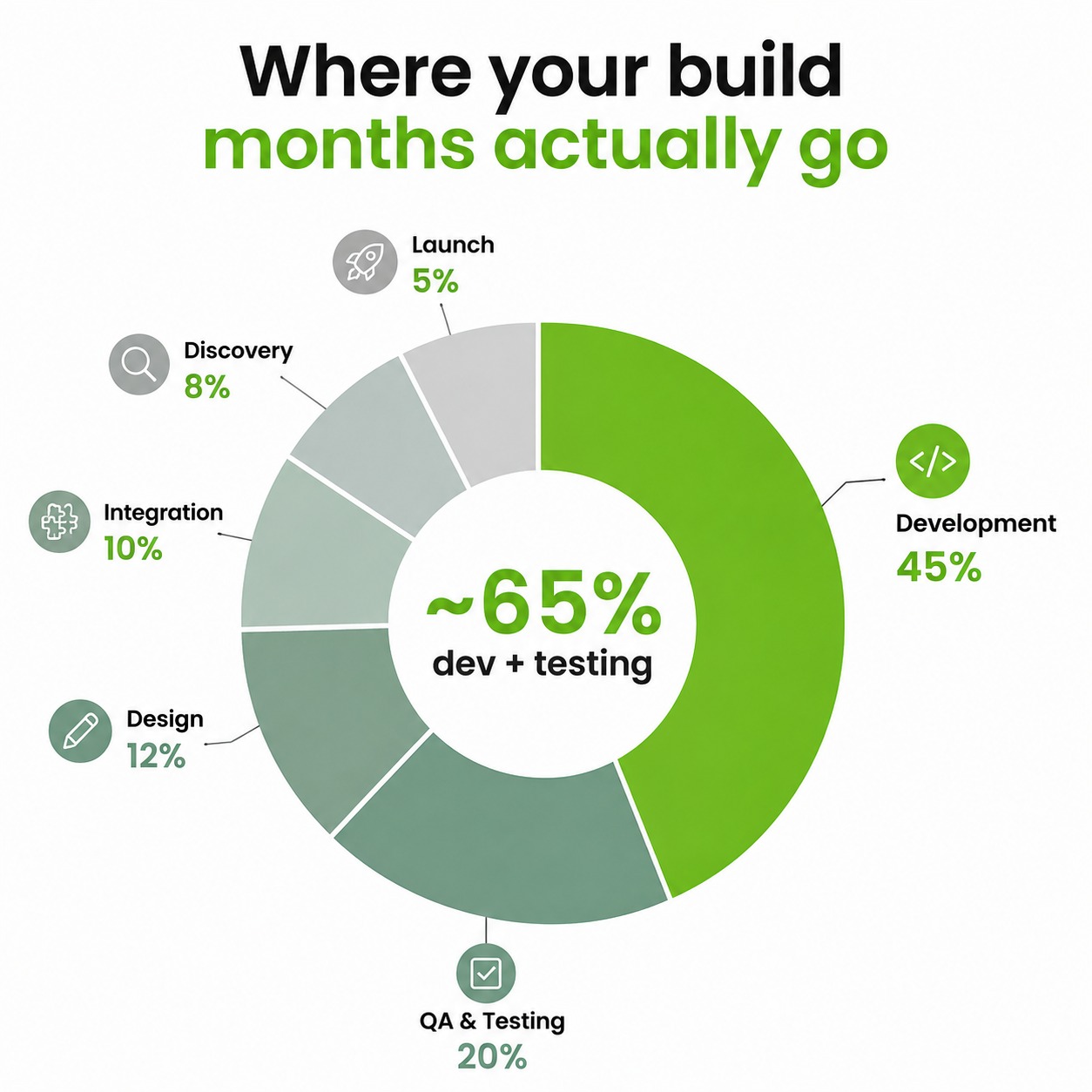
Development is the long pole
Every feature is a cycle of writing code, reviewing it, and fixing what breaks. Complex logic such as a wallet or a live map multiplies those cycles. The more your app has to do, the longer this stage runs.
The back end is invisible and heavy
The back end never shows on a screen, yet it carries the heaviest load. It holds your database, your business rules, and the servers that keep everything running. Users never see it, but it takes weeks to build right.
Testing is where quality is won or lost
Testing protects your brand on launch day. Regulated apps and multi-role apps need long test cycles, because a single fix can open a new bug. Rushing this stage is how public failures happen.
Scope changes are the quiet threat behind all of this. Around half of software projects overrun their schedule or budget (Standish CHAOS). A feature added in month four sends ripples back through design, development, and testing.
The lesson for buyers is simple. Guard development and testing from mid-flight changes, and the calendar tends to behave.
How app complexity changes the time to build a mobile app
Complexity, not screen count, decides how long you wait. A ten-screen app with a payment wallet outranks a twenty-screen catalogue. Use the four tiers below to place your product honestly.
Simple apps (2 to 4 months)
A simple app does one thing for one type of user. A booking tool or a company app fits here. Standard design components and few connections keep the build light and fast.
Medium apps (4 to 6 months)
A medium app adds accounts, payments, and a few connected services. A mobile chat app or a mobile ordering app lives at this level. Two user types are common, which grows the testing load.
Complex apps (6 to 9 months)
A complex app has multiple user types, live features, and deep integrations. Marketplaces and finance apps qualify. Custom design and stronger security push the timeline toward the upper end.
Enterprise apps (9 to 14 months)
An enterprise app runs at large scale with strict rules and legacy connections. Super apps and digital banks sit here. Heavy load handling, audits, and governance stretch every single stage.
Each jump between tiers usually adds a feature that touches the back end. That is why a request that sounds small can quietly move your app a full tier higher.
Steps to build a mobile app for ordering, chat, and restaurants
Three app types come up again and again in Dubai. Below is what goes into each, what every feature adds for your users, and how it affects the timeline. Read these if you want a feel for your own build.
How to build a mobile ordering app
A mobile ordering app lets customers browse products, customize an order, pay, and track delivery. Retail, grocery, and pharmacy brands across the UAE rely on this model. A typical build runs four to seven months.
- Product catalogue with search. This is the digital shelf your customers browse. It adds a week or two, since search and filters need indexing and testing across large product lists.
- Cart and checkout with a UAE payment gateway. Checkout is where money changes hands, so it must be secure and reliable. Payment integration adds two to three weeks, because every transaction path has to be tested for failure.
- Live order tracking. Tracking shows the customer where their order is on a map. It adds two to three weeks, since it needs GPS data, a live connection, and testing across weak networks.
- Customer, merchant, and admin roles. Three roles mean three connected apps working together. Each role adds screens and permissions, which extends both development and testing.
- Push notifications. These are the alerts that tell a customer their order is confirmed or on the way. They are quick to add, though they still need setup and delivery testing.
How to build a mobile chat app
A mobile chat app handles real-time messaging, presence, and media sharing. The chat bubble is the easy part. The hard part is the infrastructure that delivers every message instantly and keeps it private. Expect four to eight months.
- Real-time messaging with receipts. Messages must arrive the instant they are sent, with delivered and read markers. This needs a real-time server setup, which is a core reason chat apps take longer than they look.
- Media and file sharing. This lets users send photos, videos, and documents. It adds time, because files need upload handling, storage, and compression to stay fast.
- Group chats and presence. Groups and online status let people see who is available. Group logic is complex to build and test, since many users act at once.
- End-to-end encryption. Encryption keeps messages readable only by the sender and receiver. It is a privacy must-have, and it adds weeks because security has to be tested with care.
- Offline sync. This delivers messages once a user comes back online. It adds testing time, since the app must handle poor connections without losing data.
How to build a mobile app for restaurants
A restaurant mobile app blends menu browsing, ordering, payment, and loyalty in one place. Cloud kitchens and chains add live dispatch on top. A build usually takes four to seven months.
- Digital menu with modifiers. This is the interactive menu where customers pick items and add extras. It adds moderate time, since combos and options need careful data setup.
- Dine-in, takeaway, and delivery flows. Each order type behaves differently and needs its own screens and logic. More flows mean more to build and test.
- Payment and split-bill support. This lets groups share a bill and pay in-app. Split payments add logic and testing time on top of a standard gateway.
- Loyalty and reorder features. These reward repeat customers and speed up ordering. They add a week or two, since points and offers need rules and tracking.
- Kitchen and rider dashboards. These show live orders to staff and drivers. Real-time dashboards are complex, so they push a multi-branch build toward the higher end.
For a deeper walkthrough on this vertical, our team keeps a full guide on how to build a food delivery app in Dubai that covers AI dispatch and rider logistics.
Android, iOS, or cross-platform: the fastest way to build a mobile app
Your platform choice shapes both timeline and reach. iPhone users in the UAE tend to spend more per head, while Android carries the widest device footprint. The route you pick sets your calendar, so it is worth understanding before you commit.
Native app development
Native development means building a separate app for each platform in its own language. iPhone apps are written in Swift, and Android apps in Kotlin. This approach gives you the smoothest performance and full access to every device feature, from the camera to biometric login.
The trade is time. Two platforms mean two codebases and two rounds of testing. Building both native apps can add 40 to 60% to the timeline over a single build. You choose this path when performance and deep device features matter most.
Cross-platform app development
Cross-platform development takes one codebase and ships it to both stores. Frameworks such as Flutter and React Native make this possible. One team writes the app once, then releases it on the App Store and Google Play together.
The payoff is speed. Most teams save around a third of the calendar this way, since there is a single build to write and test. For the majority of business apps, the performance gap is now hard for a user to notice.
Which path is faster for your app?
Cross-platform wins on speed and budget for most products. It is the shortest route to a wide audience across both stores. A tighter build and a single test cycle are what pull the timeline in.
Native still earns its place in specific cases. Heavy graphics, deep hardware features, or the last few percent of performance can justify it. Let your product goals decide the path, rather than habit or trend.
Why UAE apps target both stores
The UAE market rewards reach across iPhone and Android. Mobile connections sit at 195% of the population (DataReportal Digital 2025 UAE). Covering only one platform leaves a serious share of users behind.
To weigh the options with specialists, it helps to talk to an Android app development company in Dubai and an iOS app development company in Dubai, UAE before you decide.
How long does it take to build a mobile app in each industry?
Timelines shift by sector, because regulation and feature depth shift by sector. A booking app and a digital bank sit worlds apart. Below is how the verticals we build most tend to behave in the UAE.
Food delivery and restaurant ordering apps
Usually take four to seven months. The weight comes from real-time dispatch, payment handling, and the three user types these platforms need. You can plan a build with a food delivery app development team in the UAE that has shipped this model before.
E-commerce apps
Land around four to six months. Product catalogues, payment gateways, and delivery integrations drive most of that time. The compliance surface is light, which keeps the pace brisk. An E-Commerce app development company in Dubai can scope the catalogue and checkout together.
Fintech and digital wallet apps
They sit at the top, at seven to twelve months. The reason is oversight. These apps pass through the Central Bank sandbox, add strict identity checks, and face security audits that other sectors never touch. A fintech app development company in Dubai plans that approval work into the schedule.
Healthcare and telemedicine apps
Need six to ten months. They answer to DHA and MOHAP, and patient records fall under data-residency rules. That compliance work is real calendar time, which is why a healthcare app development company in the UAE builds it into the plan from the start.
Real estate and property apps
Require five to eight months. Listings, RERA and DLD data, and virtual tours shape the build. A real estate app development partner in Dubai can connect the local property data your users expect.
Logistics and last-mile apps
These take six to nine months. Live fleet tracking and route optimization sit at the core, and both are heavy to build and test. A logistics app development company in the UAE will build you a ready tracking stack.
How long does it take to build a mobile app with AI features?
AI moves your timeline in both directions. Smart features add weeks to the build, while AI tools cut weeks off the work. The net effect depends on how deep your AI goes.
AI features that add time
Rule-based chatbot (+2 to 4 weeks)
This is a simple assistant that answers set questions using fixed rules, like a phone menu in chat form. It is quick to add, since it follows a script rather than thinking.
Conversational AI assistant (+6 to 12 weeks)
A chatbot powered by a large language model that understands free text and replies in natural language. It needs data pipelines, careful prompt design, and safety testing, so it takes far longer.
Recommendation engine (+4 to 8 weeks)
Suggests products or content based on what a user likes, the way Netflix suggests shows. It adds time, since it needs data and tuning to make good suggestions.
Computer vision (+6 to 10 weeks)
Lets the app understand images, such as scanning an ID or reading a receipt. It adds weeks because the model needs training and heavy accuracy testing.
Predictive analytics (+4 to 8 weeks)
Forecasts outcomes from past data, such as predicting demand or churn. It adds time for data modelling and validation before you can trust it.
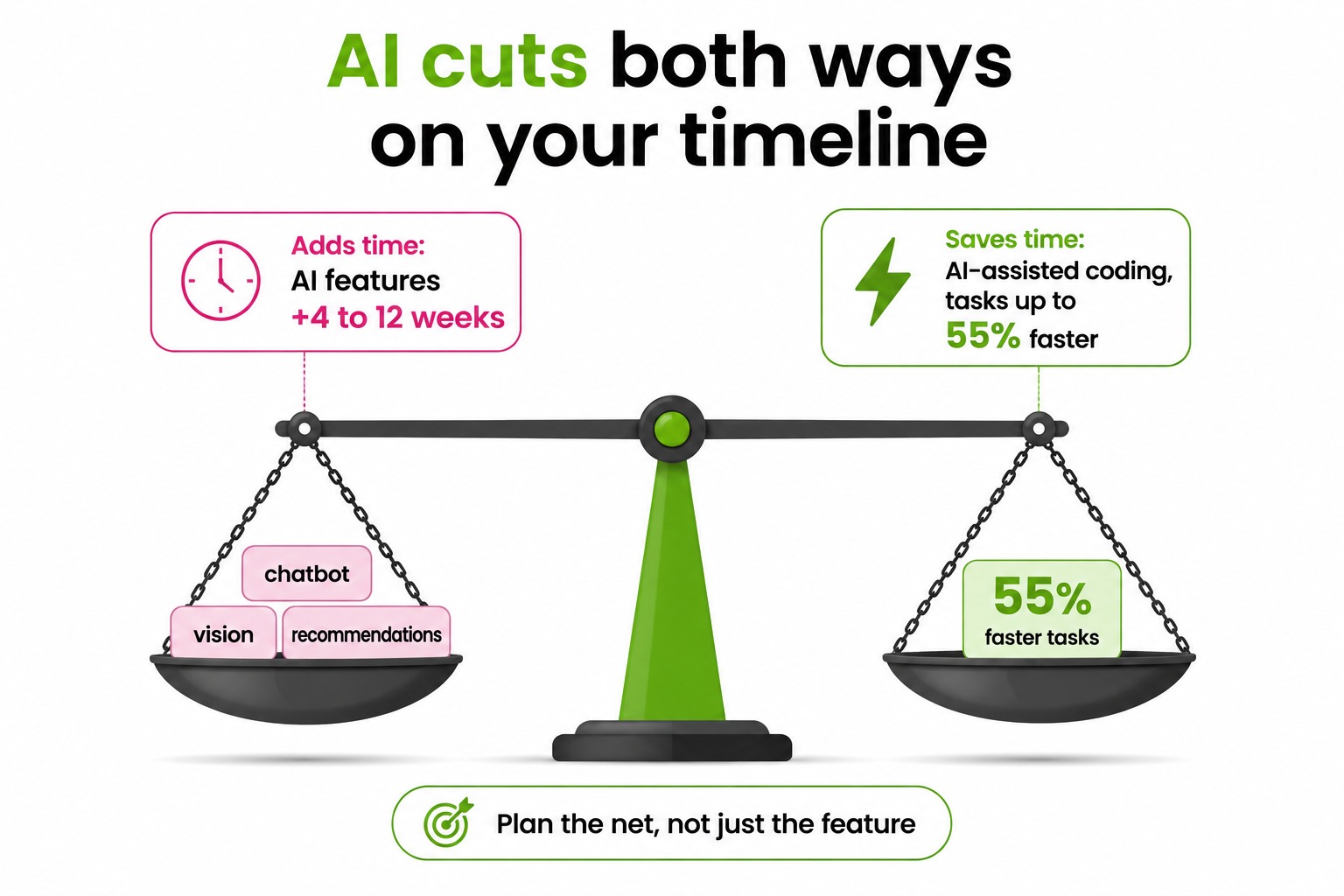
AI that saves time
The same technology speeds up the team building your app. Developers using GitHub Copilot finished a coding task 55% faster in a controlled study (GitHub research). Used well, AI tools trim the development stage.
Adoption has moved from experiment to routine. About 65% of organizations now use generative AI, close to double the year before (McKinsey, State of AI 2024).
To plan AI scope without overspending, work with an AI app development company in Dubai and check current pricing in our AI development cost in the UAE guide.
Adding AI to your app? A phased delivery plan that shows where every week goes.
How UAE rules change the time to build a mobile app
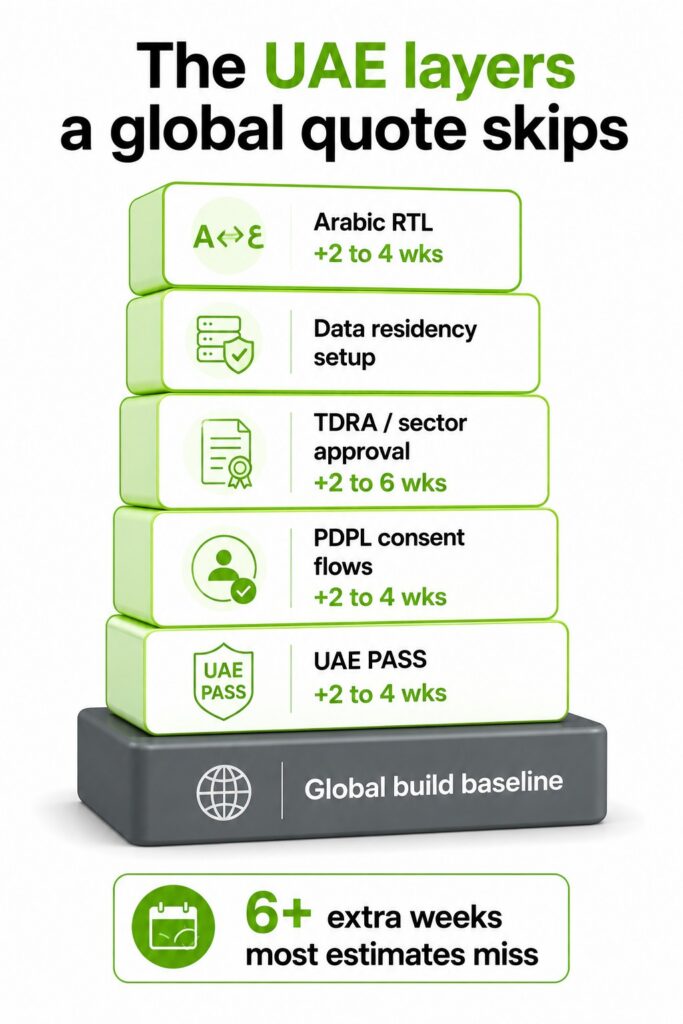
Compliance is a line-item on your calendar, not a footnote. Global timeline estimates ignore it. In the UAE, the right approvals can each add two to six weeks, so plan for them early.
UAE PASS integration
UAE PASS is the national digital identity that lets residents log in and sign documents securely. Adding it gives your app trusted, verified sign-in. It adds an integration and a review cycle, which is why apps that need it run longer.
PDPL compliance
The Personal Data Protection Law governs how you collect and store user data. It protects your users and shields your business from fines. Building consent flows and secure storage to meet it adds real development and testing time.
TDRA requirements
The Telecommunications and Digital Government Regulatory Authority sets rules for certain app categories. Meeting them keeps your app live and lawful. Some categories need approvals before launch, which adds to the schedule.
Sector regulators
Some industries answer to their own bodies. Health apps must satisfy DHA and MOHAP, and finance apps pass through the Central Bank sandbox. These reviews are thorough, so they extend the timeline for regulated apps.
Data residency
Some sectors require user data to stay on servers inside the UAE. This affects where and how you host the app. Meeting it can add infrastructure work at the start of the build.
Arabic and bilingual support
Arabic is a build task, not a quick toggle. It uses right-to-left layouts, which means screens must be redesigned to flow the other way, then retested. Budget two to four weeks for right-to-left design and bilingual quality checks across every screen.
The UAE holds digital work to a high bar, and buyers should plan for that rigor. Dubai became the first city to run a fully paperless government, saving about AED 1.3 billion (Digital Dubai). The wider D33 agenda targets AED 32 trillion in output over a decade (UAE Government).
For regulated builds, our fintech app development in the Middle East guide walks through compliance sequencing step by step.
Why projects get delayed when you build a mobile app
Most overruns trace back to a short list of causes. Each one carries a time cost you can plan around. Knowing them in advance is how you keep a launch date honest.
Unclear or shifting requirements (+2 to 4 weeks)
A vague brief forces the team to guess at what you want. Once the real intent surfaces, they rebuild. Shifting requirements are the single most common reason apps run late.
Late sign-offs (+1 to 3 weeks)
A design waiting days for approval stalls everything behind it. Slow decisions ripple through the whole schedule. Fast, empowered approvers are one of the cheapest accelerators you have.
Third-party delays (+1 to 3 weeks)
Your app depends on outside services for payments or data. When a provider is slow to grant access or fix a bug, your team waits. That wait is outside your control, so plan a buffer.
Store rejection loops (+1 to 2 weeks each)
Apple or Google can reject an app for policy or privacy issues. Each rejection restarts the review clock. Clean metadata and clear privacy disclosures cut this risk sharply.
Scope creep mid-build (+3 to 6 weeks)
A feature added in month four is far costlier than one planned at the start. It reopens design, development, and testing. Around half of projects overrun for reasons like these (Standish CHAOS).
How to build a mobile app faster in Dubai
You can compress the calendar without cutting corners. The aim is to shorten elapsed time, not to pile pressure on the team. Five levers do most of the work.
Ship an MVP first
An MVP is a minimum viable product, the smallest version that delivers real value. Launching it puts your app in the market months sooner. You then grow it with features shaped by real user behaviour, which avoids wasted effort. Around 43% of startups fail from poor product-market fit (CB Insights 2024), so testing demand early pays off.
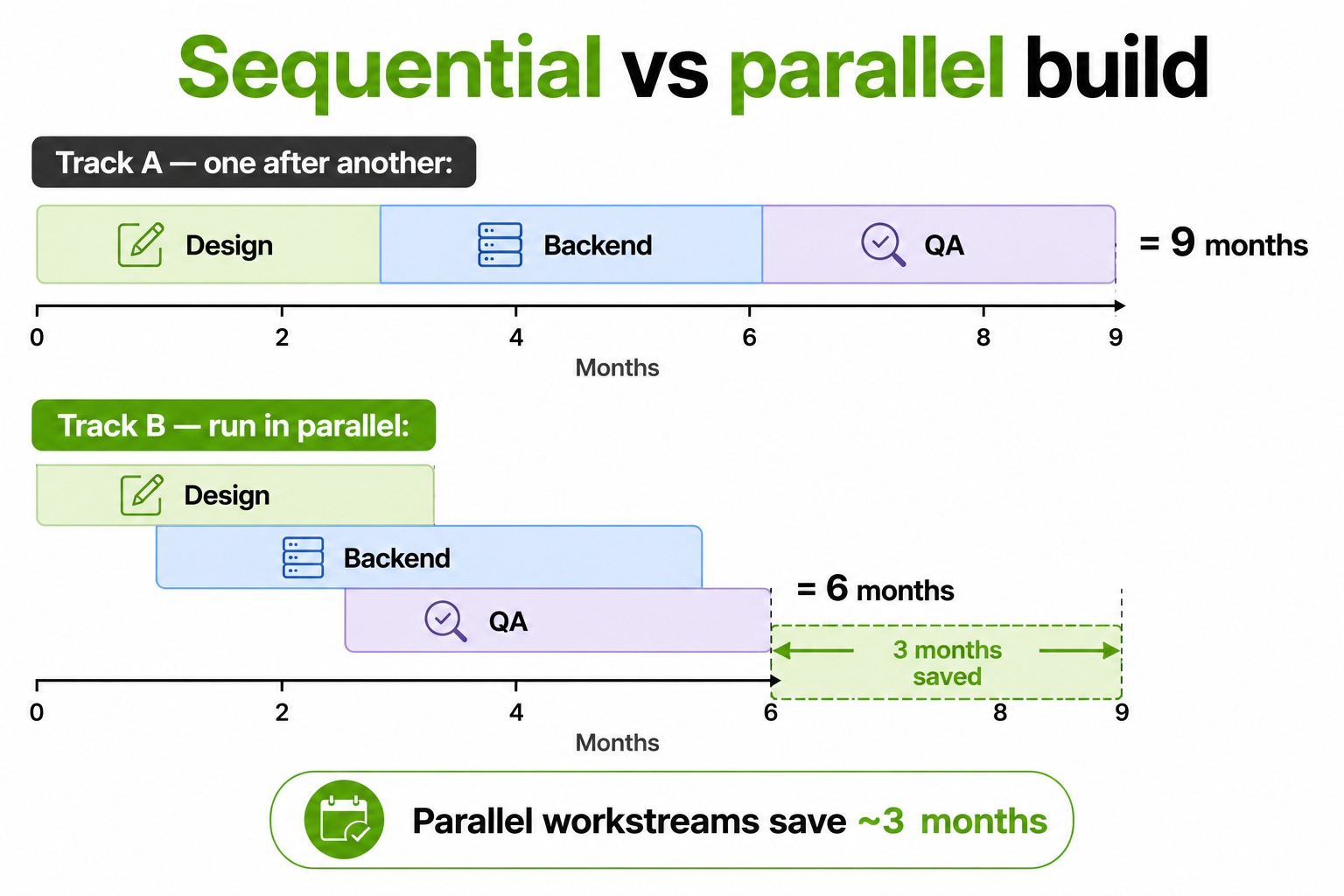
Run workstreams in parallel
Design, back end, and content prep can advance at the same time. Working them in parallel, rather than one after another, removes weeks of waiting. A well-staffed team makes this possible.
Build cross-platform
One codebase for both stores saves around a third of the timeline. For most business apps, this is the fastest route to a wide audience. Native remains the choice only when performance demands it.
Reuse proven modules
Many features are already solved. Pre-built login, payments, and chat components skip work your team would otherwise repeat. Reusing them shaves real time off the build.
Lock scope early
A frozen first-version feature list keeps the critical path clean. Every new idea gets parked for version two. This one habit prevents the scope creep that wrecks schedules.
How your team affects the time to build a mobile app
Team shape drives velocity as much as feature count. One developer and a full pod produce very different calendars. Adding people late rarely rescues a slipping deadline.
A single developer can handle a simple app, though slowly, since one person cannot work on many parts at once. A dedicated pod runs design, front end, back end, and testing together. That overlap is where the real time savings come from.
A typical pod holds a project manager, two developers, a designer, and a quality engineer. Each role owns a lane, and the lanes move in parallel. The result is a faster, steadier build than any solo effort can match.
There is a trap worth naming. Adding people to a late project often slows it further. New members need context, and bringing them up to speed costs the team more than it gains at first. The fix is to plan the right pod at the start.
When you need a ready team without a long hiring cycle, you can hire app developers in Dubai as an extension of your own staff.
What happens after you build a mobile app?
Launch day is a milestone, not the finish line. A live app enters a rhythm of monitoring and updates. Planning this phase keeps your product healthy and your users loyal.
In week one, the team watches closely for crashes and early feedback, with hotfixes ready. Small issues always surface once real users arrive, and quick fixes protect your reviews and ratings.
Across weeks two to four, a first patch cleans up the rough edges. This version 1.1 addresses the bugs and friction that testing could not fully predict. It signals to users that the app is cared for.
Between weeks six and twelve, the first real feature update lands. By now you have usage data showing what people actually do. That evidence guides what you build next, so the roadmap follows demand.
From there, maintenance becomes ongoing. Every new iOS and Android release can affect your app, so it needs regular compatibility work. An app left untouched drifts out of date within a year as phones and systems move on.
Budget for this phase from the start. A maintenance plan is part of the true cost of owning an app, and skipping it is a false economy.
How much does it cost to build a mobile app in Dubai?
Cost tracks the timeline closely, because both climb with complexity. More features mean more engineering hours, and hours drive the AED figure. The ranges below mirror the complexity tiers from earlier in this guide.
| App complexity | Timeline | Indicative cost (AED) |
| Simple | 2 to 4 months | 55,000 – 150,000 |
| Medium | 4 to 6 months | 150,000 – 350,000 |
| Complex | 6 to 9 months | 350,000 – 700,000 |
| Enterprise | 9 to 14 months | 700,000 – 1,800,000+ |
Three things push you toward the top of a band. More user types, deeper integrations, and stricter compliance each add hours the estimate must absorb. A wallet, a live tracker, or a DHA audit are common examples.
These ranges draw on GoodFirms cost data converted to AED (GoodFirms 2022) alongside local project history. For a figure tailored to your idea, see our full breakdown on how much it costs to develop an app in Dubai.
Why choose Code Brew Labs to build a mobile app in Dubai
Code Brew Labs has spent more than thirteen years building enterprise mobile apps in the UAE market. In that time, we have launched over 2,600 custom apps, and it keeps 650-plus developers based in the country. A 95% client retention rate is the number the team is quietest about and proudest of.
That history shapes how we approach a build. Compliance comes first and product second, because a UAE app that cannot pass PDPL or DHA review is not finished, however good it looks. Our teams treat UAE PASS, Central Bank sandbox work, and Arabic layouts as routine parts of the plan rather than late surprises.
The proof sits in production, not in adjectives. We built a mission-critical app for Airbus that cut unscheduled downtime by 28%. For duPay, a UAE digital wallet, we shipped a platform that runs at a 99.9% transaction success rate across more than 1.5 million downloads. REDTAG saw mobile revenue climb 35% after launch, on 2.5 million downloads. Trukker now manages over 12,000 verified drivers and 5,000 active shippers on the logistics platform we delivered.
What this means for your timeline is discipline. Fixed discovery, parallel workstreams, and weekly demos are how we protect a launch date once it is set. You see the app grow every week, so there are no surprises near the finish.
If it helps your decision, we can scope your app end-to-end and hand you a phased plan with an AED range before you commit to a full build. You can review the breadth of the work first in Code Brew’s mobile app development portfolio in Dubai, or see how we rank among the top mobile app development companies in Dubai.
Ready to build a mobile app that launches on schedule?
Conclusion
Complexity, compliance, and scope discipline decide your calendar far more than the platform alone. A simple app reaches the store in two to four months, while enterprise builds run nine to fourteen. Development and testing hold the longest stretches, and UAE approvals add real weeks on top.
The encouraging part is that the timeline is controllable. A tight first version, parallel workstreams, and a dedicated pod all pull your launch date forward. Plan the compliance work early, and the surprises fade away.
Frequently Asked Questions
How long does it take to build a simple app vs a complex app in Dubai?
A simple app takes two to four months. A complex app with several user types and integrations takes six to nine months. The gap comes from back-end depth and testing, not the number of screens. Regulated sectors sit at the higher end because of audits.
Is it faster to build one cross-platform app for iPhone and Android?
Yes. A cross-platform build shares one codebase across both stores and saves around a third of the timeline compared to two native apps. Flutter and React Native suit most business apps well. Choose native when you need top performance or deep device features.
How long does App Store and Google Play approval take?
Apple review usually takes one to three days, and Google Play often clears faster. A rejection restarts the clock and can add one to two weeks. Clean metadata, honest privacy disclosures, and guideline compliance cut the risk of a bounce.
How long does it take to add Arabic language support?
Budget two to four weeks. Arabic needs right-to-left layouts, which call for dedicated design and testing rather than a simple text swap. A bilingual quality pass across every screen catches layout and formatting issues before launch.
How long does it take to build an MVP?
A focused MVP reaches the store in two to four months. The goal is to launch the core value and test real demand early. You then expand with features shaped by user data, which lowers wasted build effort down the line.
How much faster is development with AI in 2026?
AI-assisted coding speeds up delivery, with one study showing tasks finished 55% faster using GitHub Copilot. The gain varies by task and codebase. Adding AI features to the app itself, though, extends the timeline by four to twelve weeks.
How long does it take to build a food delivery app in Dubai?
A food delivery or restaurant ordering app takes four to seven months. Real-time dispatch, payment integration, and three user types drive that range. Multi-branch support and AI-based routing push it toward the upper end.
Let's Convert Your Business Idea Into Success!
Free Consultation from Top Industry Experts
Let’s Build Your Dream App!
Share article on :


 No commitment required
 NDA on request
 24-hour response


