
Quick Summary:
- PDPL-compliant app development keeps UAE resident data inside approved infrastructure with a documented legal basis.
- Federal Decree-Law No. 45 of 2021 reaches your app even without a UAE office.
- Health records and bank master systems of record carry hard localisation duties beyond the PDPL itself.
- No administrative fine amount appears in the published PDPL text, despite what most guides claim.
- DIFC and ADGM run separate laws, and ADGM exposure reaches roughly AED 102.8 million per offence.
- Azure UAE North, Oracle UAE East and Core42 currently give the deepest in-country service coverage.
- Your CDN, analytics SDK and crash reporter break residency claims more often than your database does.
- Enterprise buyers now request a residency attestation before technical evaluation even begins.
- Treat 1 January 2027 as a procurement deadline rather than a courtroom one.
PDPL-compliant app development in Dubai keeps UAE resident personal data inside approved infrastructure, with residency settled before your first sprint. Most teams discover this too late.
The trigger is rarely a regulator. A procurement questionnaire arrives from a UAE bank, hospital group, or a government entity. Question fourteen asks where resident data is stored. Your honest answer is Frankfurt, and the deal stalls for a quarter.
Federal Decree-Law No. 45 of 2021 has been in effect since 2 January 2022. Scope does not depend on where your company sits. Any organisation processing the personal data of people inside the UAE falls under it, whether or not a local entity exists (UAE Government).
That reach surprises engineering teams. Legal teams tend to know it already.
The date circulating in every 2026 compliance deck is 1 January 2027. Transitional grace ends around then, and the UAE Data Office gains room to act without a warning period. Treat it as the moment your buyers start asking for evidence rather than assurances.
Residency is an architecture decision with a commercial payback, and the number that settles it is not the fine. It is the enterprise contract you cannot sign without a UAE region.
Building an app that will process UAE resident data and needs to clear an enterprise residency review?
What is PDPL-compliant app development?
PDPL-compliant app development is the practice of designing an application so that UAE resident personal data is collected, stored, processed, and deleted under Federal Decree-Law No. 45 of 2021, with infrastructure and consent controls in place from the first commit rather than bolted on before an audit.
Six engineering conditions decide whether an app qualifies.
A recorded lawful basis for every processing purpose
Consent is the default route under the PDPL. Contract performance, legal obligation, vital interests, and legitimate interests also exist. Your data model should carry the basis alongside the field, because auditors ask per purpose and not per table.
Storage, compute, backup, disaster recovery in the regions
Teams pin the primary database and forget the read replica. Backups drift to a global bucket. DR sits in a European pair because it was cheaper at procurement.
Granular consent captured in Arabic & English
One checkbox covering analytics, marketing and profiling will fail review. Each purpose needs its own toggle, its own timestamp and its own withdrawal path.
Data-subject request endpoints that execute
Access, rectification, erasure, restriction, portability and objection are rights with engineering consequences. A support inbox is not a fulfilment mechanism.
Breach detection wired to a seventy-two-hour clock
Detection has to be automated, because the clock starts when you become aware, and manual discovery burns half the window.
A sub-processor register with residency clauses
Every SDK, every SaaS tool, and every contractor with production access belongs on that list.
Three terms get used as synonyms by vendors. They mean different things, and the difference decides your architecture.
| Term | What it means | What imposes it in the UAE |
| Data residency | Data sits in a chosen geography by design | Contracts, customer policy, procurement questionnaires |
| Data localisation | Data is legally required to remain in country | Health Data Law, CBUAE outsourcing rules, TDRA |
| Data sovereignty | Data falls under UAE jurisdiction alone, with local key custody | Government workloads, sovereign cloud mandates |
Is PDPL the same as GDPR?
No. Structural similarity is real, and the differences bite where it matters to engineers.
GDPR treats consent as one of six equal bases. The UAE PDPL leans toward consent as the primary route, with narrower carve-outs. GDPR publishes fixed adequacy decisions. The UAE has not published an equivalent list, which removes the easiest transfer route from your options.
GDPR fixes a one-month response window for data-subject requests. The PDPL uses “without undue delay”, and thirty days has become the working interpretation rather than a statutory rule.
A GDPR-ready codebase gives you a strong head start. It does not give you compliance.
Does PDPL apply if my company is not registered in the UAE?
Yes. Processing the personal data of people inside the UAE brings you into scope regardless of incorporation. A Singapore SaaS product with four hundred users in Dubai carries the same obligations as a Dubai-licensed company.
Why PDPL-compliant app development became a board decision in 2026
PDPL-compliant app development moved from the legal budget to the architecture budget in 2026, pushed by three forces.
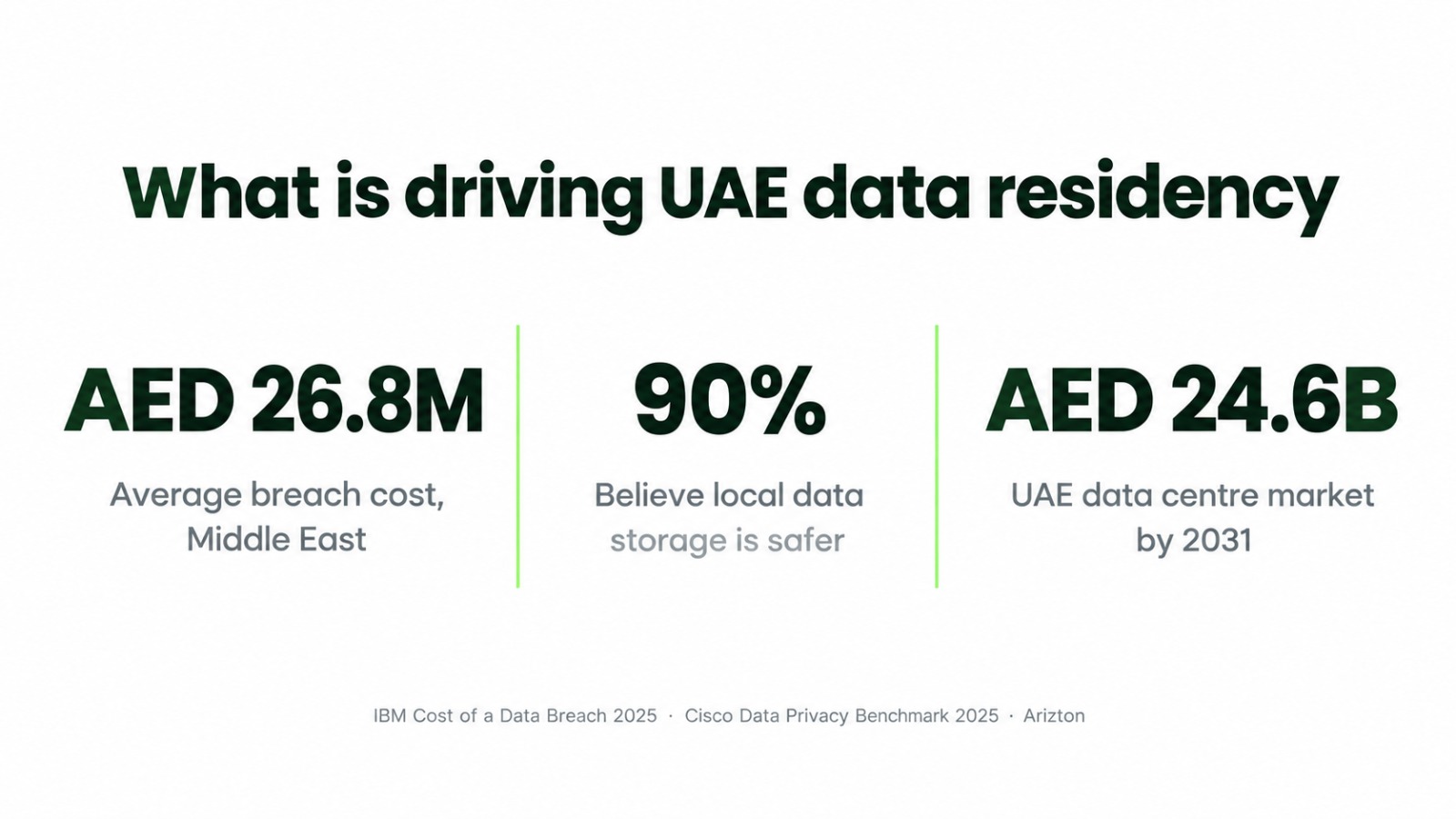
Infrastructure caught up first. The UAE data centre market reached USD 2.38 billion in 2025 and is forecast at USD 6.70 billion by 2031, roughly AED 8.7 billion growing to AED 24.6 billion (Arizton). Microsoft committed a further USD 7.9 billion, near AED 29 billion, across 2026 to 2029.
Five years ago, staying in country meant accepting a thinner service catalogue. That trade-off has mostly closed.
Government policy pushed second. The Digital Economy Strategy targets a rise from 9.7 percent of GDP to 19.4 percent within a decade (UAE Government). Public sector procurement now carries residency language as standard.
Breach economics did the rest. IBM puts the Middle East average breach cost at USD 7.29 million, about AED 26.8 million, with financial services topping the table (IBM Cost of a Data Breach 2025).
Buyer psychology moved alongside the numbers. Cisco found 90 percent of organisations consider local storage inherently safer, even while acknowledging the operational cost (Cisco 2025 Data Privacy Benchmark Study).
Whether that belief is technically correct matters less than you would like. Your buyer holds it, and your buyer signs the contract.
Why do UAE enterprises ask for local data storage?
Procurement teams at UAE banks, insurers, hospital groups and government entities inherit residency requirements from their own regulators. Asking you the question is how they discharge that duty. Fail it, and you become a documented exception, which requires internal approval nobody wants to chase.
| Driver | Signal | What it changes for engineering |
| Regulatory | CBUAE, MOHAP, TDRA mandates | Region choice becomes fixed, not negotiable |
| Commercial | Residency clause in RFPs | Attestation needed before technical scoring |
| Risk | AED 26.8M average regional breach cost | Encryption and key custody move up the backlog |
| Latency | In-country round trips | Edge and caching design shifts |
PDPL-compliant app development scope: obligations and three parallel UAE regimes
Reading the decree-law as a CTO means translating twelve chapters of legal drafting into constraints your team can build against. Below is that translation.
What PDPL-compliant app development covers
Controllers decide why and how personal data gets processed. Processors act on a controller’s instruction. Both sit in scope when established in the UAE, and both sit in scope when established elsewhere while handling the data of people inside the UAE.
Your analytics vendor is a processor. So is your offshore development partner with production database access. Naming them correctly on paper determines who carries which obligation during an incident.
Processing principles as engineering constraints
Six principles run through the law. Each one lands as a design rule.
- Lawfulness and fairness requires a stored basis per purpose, queryable at audit time.
- Purpose limitation means the marketing team cannot query the KYC table, and your schema should enforce that rather than your policy document.
- Data minimisation asks whether a field earns its place. Most signup forms collect two or three fields nobody uses.
- Accuracy demands a rectification path that propagates downstream, including into caches and search indexes.
- Storage limitation turns into scheduled deletion jobs with receipts, since an untouched row is still retained data.
- Integrity and confidentiality cover encryption, access control, and logging, discussed in the architecture section.
Data-subject rights and what each demands from your database
Rights look like a legal list. They behave like a product backlog.
Access needs an export that assembles records across every store holding the subject’s data. Rectification needs write paths in systems your team treats as read-only. Erasure needs a cascade reaching backups, warehouses, feature stores and vector indexes.
Restriction needs a processing flag your services actually check. Portability needs a structured, machine-readable format. Objection needs a route that halts profiling without breaking the account.
Response timing sits at “without undue delay”. Thirty days has become the operating norm across UAE practice, though the statute does not fix it.
When a DPO becomes mandatory
Article 10 sets three triggers: high-risk processing driven by new technology or data volume, systematic large-scale evaluation of sensitive data including profiling, and large-scale processing of sensitive personal data.
Independence is where appointments go wrong. Your CISO owns the security controls a DPO must assess, which creates a conflict auditors will flag. Outsourced DPO-of-record arrangements in the UAE start near AED 6,980 per month (business-ciso).
What triggers a DPIA
Run one before go-live when your feature involves large-scale sensitive data, systematic monitoring of a public area, automated decisions with legal effect, new tracking technology, children’s data, or a combination of datasets the subject would not expect.
Date the assessment. Record mitigations. Get sign-off before release, because a retrospective DPIA reads as theatre.
Sector rules that override the PDPL
Three regimes sit above the general law and impose harder duties. Health falls under Federal Law No. 2 of 2019. Banking falls under CBUAE outsourcing rules. Telecom and critical infrastructure fall under TDRA policy. Each gets detailed treatment further down.
The three parallel regimes
Mainland, DIFC and ADGM run separate laws with separate regulators. A DIFC-licensed entity answers to the DIFC Commissioner, not the UAE Data Office.
| Dimension | Federal PDPL | DIFC Law No. 5/2020 (amended 2025) | ADGM Regulations 2021 (amended Sept 2025) |
| Applies to | Mainland plus extraterritorial reach | DIFC-established entities | ADGM-established entities |
| Regulator | UAE Data Office | DIFC Commissioner of Data Protection | ADGM Office of Data Protection |
| Transfer test | Adequacy, safeguards, consent, limited grounds | Documented adequacy assessment under Article 10 | Adequacy or appropriate safeguards |
| Maximum administrative fine | Not published; Cabinet decision pending | USD 100,000, about AED 367,000 | USD 28 million, about AED 102.8 million |
| Annual registration | Not required | Required | Required |
Sources: Bird & Bird on DIFC Amendment Law No. 1 of 2025, DLA Piper
Data residency rules for PDPL-compliant app development: where UAE data must live
Data residency rules for PDPL-compliant app development split into two questions that teams keep merging into one. One asks what the PDPL permits. The other asks what your sector mandates. Answers differ, and the second usually wins.
What Articles 22 and 23 permit
Cross-border transfer is allowed on four broad grounds:
- To a country with an adequate protection level.
- Under appropriate contractual safeguards such as standard clauses or binding corporate rules.
- With the subject’s explicit consent.
- Transfer under narrow necessity grounds covering legal claims, international judicial cooperation and similar cases.
One practical problem undermines the first route. An adequacy list has not been published, and neither have official model clauses. Guidance remains in development at the UAE Data Office (Chambers Data Protection & Privacy 2026, UAE).
So the cleanest transfer mechanism on paper is unavailable in practice. Most competent UAE counsel now recommend the same thing. Keep resident data in country and remove the transfer question from your risk register.
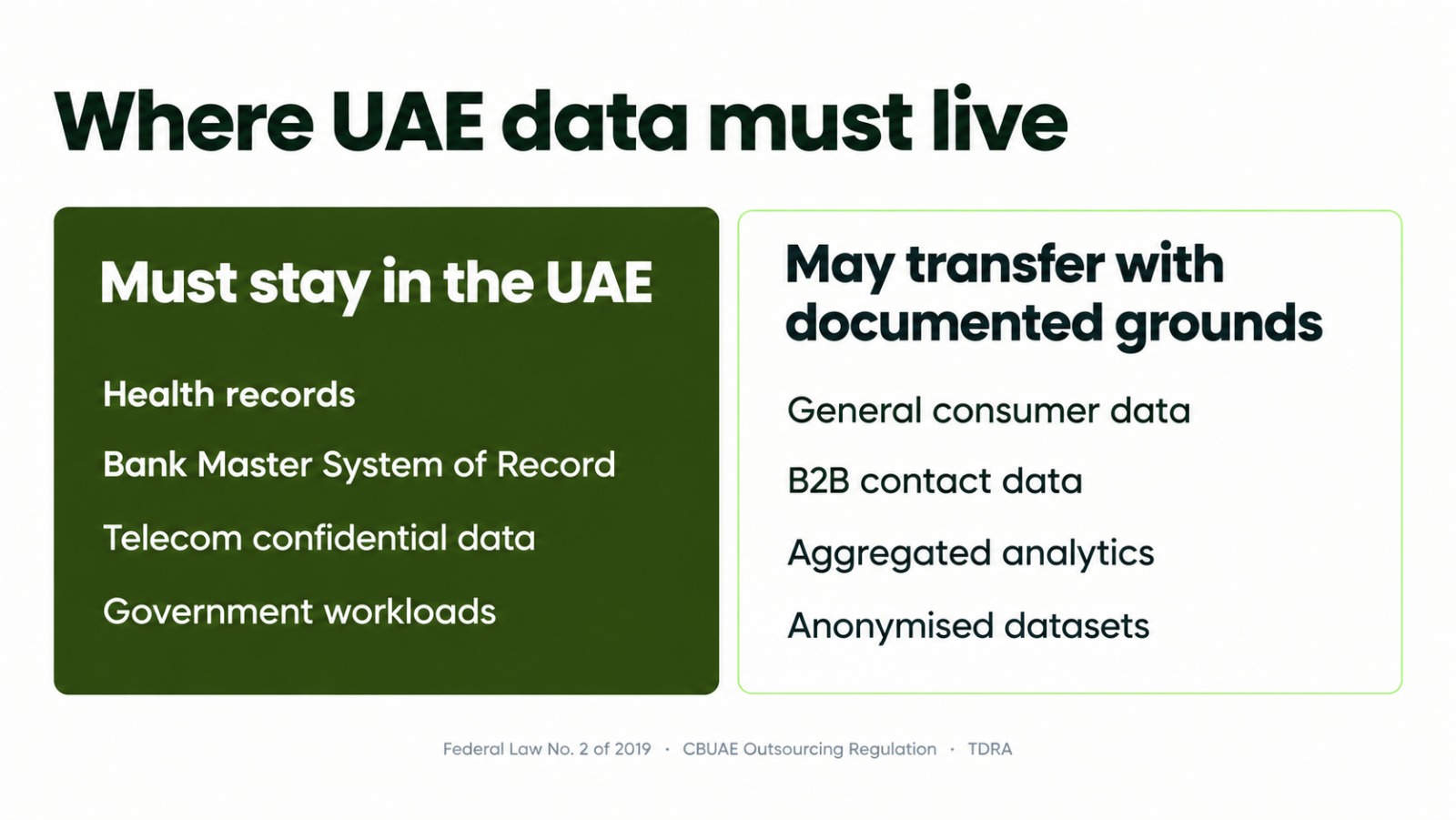
Three categories where UAE data localisation is mandatory
Health data
Federal Law No. 2 of 2019 prohibits storing, processing, generating, or transferring health information connected to UAE services outside the country, unless a health authority approves it in coordination with MOHAP (MOHAP; Oracle OCI advisory). Free zones are included. Wellness apps that add symptom checkers or clinician chat cross into scope without a formal decision being made.
Banking
The CBUAE Outsourcing Regulation requires the Master System of Record, covering all Confidential Data needed to run core activities, to be continuously maintained and stored within the UAE. Customer confidential data cannot leave without Central Bank approval and prior written customer consent (CBUAE Rulebook, Article 6). Hosting in a jurisdiction whose secrecy laws block supervisory access is prohibited outright.
Telecom and critical infrastructure
Confidential data tied to critical national infrastructure stays local under TDRA expectations, with sovereign cloud preferred for government workloads.
Sensitive data carries a higher bar
Biometric, genetic, health, religious, political, criminal and similar categories attract stricter handling. Consent must be explicit. Security expectations rise. Customer-managed keys stop being a nice-to-have.
Cloud regions that support UAE data residency
Regional coverage has improved, and one recent event deserves your attention when designing disaster recovery.
| Provider | Region | Location | Practical note |
| Microsoft Azure | UAE North | Dubai | Three availability zones, deepest in-country managed service catalogue |
| Microsoft Azure | UAE Central | Abu Dhabi | Pair region, thinner service coverage |
| Oracle OCI | UAE East | Dubai | Live since September 2020 |
| Oracle OCI | UAE Central | Abu Dhabi | Live since November 2021, GPU expansion announced |
| AWS | me-central-1 | UAE | Two availability zones physically damaged in March 2026 |
| AWS | me-south-1 | Bahrain | Outside the UAE. Governed by PDPL Bahrain |
| Core42 (G42) | Sovereign Public Cloud | UAE | Azure-powered, over 200 mapped controls, government-grade |
| Moro Hub, du, Khazna | Colocation and sovereign nodes | Dubai, Abu Dhabi | Useful for hybrid and regulated workloads |
Sources: Oracle UAE regions, Core42, The Register, March 2026
That AWS entry matters for architecture, not for vendor scoring. Objects struck the Dubai facility during regional hostilities, and two of three availability zones went down (DataCenterDynamics). Single-region DR inside one country now carries geopolitical risk alongside the usual failure modes. Plan for a second in-country provider rather than a foreign failover region.
Is AWS Bahrain good enough for UAE data?
Bahrain is a cross-border transfer out of the UAE. You need a documented ground for it, and the adequacy route remains unavailable.
A second regime also applies. PDPL Bahrain, Law No. 30 of 2018, governs data once it lands, and transferring personal data out of Bahrain unlawfully carries up to a year of imprisonment plus a fine of BHD 1,000 to BHD 20,000, roughly AED 9,740 to AED 195,000 (DLA Piper Bahrain).
Choosing Bahrain to simplify compliance puts you inside two frameworks instead of one.
Data-residency architecture patterns for PDPL-compliant app development
Residency is an infrastructure property, and treating it as an application concern produces claims your team cannot evidence. What follows is the pattern library we build from.
Choosing an isolation model for UAE data
Three models cover most builds. Sensitivity of data and the buyer’s audit appetite decide which one fits.
Single-tenant UAE stack
Dedicated compute, dedicated database, dedicated keys, nothing shared across customers. Banking, health, and government workloads land here. Attestation is straightforward because the boundary is physical rather than logical.
Regional cell with routing enforcement
One codebase, multiple regional cells, each customer pinned to a cell at onboarding. Routing decisions happen at the edge, before any application logic runs. Multi-country SaaS products usually settle here.
Logical separation inside a shared region
Row-level tenancy with region-agnostic infrastructure. Cheapest to run, hardest to defend in an audit, and rarely acceptable to a regulated buyer.
| Pattern | Best suited to | Residency strength | Main operational burden |
| Single-tenant UAE stack | Banking, health, government | Strongest | Deployment fan-out, upgrade coordination |
| Regional cell pinning | Multi-country SaaS | Strong when routing is enforced at edge | Cell allocation, cross-cell reporting |
| Logical separation | Low-sensitivity consumer apps | Weakest | Proving isolation during review |
The control plane problem
Data planes get the attention. Control planes cause the failures.
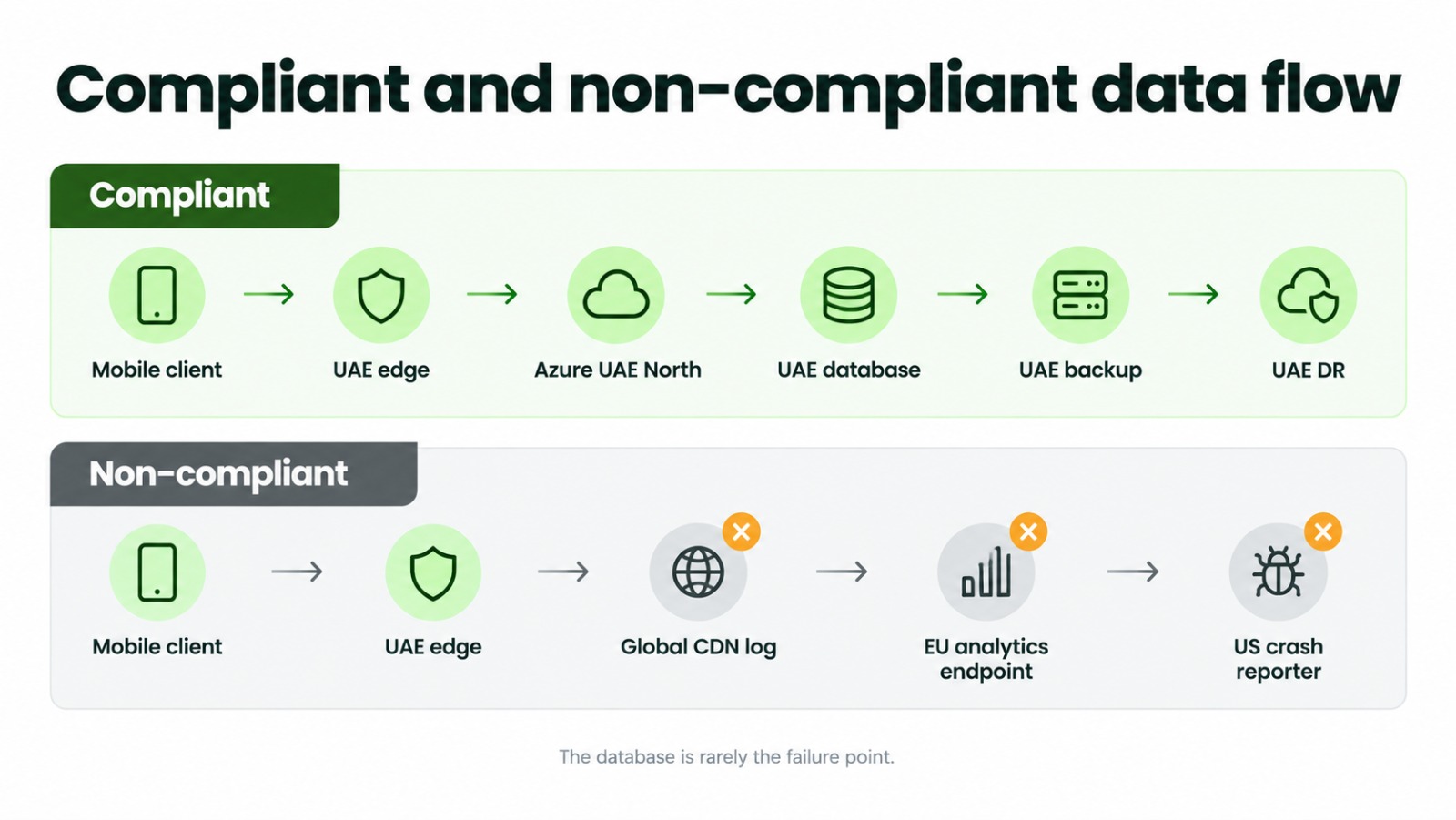
Your database can sit in Azure UAE North while your admin console terminates in Ireland. CI runners in Virginia pull production dumps. Observability ships logs containing user identifiers to a US-hosted vendor. Each path moves personal data out of the country while your architecture diagram shows a clean UAE boundary.
Audit the control plane before you audit the data plane. Failures cluster there.
Encryption and key custody
AES-256 at rest and TLS 1.2 or above in transit form the baseline. Nobody will praise you for meeting it.
Key custody separates a residency claim from a sovereignty claim. Provider-managed keys mean the provider can technically access plaintext. Customer-managed keys held in a UAE HSM remove that, and government and banking reviewers increasingly ask for the distinction in writing.
Build key rotation and revocation into the platform early. Retrofitting BYOK across a live system is painful work.
Minimisation, pseudonymisation and tokenisation
Collect less and your residency surface shrinks. That sounds obvious, though few teams audit their own forms.
Pseudonymisation replaces direct identifiers with reversible tokens held in a separate, tightly controlled store. Analytics pipelines can then run on pseudonymous records. Anonymisation goes further and takes the data out of PDPL scope entirely, provided re-identification is genuinely infeasible.
Draw the tokenisation boundary early, because moving it later means rewriting every downstream consumer.
Consent management that survives an audit
Granular purposes, each with independent toggles. Arabic and English parity, with equal prominence rather than a translated afterthought. Timestamped, versioned records tied to the consent text shown at the time.
Withdrawal is where systems fail. A revoked consent should propagate to token revocation, halt downstream processing and reach your analytics pipeline within a defined SLA. Write that SLA down, then test it.
DSR endpoints as product surface
Treat access, export, erasure, rectification, restriction and objection as API routes with their own tests and audit trails.
Erasure needs particular care. A delete that clears the primary row while leaving copies in backups, a warehouse, Elasticsearch and an ML feature store has not fulfilled the right. Map every store holding personal data, then build the cascade.
Retention, logging and access control
Retention policy belongs in code. Scheduled jobs execute deletion, and deletion receipts provide the audit evidence.
Role-based access with least privilege, a documented break-glass procedure, and immutable audit logs retained inside the region complete the picture. Keep the log retention window itself compliant, since logs carry personal data.
Mobile-specific residency considerations
App Tracking Transparency on iOS interacts with your consent model, and showing the ATT prompt before your own notice creates a sequencing problem. Android runtime permissions need a purpose explanation at request time rather than at install.
In-app privacy notices should reach the same content as your web policy, in both languages, without a WebView pointing at an external domain.
Where PDPL-compliant app development quietly breaks: four silent transfer points
We call this the Silent Transfer Framework. Every failure we have found in a UAE residency review fell into one of these buckets, and none of them involved the primary database.
1. CDN edge caching and logs
Edge points of presence outside the UAE cache responses and write request logs containing IP addresses, device identifiers, and sometimes full URLs with parameters. Nobody thinks of a log line as personal data until an auditor does. Fix it with regional log pinning, shielded origins, or a CDN that terminates inside the UAE.
2. Analytics and product telemetry
Firebase, Mixpanel, Amplitude, and GA4 route to non-UAE processing by default. Event payloads carry user IDs, screen names, and behavioural traces. Server-side tagging with a UAE-hosted collector solves most of it, and self-hosted analytics solves the rest.
3. Crash reporting and application monitoring
Stack traces contain more personal data than teams expect, including email addresses in variable state and record IDs in query strings. Crashlytics and Sentry both need scrubbing configured at the SDK level, plus a region selection where the vendor offers one.
4. Push notification and messaging providers
Notification payloads travel through vendor infrastructure abroad. Send a data-free ping and have the app fetch content from your UAE backend.
A fifth deserves mention, since it bypasses engineering entirely. Support tooling becomes a transfer point the moment an agent pastes a customer record into Zendesk, Intercom, or Slack. Those platforms belong on your sub-processor register.
| Leak point | Typical data exposed | Detection method | Fix |
| CDN edge | IP, device ID, URL parameters | Edge log location audit | Regional log pinning or UAE-terminating CDN |
| Analytics SDK | User ID, events, behaviour | Network traffic capture on device | Server-side tagging, region-locked instance |
| Crash reporter | Stack traces with PII | Sample crash payload review | SDK scrubbing plus region selection |
| Push provider | Notification content | Payload inspection | Data-free ping, in-app fetch |
| Support tooling | Full customer records | Sub-processor inventory | DPA with residency clause |
How do CDNs affect UAE data residency?
A CDN distributes content across global edge nodes by design. Each node that serves a UAE user may log that request abroad, which counts as processing outside the country. Configure regional log retention, disable caching of authenticated responses, and confirm in writing where edge logs are stored.
PDPL-compliant app development from day one: the lifecycle playbook
Retrofitting residency means migrating live data under time pressure while the product team waits. One documented UAE case saw a Dubai payments platform rebuild its authentication layer across eight weeks under a ninety-day regulator notice, at roughly three times the cost of getting it right initially (keycloakpro).
Sequencing the work properly avoids that entirely.
Sprint zero activities
Before the first feature ticket, produce four artefacts. A data inventory listing every personal data field, its purpose, its lawful basis, and its store. An SDK and vendor inventory covering anything that touches production. A DPIA for any high-risk feature already on the roadmap. An architecture decision record fixing your region and isolation model, so the choice survives team turnover.
Two days of work here removes months of rework later.
The compliance backlog
Ten tickets belong in your first three sprints. Consent capture UI with per-purpose toggles, consent storage with versioning, and consent withdrawal propagation. DSR export endpoint. DSR erasure cascade. Retention policy scheduler. Audit log pipeline with in-region storage. Region assertion tests. Sub-processor register with review dates. Breach detection alerting.
Size them properly, and they compete fairly against feature work. Leave them unsized, and they never get scheduled.
Environments and test data
Real personal data has no place in development, testing, or staging. Synthetic generation covers most needs, and masked production snapshots cover the rest when volume realism matters.
Enforce it technically. A policy that relies on developer discipline will fail during an incident investigation, which is exactly when it gets examined.
CI/CD compliance gates
Pipelines can catch residency regressions before they ship.
- Add an infrastructure-as-code policy check that fails on a non-approved region declaration.
- Add a dependency scan that flags new SDKs against your allowlist.
- Add an integration test asserting that data written through the API lands in the expected regional store.
Gates turn compliance from a quarterly review into a build-time property.
The audit evidence pack
Assemble these before anyone asks. Records of processing activities. Transfer impact assessments for anything leaving the country. Completed DPIAs with dates and sign-off. Sub-processor register. Consent logs. Deletion receipts. Breach response runbook with the seventy-two-hour timeline mapped.
Most organisations can reach compliance from a low maturity baseline in three to five months. Teams already aligned to ISO 27001:2022 or GDPR often compress that to six to ten weeks (business-ciso).
| Lifecycle stage | Compliance activity | Artefact produced |
| Sprint zero | Data map, vendor inventory, residency ADR | Records of processing |
| Design | DPIA for high-risk features | Signed DPIA with mitigations |
| Build | Consent layer, DSR endpoints, retention jobs | Test evidence |
| CI/CD | Region assertions, SDK allowlist checks | Pipeline logs |
| Pre-launch | Evidence pack assembly, DPO sign-off | Audit-ready documentation |
| Operate | Quarterly sub-processor review | Updated register, deletion receipts |
Want your residency architecture reviewed before it turns into a migration project?
Sector rules that reshape PDPL-compliant app development in the UAE
Sector rules reshape PDPL-compliant app development at the boundaries, and general guidance breaks down exactly there. What follows covers the situations where the standard answer is wrong.
Fintech and banking
The CBUAE framework raises the bar well above the federal law. Your Master System of Record, covering every piece of Confidential Data required to run core activities and serve clients, must stay inside the UAE continuously. Moving customer confidential data abroad requires Central Bank approval plus prior written consent from the individual customer.
One clause catches teams off guard. Banks cannot outsource to any jurisdiction whose secrecy or blocking laws would restrict supervisory access to data. That rules out several popular hosting locations regardless of technical controls.
Architectural consequences follow quickly. Ledger, KYC records, transaction history, and customer master data live in-country. Single-tenant isolation becomes the practical default. Key custody moves to a UAE HSM under your control, since the bank’s own auditors will ask who can decrypt.
Payment apps face an extra layer. Card data brings PCI DSS scope alongside PDPL duties, and the two evidence packs overlap without matching. Build tokenisation early so the cardholder data environment stays small.
Code Brew Labs has delivered this profile of work in the market, including Du Pay, a UAE digital wallet and remittance platform with over a million downloads, and Alfardan Exchange, a remittance product running at 99.9 percent availability. Teams building in this space can review how we approach fintech apps built for UAE banking rules.
Health and wellness apps
Federal Law No. 2 of 2019 imposes the strictest localisation in the country. Health information connected to services delivered in the UAE cannot be stored, processed, generated, or transferred abroad without health authority approval coordinated with MOHAP. Free zones get no exemption.
The hard part is scope creep. A fitness app tracking steps sits outside health data. Add a symptom checker, a clinician chat, a medication reminder tied to a prescription, or a wearable feeding vitals, and the product has quietly become a health application.
Teams rarely notice the crossing, because it happens one feature at a time.
Practical guidance for product leaders: classify at the feature level, not the app level. Keep a documented boundary for what constitutes health data in your schema. Route anything inside that boundary to in-country storage even if the rest of the platform runs elsewhere.
Telehealth adds licensing obligations on top, since consultations carry provider licensing requirements alongside data duties. Our work on Emirates Home Nursing and regional telemedicine products informs how we structure healthcare apps that keep patient records in the UAE.
Government contractors and critical infrastructure
Selling to a UAE government entity introduces a data classification scheme and a sovereign cloud expectation. Core42, a G42 company, runs a Sovereign Public Cloud on Azure infrastructure inside the UAE with over two hundred mapped technical controls, and Abu Dhabi’s government partnership with Microsoft and G42 processes more than eleven million digital interactions daily (Core42; G42).
Contractors should expect questions about operational sovereignty rather than storage alone. Who administers the environment? Which nationality of personnel can access production? Whether support escalation routes abroad.
Answering those requires an operating model decision, not just a region selection.
Consumer apps compared with B2B SaaS
Failure modes split cleanly between the two.
Consumer products fail on consent quality and third-party SDKs. High user volumes, aggressive analytics instrumentation, and marketing attribution tooling create dozens of transfer points. Complaints reach the regulator through individuals rather than auditors.
B2B SaaS products fail on tenant isolation and sub-processor transparency. Nobody complains to the Data Office. Instead, a procurement questionnaire exposes the gap, and the deal dies without explanation.
Both failures cost money. Only one of them tells you why.
Free zones and intra-UAE transfers
Moving data from a DIFC entity to a mainland affiliate is a transfer between legal regimes, despite both endpoints sitting in Dubai. DIFC requires a documented assessment of whether subjects retain adequate protection and effective remedies in the receiving jurisdiction.
Group structures spanning DIFC, ADGM and mainland need an intra-group data transfer agreement. Treating the UAE as one jurisdiction for data purposes is a common and expensive assumption.
AI and machine learning features
Four questions decide whether an AI feature stays compliant.
Where does training data live, and does it contain personal data requiring a lawful basis for that specific purpose? Where does inference run, since sending a prompt containing customer data to a foreign API endpoint is a cross-border transfer? Are prompts and completions logged, and if so, where? Where does your vector store sit, given embeddings derived from personal data remain personal data?
Automated decisions with legal or similar significant effect trigger both a DPIA and the subject’s right to object. A credit decision, an insurance quote or an eligibility screen falls squarely inside that. Teams shipping this profile of product can see how we structure enterprise AI systems deployed inside UAE infrastructure.
| Sector | Governing rule beyond PDPL | Residency position | Architecture consequence |
| Banking and fintech | CBUAE Outsourcing Regulation | Master System of Record stays in UAE | Single tenancy, UAE key custody |
| Health and telehealth | Federal Law No. 2 of 2019 | Hard localisation, no free zone carve-out | Feature-level classification boundary |
| Government and CNI | TDRA policy, sovereign cloud expectation | In-country, operational sovereignty | Personnel and admin access controls |
| Consumer apps | PDPL general | Discretionary, procurement-driven | SDK governance, consent depth |
| B2B SaaS | PDPL plus customer contracts | Customer dictated | Cell isolation, sub-processor register |
| AI features | PDPL plus DPIA duty | Inference and vectors in region | In-region model hosting or endpoints |
PDPL-compliant app development penalties: enforcement and the figure most guides get wrong
Penalties attached to PDPL-compliant app development are widely misquoted, and one figure circulates across UAE compliance content without a source. Fines from AED 50,000 to AED 5 million under the PDPL. We could not verify it in the law, and we think you should know why before you brief your board.
Federal Decree-Law No. 45 of 2021 does not publish administrative fine amounts. The text defers penalties to a Cabinet decision, and that decision has not appeared publicly as of September 2026. The UAE Legislation portal lists no related implementing legislation, and the Government portal’s data protection page does not refer to it (u.ae). Practitioner guidance published in 2026 reaches the same conclusion (business-ciso).
Where does AED 5 million come from? The Cybercrime Law, Federal Decree-Law No. 34 of 2021, carries real penalties, including imprisonment for unlawful disclosure of personal data. Genuine exposure exists there, and it is a separate statute with separate triggers.
Quoting a PDPL fine that has not been published damages your credibility with legal counsel. Say what is known instead.
What is enforceable today
Free zone penalties are published and live. DIFC administrative fines reach USD 100,000, around AED 367,000, for breaches of data-subject rights, with a general range of USD 25,000 to USD 50,000. ADGM carries the heaviest exposure in the region at USD 28 million per offence, roughly AED 102.8 million.
Federal enforcement operates through instruments that arrive before fines do. The UAE Data Office can order suspension or restriction of processing, issue corrective directions, and disclose violations publicly. A processing suspension order stops your product. No fine schedule is required for that to hurt.
Breach notification
Seventy-two hours from awareness is the outer limit for notifying the regulator. Affected individuals must be told where the breach is likely to create high risk.
Awareness is the trigger, not confirmation. Teams lose a day debating whether an anomaly qualifies, then discover the clock has been running.
| Regime | Published maximum fine | Non-financial sanctions |
| Federal PDPL | Not published, pending Cabinet decision | Suspension, restriction, corrective orders, public disclosure |
| DIFC | AED 367,000 for data-subject-rights breaches | Enforcement notices, registration consequences |
| ADGM | AED 102.8 million per offence | Enforcement action, registration consequences |
| Cybercrime Law | AED 5 million plus imprisonment | Criminal record |
What is the fine for PDPL non-compliance in the UAE?
No administrative fine schedule has been published under Federal Decree-Law No. 45 of 2021. Penalties await a Cabinet decision. Free zone regimes publish their own, with DIFC at roughly AED 367,000 and ADGM at roughly AED 102.8 million. Criminal exposure under the separate Cybercrime Law reaches AED 5 million with imprisonment.
Your PDPL-compliant app development roadmap: 0 to 120 days
Your PDPL-compliant app development roadmap works in four phases, and sequencing matters more than speed. Work done in the wrong order gets repeated.
Days 0 to 30, discovery
Map every personal data field and its store. Inventory SDKs, vendors and anyone with production access. Audit where your data actually sits today, including backups, logs, and analytics. Expect surprises in the third category.
Days 15 to 45, decisions
Record your residency architecture decision. Complete DPIAs for high-risk features. Shortlist cloud regions and providers against your sector rules. Draft the transfer assessments for anything that must leave the country.
Days 30 to 90, build
Migrate to the chosen region. Ship the consent layer, DSR endpoints and retention automation. Add CI/CD region gates. Configure SDK scrubbing and server-side tagging.
Days 75 to 120, attestation
Assemble the evidence pack. Appoint or contract a DPO where triggers apply. Run an internal audit against your own documentation, because finding gaps yourself costs less.
Ongoing
Quarterly sub-processor review. Deletion job monitoring. Annual DPIA refresh for changed features.
| Phase | Window | Primary deliverable | Evidence produced |
| Discover | Days 0 to 30 | Data map, SDK inventory, region audit | Records of processing |
| Decide | Days 15 to 45 | Residency ADR, DPIAs, vendor shortlist | Transfer assessments |
| Build | Days 30 to 90 | Region migration, consent layer, DSR endpoints | Test evidence, CI logs |
| Attest | Days 75 to 120 | Evidence pack, DPO appointment | Audit-ready documentation |
| Operate | Ongoing | Sub-processor review, retention jobs | Deletion receipts |
Measuring whether it worked
Two metrics tell you enough. Audit readiness, measured as the percentage of evidence artefacts you could produce within forty-eight hours of a request. Procurement win rate on deals carrying a residency clause, tracked before and after the work.
The second metric converts compliance spend into a revenue argument your CFO will accept.
Decision frameworks for PDPL-compliant app development
Four tools support PDPL-compliant app development decisions, each designed for use without a lawyer in the room.
Does this data need to stay in the UAE?
Work through seven questions in order, stopping at the first clear answer.
- Is it personal data, meaning it identifies a person directly or indirectly? A no puts you out of scope.
- Does it relate to a person inside the UAE? A no removes PDPL application.
- Is it health information tied to a UAE service? A yes means hard localisation.
- Is it bank confidential data forming part of a Master System of Record? A yes means UAE storage.
- Is it government or critical infrastructure data? A yes means sovereign cloud.
- Is it a sensitive category under the PDPL? A yes raises the security bar and narrows transfer options.
- Do you hold a documented, defensible transfer ground? Without one, keep it in country.
Data-mapping template
Nine columns cover what auditors ask for: data element, category, purpose, lawful basis, source system, storage location, retention period, downstream consumers, and sub-processor exposure.
Populate it per system rather than per team. Team boundaries shift, systems persist.
DPIA trigger checklist
Six questions, and a single yes means run one. Large-scale sensitive data. Systematic monitoring of a publicly accessible area. Automated decisions with legal effect. New technology with unclear privacy impact. Children’s data. Dataset combination the subject would not reasonably expect.
Vendor RFP questions on residency
Twelve questions belong in every RFP. Four of them get dodged, and those four are the ones worth watching: where edge and CDN logs are stored, which personnel nationalities can access production, whether customer-managed keys are supported in the UAE region, and what the sub-processor change notification period is.
A vendor that answers the first eight cleanly and deflects these four has told you something.
PDPL-compliant app development in practice: two worked scenarios
A multi-tenant SaaS onboarding its first UAE enterprise customer
A workforce management platform running on a single European region wins a UAE bank as a prospect. Procurement question fourteen asks where employee data resides. The honest answer stalls technical evaluation.
Rebuilding as a single tenant would take two quarters. Instead, the team introduces a UAE cell. Customer records route at the edge based on tenant region; the cell runs in Azure UAE North, and cross-cell reporting moves to an aggregation layer that handles only anonymised counts.
Evidence produced: a cell architecture diagram, a region assertion test suite, a sub-processor register with residency clauses, and a transfer assessment for the two vendors that could not offer a UAE region.
The bank accepted the cell model. Procurement moved to technical scoring six weeks later.
A consumer mobile app collecting location and identity data
A UAE delivery app with strong local growth runs an SDK audit before a funding round. Findings: eleven third-party SDKs, four transmitting to non-UAE endpoints, one crash reporter capturing email addresses inside stack traces.
Consent was a single checkbox covering everything. Arabic text existed, in smaller type, below the fold.
Remediation ran across five sprints. Server-side tagging replaced direct analytics calls. Crashlytics scrubbing was configured at the SDK level. Consent moved to four independent toggles with Arabic and English at equal prominence. Two SDKs were removed after nobody could name their owner.
The ATT prompt was resequenced to appear after the app’s own privacy notice, which lifted opt-in rates alongside the compliance fix.
How Code Brew Labs delivers PDPL-compliant app development for UAE enterprises
Code Brew Labs delivers PDPL-compliant app development for the UAE market, with residency architecture settled during design. Our delivery covers fintech platforms governed by CBUAE outsourcing rules, telehealth products operating under Federal Law No. 2 of 2019, logistics systems moving data across GCC borders, and AI enterprise applications for organisations that run their own security review before signing anything.
Local delivery portfolio sits behind that. We built DuPay, a UAE digital wallet and remittance platform with over a million downloads and a 4.6 rating, and Alfardan Exchange, a remittance product holding 99.9 percent availability. Zajel and Logisty handle UAE last-mile and shipment operations, with Logisty processing more than 500,000 shipments daily. Emirates Home Nursing runs home healthcare workflows under UAE health data rules. AWR Connect serves vehicle management across the Emirates.
Enterprise work extends beyond the region. Airbus runs a push-to-talk system we delivered with zero unscheduled downtime. ACWA Power operates across a 98 GW portfolio with platforms we built.
Engineering practice reflects the compliance requirements described above. Region assertion tests in CI. Consent layers built in Arabic and English from the first sprint. DSR endpoints with erasure cascades reaching warehouses and feature stores. Sub-processor registers maintained as living documents rather than launch artefacts.
Teams evaluating partners can review our UAE product builds in the portfolio, our approach to custom software development in Dubai for regulated workloads, and how we handle mobile app development in Dubai with consent and SDK governance.
Need UAE resident data handled inside approved infrastructure before your next enterprise review?
Conclusion
Architecture decisions made in week one determine what compliance costs you in year three. Teams that pick a UAE region during design spend a few extra days. Teams that pick it during a regulator notice spend a quarter.
The deadline worth planning against is not the one in the statute. Check your next enterprise RFP instead, and find the question about where resident data lives.
Two artefacts should exist by the end of this quarter. A data map covering every personal data field and its storage location. An architecture decision record fixing your region, isolation model, and key custody approach.
Everything else builds from those.
Frequently asked questions
Can we use global AWS regions for UAE user data?
Technically yes, legally risky. Any region outside the UAE makes the storage a cross-border transfer needing a documented ground, and no adequacy list has been published. Health data and bank confidential data cannot leave at all. For general consumer data, you would rely on explicit consent or contractual safeguards, both of which your enterprise buyers will question.
Do we need a UAE entity to comply with the PDPL?
No. The law applies based on whose data you process, not where you are incorporated. A company anywhere in the world processing the personal data of people inside the UAE falls within scope. An entity helps with commercial credibility and certain sector licences, though it is not a compliance prerequisite.
Is GDPR compliance enough for the UAE?
It gets you most of the way and leaves real gaps. Consent rules differ, the UAE publishes no adequacy list, and sector localisation duties under health and banking law have no GDPR equivalent. A GDPR-aligned team can usually reach PDPL readiness in six to ten weeks rather than three to five months.
Where do backups and logs need to live?
In the same approved region as your primary data. Backups contain identical personal data and carry identical obligations. Logs are the more common failure, since application logs, edge logs, and audit trails all carry identifiers, and default retention often sits in a global bucket nobody reviews.
How do CDNs affect UAE data residency?
Edge nodes outside the UAE log requests containing IP addresses and identifiers, which counts as processing abroad. Configure regional log retention, avoid caching authenticated responses at foreign edges, and get written confirmation from your provider on edge log storage locations.
What is the difference between PDPL UAE and PDPL Bahrain?
Separate laws in separate jurisdictions. PDPL Bahrain is Law No. 30 of 2018, enforced by Bahrain’s Personal Data Protection Authority, with criminal penalties reaching BHD 20,000 plus imprisonment for unlawful transfers. Hosting UAE data in AWS Bahrain places you under both frameworks at once.
Do we need a DPO for a mobile app?
Only where Article 10 triggers apply: high-risk processing, systematic large-scale evaluation of sensitive data, or large-scale sensitive data processing. A consumer app with location tracking and behavioural profiling at scale usually qualifies. The appointment must be independent of whoever owns the controls being assessed.
Can we run LLM inference outside the UAE on UAE user data?
Sending a prompt containing personal data to a foreign API endpoint is a cross-border transfer requiring a documented ground. Prompt logging by the provider extends the exposure. In-region model hosting or a UAE inference endpoint removes the issue. Vector stores holding embeddings derived from personal data follow the same rule.
What happens on 1 January 2027?
Transitional grace is widely expected to end, giving the UAE Data Office room to act without a warning period. The date is not a statutory cliff in the decree-law text. Its practical effect is commercial, since enterprise buyers are already using it as their own internal compliance deadline.
How long does PDPL-compliant app development add to a project timeline?
Designed in from sprint zero, roughly three to five percent of total build effort. Retrofitted after launch, one documented UAE case required an eight-week rebuild at around three times the original cost. Discovery and decision phases account for most of the upfront time.
Let's Convert Your Business Idea Into Success!
Free Consultation from Top Industry Experts
Let’s Build Your Dream App!
Share article on :





 No commitment required
 NDA on request
 24-hour response


