
Quick Summary:
- An AI agent in the UAE costs AED 90,000 to AED 1.5 million to build in 2026.
- Ongoing operation drives most of the three-year spend, well above the first build invoice.
- Data readiness and system integrations shape the budget more than the model you pick.
- Arabic dialect handling and UAE compliance are the two costs buyers underestimate most.
- Gartner expects over 40 percent of agentic AI projects cancelled by the end of 2027.
- Scoping for production, real evaluations, and a named owner protect the budget best.
- Payback on a well-scoped support agent can arrive inside a single year.
- Falling inference prices keep long-term operating costs on a downward path.
An AI agent earns its budget only when it reaches production, so in the UAE the cost question comes before the code. Buyers want one number they can defend to a board, in dirhams, across three years.
That number rarely matches the build quote. A quote covers the build. Then the monthly inference bills, the compliance work, and the model updates arrive, and the real figure doubles or triples.
Gartner expects over 40 percent of agentic AI projects to be cancelled by the end of 2027, mostly over cost surprises and thin business value (Gartner, 2025). That gap between quote and reality breaks budgets across the Emirates.
This guide gives you the real 2026 cost of an AI agent in the UAE. You will see the build price, the monthly bills, and the hidden costs that swallow budgets. By the end, you will hold an AED range and a plan you can take to a board.
Ready to build an AI app that reaches production, not just a demo?
What does AI agent development cost in the UAE in 2026?
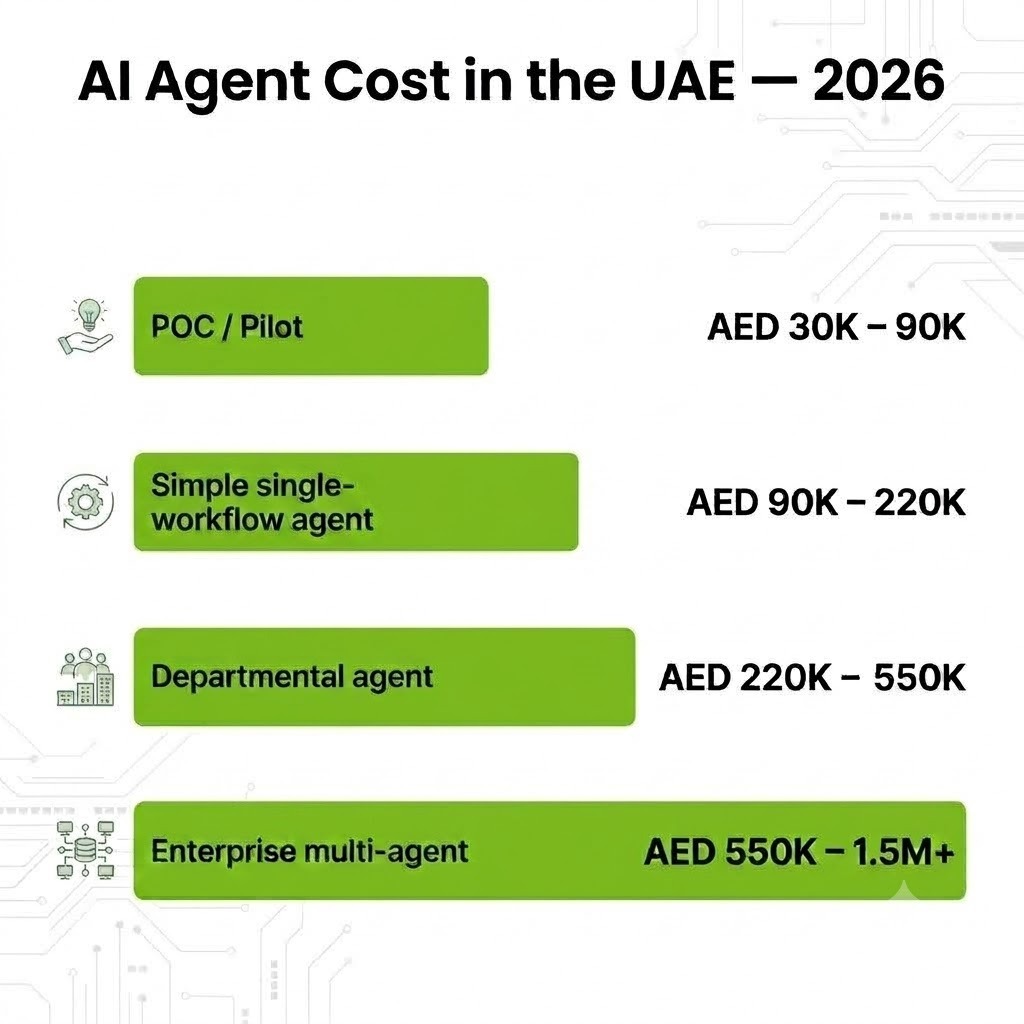
AI agent development in the UAE costs between AED 90,000 and AED 1.5 million in 2026. Where a project lands inside that range depends on three things:
- how much the agent decides on its own,
- how many systems it connects to,
- how heavy the compliance load is.
A short proof-of-concept sits at the bottom of the range. It answers one question against one data source, with a person checking every output.
Push the agent into several workflows, give it memory, and connect it to a CRM and an ERP, and the figure climbs into the mid-hundreds of thousands. Regulated, multi-agent systems that coordinate across departments cross AED 550,000 and keep rising with audit and residency requirements.
The table below turns those descriptions into 2026 price bands.
| Agent tier | What it does | Build cost (AED) | Typical timeline |
| POC / pilot | One task, one source, human checks each step | 30,000 – 90,000 | 3 – 6 weeks |
| Simple single-workflow agent | One department, one or two integrations | 90,000 – 220,000 | 6 – 12 weeks |
| Multi-workflow departmental agent | Several tools, memory, retrieval, dashboards | 220,000 – 550,000 | 3 – 6 months |
| Enterprise / regulated multi-agent | Orchestration, compliance, human oversight | 550,000 – 1,500,000+ | 6 – 12 months |
Delivery model shifts these numbers too. A fully offshore team lands lower, and an onshore, sector-regulated build lands at the top. For the wider picture across model types, our breakdown of AI development cost in the UAE covers the full stack.
What is an AI agent, and how is it different from a chatbot?
An AI agent is software that plans and acts toward a goal with little human input. It reasons through a task, calls the tools it needs, and finishes the job rather than stopping at a reply.
That distinction carries real cost weight, so it deserves precision before we price anything.
The difference from a chatbot
A chatbot responds to a message and waits for the next one. An AI agent takes the message, decides what to do, and completes several steps toward an outcome. Ask a chatbot about a delayed order, and it explains the policy. Give the same query to an agent, and it checks the shipment, updates the record, and sends a revised delivery time.
The three properties that raise cost
-
Memory across steps
The agent remembers earlier context within a task, which needs state management and storage. Building and testing that memory adds engineering hours a scripted bot never carries.
-
Tool selection
An agent decides which system to call and when, so it needs safe access to APIs and error handling around each call. Every tool it can reach widens the testing surface and the invoice.
-
Self-checking
A production agent reviews its own output before acting, which demands evaluation logic and guardrails. That safety layer is a large share of any serious build.
Reasoning, tools, and state place an agent well above a simple FAQ bot on effort and price. For a pure conversational build with none of this autonomy, our AI chatbot development in Dubai service is the lower-cost path.
What types of AI agents can UAE businesses build in 2026?
UAE businesses build seven common agent types in 2026, and price climbs with autonomy and the number of systems each one touches. Understanding the type you need is the fastest way to sharpen a budget, because a support agent and a multi-agent orchestration sit worlds apart on cost.
Support and sales agents
Customer support agents resolve tickets across WhatsApp, web, and email, and they carry moderate cost because the workflows are well understood. Sales and lead-qualification agents book demos and update the CRM, which adds integration work and pushes the price a little higher.
Internal and workflow agents
Internal knowledge agents answer staff questions over policies and documents, so their cost rides on how clean that document base is. Workflow automation agents handle approvals and back-office data tasks, and they cost more because each connected system needs its own logic and safeguards.
Voice and multi-agent systems
Voice agents take inbound calls in Arabic and English, and speech handling plus dialect coverage make them one of the pricier builds. Multi-agent orchestration sits at the top, where several agents coordinate on one process under a controller that has to be designed and tested end-to-end.
| Agent type | Example use | Estimated Build cost (AED) |
| Customer support agent | Ticket resolution across channels | 90,000 – 300,000 |
| Sales/lead qualification | Demo booking, lead scoring, CRM updates | 120,000 – 350,000 |
| Internal knowledge agent | Staff queries over policies and docs | 110,000 – 320,000 |
| Workflow automation agent | Approvals, data entry, back-office tasks | 180,000 – 500,000 |
| Voice agent | Inbound calls in Arabic and English | 200,000 – 600,000 |
| Data/analytics agent | Live queries and on-demand reporting | 200,000 – 550,000 |
| Multi-agent orchestration | Several agents on one coordinated process | 550,000 – 1,500,000+ |
To scope any of these, our AI automation agency in Dubai builds across departments, and our enterprise AI development company in Dubai handles orchestration at scale.
Steps involved in building an AI Agent
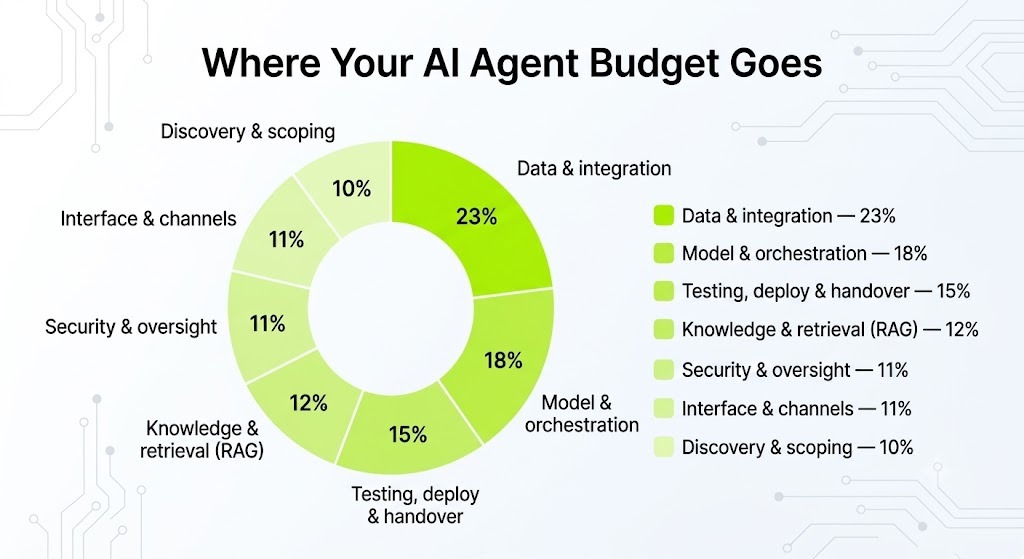
Building an AI agent moves through seven stages, and each one adds a distinct slice to the invoice. Knowing what happens at every stage, and why it costs what it does, is how buyers avoid the mid-project overruns that sink budgets.
1. Discovery and use-case scoping
Work here defines the goal, the success metric, and the guardrails before a line of code exists. Teams map the workflow, the data sources, and the failure modes the agent must handle. Skipping this stage is the single biggest cause of overspend, since unclear scope grows during the build. Cost impact: 8 to 12 percent of the total.
2. Data pipeline and integration
Engineers connect the agent to the systems it needs and clean the data feeding it. Messy records, scanned PDFs, and Arabic documents without structure all raise the effort here. Integration is where surprises hide, because each system has its own quirks and rate limits. Cost impact: the largest single slice, often 20 to 25 percent.
3. Model selection and agent orchestration
The team picks the model, designs the prompts, and builds the planning logic that lets the agent choose tools. A frontier API, a hosted open-weight model, or an Arabic-tuned model each changes both build and running cost. Orchestration logic, the part that decides the order of actions, is delicate to get right. Cost impact: 15 to 20 percent.
4. Knowledge layer and retrieval
Retrieval-augmented generation, or RAG, gives the agent access to your knowledge base through a vector database. Building this layer means chunking documents, generating embeddings, and tuning search quality. Poor retrieval produces confident wrong answers, so evaluation of this layer matters. Cost impact: 10 to 15 percent.
5. Interface and channels
Users reach the agent through a web widget, WhatsApp, a mobile app, or voice, and each channel needs its own front-end work. Arabic interfaces add right-to-left layout and mixed-script rendering. Voice channels carry the heaviest interface cost because of speech input and output. Cost impact: around 10 percent.
6. Security, guardrails, and human oversight
This stage adds access control, prompt-injection defense, content filters, and the review steps that keep a human in the loop. Regulated builds spend more here because audit trails and approvals are mandatory. Weak guardrails are what turn one visible error into lost trust. Cost impact: 10 to 12 percent.
7. Testing, deployment, and handover
Teams run accuracy evaluations, edge-case checks, and load tests before go-live, then document the system and train staff. Evaluation is recurring rather than a one-time gate, which many quotes miss. Handover decides whether your own team can maintain the agent. Cost impact: testing 8 to 10 percent, deployment about 5 percent.
| Build stage | Share | Estimated Cost (AED) |
| Discovery and scoping | 8–12% | 30,000 – 45,000 |
| Data pipeline and integration | 20–25% | 70,000 – 90,000 |
| Model and orchestration | 15–20% | 55,000 – 70,000 |
| Knowledge layer and retrieval | 10–15% | 40,000 – 55,000 |
| Interface and channels | 10% | 35,000 |
| Security, guardrails, oversight | 10–12% | 40,000 |
| Testing, deployment, handover | 13–15% | 50,000 – 55,000 |
What factors decide AI agent development cost in the UAE?
Eight factors move the price more than any brand name, and each is a lever you can adjust during scoping. Reading them as trade-offs, rather than fixed costs, is how buyers bring a budget into line.
-
Autonomy level
A single decision costs far less than a chain of ten. More reasoning steps raise token use during operation and multiply the paths that testing must cover, so autonomy shows up twice on the bill.
-
Number of integrations
Every connected system adds engineering and error handling. A CRM, an ERP, and a payment gateway each bring their own authentication, data format, and failure cases, and the cost stacks with each one.
-
Model choice
A hosted open-weight model on your own cloud carries different economics than a frontier API. The model also sets your monthly running cost, so this choice echoes for years, not just at build time.
-
Knowledge base and retrieval
Clean, structured data lowers cost because retrieval works with less tuning. Fragmented records and scanned Arabic files raise it, since the team has to structure them before the agent can use them.
-
Language and dialect
Arabic dialect coverage adds data sourcing, labeling, and separate evaluation sets. A bilingual agent that handles Gulf Arabic and English code-switching needs more test data than an English-only build.
-
Compliance and data residency
Regulated sectors need on-shore hosting, audit logging, and impact assessments. These are engineering and legal line items, and they scale with how sensitive the data is.
-
Human oversight design
Review and escalation steps protect against costly errors and add interface and workflow effort. The right amount of oversight is cheaper than repairing a mistake in production.
-
Team location and seniority
A machine learning engineer in the UAE averages about AED 344,000 a year (ERI salary data). Blended teams that pair UAE oversight with offshore build lower the effective rate without losing local accountability.
Scope discipline across these eight controls the bulk of any budget, and it does so before the first sprint.
How much do AI agents cost to operate each month in the UAE?
Monthly operating cost ranges from about AED 3,000 for a small agent to AED 150,000 at enterprise scale. Volume of use and choice of model set the figure, and both are within your control after launch.
Five items make up the monthly bill. Inference covers the model calls the agent makes, and it rises with traffic and reasoning depth. Cloud hosting and compute keep the agent available, while a vector database and storage hold the knowledge layer. Monitoring and evaluation track accuracy over time, and maintenance covers model updates and integration fixes as connected systems change.
One trend works firmly in your favor here. Stanford HAI reports that the cost of operating a model at GPT-3.5 quality fell about 280 times in two years, from around 20 dollars to 0.07 dollars per million tokens (Stanford HAI 2025 AI Index). Token cost rarely dominates the bill anymore.
Maintenance and the engineers who keep the agent accurate now carry most of the monthly figure. Budget for people first and the meter second.
| Monthly cost item | Small agent | Mid-tier agent | Enterprise |
| Model/inference | 300 – 2,000 | 3,000 – 12,000 | 15,000 – 60,000 |
| Cloud hosting and compute | 400 – 1,500 | 2,000 – 8,000 | 10,000 – 40,000 |
| Vector database and storage | 200 – 800 | 1,000 – 3,000 | 4,000 – 12,000 |
| Monitoring and evaluation | 300 – 1,000 | 1,500 – 4,000 | 5,000 – 15,000 |
| Maintenance and updates | 1,500 – 4,000 | 5,000 – 15,000 | 20,000 – 60,000 |
| Approx. total per month | 3,000 – 8,000 | 12,000 – 40,000 | 50,000 – 150,000 |
What are the hidden costs of AI agent development in the UAE?
Hidden costs add 20 to 40 percent on top of the build quote, and most quotes leave them out. Naming them before sign-off is what separates a budget that holds from one that slips.
-
Data preparation
Cleaning, structuring, and labeling messy data can reach a quarter of a build. Arabic documents and scanned records raise this further, since they need extra processing before the agent can read them.
-
Evaluation and testing
Accuracy checks and red-teaming repeat as the agent and its data change. Treating evaluation as a one-time gate is why so many agents drift into wrong answers after launch.
-
Integration maintenance
Every system the agent connects to updates its API over time. Each change needs engineering attention, and the cost recurs for as long as the agent lives.
-
Model drift and re-tuning
Accuracy decays as user behavior and data shift, so periodic re-tuning keeps quality steady. Ignoring drift quietly erodes the value the agent was built to deliver.
-
Guardrails and safety
Prompt-injection defense and content filters need ongoing updates as new attack patterns appear. Security here is a subscription of effort, not a fixed purchase.
-
Change management and adoption
Staff training and workflow redesign decide whether people use the agent at all. An unused agent is pure cost, which makes adoption spend a protective investment.
The market data confirms the pattern. McKinsey reports 88 percent of organizations now use AI, yet only about 39 percent see bottom-line impact (McKinsey, State of AI 2025). Unbudgeted hidden costs sit behind much of that gap.
How much does an Arabic-first AI agent cost to build?
An Arabic-first AI agent costs about 15 to 30 percent more than an English-only build. Dialect handling and Arabic retrieval drive the premium, and both matter for any UAE audience.
Arabic behaves as many languages in practice. Modern Standard Arabic differs from spoken Gulf, Egyptian, and Levantine dialects, and UAE users move between them. Customers also switch into English mid-sentence and type Arabizi, Arabic written in Latin letters with numbers standing in for sounds.
Where the premium comes from
-
Dialect coverage
Emirati and Gulf dialect data has to be sourced and labeled, which adds a data cost that English builds avoid. Without it, the agent misreads everyday phrasing.
-
Arabic retrieval
The knowledge layer needs Arabic-tuned embeddings and diacritics handling, or search quality drops. Tuning retrieval for Arabic is slower and adds engineering hours.
-
Voice handling
Arabic speech recognition and synthesis raise the cost of any voice agent. Accents and dialects widen the test matrix the team has to cover.
-
Right-to-left interface
RTL layout and mixed Arabic-English rendering need dedicated front-end work. Getting this clean matters most on government and customer-facing agents.
-
Evaluation sets
A separate Arabic test suite catches dialect errors that English evaluations miss. This extra layer is a recurring cost, not a one-off.
Model choice changes the math. Jais, the Arabic-first model from Inception (G42), MBZUAI, and Cerebras, launched at 13 billion parameters trained on 395 billion tokens (Cerebras). Its 2025 generation, Jais 2, reaches 70 billion parameters as an open-weight model (PR Newswire).
An Arabic-tuned model lifts accuracy on dialect and cuts rework, and that accuracy pays back the premium on government and high-volume customer agents.
Compliance and data residency: what they add to AI agent cost
Compliance and data residency add 10 to 30 percent to a regulated build. Financial, health, and government agents carry the heaviest load, because their data cannot move freely.
Four regimes shape most UAE projects, and each one turns into concrete engineering.
-
PDPL
Federal Decree-Law No. 45 of 2021 governs personal data across the Emirates. Meeting it means consent handling, data-subject rights, and clear records of what the agent stores.
-
Central Bank rules
The CBUAE sets data and outsourcing standards for financial firms. Agents in banking and payments need controls that satisfy audit and reporting duties.
-
DIFC and ADGM laws
Both financial free zones carry their own data-protection statutes, with DIFC’s law modeled on European standards. A firm inside these zones inherits stricter obligations.
-
Health data rules
Dubai and Abu Dhabi health authorities require patient data to stay inside the UAE. That single rule forces on-shore or sovereign cloud hosting for any clinical agent.
These regimes convert into line items you can price. On-shore hosting costs more than a default cloud region, audit logging adds engineering, and impact assessments add legal effort. Human review steps, mandatory in sensitive workflows, add interface and staffing costs.
Fintech teams can see the pattern in practice through agentic AI in UAE fintech. Pricing the compliance premium during discovery keeps it from becoming an expensive retrofit later.
AI agent development cost by industry in the UAE
Cost shifts sharply by sector, because the data an agent handles, the systems it touches, and the rules it answers to differ from one industry to the next. Walk through six sectors that lead UAE demand in 2026, with the specific agent work behind each price band.
Fintech
Fintech carries the highest bands because every agent sits inside a regulated perimeter. A bank building a KYC or fraud-triage agent has to satisfy CBUAE controls, keep an audit trail on every decision, and hold data on approved infrastructure.
Collections and support agents add integrations into core banking and payment rails, each one a fresh compliance surface. Arabic and English coverage is non-negotiable for a customer base that switches between both. These layers push fintech builds from AED 250,000 for a contained tool to well past a million for a multi-agent platform. Teams weighing this can start with fintech app development in Dubai, or study the mechanics in agentic AI development in the UAE.
Healthcare
Healthcare agents live under a data-residency rule that shapes their entire architecture. Patient intake, triage, and records-lookup agents must keep clinical data inside the UAE, which forces on-shore hosting from day one.
Accuracy tolerance is tight, so evaluation and human oversight take a larger share than in most sectors. Integrations into hospital and clinic systems add effort, and Arabic support matters for patient trust. A focused clinical assistant starts near AED 220,000, while a connected care-coordination agent runs far higher. Our healthcare app development in Dubai builds to these constraints.
Logistics
Logistics agents earn their cost through the number of live systems they coordinate. A dispatch or fleet-query agent pulls from tracking, routing, and warehouse platforms, and it has to act on data that changes minute by minute.
Delivery-tracking agents talk to customers in Arabic and English across channels, adding interface and language work. Real-time reliability raises the testing bar, since a wrong dispatch has a physical cost. We map where automation pays first in AI in the logistics industry in the UAE. Bands range from AED 180,000 for a single workflow to AED 700,000 for a coordinated fleet system.
A logistics software development team in Dubai wires those platforms into one agent that acts on live data. Delivery-tracking agents then handle customers in Arabic and English across channels.
E-commerce
E-commerce agents sit lower on cost because the workflows are mature and the compliance load is lighter. Product-search and recommendation agents lift conversion by understanding intent across a large catalog.
Support and cart-recovery agents handle high volume, so operating cost matters more than build cost here. Arabic search and dialect-aware recommendations separate a UAE-ready agent from a generic one. An e-commerce app development in Dubai builds toward that edge, and prices land between AED 120,000 and AED 500,000 as channels and catalog grow.
Real estate
Real estate agents focus on lead quality and speed of response, which keeps their scope contained. A lead-qualification agent scores enquiries, answers listing questions, and books viewings against a live inventory.
Integration into property and CRM systems is the main cost driver, along with bilingual coverage for a mixed buyer base. Bands run from AED 110,000 to AED 450,000 as the agent takes on more of the sales workflow. Our real estate app development in Dubai page covers the build.
Food delivery
Food-delivery agents combine customer support with live operational data, which places them in the mid-range. An order-support agent resolves issues across the delivery window, while a dispatch agent coordinates riders against demand.
Peak-hour reliability sets the engineering standard, since failures happen when volume is highest. Arabic and English support is essential across a diverse user base. Costs land between AED 120,000 to AED 480,000, as detailed in food delivery app development in Dubai.
| Industry | Common agent use | Build cost (AED) |
| Fintech | KYC, fraud triage, collections, support | 250,000 – 1,200,000 |
| Healthcare | Intake, triage, records lookup | 220,000 – 900,000 |
| Logistics | Dispatch, fleet queries, tracking | 180,000 – 700,000 |
| E-commerce | Search, recommendations, support | 120,000 – 500,000 |
| Real estate | Lead qualification, listings, viewings | 110,000 – 450,000 |
| Food delivery | Order support, dispatch, tracking | 120,000 – 480,000 |
What is the 3-year total cost of ownership of an AI agent?
Three-year total cost of ownership reaches three to four times the build price. A build near AED 350,000 often carries a total close to AED 1.2 million once operation and iteration are counted.
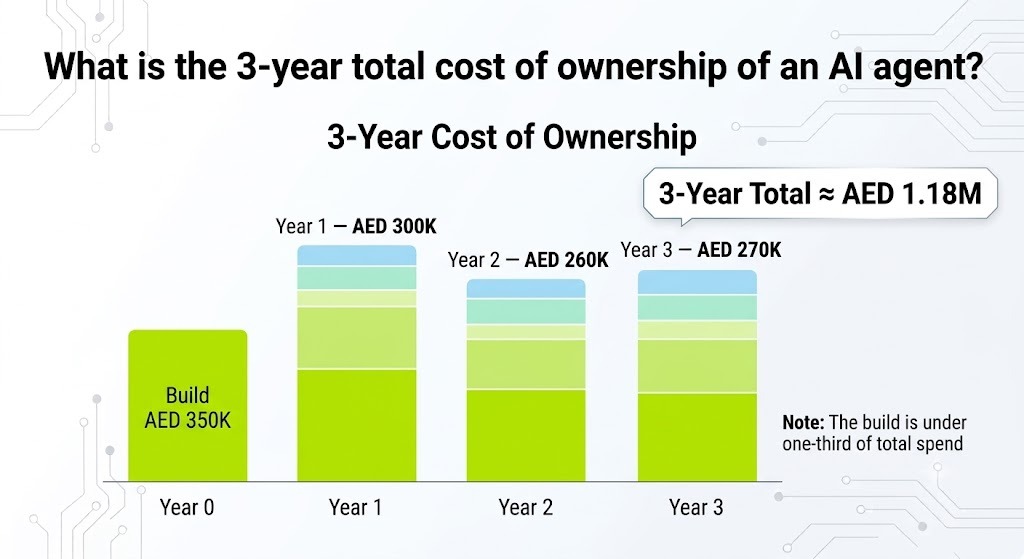
The reason is structural. The build is a single event, while operation, maintenance, and new use cases recur every month for years. A budget that stops at the build quote understates the real commitment by a wide margin, which is how well-funded projects still run out of money in Year 2.
The model below tracks a mid-tier departmental agent at moderate usage.
| Period | What it covers | Estimated Cost (AED) |
| Year 0 | Build and go-live | 350,000 |
| Year 1 | Operation plus enhancements | 300,000 |
| Year 2 | Operation plus iteration and new use cases | 260,000 |
| Year 3 | Operation plus model updates and scaling | 270,000 |
| Three-year TCO | ≈ 1,180,000 |
Two facts stand out from the model. The build accounts for under a third of the total, and ongoing costs decide the real spend. Falling inference prices soften Years 2 and 3, while rising usage and fresh use cases push them back up. Model the full three years before you sign, so the ROI case rests on the true figure.
What ROI and payback can UAE enterprises expect from AI agents?
Payback on a well-scoped agent often arrives within five to eight months. Support and back-office agents show the clearest returns, because their savings are easy to measure.
Consider a support agent that handles 20,000 tickets a month. If it resolves 55 percent without a human, it removes roughly 11,000 tickets from the queue every month. At a blended agent-hour cost, that can save around AED 900,000 a year in handling time. Set against an AED 350,000 build, payback lands near five months, and the agent keeps returning value after that.
The honest caveat sits in the data. McKinsey finds only about 6 percent of firms qualify as AI high performers (State of AI 2025). Returns follow scope discipline and adoption rather than the model brand.
Agents already earn their keep at scale. LangChain reports 51 percent of teams have agents in production, with 78 percent planning to follow (State of AI Agents). Value shows up once an agent reaches production, which is exactly where budgets should aim.
Why do 40 percent of agentic AI projects fail, and how do you protect your budget?
Gartner expects over 40 percent of agentic AI projects to be cancelled by the end of 2027 (Gartner, 2025). Most collapse for reasons a buyer can see and prevent during scoping.
Five patterns cause the bulk of cancellations. A missing success metric leaves value undefined, so the project cannot prove its worth at review. Demo-grade scoping skips evaluation and guardrails, and the agent breaks the moment it meets real users.
Unready data turns integration into a surprise that drains the budget mid-build. Absent human fallback lets one visible error destroy trust across the business. No named owner means accuracy decays after launch, and the agent quietly stops earning.
The opportunity behind the risk is large. The UAE agentic AI segment is forecast to grow from 65 million dollars in 2025 to over one billion by 2030 (MarketsandMarkets). Firms that scope for production capture that growth, while demo-chasers fund the cancellation statistic.
Three moves protect a budget. An evaluation gate before go-live proves the agent works, a data audit before build removes the biggest overrun, and a named owner keeps quality steady afterward.
Are you worried about your agent being stalled before go-live & want to get a production-readiness plan?
Build vs buy: should UAE enterprises build a custom AI agent or use SaaS?
Buy off-the-shelf when the task is common, and speed matters most. Build custom when the agent touches core data, sits under compliance, or handles a workflow you want to own outright.
SaaS agents win on the first invoice and on time to launch, since someone else has done the engineering. The trade-off shows up at enterprise volume, where per-seat and per-message pricing keeps climbing as adoption grows.
A custom build costs more upfront and then amortizes, so its cost per interaction falls as usage rises. Data control and compliance fit also favor a custom build, because the agent lives on your infrastructure under your rules.
| Factor | SaaS agent | Custom build |
| Upfront cost | Low, per seat or message | Higher, from AED 90,000 |
| Time to live | Days to weeks | Weeks to months |
| Data control | Vendor-hosted | Your cloud, your rules |
| Compliance fit | Generic | Sector-specific |
| Differentiation | Shared with rivals | Owned by you |
| Three-year cost at scale | Rises with seats and volume | Amortizes as usage grows |
A blended path suits many UAE buyers. Prove value on SaaS first, then build the version you own once the case is clear. Our guide on how to choose an AI app development company in Dubai covers the vendor due diligence that decision needs.
How long does it take to build an AI agent, or add AI features to an existing app?
An AI agent takes between three weeks and twelve months to build, and adding AI features to a live app takes four to ten weeks. Scope sets the timeline, and clean data shortens it.
A proof-of-concept moves fast because it answers one question with a person checking each step. A single-workflow agent needs a couple of months once integrations and testing enter the picture.
Departmental agents that touch several systems run three to six months, while enterprise multi-agent systems with compliance take up to a year. Adding AI features to an existing product lands in between, since the app already exists and only the agent layer is new.
| Scope | Timeline |
| POC / pilot | 3 – 6 weeks |
| Simple single-workflow agent | 6 – 12 weeks |
| Add AI features to a live app | 4 – 10 weeks |
| Multi-workflow departmental agent | 3 – 6 months |
| Enterprise / multi-agent system | 6 – 12 months |
Timelines stretch when data is messy, or approvals move slowly, and they compress when a decisive owner clears blockers. For teams weighing speed against scope, understanding how long it takes to build an app in Dubai adds useful context.
How to reduce AI agent development cost in the UAE without cutting corners
The smart savings come before the build starts, and they never touch evaluation or safety. Trimming scope in the right places lowers cost, while trimming testing raises it through rework.
-
A single high-value use case first
One well-chosen workflow proves value and controls spend before expansion. Trying to automate everything at once inflates the build and dilutes the result.
-
A data audit at the outset
Knowing the state of your data early removes the largest source of overruns. Clean inputs cut both build effort and later re-tuning.
-
A model matched to the task
A smaller model handles many jobs at a fraction of the cost of a frontier one. Right-sizing the model lowers both build and monthly bills.
-
Reuse of existing systems
Fewer new integrations mean less engineering and a smaller test surface. Connecting to what you already own is cheaper than rebuilding it.
-
A blended delivery team
UAE oversight paired with offshore build lowers the effective rate while keeping local accountability. This balance protects quality and budget together.
-
Human review kept in early
Catching errors through oversight costs less than repairing them in production. Oversight is a saving disguised as a cost.
Falling inference prices help the monthly figure over time, and scope discipline helps the build figure now. Applied together, the two protect the three-year total.
How Code Brew Labs builds production-grade AI agents in the UAE
Code Brew Labs builds compliance-led AI agents for UAE government entities, enterprises, and high-growth startups. Governance and evaluation sit inside the delivery process from the first sprint. Audit readiness gets proven at handover, not patched in after a regulator asks.
The work covers the agents UAE operators need most, built to hold up under real traffic. A production-grade support agent resolves more than half of incoming tickets without human help.
Delivery holds to the standards UAE regulators expect. Builds account for PDPL, Central Bank rules, and the data-protection laws inside DIFC and ADGM.
Evaluation, guardrails, and human oversight are part of every build, which is the direct answer to the 40 percent of projects Gartner expects to fail.
Arabic sits at the core of every build the team ships to the Emirates. Dialect coverage, Arabic-tuned retrieval, and right-to-left interfaces come designed in from day one. One accountable team owns the data, model, orchestration, and interface. That single line of ownership removes the delays and cost that multi-vendor builds carry.
Our portfolio backs the approach. The team built RJ SkyAssist, an MCP-enabled travel concierge for a national flag carrier, and Kaizan AI for conversational analytics and reporting. Trukker applies AI freight-matching across MENA logistics, while MCP Nexus governs AI-native engineering at platform scale. Alfardan digital remittance and DuPay operate in UAE fintech, with enterprise delivery behind ACWA Power and Airbus mission-critical communications.
The need might be a scoping assessment, a reference architecture, or a full build team. Code Brew Labs takes any of them from budget to production. Start with our AI agent development company in Dubai service, or explore agentic AI development in the UAE for your sector. To staff a build directly, hire AI and app developers in Dubai.
From budget to build; get a fixed-scope AI agent quote in AED, mapped to your data and compliance needs
Conclusion
The build quote is the smallest number in this decision, and treating it as the whole cost is why so many UAE projects stall. Operation, compliance, and maintenance decide the real three-year figure.
Price all of it in AED before you commit. A mid-tier agent near AED 350,000 to build often carries a three-year total close to AED 1.2 million. That figure is not a reason to hold back. It is the number that makes an ROI case honest and a board approval durable.
Gartner’s 40 percent cancellation forecast describes a scoping failure, not a technology one. Define one metric, audit your data, and give the agent a named owner. Get those three right, and payback inside a year moves from hope to plan.
Frequently asked questions
How much does it cost to build an AI agent in Dubai in 2026?
Between AED 90,000 and AED 1.5 million. A simple single-workflow agent starts near AED 90,000. Departmental agents run from AED 220,000 to AED 550,000. Enterprise systems with compliance and orchestration cross AED 550,000, and a short pilot can begin from AED 30,000.
What is the monthly cost of operating an AI agent in the UAE?
Between AED 3,000 and AED 150,000 a month. Small agents sit at AED 3,000 to AED 8,000, mid-tier agents at AED 12,000 to AED 40,000, and enterprise systems reach AED 150,000. Maintenance and engineering, rather than token bills, now shape most of that figure.
Are AI agents more expensive to build in Arabic?
Yes, by about 15 to 30 percent. Dialect coverage, Arabic-tuned retrieval, right-to-left interfaces, and separate evaluation sets add effort. Voice agents cost more again because of Arabic speech handling. An Arabic-first model such as Jais can raise accuracy and cut rework on dialect-heavy tasks.
Is it cheaper to build a custom AI agent or buy SaaS?
SaaS costs less on day one. A custom build usually wins on total cost at enterprise volume across three years. Buy SaaS for common tasks and fast proof of value. Build custom when the agent handles core data, compliance, or a workflow you want to own.
How long does AI agent development take in the UAE?
Between three weeks and twelve months. A pilot takes three to six weeks, a single-workflow agent six to twelve weeks, and a departmental agent three to six months. Enterprise multi-agent systems take up to a year. Adding AI features to a live app takes four to ten weeks.
What hidden costs should UAE enterprises budget for?
Plan for 20 to 40 percent above the build quote. The common gaps are data preparation, ongoing evaluation, integration maintenance, model re-tuning, guardrails, and staff training. Regulated sectors add compliance, hosting, and audit costs, and these recurring items decide the real three-year spend.
Let's Convert Your Business Idea Into Success!
Free Consultation from Top Industry Experts
Let’s Build Your Dream App!
Share article on :



 No commitment required
 NDA on request
 24-hour response


