
Quick Summary:
- The UAE logistics market exceeds AED 210 billion and is digitizing at speed.
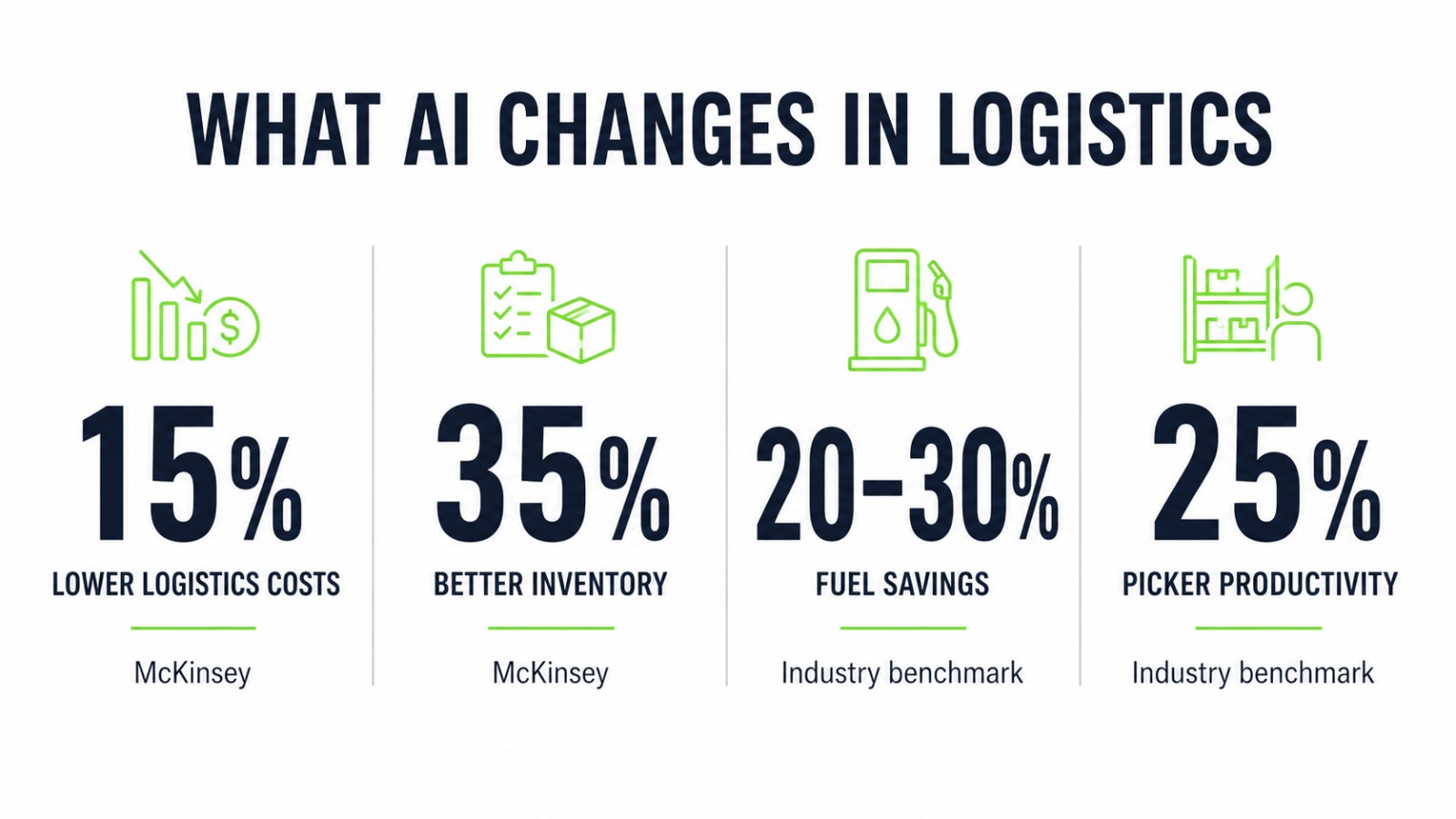
- McKinsey links AI adoption to 15% lower logistics costs and 35% better inventory.
- Route optimization AI cuts fuel spend 20 to 30% across UAE delivery fleets.
- PDPL data residency, RTA, Salik, and Dubai Trade shape every UAE build decision.
- DP World, Aramex, and TruKKer already run AI across regional logistics operations.
- Build cost depends on scope, integrations, and compliance rather than vendor price lists.
- Enterprises win by proving one pillar first, then scaling on real data.
AI in logistics runs UAE fleet, warehouse, dispatch, and delivery operations from one connected system.
A Dubai fleet manager opens the morning to three problems at once. One driver sits idle at a Jebel Ali gate. Meanwhile, a customer has moved a delivery window. Finance is still matching yesterday’s cash-on-delivery totals.
AI logistics software development targets that exact morning. It reads live data from vehicles, warehouses, and orders. Then it acts before small delays turn into missed SLAs.
For UAE enterprises, the stakes sit in cost and reliability. Fuel, failed deliveries, and idle assets drain margin every day. Government targets now push operators toward connected operations.
The blog explains what AI does across four operations. They cover real deployments, AED build costs, and local compliance rules.
Map AI to your fleet, warehouse, or delivery workflow with our UAE team
What is AI in logistics and how does it work?
AI logistics software is a system that plans and automates the movement of goods. It applies machine learning, computer vision, and predictive analytics across transport, storage, and delivery.
The software reads live data from vehicles, orders, and warehouses. Then it acts on that data in real time.
Four techniques do most of the work here:
- Predictive analytics forecasts demand, delays, and maintenance needs.
- Computer vision reads labels, damage, and load conditions.
- Route optimization engines rebuild delivery paths against live traffic.
- Generative AI copilots draft documents and flag exceptions for dispatchers.
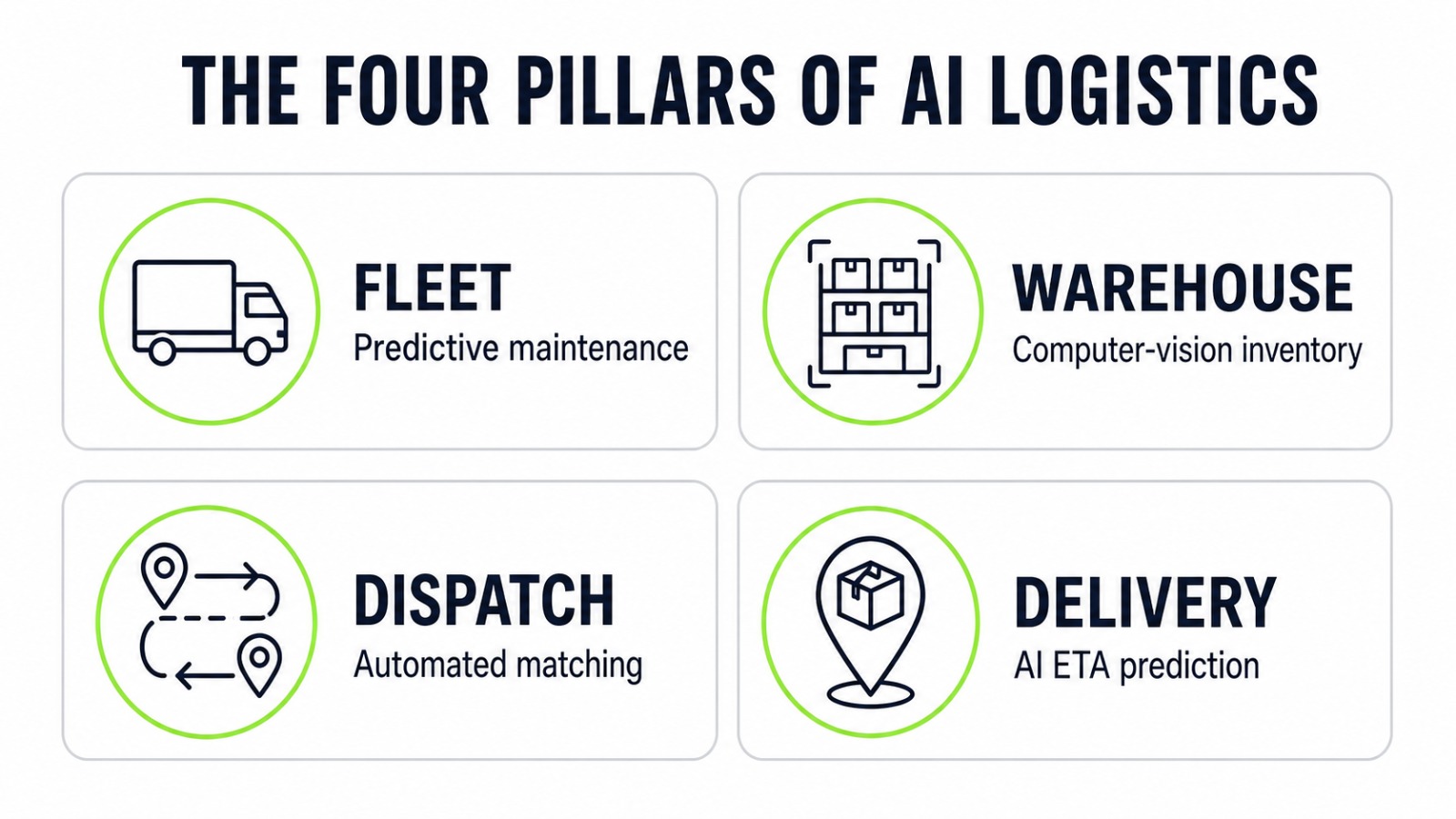
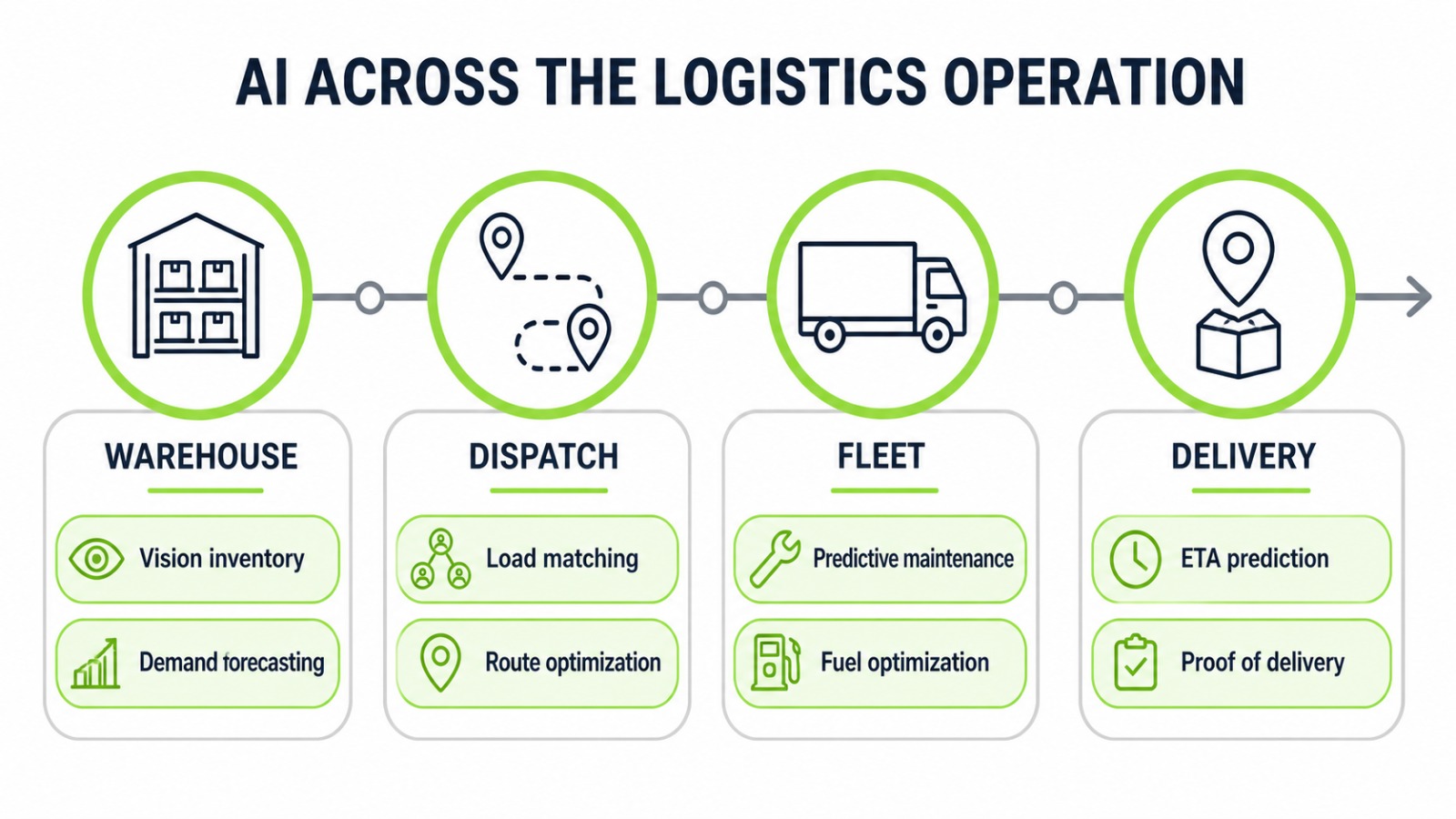
These techniques run across four operations. Fleet, warehouse, dispatch, and delivery each carry their own AI use cases.
Code Brew Labs works as an AI app development company in Dubai, building these systems for regional operators.
Why are UAE enterprises adopting AI in logistics in 2026?
UAE enterprises are adopting AI in logistics because policy, e-commerce volume, and cost pressures now demand it.
Dubai’s RTA set a Commercial and Logistics Land Transport Strategy 2030. It targets AED 16.8 billion in direct sector contribution. The plan also seeks a 75% rise in infrastructure technology adoption.
Delivery demand climbs alongside that policy push. The UAE logistics market now sits above AED 210 billion, per IMARC Group. Growth adds pressure on routing, delivery windows, and settlement.
Cost sits mostly in the last mile. Capgemini has cited last-mile delivery as 41% of total logistics supply chain costs.
National infrastructure raises the ceiling further. Etihad Rail now runs a 900 km freight network across all seven emirates. Its capacity reaches 60 million tonnes each year.
Dubai’s D33 agenda sets the destination. It aims for a top-five global logistics hub by 2033.
For enterprise groups, that combination changes the build case. Enterprise AI development in the UAE now reads as infrastructure, not experiment.
How is AI improving supply chain management in logistics?
AI improves supply chain management by predicting demand and coordinating every stage from one data view. A supply chain spans sourcing, storage, transport, and delivery. AI connects these stages into a single planning layer.
Demand forecasting reads sales history, seasonality, and market signals. Forecast accuracy improves 20% to 50% with AI models, per McKinsey.
End-to-end visibility tracks every shipment and stock level in real time. Managers spot a disruption before it reaches the customer. Inventory optimisation holds less stock without risking a stockout. The same McKinsey study ties AI supply chains to 35% better inventory levels.
Supplier risk scoring flags a vendor before a delay hits production. Procurement teams shift orders early on that signal.
Resilience matters for a trade hub like the UAE. Ports, rail, and road feed one national flow of goods.
A digital twin models the whole network before a change goes live. Planners test a new route or hub without operational risk.
Supply chain gains land inside four operations. Each pillar below carries its own AI use cases.
How does AI improve fleet management and vehicle operations?
AI improves fleet management by predicting failures, scoring drivers, and rebuilding routes in real time.
Fleet management stands as its own discipline inside logistics. It covers vehicles, drivers, fuel, maintenance, and compliance.
Predictive maintenance reads engine, brake, and tyre sensor data. It flags a failing part before the vehicle breaks down. McKinsey ties the approach to 30% to 50% less downtime.
Route optimisation engines read live traffic, Salik tolls, and delivery windows. Routes rebuild mid-shift when a road closes or an order changes. Reported deployments cut fuel and mileage by 10% to 30%.
Driver-behaviour scoring tracks speeding, harsh braking, and idling. Safer driving lowers accident rates and insurance exposure. Telematics ties each vehicle to a live dashboard for managers.
UAE conditions add pressure most global tools ignore. Heat above 45°C shortens EV range and drains batteries faster. AI adjusts charging windows and route length against that reality.
How does AI cut costs in fleet operations?
AI cuts fleet costs across four line items.
Fuel is the highest variable cost in most fleets. Optimised routing and idle reduction trim that spend by 10% to 30%.
Maintenance costs fall when repairs happen before a breakdown. Predictive alerts extend vehicle life and cut emergency callouts.
Labour costs drop when dispatch fits more stops into each shift. Fewer failed deliveries also cut costly repeat trips.
Insurance premiums ease as driver scores improve over time. Compliance fines fall when telematics logs every trip.
For a 100-vehicle fleet, combined savings can reach six figures in AED each year
What can AI do in warehouse operations?
AI runs warehouse operations by directing storage, picking, inspection, and replenishment from live data.
Dynamic slotting places fast-moving stock within closer reach of packers. McKinsey links this to 25% higher picker productivity and 30% better space use.
Computer vision inspects labels, damage, and load conditions as goods move. Cameras catch errors that manual checks miss at speed.
Autonomous mobile robots move pallets across large distribution centres. Robotic picking handles high-volume orders without added shifts.
Demand-driven replenishment refills shelves before a stockout hits. Forecasts read sales history and live order flow together.
Cold-chain monitoring matters in a 50°C climate. Sensors track temperature for pharma and food inside every zone. An alert fires the moment a reefer drifts out of range.
JAFZA and KIZAD host large bonded warehouses across the UAE. AI ties these sites to customs and inventory systems in one view.
A custom software development company in Dubai can connect these modules to existing warehouse hardware.
How does AI-powered dispatch and load planning work?
AI dispatch matches orders to drivers and rebalances loads as conditions change.
An AI dispatcher assigns each order by location, capacity, and promised window. It weighs traffic and driver availability in the same decision.
Plans break in live operations every day. A driver runs late, a vehicle fails, an order cancels. AI re-dispatches within seconds and holds the schedule.
Load planning packs each vehicle to its full capacity. Better fill rates cut the number of trips per route.
Geofencing confirms pickup and drop-off without manual check-ins. Exception alerts reach the dispatcher before a customer complains.
Cash-on-delivery reconciliation closes at dispatch, not days later. Each driver settles cash, card, and wallet against the shipment.
A generative AI copilot answers dispatcher questions in plain language. It surfaces the next best action during a busy shift.
We engineered AI logistics platforms for TruKKer, Zajel, and Logisty across the UAE and MENA.
How is AI changing last-mile delivery in the UAE?
AI changes last-mile delivery in the UAE through sharper ETAs, smart routing, and autonomous drops.
ETA models read traffic, weather, and driver progress in real time. Customers get an accurate window instead of a full-day slot.
Address intelligence resolves the unnamed streets common across the Emirates. It learns from past drops to guide drivers to the right door.
Failed deliveries drain margin on every route. AI predicts a likely miss and reschedules before the driver leaves.
Dynamic routing adds and drops stops through the shift. Drivers follow the shortest live path between deliveries.
Autonomous drops now carry policy backing in the UAE. The RTA approved a framework for autonomous heavy logistics vehicles. Drones and delivery robots extend that shift in dense areas.
UAE holds close to 35% of MEA autonomous-delivery activity, per GM Insights. The segment climbs toward AED 42 billion of global value by 2035.
Driver and customer apps need Arabic and right-to-left layout from day one. Bilingual delivery app development in the UAE lifts trust with local buyers.
What are the real AI use cases in logistics? Global examples
Real AI use cases in logistics already run across major operators.
DP World applies AI and automation for trade visibility across its ports and yards, per a case study on its UAE operations.
Aramex migrated core workloads to AWS in 2025 and built an AI-first data foundation for real-time intelligence.
| Operator | AI capability | Pillar |
| DP World | Automated trade visibility | Supply chain |
| Aramex | AI-first data foundation | Delivery network |
| Amazon | Predictive purchasing, robotics | Warehouse |
| DHL | Warehouse robotics fleet | Warehouse |
Global giants prove the model at scale. The next section shows what we deliver for UAE and MENA operators.
How much does it cost to build AI logistics software in the UAE?
AI logistics software in the UAE has no single price. Cost tracks scope, integration count, and compliance load.
Clutch’s July 2026 data puts most reviewed app projects between AED 36,725 and AED 183,621. The average reviewed project runs near AED 333,390.
A logistics platform sits above a simple app. Scope drives the number, as shown below.
| Build scope | Planning reference (AED) | Fit |
| Single-pillar pilot (one workflow MVP) | 150,000 to 400,000 | Test one high-cost process |
| Multi-module platform (2 to 3 pillars) | 400,000 to 1,100,000 | Driver, dispatcher, admin, backend |
| Enterprise suite (four pillars + ERP + custom AI) | 1,100,000+ | Full operation, compliance, integrations |
Build, buy, or hybrid changes the math again:
| Option | Strength | Trade-off |
| Custom build | Fits complex ops, owns code and data | Higher upfront investment |
| Off-the-shelf SaaS | Fast launch, low entry cost | Limited fit, recurring fees |
| Hybrid | SaaS modules plus custom core | Needs integration planning |
A 100-vehicle fleet cutting fuel 20% often recovers build cost inside the first year. Compare vendors on discovery quality and source-code handover, covered in our guide to logistics app development cost in the UAE.
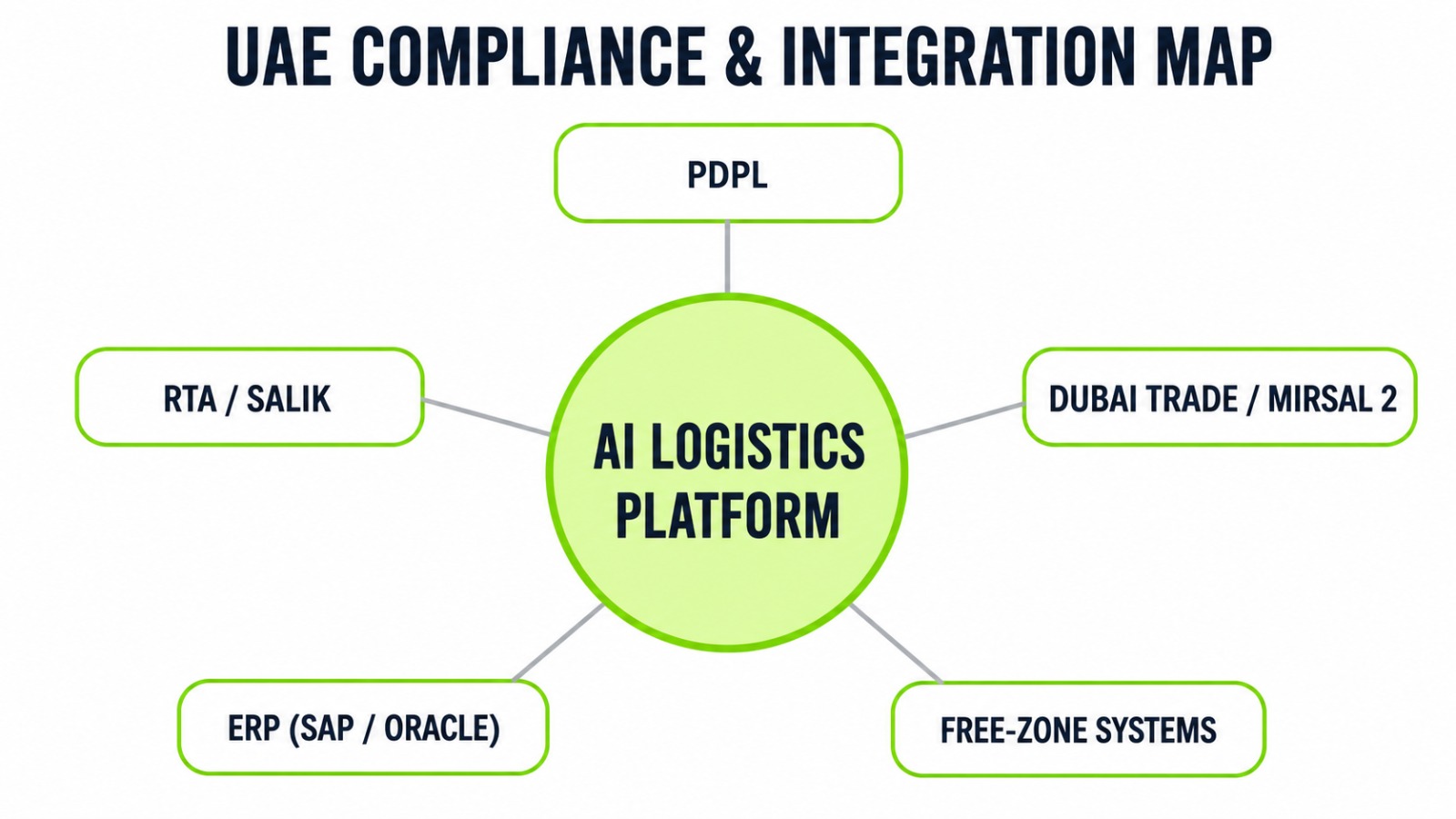
What UAE laws and integrations affect AI logistics software?
UAE law and local systems shape every AI logistics build.
The UAE PDPL governs how personal and operational data gets stored and moved. Some government and regulated workloads expect local hosting or approved transfer terms.
RTA rules cover fleet telematics. Salik and Mawaqif need direct integration for tolls and parking.
Dubai Trade and Mirsal 2 handle customs declarations. A platform without these ties creates manual rework.
Free-zone and mainland operations follow different data rules. Board-level buyers also ask about AI explainability and audit trails.
How should enterprises roll out AI logistics software?
Enterprises should roll out AI logistics software one pillar at a time.
- Assess data readiness across fleet, warehouse, and orders.
- Pick one high-pain pillar with clear cost.
- Run a scoped pilot on real operations.
- Prove ROI on measured data.
- Scale across pillars and GCC markets.
AI features belong in the plan once clean operational data exists. An AI workflow automation agency in Dubai can sequence the rollout without stalling live operations.
Why choose Code Brew Labs as your AI logistics software development partner?
Code Brew Labs is an AI enterprise logistics solution development company. We have engineered AI-first digital products since 2013. Our teams serve the UAE, the Middle East, and global markets. Delivery spans more than 35 industries, including fintech, healthcare, and real estate.
For logistics, we build across fleet, warehouse, dispatch, and delivery. Each build ships with the compliance and integration UAE operators need.
TruKKer, freight marketplace for MENA
We engineered TruKKer, a freight marketplace for the MENA region. The operator needed to connect shippers with reliable truck capacity. We built matching, tracking, and payment into one platform. TruKKer now links shippers with more than 12,000 trucks.
Logisty, goods delivery for the UAE
We built Logisty, a goods delivery platform for the UAE. The team wanted real-time visibility across a large fleet. We delivered live tracking, dispatch, and shipment management. Logisty now handles more than 500,000 shipments each day.
Zajel, last-mile driver operations
We developed Zajel’s driver operations app for UAE last-mile teams. Drivers struggled with scattered tools for payment and navigation. We centralised payment collection, order tracking, and live navigation. Field teams now run each delivery from one app.
We own the full lifecycle from discovery to launch and support. You keep source code, data, and control at handover. See more builds in our logistics software portfolio.
Our team builds AI logistics software for UAE operators.
Conclusion
UAE logistics rewards operators who treat AI as an operating layer. Fleet, warehouse, dispatch, and delivery share one data core. A platform built for local compliance holds up under audit and peak season.
Go back to that 7:30 a.m. dispatcher. Start with the workflow that costs the most today. Prove the return, then scale across pillars and GCC markets.
FAQs
How is AI used in logistics operations?
AI runs four core jobs in logistics. It forecasts demand and maintenance, optimises routes, guides warehouse picking, and matches orders to drivers. Vehicles, warehouses, and orders feed live data into one system. Operators act on that data in real time instead of end-of-day reports.
Does UAE law require logistics data to be hosted locally?
UAE data rules depend on the sector and the type of data. The UAE PDPL sets conditions for storing and transferring personal data. Some government and regulated workloads expect local hosting or approved transfer terms. A logistics platform should map data residency before launch, not after an audit.
How much does it cost to build AI logistics software in the UAE?
Cost depends on scope, integrations, and compliance rather than a fixed rate. Clutch’s July 2026 data puts most reviewed app projects between AED 36,725 and AED 183,621. A single-pillar pilot fits a smaller budget. An enterprise suite across four pillars costs more. Scope the workflows first, then request estimates.
What is the ROI of AI route optimization for a UAE fleet?
Route optimization returns value through fuel, mileage, and driver hours. Reported deployments cut fuel and mileage by 10% to 30%. A 100-vehicle fleet with high daily distance sees the fastest payback. Savings on tolls and overtime add to the case. Most operators model a return inside the first year.
Can AI logistics software integrate with SAP TM or Oracle OTM?
Yes. A custom platform connects to SAP TM, Oracle OTM, and other ERP systems through APIs. Integration covers orders, inventory, invoicing, and master data. Brownfield rollouts keep existing systems running during the switch. Integration scope drives a large share of the total build cost.
How does AI handle cash-on-delivery in UAE deliveries?
AI ties cash-on-delivery to dispatch and driver settlement in real time. The system records each collection against the shipment at drop-off. Finance sees reconciled totals the same day. COD stays common across GCC e-commerce, so the flow needs first-class support. A driver app should capture cash, card, and wallet at the door.
Is custom AI logistics software better than off-the-shelf SaaS?
The answer depends on operational fit and control. Off-the-shelf SaaS launches fast and suits standard workflows. Custom software fits complex operations, local compliance, and ERP ties. It also keeps source code and data under the operator’s ownership. Many UAE enterprises run a hybrid, with SaaS for standard modules and custom builds for core operations.
How long does it take to build AI logistics software?
Timelines track scope. A single-pillar pilot ships in about three to five months. Multi-module platforms run six to twelve months. AI features enter once clean operational data exists. A phased plan puts a working release in market before advanced automation.
Can the software work in Arabic for drivers and customers?
Yes. Driver and customer apps support Arabic and right-to-left layout from the first release. Bilingual service covers notifications, proof of delivery, and support. Arabic-first design matters for adoption among UAE drivers and buyers. Language should sit in the plan at the design stage, not as a later patch.
Let's Convert Your Business Idea Into Success!
Free Consultation from Top Industry Experts
Let’s Build Your Dream App!
Share article on :


 No commitment required
 NDA on request
 24-hour response


