
Quick Summary:
- Arabic-first AI chatbots are designed around Gulf dialect, Arabizi, and code-switching before any English layer gets added.
- Jais 2, Falcon-H1-Arabic, and ALLaM give UAE teams Arabic-native models that can run inside the country.
- WhatsApp reviews each template language on its own, and Meta never translates template text or variables.
- Under PDPL Articles 22 and 23, personal data sent to an overseas model counts as a cross-border transfer.
- Code Brew estimates put builds between AED 25,000 for WhatsApp FAQ bots and AED 550,000 for enterprise assistants.
- Health chatbots face Federal Law No. 2 of 2019, which bars offshore patient data without authority approval.
- Test every release against real Emirati, MSA, Arabizi, and mixed-English questions before it reaches WhatsApp customers.
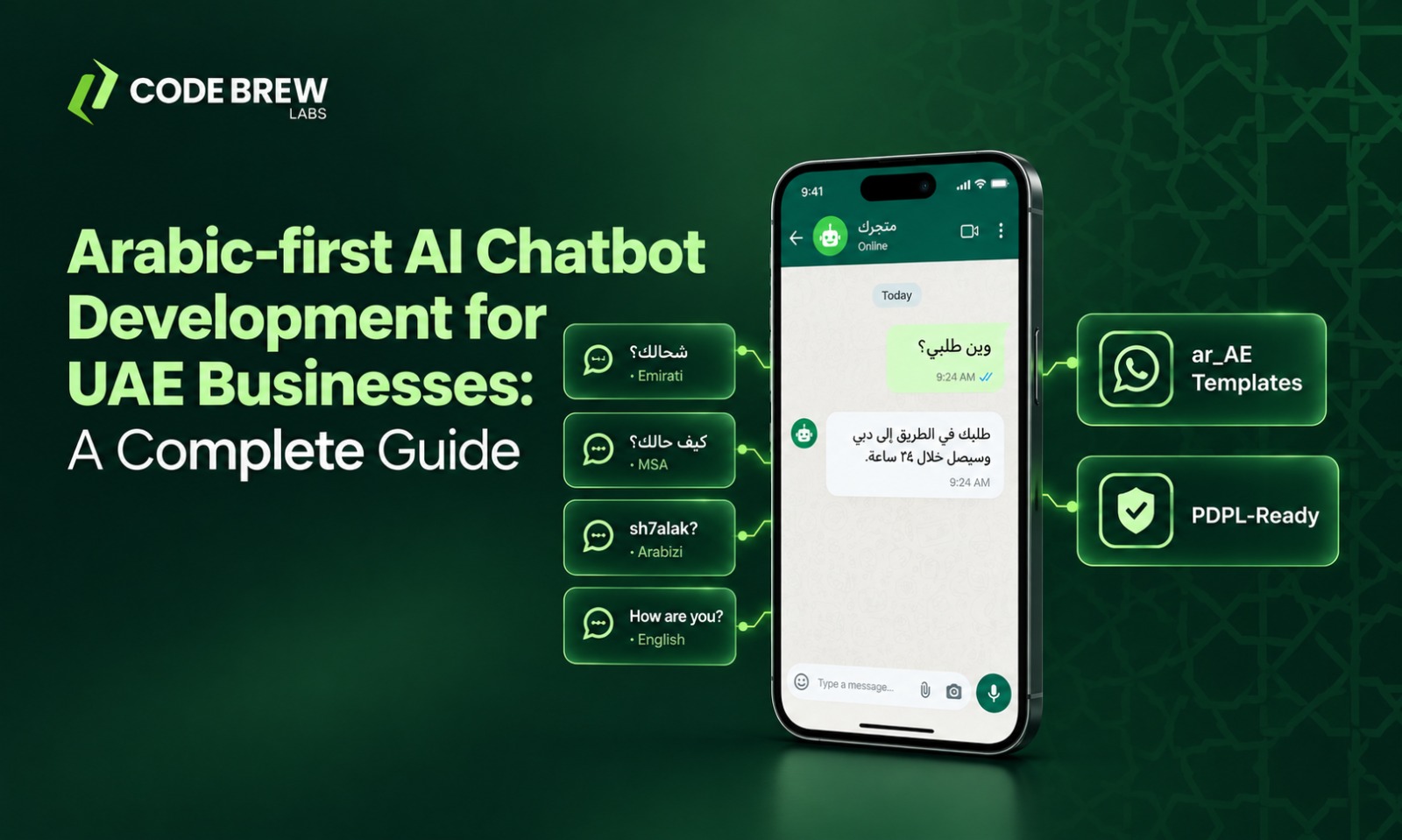
An Arabic-first AI chatbot in the UAE is a conversational assistant designed in Arabic from day one, then extended to English. It reads Emirati dialect, Arabizi, and code-switched messages, replies in the customer’s register, and works inside WhatsApp.
Translated bots run the other way round. A team builds in English, bolts on machine translation, and hopes customers type textbook Arabic. Few of them do.
Picture a Dubai customer at 11:40 pm asking about a delayed order: “وين طلبي؟ قالوا يوصل اليوم”. An English-first bot often misses “وين”, Gulf for “where”, and sends a generic tracking link.
Scale makes that miss expensive. DataReportal puts UAE internet penetration at 99% for 2026. In a 2024 YouGov survey for Zbooni, 85% of residents said they prefer WhatsApp for company contact.
Arabic has more than 400 million everyday users, according to UNESCO. Yet W3Techs finds Arabic on 0.6% of websites, a thin base for any model learning Gulf speech.
Getting an Arabic chatbot right means treating the model, channel, hosting region, and dialect tests as one decision. Each choice carries an AED price tag and a PDPL consequence.
Curious how many WhatsApp questions an Arabic-first AI chatbot could answer in your customers’ own dialect?
What Is an Arabic-first AI Chatbot?
An Arabic-first AI chatbot is built on Arabic data, intents, and test sets before English enters. Arabic-supported bots start in English and add Arabic intents later.
A translated bot holds no Arabic knowledge at all. It converts each message into English, answers, then converts the reply back.
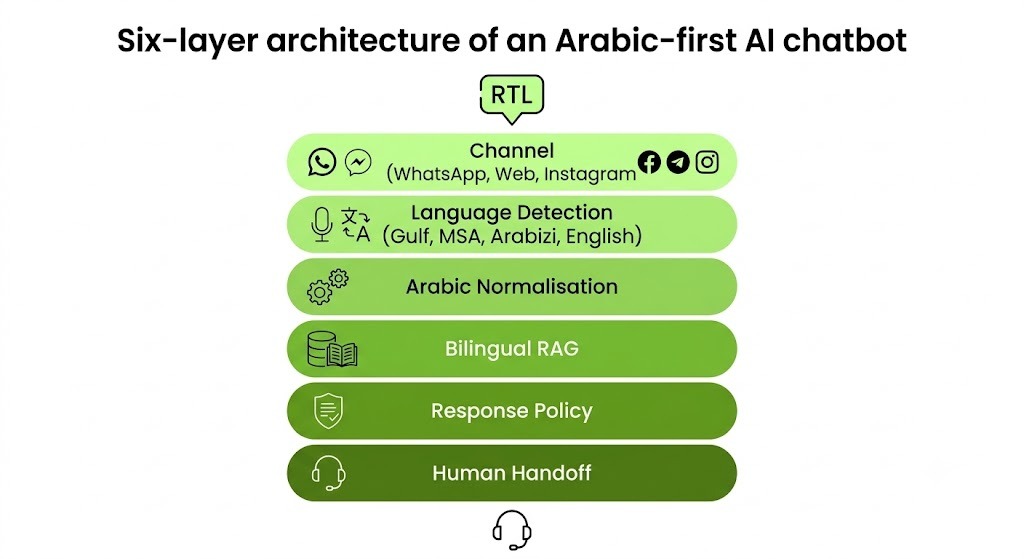
How Arabic-first Design Works Across Five Layers
-
Channel layer
Each channel renders Arabic in its own way, so direction and locale get stored with every turn.
-
Language routing
Every message is tagged as Gulf, MSA, Levantine, Egyptian, Arabizi, or English. Routing then picks the retrieval index and reply register.
-
Retrieval
A bilingual knowledge base, normalised for Arabic spelling variants, feeds grounded answers.
-
Response policy
Rules set dialect, formality, and the point where the bot stops guessing. Sitting outside the model, they survive upgrades.
-
Human handoff
An agent receives the transcript, detected dialect, and a two-line summary, so customers never repeat themselves.
Arabic-first, Arabic-supported and Translated Bots Compared
| Dimension | Arabic-first | Arabic-supported | Translated |
| Design language | Arabic knowledge base first | English first, Arabic added | English plus machine translation |
| Dialect handling | Emirati, Gulf, MSA, Levantine, Egyptian | MSA in most cases | Whatever the engine guesses |
| Arabizi | Detected and converted | Seldom handled | Fails |
| RTL and mixed text | Tested per channel | Partial | Breaks on numbers and prices |
Why Do UAE Businesses Need an Arabic-first AI Chatbot in 2026?
Three forces push UAE firms toward Arabic-first automation: channel habits, a language gap online, and public-sector benchmarks. Contact-centre economics add a fourth.
WhatsApp Is Where UAE Customers Start the Conversation
Residents treat WhatsApp as a service desk. The YouGov survey for Zbooni found 65% used it for product or service enquiries within a year. Yet 87% of respondents still prefer a human agent. A good Arabic bot answers fast and hands over faster.
Arabic Demand Outruns Arabic Content Online
CSA Research surveyed 8,709 consumers across 29 countries. Of them, 76% want product information in their own language; 40% never buy from foreign-language sites.
Emiratis make up about 11.5% of the population, per Global Media Insight. Arabic is also the working language of federal services.
Government Services Have Set the Bar
RTA’s Mahboub joined WhatsApp in July 2019 with 64 services. By January 2024, it handled more than 250, including driving-test bookings.
DEWA’s Rammas answered 2 million enquiries in 2024 across Arabic and English. Abu Dhabi’s TAMM 3.0 put an Arabic and English voice assistant in front of 800-plus services.
Someone who books a driving test in Gulf Arabic expects the same from a clinic or retailer.
The Economics of Automated Arabic Support
Gartner projected conversational AI would cut contact-centre agent labour costs by about AED 294 billion in 2026. Its 2025 forecast expects agentic AI to resolve 80% of common service issues by 2029.
An NBER study of 5,179 support agents found AI help raised issues resolved per hour by 14%. Novice agents gained 34%.
PwC puts AI’s 2030 share of UAE GDP near 14%, a target the National AI Strategy 2031 supports.
Why Do Generic Chatbots Fail in Arabic? 6 Challenges for a Natural Language Chatbot in Arabic
Six properties of Arabic trip up English-trained pipelines, and each needs its own fix.
1. Dialects Split One Language Into Many
Modern Standard Arabic is the written standard, yet customers type the way they speak. The MADAR project mapped dialect variation across 25 Arab cities.
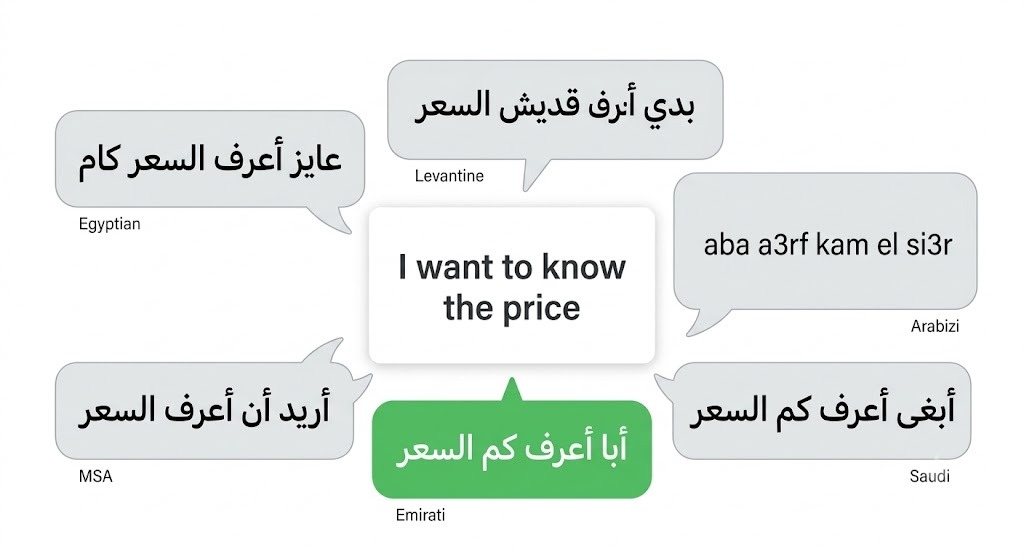
Machines still struggle: at NADI 2024, the best system scored 50.57 F1 on multi-label dialect identification. Everyday words carry the gap, as the comparison shows.
| Meaning | MSA | Emirati | Saudi | Egyptian | Levantine | Gulf Arabizi |
| How are you? | كيف حالك؟ | شحالك؟ | وشلونك؟ | إزيك؟ | كيفك؟ | sh7alak? |
| I want to know the price | أريد أن أعرف السعر | أبا أعرف كم السعر | أبغى أعرف كم السعر | عايز أعرف السعر كام | بدي أعرف قديش السعر | aba a3rf kam el si3r |
| Now | الآن | الحين | الحين | دلوقتي | هلق | el7een |
2. Arabizi and Code-Switching Break Intent Detection
Arabizi writes Arabic in Latin letters, with digits standing in for sounds that English lacks. Gulf users type 3 for ع, 7 for ح, 5 for خ, and 6 for ط.
A message like “aba a3rf el si3r” looks like noise to an English tokenizer. Code-switching adds a second layer: “ابغى أعرف الـpricing حقكم” mixes scripts inside one word.
The fix is a detection step that labels script and variety, then converts Arabizi before retrieval. Shehadi and Wintner’s 2022 paper, presented in Abu Dhabi, tags code-switched Arabizi word by word.
3. Rich Morphology Needs Normalisation Before Retrieval
One Arabic word can carry a conjunction, preposition, article, and noun. “وبالسعر” packs “and with the price” into a single written word.
Customers also write أ, إ and آ for the same letter, swap ة with ه, and drop diacritics.
A retrieval pipeline should normalise these forms, strip tatweel, convert Arabic-Indic digits, and split clitics. CAMeL Tools from NYU Abu Dhabi and QCRI’s Farasa both handle segmentation.
4. RTL and Bidirectional Text Corrupt Numbers and Prices
Arabic runs right to left, while order numbers, phone numbers, and prices run left to right. Mixed lines can reorder hyphens, plus signs, and currency codes.
Web widgets need dir=”auto” on each bubble and Unicode isolates around numbers. WhatsApp sets direction from the first strong character. A template opening with an English brand name therefore aligns left.
5. Register, Greetings and Gender Carry Cultural Weight
Gulf customers notice tone fast. “السلام عليكم” expects “وعليكم السلام” in reply, and “حياك الله” sounds warmer than a stock “Welcome”.
Arabic verbs and adjectives change with gender, so a bot that guesses wrong can offend. Safer replies use plural forms such as “تفضلوا” until the customer’s own words show gender.
6. Arabic Costs More Tokens per Answer
Tokenizers built for English split Arabic into more pieces. Petrov and colleagues measured about three times more tokens for Arabic than English on the GPT-4 tokenizer.
Newer tokenizers narrow the gap, so measure it on your own transcripts before choosing a model.
Core Features of an Arabic-first AI Chatbot
Every capability on this list closes one of the six gaps described earlier. Teams scoping bilingual AI chatbot development in the UAE can treat it as a baseline.
-
Dialect-aware understanding
The model classifies Gulf, MSA, Levantine, Egyptian, and Arabizi input before answering. Intent accuracy gets tracked per variety, so a weak dialect shows up in reporting.
-
Register matching
Replies mirror the customer within brand limits: a bank stays formal, a café chain sounds Emirati.
-
Detection on every turn
Customers switch language mid-thread, so script and variety get checked on each message. A session that opens in English can close in Arabic.
-
Arabic normalisation in retrieval
Spelling variants, digits, and clitics get standardised before search. “الاسعار” and “الأسعار” then match the same price page.
-
Bilingual RAG
Retrieval-augmented generation pulls answers from approved documents in both languages. An English returns policy can still produce a grounded Arabic reply.
-
RTL-safe interfaces
Widgets, templates, and buttons get tested with mixed-direction prices, order IDs, and phone numbers.
-
Human handoff with context
Explicit requests, low confidence, and negative sentiment all trigger a transfer with full context.
-
WhatsApp-native messaging and integrations
Templates exist as ar_AE and English pairs. CRM records, payments, and UAE Pass checks run inside the same flow.
-
Voice notes in Gulf Arabic
Speech-to-text tuned on Gulf audio turns recorded questions into searchable text.
-
Privacy controls and split analytics
Dashboards report CSAT per dialect, and card details get redacted before any prompt leaves.
Which AI Chatbot Arabic Model Fits a UAE Business? Jais vs Falcon vs ALLaM vs GPT
Model choice in the UAE turns on three questions: Arabic quality, where inference runs, and licence terms. Benchmarks answer the first; contracts settle the other two.
UAE-Built and Regional Arabic Models
- Jais 2: Inception, MBZUAI and Cerebras released it in December 2025 in 70B and 8B open-weight sizes. It covers MSA, regional dialects, and Arabic-English code-switching.
- Falcon-H1-Arabic: TII’s January 2026 family comes in 3B, 7B, and 34B sizes, with context windows up to 256K tokens. Its 34B model scores about 75% on the Open Arabic LLM Leaderboard.
- ALLaM: Saudi Arabia’s SDAIA trained it on a 500-billion-token Arabic dataset. A 7B version is available through Microsoft Azure, a fit for GCC brands with Saudi audiences.
- Pronoia (Arabic.AI): Tarjama& launched Arabic.AI at Dubai AI Week in April 2025. Pronoia, its 14B model, fits one GPU.
Global Models With UAE Hosting Options
- OpenAI GPT-5.2: OpenAI offers UAE storage and processing through ae.api.openai.com for a few snapshots, GPT-5.2 among them. Gulf dialect handling still needs prompt rules.
- Claude through Amazon Bedrock: Anthropic’s own API offers US or global inference. Bedrock serves Claude from the UAE region, though cross-region inference may process prompts elsewhere.
- Self-hosted open weights: Jais 2 and Falcon-H1-Arabic run on UAE cloud or private GPUs, at your operating cost.
Prompting, RAG or Fine-Tuning: Which Comes First?
The custom AI development in Dubai starts with a strong system prompt and RAG over client documents. Changing a prompt costs hours; retraining weights costs weeks.
Fine-tuning earns its cost once dialect accuracy plateaus on your test set. A 2025 study adapted ALLaM to Saudi dialect with LoRA, a low-cost fine-tuning method.
Public benchmarks such as ArabicMMLU and BALSAM give a first filter. None tests Emirati customer service, so your own dialect set decides the shortlist.
| Model | Arabic strength | UAE hosting route | Best fit |
| Jais 2 (70B, 8B) | MSA, dialects, code-switching | Self-host on UAE cloud | Sovereign or regulated builds |
| Falcon-H1-Arabic | About 75% on OALL (34B) | Self-host | High-volume, cost-sensitive bots |
| ALLaM 7B | 500B Arabic training tokens | Azure model catalogue | Saudi-facing GCC brands |
| Pronoia | 14B, single GPU | Vendor platform | Enterprise Arabic workflows |
| GPT-5.2 | Strong multilingual | UAE regional endpoint | Fast builds needing residency |
| Claude | Strong multilingual | Bedrock me-central-1 | Redacted or non-sensitive data |
How to Build an Arabic-first AI Chatbot: A 7-Step Development Guide
Seven steps take a project from scoping to a monitored launch. The first three decide most of the cost, so they deserve the most time.
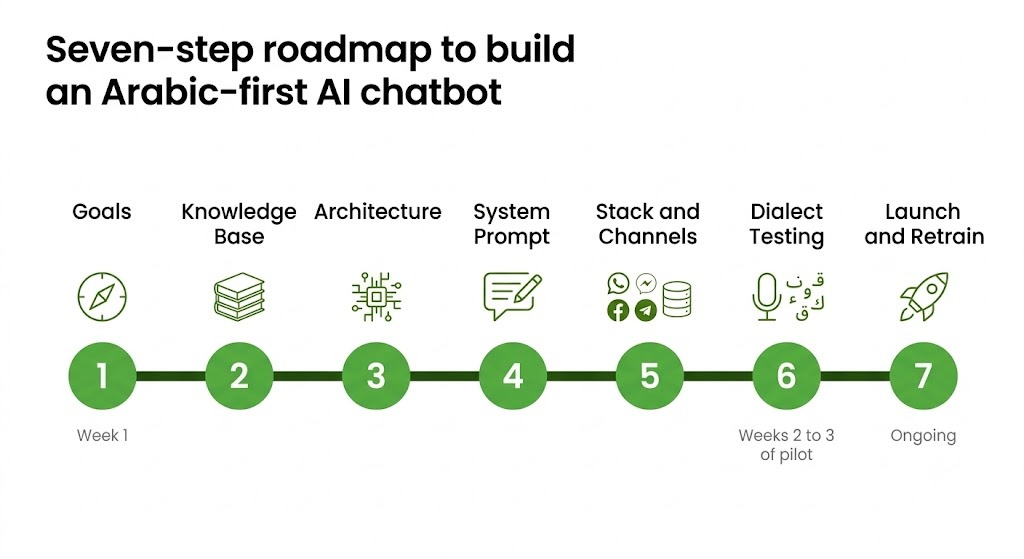
Step 1: Set Goals, Metrics, and a Language Strategy
Start with the queries that eat the most agent time, and pick three to five. Order tracking, appointment changes, and lead qualification are common UAE starting points.
Language strategy comes next. Arabic-only suits government-facing services; Arabic-first bilingual suits retail and healthcare; English-first with Arabic fits B2B tech firms.
Containment, resolution quality, and CSAT should each be split by language and dialect.
Step 2: Mine Real Conversations and Write the Knowledge Base in Customer Voice
Your WhatsApp inbox is the best training brief you own. Three to six months of exported chats, stripped of personal data, reveal the real intents.
Write each answer twice where needed: once in Gulf phrasing, once in simple MSA. Tag entries with product, emirate, language, and validity date, so stale offers drop out of retrieval.
Step 3: Choose the Architecture
Refunds, bookings, and payments run best on fixed flows with API calls. Open questions belong to RAG, and multi-step tasks suit an agent with tool access.
For Arabic search, hybrid retrieval pairs BM25 keyword matching with multilingual embeddings such as BGE-M3. Scanned Arabic PDFs need Arabic-tuned OCR before chunking.
Step 4: Write an Arabic-aware System Prompt
The system prompt carries your register policy, etiquette rules, handoff triggers, and privacy limits. A Gulf-focused retail sample looks like this:
You are Noor, the Arabic-first assistant for [Brand], a Dubai retailer.
- Reply in the customer’s variety: Gulf gets simple Gulf Arabic, MSA gets MSA, Arabizi gets Arabic script.
- Mixed Arabic and English: reply in Arabic; keep product names in English.
- Return greetings in kind: “السلام عليكم” → “وعليكم السلام، حياك الله”.
- Use plural forms: until the customer’s own words show gender.
- Answer from retrieved documents: If they lack the answer, offer a human.
- Transfer on: “أبا أكلم موظف”, “agent,” or after two failed answers.
- Never request: Emirates ID, card numbers, or health details in chat.
Privacy limits belong in code as well, since clever users can talk a model around a prompt.
Step 5: Pick the Chatbot Arabic Stack and Channels
Most UAE builds pair WhatsApp Cloud API and a web widget with a vector database such as Qdrant.
Step 6: Test With a Dialect Evaluation Set, Then Pilot
Build an evaluation set of 300 to 500 real questions. A useful split is 35% Emirati and Gulf, 20% MSA, 15% Arabizi, 15% English, and 15% mixed.
Six metrics matter: dialect intent accuracy, groundedness, handoff precision, RTL rendering, latency, and voice-note error rate. A short pilot on one channel then surfaces gaps the test set missed.
Step 7: Launch, Monitor and Retrain
After launch, failed turns get reviewed every week and missing answers go into the knowledge base. Prompts get re-tuned each quarter, with the evaluation set re-run before each release.
No-Code Platform or Custom Build?
A SaaS bot from a WhatsApp provider launches in days and suits one channel with a short FAQ. Custom development pays off once you need CRM depth, UAE hosting, regulated data, or several channels.
Chatbot Arabic Support on WhatsApp and the Facebook Chatbot API: Arabic Rules That Matter
Meta’s platforms carry much of the UAE’s chatbot traffic, and each sets its own Arabic rules.
WhatsApp Business Platform
- Arabic template locales: Meta supports ar plus regional codes, including ar_AE for the UAE. Each language version of a template goes through review as its own submission.
- Review and translation: Review is automatic and can take up to 24 hours. Meta does not translate template strings or variables, so your team writes the Arabic.
- Per-message pricing: Since 1 July 2025, Meta charges per delivered template by category. Free-form replies inside the 24-hour service window cost nothing.
- UAE rates: On Meta’s October 2025 card, UAE marketing templates cost about AED 0.18 each. Utility templates cost about AED 0.06.
Messenger and Instagram: Through the Facebook Chatbot API
- 24-hour window: Pages can reply for 24 hours after a user’s last message. The Human Agent tag extends that to seven days for staff replies.
- Locale detection: A locale field appears in the user profile once the app holds the pages_user_locale permission. Treat it as a hint, since plenty of Arabic speakers keep phones set to English.
- Short labels: Quick reply titles are capped at 20 characters. “تتبع الطلب” fits; a long MSA phrase will not.
| Channel | Messaging window | Pricing |
| WhatsApp Cloud API | 24 hours | Per delivered template |
| Messenger and Instagram | 24 hours; 7 days with Human Agent tag | No per-message fee |
How Much Does an Arabic-first AI Chatbot Cost in the UAE?
Published UAE prices run from AED 4,000 for rule-based WhatsApp bots to AED 1.47 million for enterprise builds. The spread reflects scope: channels, integrations, hosting, and how much Arabic data needs preparing.
What Drives Build Cost
-
Channel count
Each extra channel adds templates, RTL testing, and analytics work. WhatsApp plus web is the usual starting pair.
-
Knowledge base preparation
Cleaning, dialect rewriting, and tagging take more hours than buyers expect. A 300-question base with Gulf and MSA variants is a typical first scope.
-
Integrations and hosting
CRM, payment, and UAE Pass connections each add a security review. Self-hosted Jais or Falcon adds GPU provisioning and MLOps.
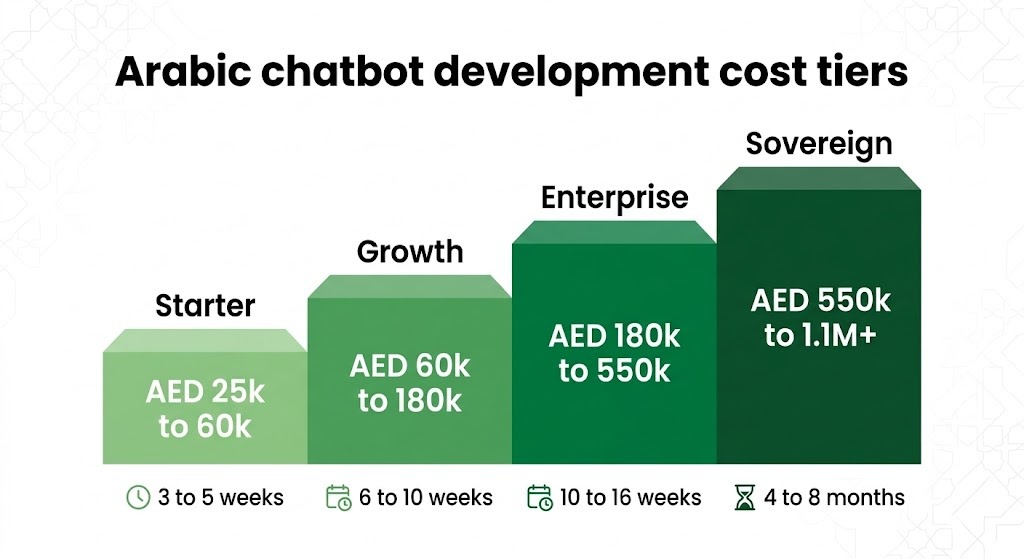
Build Cost by Tier
Code Brew estimates exclude 5% VAT and assume a bilingual, Arabic-first scope.
| Tier | Scope | Build cost | Timeline |
| Starter | WhatsApp and web FAQ or lead bot | AED 25,000 to 60,000 | 3 to 5 weeks |
| Growth | Bilingual RAG, dialect tuning, CRM, 2 to 3 channels | AED 60,000 to 180,000 | 6 to 10 weeks |
| Enterprise | Agent workflows, payments, UAE Pass, UAE-hosted inference | AED 180,000 to 550,000 | 10 to 16 weeks |
| Sovereign | Self-hosted Arabic model, dialect fine-tune, private GPUs | AED 550,000 to 1,100,000+ | 4 to 8 months |
Monthly Running Costs
-
Model tokens
At 12,000 input and 1,200 output tokens per conversation, 1,000 conversations cost about AED 9 on GPT-4o-mini. The same volume costs about AED 139 on GPT-5.2 via the UAE endpoint.
-
WhatsApp templates
Marketing and utility templates cost about AED 0.18 and AED 0.06 each outside the service window.
-
Platform and hosting
A BSP plan, vector database, and hosting add AED 500 to 3,000 a month at SME volumes.
-
Upkeep
Plan for 15% to 25% of build cost a year for retraining, Arabic QA, and template updates.
Worked Example: A Dubai Retailer at 20,000 Conversations a Month
Take a Dubai fashion retailer handling 20,000 WhatsApp conversations a month on GPT-5-mini. It also sends 8,000 utility order updates and 4,000 marketing messages.
| Cost line | Monthly cost |
| GPT-5-mini tokens | AED 397 |
| 8,000 utility templates | AED 462 |
| 4,000 marketing templates | AED 733 |
| BSP and hosting | AED 1,500 |
| Total | About AED 3,090 |
How to Estimate ROI
Monthly savings equal contained conversations times cost per agent-handled chat, minus run costs. Assume 40% containment and AED 7 per human-handled chat.
The retailer then saves AED 56,000 gross, or about AED 52,900 net. Treat containment above 50% in month one with suspicion, given that 87% of residents prefer a human.
Agent-heavy scopes appear in what an AI agent costs in the UAE. Wider programmes follow enterprise AI development pricing in the UAE.
Need one AED estimate that covers the build, WhatsApp fees, model tokens, and UAE hosting together?
Does an Arabic-first AI Chatbot Need to Comply With UAE PDPL? Data Residency and Sector Rules
Yes. Any chatbot that collects names, phone numbers, or order details processes personal data under UAE law. Free-zone and sector rules sit on top.
What PDPL Requires From Chatbot Data
The Personal Data Protection Law, Federal Decree-Law No. 45 of 2021, took effect on 2 January 2022. Consent must be specific, clear, unambiguous, and easy to withdraw.
Articles 22 and 23 govern transfers abroad. Sending a customer’s details to an LLM hosted outside the UAE counts as one.
That transfer needs an approved adequacy route, binding contract terms, or express consent. Executive regulations were still unpublished in Chambers’ 2026 guide.
Where Can Chatbot Data Be Hosted in the UAE?
- OpenAI UAE endpoint: Regional storage and processing apply to eligible snapshots, with a 10% uplift for newer models.
- Azure UAE North and Core42: Microsoft’s Dubai region has three availability zones. Core42 adds UAE sovereignty controls on top for regulated firms.
- Amazon Bedrock me-central-1: Data is stored in the UAE region, though cross-region inference can process prompts elsewhere.
- Private GPUs: Self-hosted Jais 2 or Falcon-H1-Arabic keeps every token inside your network.
DIFC, ADGM and Sector Regulators
- DIFC and ADGM: DIFC’s Regulation 10 has covered personal data in autonomous systems since 1 September 2023. ADGM applies its own Data Protection Regulations 2021.
- Banking: The Central Bank of the UAE issued a responsible AI guidance note on 23 February 2026. Governance, fairness, explainability and human oversight sit at its core.
- Healthcare: Article 13 of Federal Law No. 2 of 2019 keeps health data inside the UAE unless approved otherwise. Breaches carry fines of AED 500,000 to 700,000.
- Consumer protection: Federal Law No. 15 of 2020 requires product and service information in Arabic, or another language set by regulation.
- Ethics: The UAE Charter for the Development and Use of AI sets 12 principles, including transparency. Salesforce found almost 75% of consumers want to know when they talk to AI.
UAE Chatbot Compliance Checklist
Teams planning PDPL-compliant app development with UAE data residency can map each control to a sprint.
| Control | Why it matters |
| Consent captured in the first message | PDPL lawful basis |
| Bot disclosed in Arabic and English | UAE AI Charter transparency |
| Hosting region recorded for every data hop | Articles 22 and 23 |
| Redaction of Emirates ID, card and health data | Data minimisation |
| Health data kept in the UAE | Federal Law No. 2 of 2019 |
| Human oversight on financial decisions | CBUAE guidance note |
Arabic Chatbot Use Cases Across UAE Industries
Each sector meets Arabic customers at a different moment, under a different regulator.
Retail and E-commerce
A shopper in Sharjah sends a voice note at midnight: her abaya arrived in the wrong size. An Arabic-first bot transcribes the Gulf audio, finds the Shopify order and offers an exchange slot.
- Order tracking and delivery changes: Courier APIs let the bot answer “وين طلبي” with a live status. Address changes and delivery windows update without an agent.
- Returns and exchanges: Policy rules decide eligibility, then the bot generates a return label and books a pickup.
- Arabic product search: Normalisation lets “عبايه” and “عباية” return the same items.
- Cash-on-delivery confirmation: A utility template confirms the order and address before dispatch, aiming to cut failed deliveries.
Retailers investing in e-commerce app development in Dubai reuse this knowledge base for agentic commerce in UAE retail.
Real Estate
An investor in Riyadh messages a Dubai brokerage at 10 pm in Saudi dialect. It concerns two-bedroom off-plan units in Dubai Creek Harbour.
- Lead qualification: The bot captures budget, community, ready versus off-plan, and financing, then scores the lead in the CRM. A Saudi-speaking agent gets it with the full thread by morning.
- Viewing bookings: Calendar sync offers real slots, and Arabic reminders go out the day before.
- Listing answers: Replies pull from the property database, including Trakheesi permit details that Dubai advertising rules require.
Property leads go cold within hours, so out-of-hours Arabic response matters here more than almost anywhere. Brokerages pairing chat with real estate app development in Dubai keep one lead record across both.
Healthcare
A patient in Al Ain writes in Emirati dialect to move a dermatology appointment and check Daman cover.
- Booking and rescheduling: The bot reads live slots from the hospital information system and confirms in Arabic.
- Reminders that read Gulf replies: “إن شاء الله” gets logged as a soft yes, with a follow-up the day before.
- Insurance pre-checks: Plan names and coverage rules come from the payer list, with a handoff for exceptions.
- Safe triage: The bot routes symptoms to the right department and never offers a diagnosis.
Federal Law No. 2 of 2019 makes UAE hosting the default for these builds. Our regional healthcare coordination platform cut missed follow-ups by 30% and sped up coordination by 45%.
More on healthcare chatbots built for UAE clinics sits in our dedicated guide.
Banking and Finance
A customer types “الصراف بلع بطاقتي”, Gulf slang for an ATM keeping a card. The bot authenticates the user, blocks the card, and orders a replacement in under a minute.
- Card and account servicing: Blocks, limits, and replacements run after in-app or OTP authentication.
- Remittance status: Transfer tracking answers the question exchange houses hear most, in Arabic, Urdu, or English.
- Islamic finance explainers: Murabaha, ijara, and takaful terms get plain-Arabic explanations drawn from approved product sheets. Dispute decisions stay with staff.
The CBUAE guidance note expects human oversight and explainability. Teams building agentic AI for UAE banks and fintechs design those checkpoints into the flow from the start.
Hospitality and Travel
A Kuwaiti family asks a Dubai hotel for adjoining rooms and a late checkout after Eid prayers.
- Booking changes: Dates, room types, and add-ons update through the property management system.
- Concierge requests: Restaurant bookings, airport transfers and desert safaris get confirmed in chat.
- Seasonal answers: Iftar and suhoor timings, Ramadan opening hours and Eid offers stay current through tagged entries.
Our conversational travel concierge for a national flag carrier resolves passenger requests 60% faster. It also automates 45% more service requests.
Government-Adjacent Services
Utilities, transport authorities, free zones and semi-government entities serve residents who expect Arabic first. Formal MSA suits official replies, yet the bot must still understand Gulf input.
- Permit and application status: Residents check progress without calling a centre.
- Bills and payments: DEWA’s Rammas reported 95% satisfaction in the first half of 2024.
- Appointments and document checklists: UAE Pass identity verification removes repeat form-filling.
- Safety and reporting: Dubai Police’s Amna handled 14,132 enquiries between January and October 2020.
| Industry | Priority Arabic use cases | Key integration | Rule to plan for |
| Retail and e-commerce | Tracking, returns, COD confirmation | Shopify, courier APIs | Consumer Protection Law |
| Real estate | Lead scoring, viewings | CRM, calendars | Dubai advertising permits |
| Healthcare | Bookings, reminders, insurance checks | HIS, payer lists | Federal Law No. 2 of 2019 |
| Banking and finance | Card servicing, remittance status | Core banking, OTP | CBUAE AI guidance |
| Hospitality and travel | Booking changes, concierge | PMS, airline systems | PDPL consent |
| Government-adjacent | Status checks, bills | UAE Pass | UAE AI Charter |
More of the AI products we have shipped across the GCC appear in our portfolio.
Common Arabic Chatbot Mistakes and How to Avoid Them
- Bolting translation onto an English bot. Gulf intents get misread, and answers drift from policy. Building the Arabic knowledge base first prevents it.
- Replying in stiff MSA to casual Gulf messages. Customers read it as robotic. A register policy that mirrors the customer fixes the tone.
- Hiding the human. With 87% of residents preferring people, a buried handoff damages trust. One tap or one phrase should reach an agent.
- Leaving Arabizi out of testing. Latin-script messages fall through to fallback replies. Keep 15% to 20% Arabizi in the evaluation set.
How to Choose an Arabic Chatbot Development Partner in the UAE
A demo in MSA proves little. Ask shortlisted partners to run your own WhatsApp questions, Arabizi included, through their stack.
Hosting answers should name a region. Integration claims deserve a live CRM example, and pricing should split build cost from run cost in AED.
| Criterion | Weight |
| Dialect accuracy proven on your data | 25% |
| Data residency and PDPL readiness | 20% |
| WhatsApp and Meta platform maturity | 15% |
| Integration depth | 15% |
| Evaluation and monitoring practice | 15% |
| AED build and run transparency | 10% |
SMEs often begin with a WhatsApp pilot through AI automation for Dubai SMEs. Larger groups tend to commission enterprise AI programmes in Dubai and Abu Dhabi with UAE hosting.
What’s Next for Arabic-first AI Chatbot in the UAE?
Four shifts will shape Arabic chatbots through 2028.
-
Agentic workflows
Gartner expects agentic AI to resolve 80% of common service issues by 2029. Bots will complete refunds and rebookings end to end.
-
Gulf voice
TAMM 3.0 already takes Arabic voice commands, and WhatsApp voice notes push firms toward Gulf-tuned speech recognition.
-
Sovereign compute
Stargate UAE plans its first 200MW of capacity in 2026. With OpenAI’s UAE inference residency, local hosting gets cheaper.
-
An Emirati-dialect government assistant
G42 and OpenAI are reportedly building a UAE ChatGPT that understands Emirati dialect, per Semafor.
By May 2025, 325 companies had applied for the Dubai AI Seal. Firms exploring agentic AI development across the UAE should plan for it.
Why Choose Code Brew Labs for Arabic-first AI Chatbot Development?
Code Brew Labs builds Arabic-first AI chatbots for UAE retailers, banks, clinics, developers, and government-adjacent teams. Dialect testing, RTL checks, and PDPL controls sit inside every sprint from discovery onward.
Our conversational portfolio in the UAE includes a travel concierge for a national flag carrier, which resolves passenger requests 60% faster. A regional healthcare coordination platform we built cut missed follow-ups by 30%.
Kaizan AI, another of our builds, answers natural-language business questions with charts and produces reports 70% faster. For a Saudi food-ordering platform, we shipped bilingual Arabic-English ordering with Tawseel compliance reporting.
Each build maps to UAE PDPL, DIFC Regulation 10, and the CBUAE guidance note on AI. Health projects add Federal Law No. 2 of 2019 hosting controls.
Models can run where data must stay: OpenAI’s UAE endpoint, Azure UAE North, Core42, or self-hosted Jais. We settle hosting in week one, alongside the dialect test set.
Whether you need a WhatsApp pilot, a bilingual RAG assistant, or sovereign hosting, our team scopes it. Engagements with our AI chatbot development company in Dubai open with a dialect audit of WhatsApp messages.
Ready to launch an Arabic chatbot that speaks Emirati, stays PDPL-ready, and resolves queries on WhatsApp?
Start With the Messages Your Customers Already Send
The customer asking “وين طلبي؟” at 11:40 pm is waiting in a WhatsApp inbox right now. An Arabic-first AI chatbot answers in that customer’s register, from data hosted where UAE law expects.
Dialect data comes first, hosting second, channels third, and the model last, since models change every quarter.
Run a sample of real messages through any shortlisted model, and the right build tier becomes clear.
Frequently Asked Questions
Can an Arabic chatbot understand Emirati dialect and code-switching?
Yes, when it is built and tested on Gulf data. The pipeline detects dialect per message, converts Arabizi, and normalises spelling. Accuracy should be measured per dialect on real UAE questions.
How does chatbot Arabic support work on the WhatsApp Business API?
Arabic templates use the ar or ar_AE locale and pass Meta’s automatic review within 24 hours. Replies inside the 24-hour service window are free and can use any Arabic variety.
Does the Facebook Chatbot API support Arabic on Messenger and Instagram?
Yes. The Messenger Platform exposes each user’s locale, and Arabic renders right-to-left. Pages can reply for 24 hours, or seven days with the Human Agent tag.
How much does an Arabic-first AI chatbot cost in the UAE?
Code Brew estimates run from AED 25,000 for a WhatsApp FAQ bot to AED 550,000 for enterprise assistants. Sovereign builds on self-hosted models can exceed AED 1 million.
Does UAE PDPL require chatbot data to stay in the UAE?
Not in every case. Articles 22 and 23 allow transfers through adequacy decisions, binding contracts, or express consent. Health data must stay in the UAE under Federal Law No. 2 of 2019.
Arabic-only or bilingual: which chatbot suits a UAE business?
Bilingual, with Arabic designed first. Expatriates make up about 88.5% of the population, so English stays essential.
How long does it take to launch an Arabic chatbot?
Starter bots go live in three to five weeks, and growth builds in six to ten. Enterprise assistants need ten to sixteen weeks, plus a two- to three-week pilot.
What is the difference between an Arabic-first chatbot and a translated bot?
An Arabic-first chatbot stores Arabic knowledge and tests dialects before launch. A translated bot converts every message through English, which loses Gulf phrasing, Arabizi, and cultural tone.
Let's Convert Your Business Idea Into Success!
Free Consultation from Top Industry Experts
Let’s Build Your Dream App!
Share article on :


 No commitment required
 NDA on request
 24-hour response


