
Quick Summary:
- UAE banks now shift from AI pilots to live agents in fraud, onboarding and payments.
- The CBUAE issued formal responsible-AI guidance for financial institutions in February 2026.
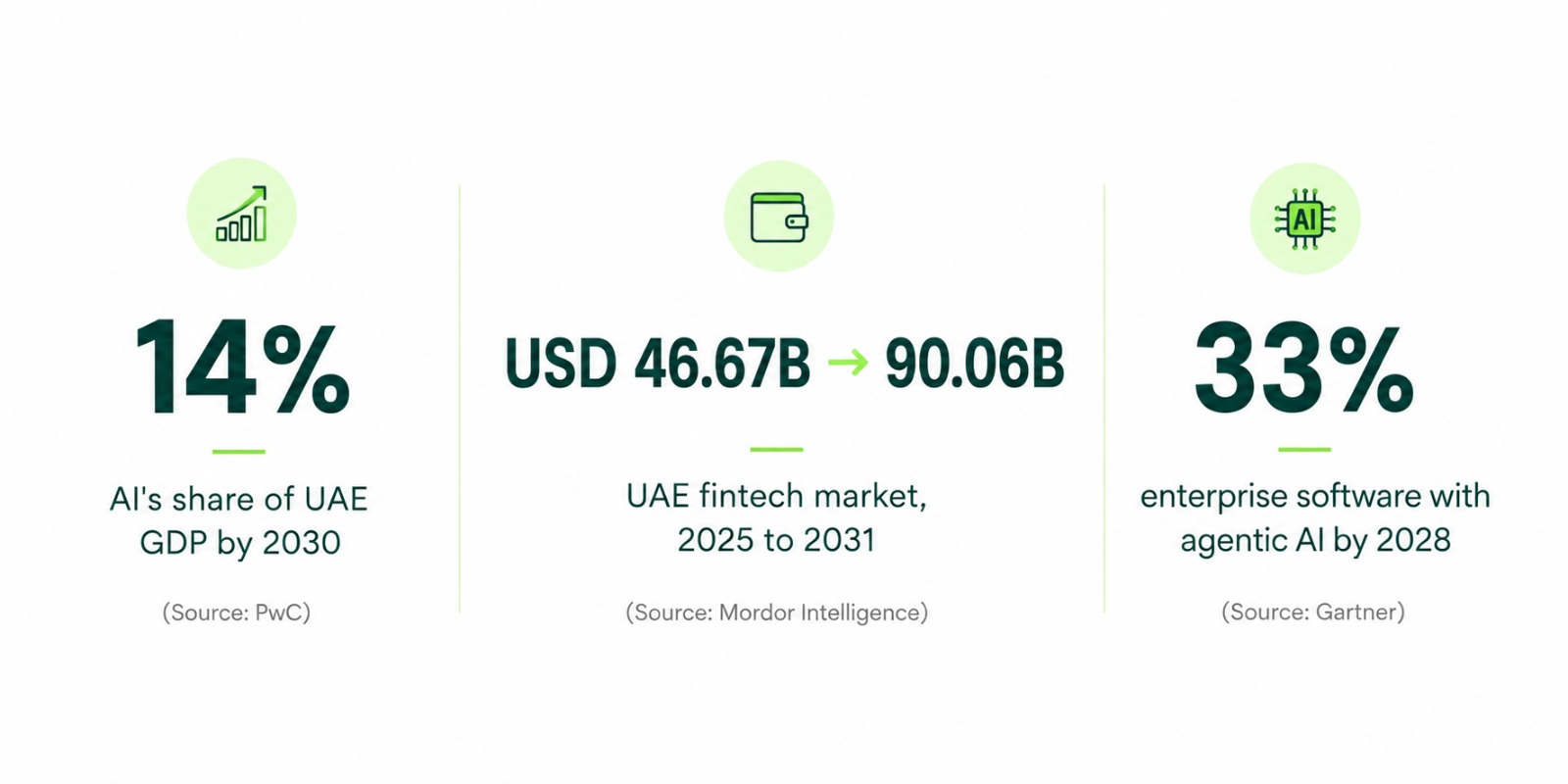
- Gartner expects 33% of enterprise software to embed agentic AI by 2028.
- PwC projects AI to add 14% to UAE GDP by 2030.
- Ruya Bank runs three agentic use cases in production, inside its own cloud.
- FAB already applies agentic AI to payment processing and relationship management.
- Legacy core systems connect to agents through APIs, without a full rebuild.
- Most UAE fintech use cases reach production in three to nine months.
Agentic AI in fintech runs tasks end-to-end, deciding and acting without constant human prompts.
A rule-based system waits to be told what to do. An agent in a fintech app in Dubai decides, then acts. That single gap separates the automation UAE banks bought a decade ago from what they deploy in 2026.
The pressure behind the shift is concrete. Fraud now moves faster than any manual review team. Compliance headcount keeps climbing against thinning margins. Customers expect a resolved query at 2 am, not a ticket number and a three-day wait.
PwC estimates AI could add 14% to UAE GDP by 2030, the highest share of any economy in the region (PwC Middle East). Agentic AI is the slice of that projection now reaching live banking floors, and the Gulf is moving faster than most markets.
This guide explains what agentic AI changes across UAE fintech. It covers the mechanics under the hood, the banks already in production, the CBUAE rules, the cost in AED, and a build sequence you can act on. Every figure carries its source, so your risk team can check the work.
Want to know where agentic AI fits your stack before you spend a dirham?
What is Agentic AI, and how does it work?
Agentic AI is software that sets a goal, plans the steps, uses tools, and adapts as conditions change. It works with limited human input.
Anthropic, which builds frontier models, defines agents as systems where the model directs its own process and tool use. The model keeps control over how a task gets done. That control is the dividing line between an agent and everything marketed as one.
The building block: an augmented model
A basic chatbot answers, then stops. An agent starts from a model given three additions: retrieval, tools, and memory. It writes its own search queries, selects the right tool, and decides what to keep for the next step.
Picture the difference in a bank. A chatbot tells a customer their card is blocked. An agent checks why, confirms the transaction was genuine, unblocks the card, and logs the reason.
The loop that makes it agentic
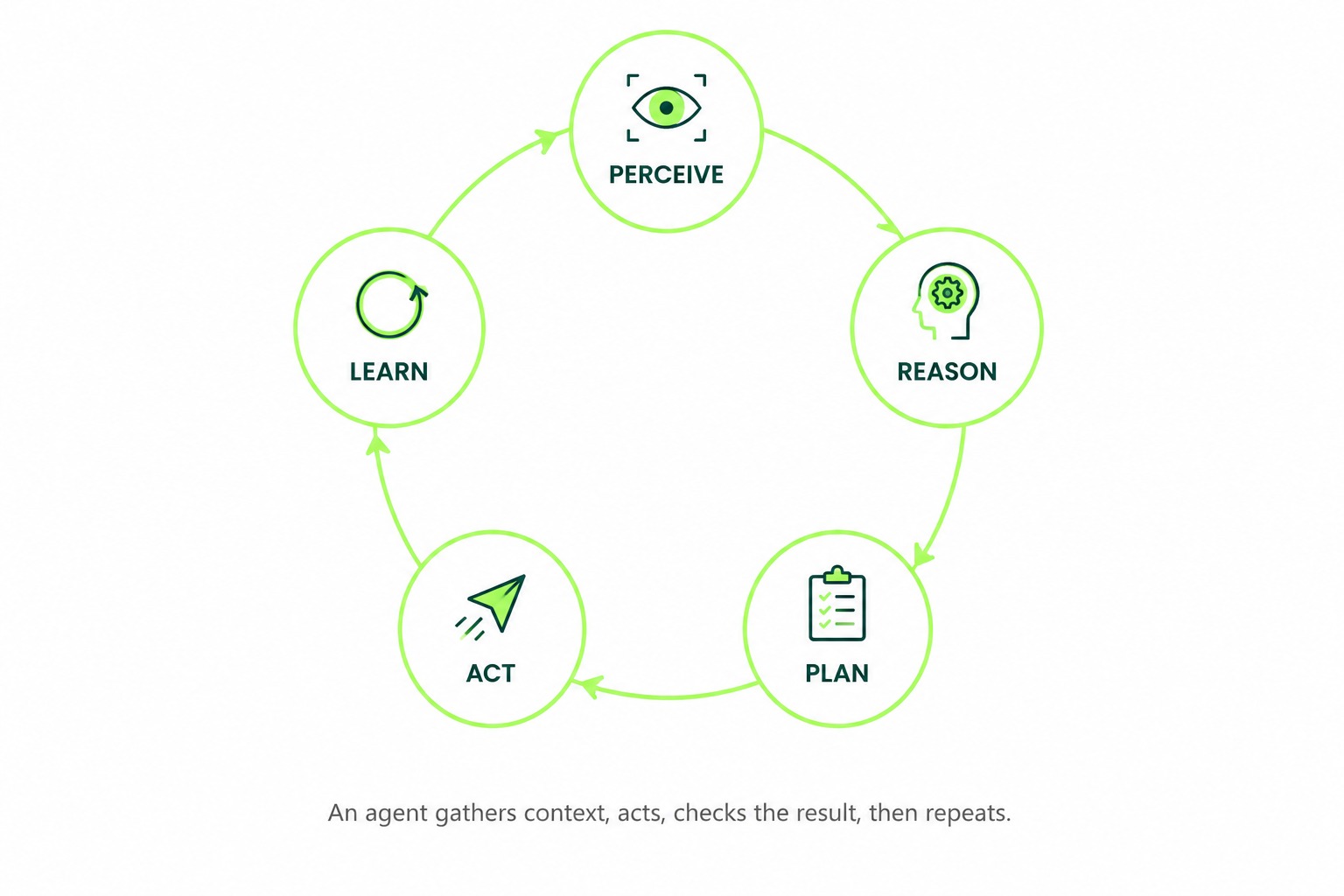
An agent works in a cycle. It gathers context, takes an action, checks the result against the real world, then repeats until the goal is reached.
Every pass runs on ground truth. A tool call returns fresh data. A payment gateway sends a response code. The agent reads that feedback, judges its progress, and corrects the next move.
This loop is why an agent handles messy, multi-step work. A rule engine cannot recover when reality differs from its script. An agent re-plans against what actually happened.
Workflows versus true agents
Here is a distinction most vendors blur, and it protects your budget. A workflow runs a model through fixed code paths. A true agent chooses its own path at runtime.
Most systems sold as “AI agents” in banking are guardrailed workflows, and that is often the right choice. Knowing which one sits in the proposal keeps expectations and pricing honest. A workflow is cheaper and more predictable; a full agent handles more variety and costs more to control.
The capital backing this is real. The AI agents market was worth USD 7.84B (~AED 28.8B) in 2025. It is projected to reach USD 52.62B (~AED 193B) by 2030, a 46.3% CAGR (MarketsandMarkets).
Building one for regulated money is engineering, not a plugin install. That reality is why banks partner with an AI agent development company rather than assemble it in-house from scratch.
Agentic AI vs Generative AI for fintech: what is the difference?
Generative AI produces content when asked. Agentic AI acts on a goal and completes a multi-step task. One drafts the dispute letter; the other resolves the dispute.
Most UAE banks already run generative AI for drafting, summaries, and code. Emirates NBD put ChatGPT and Microsoft 365 Copilot across its functions in 2023, reaching contact centres, legal, compliance, and risk (Emirates NBD). Agentic AI is the next layer up, where the system owns an outcome instead of a draft.
| Dimension | Generative AI | Agentic AI |
| Trigger | A human prompt | A goal or event |
| Autonomy | One response | Plans and acts over many steps |
| Memory | Usually none | Retains context across steps |
| Tool use | Rare | Core to how it works |
| Output | Text, code, images | Completed tasks and decisions |
| Human role | Reviews the draft | Supervises exceptions |
| Fintech example | Drafts a KYC email | Runs the full KYC check |
Generative AI raises the output of the people you already employ. Agentic AI changes how much of the work needs a person at all.
That second shift is the one that bends the cost line. A bank does not save a compliance salary because an analyst drafts faster. It saves when the routine case never reaches the analyst.
Both layers coexist. A mature stack uses generative AI inside agentic workflows: the agent runs the process and calls a generative model when it needs to write a summary or a customer note.
Agentic AI vs Agentic Commerce: are they the same thing?
No. Agentic AI is the engine, while Agentic commerce is that engine pointed at checkout and payment.
Fraud, credit, compliance, and back-office operations all fall under agentic AI. One job defines agentic commerce: an agent that finds a product, compares prices, checks out, and pays on a customer’s behalf.
That payment step carries demands ordinary agents skip. A spending agent needs clean product data it can read, pricing APIs it can query, and cryptographic proof it was authorised to pay. Without that proof, no bank will settle the transaction.
The payment-rail layer
AP2 (Agent Payments Protocol)
Google and more than 60 partners built AP2 so agents can transact without holding raw card credentials. It uses signed mandates that prove a human approved the purchase and its limits (Google Cloud).
Verifiable intent
Mastercard and the FIDO Alliance are standardising how an agent proves that authorisation. The goal is a trust signal a bank can verify before it moves money (Mastercard).
Why UAE fintechs should care now
The Gulf is a high-adoption payments market with young, mobile-first spenders. When agent-led buying reaches scale, the banks and wallets that already speak these protocols will capture the flow. Those that do not will watch it route around them.
We cover the retail side of this shift in our guide to agentic commerce in the UAE, including how merchants prepare their catalogues for agent traffic.
How are UAE fintech companies using AI agents?
UAE banks and fintechs already run agents across fraud, onboarding, payments, and service. The region moved from curiosity to production within two years, and the public rankings now prove it.
The market supplies the incentive. UAE fintech was valued at USD 46.67B (~AED 171B) in 2025. It is projected to reach USD 90.06B (~AED 330B) by 2031, an 11.58% CAGR (Mordor Intelligence).
Where the leaders sit
Emirates NBD
The bank ranked first in the inaugural Evident AI Index for banks across the Middle East and Africa, published in June 2026 (The National). Its 2023 programme put GitHub Copilot in the hands of more than 1,000 developers, the base layer for later agent work.
First Abu Dhabi Bank
FAB placed third in the same index. It already applies agentic AI inside core operations, including payment processing and relationship management. That is a rare on-record agentic reference from a tier-one Gulf bank, and a signal of where the sector heads.
Wio Bank
The Abu Dhabi digital bank positions itself as AI-native. It joined NVIDIA’s Inception programme and signed an MoU with Alibaba Cloud to use Qwen models and agentic platforms across its stack (Alibaba Cloud).
Where agents touch the customer
Mashreq NeoBiz
In May 2026, Mashreq became the first UAE bank to guarantee SME account opening within one day. Electronic KYC, links to local authorities, and intelligent routing sit behind the promise (Mashreq).
ADCB
The bank announced an AI-led transformation spanning more than 150 use cases. It launched a conversational assistant that handles balances, transfers, and card control through voice and text (ADCB).
Commercial Bank of Dubai
CBD rolled out Microsoft 365 Copilot to more than 800 staff and reports saving close to 39,000 hours (Microsoft). Those hours are the raw material agents reclaim next.
The ecosystem around them
Abu Dhabi anchors its AI ambition in Hub71+ AI, a specialist track with partners including Core42 and AI71 (Hub71). Sovereign compute and local model access lower the barrier for smaller fintechs to build agents on home soil.
Proof from products we have shipped
Code Brew Labs has built fintech products used across the UAE. Alfardan Exchange, a digital remittance app, passed 100,000 downloads. Du Pay, a UAE wallet and transfer app, passed one million.
Agentic layers sit on systems like these, not on blank slates. See more in our UAE fintech case studies, and the build stack behind them in fintech app development in Dubai.
Case in point: How Ruya Bank went live with Agentic AI
Ruya, an Islamic digital bank based in Ajman, moved three agentic use cases into live production in 2026 (Middle East AI News). Few UAE banks have gone this far on the record, which makes the rollout worth reading closely.
The agents run real work. They handle business account onboarding, document verification, and case summaries for transaction workflows. A human still signs off on every material decision.
What makes the Ruya rollout worth studying
Data stays home
The system runs inside Ruya’s private cloud on open-source models. No personally identifiable customer information leaves the bank’s own infrastructure, which answers the residency question before a regulator asks it.
Human oversight by design
Agents prepare and execute the routine steps. People review anything with real consequence. That split matches the oversight model the CBUAE now expects of licensed institutions.
A staged roadmap
Next in line are collections, compliance, credit support, a customer assistant, and an internal tool the bank calls RuyaAI. Each phase adds one capability, not ten.
The platform behind it comes from Magure, a Dubai enterprise AI firm running more than 60 deployments in production. The pattern generalises to any UAE fintech. Sovereign infrastructure, human supervision, and tight scope beat a headline-grabbing moonshot that never clears risk review.
For a mid-size fintech, Ruya is the template to copy. Start with onboarding and document work, keep the data inside your own walls, and expand only once the first agents earn trust.
How can agentic AI improve and automate financial operations?
Agents automate the work that consumes analyst hours: fraud review, KYC, AML screening, credit, and reconciliation. They run around the clock and escalate only the cases a human should judge.
The prize is large enough to move a balance sheet. McKinsey estimates end-to-end operations make up 60% to 70% of a bank’s cost base (McKinsey). Earlier AI reached only a corner of that, lifting productivity by 15% to 20% because it helped people rather than doing the task itself.
Fraud detection that acts, not just alerts
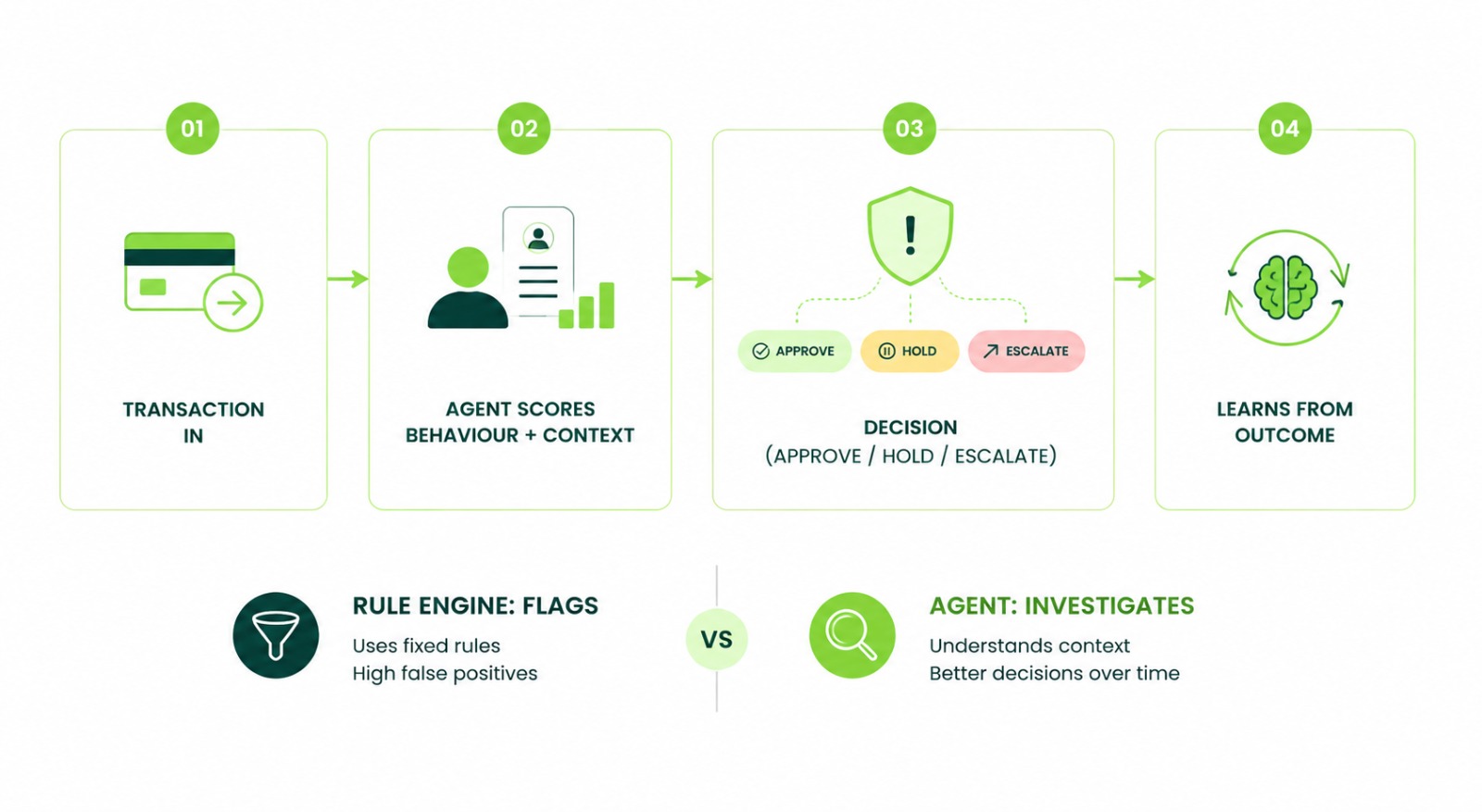
Financial crime is vast. Roughly USD 3.1T (~AED 11.4T) in illicit funds flowed through the global system in 2023 (Nasdaq Verafin). Rule engines flag against fixed thresholds and drown teams in false positives.
The mechanical difference with an agent is real. A rule system needs manual reprogramming for every new fraud pattern. An agent builds a behavioural baseline for each customer and judges every event in context (EY).
It recalculates risk mid-session as new signals arrive. A login from a new device, an odd payee, a rushed transfer: each shifts the score in real time. The agent then runs the investigation from first alert to case file, rather than parking it in a queue.
Spend follows the threat. Global outlay on AI-enabled fraud detection will pass USD 10B (~AED 36.7B) by 2027, up from around USD 6.5B in 2022 (Juniper Research). Fraud tops the agent use-case list for 64% of financial institutions (Capgemini).
KYC and onboarding without the queue
Compliance is expensive in headcount. Banks assign up to 10% to 15% of staff to KYC and AML alone, and financial-crime compliance can reach 5% of total banking costs (BCG).
An onboarding agent works the full chain. It reads documents, runs a liveness check, screens sanctions and PEP lists as tool calls, scores risk, and clears false hits before a human sees the file. BCG reports banks targeting KYC cost reductions of up to 50% through this approach.
Ruya’s live onboarding agent shows the theory running in production, not a lab. Mashreq’s one-day SME promise rests on the same foundation of electronic KYC and automated routing.
Credit that moves faster
McKinsey found agents in the corporate credit memo process deliver 20% to 60% productivity gains, with around 30% faster credit turnaround (McKinsey). Agents extract data, draft memo sections, and score confidence so reviewers prioritise the risky files. The analyst moves from writing to judging.
Reconciliation and the back office
Agents match transactions, chase breaks, and clear routine payments against policy. Month-end stops being a scramble across spreadsheets. Exceptions surface early, each with the context a controller needs to decide.
How do AI agents coordinate? Multi-agent architecture explained
One agent handles one task. Hard problems need several specialist agents that split the work and coordinate. Two open protocols now make that coordination possible, and both matter to a finance leader signing off on architecture.
MCP: the agent’s connection to tools and data
Anthropic released the Model Context Protocol in November 2024. It gives an agent one standard way to reach data and tools: a transaction database, a sanctions list, a core banking API.
Think of MCP as the vertical link. It connects a single agent down to the resources it needs. It replaces a tangle of custom integrations with one interface, which cuts build time and audit surface.
A2A: the connection between agents
Google announced the Agent2Agent protocol in April 2025 with more than 50 partners. It donated the protocol to the Linux Foundation that June, with AWS, Microsoft, Salesforce, and SAP as founding members.
A2A is the horizontal link. Each agent publishes an “Agent Card” that describes what it can do. Agents then exchange tasks and results across different vendors and frameworks, without custom glue for each pair.
How they combine inside a bank
Picture a suspicious transfer. A fraud-investigation agent opens the case, then hands the sanctions question to a screening agent through A2A. Each agent reaches its own database through MCP.
One protocol is the org chart between agents. The other is each agent’s toolbelt. A system that gets both right can add a new specialist agent without rewiring the whole floor.
Guardrails hold it together
Autonomy needs limits. Anthropic recommends sandboxed testing, scoped permissions, and output validation before any agent touches production. Spend caps, action limits, and approval gates keep a coordinating swarm inside policy.
Getting this layer right decides whether a project scales past its pilot. An enterprise AI development company in Dubai can design these orchestration and guardrail layers for regulated environments.
Can agentic AI work with existing financial systems?
Yes. Agents connect to core banking and legacy systems through APIs and middleware. A full core replacement is rarely needed, and rarely wise.
Most UAE banks run a mix of older cores and newer digital layers. Agents sit above that stack and treat each system as a callable tool through MCP-style connectors. The core keeps doing its job while the agent orchestrates around it.
Making integration realistic
Start with an API layer
Where a core lacks modern APIs, thin middleware exposes only the functions an agent needs. Nothing inside the core changes, which keeps the risk contained.
Fix access, not location
Customer records often sit spread across several systems. Agents need permissioned reach into those records, not a heavy migration that stalls for a year.
Roll out in phases
One workflow goes live, proves itself, and then the next follows. Confidence builds inside the compliance team as evidence accumulates, not as promises.
Where integration gets hard
Data quality is the usual blocker. An agent reading inconsistent records produces inconsistent decisions. A short cleanup of the one domain you start with pays for itself fast.
Older mainframes add latency and brittle interfaces. A caching and queueing layer between agent and core smooths that, and protects the core from load spikes.
Agentic AI development companies handle these integrations through custom software development in Dubai engagements, working against real production cores rather than clean-room demos.
How long does it take to implement agentic AI in fintech?
Most UAE fintech use cases reach production in three to nine months. Scope, data quality, and integration depth set the exact timeline.
A single bounded agent moves quicker. A multi-agent operation across several systems takes longer and returns more once it lands.
| Phase | What happens | Timeline | Indicative cost (AED)* |
| Discovery | Use case, data audit, compliance scope | 2–4 weeks | 40,000 – 90,000 |
| Data & access | APIs, permissions, guardrails | 3–6 weeks | 90,000 – 250,000 |
| Pilot | One agent, human-in-the-loop | 4–8 weeks | 150,000 – 400,000 |
| Integration | Core systems, monitoring | 4–8 weeks | 200,000 – 600,000 |
| Scale | More agents, wider rollout | Ongoing | 550,000+ |
Indicative UAE market ranges. Final scope drives the number, and our AI development cost in the UAE guide breaks the drivers down.
The variable that moves the timeline most is data readiness. A fintech with clean, API-accessible records ships in months. One with siloed legacy data spends the first phase on plumbing.
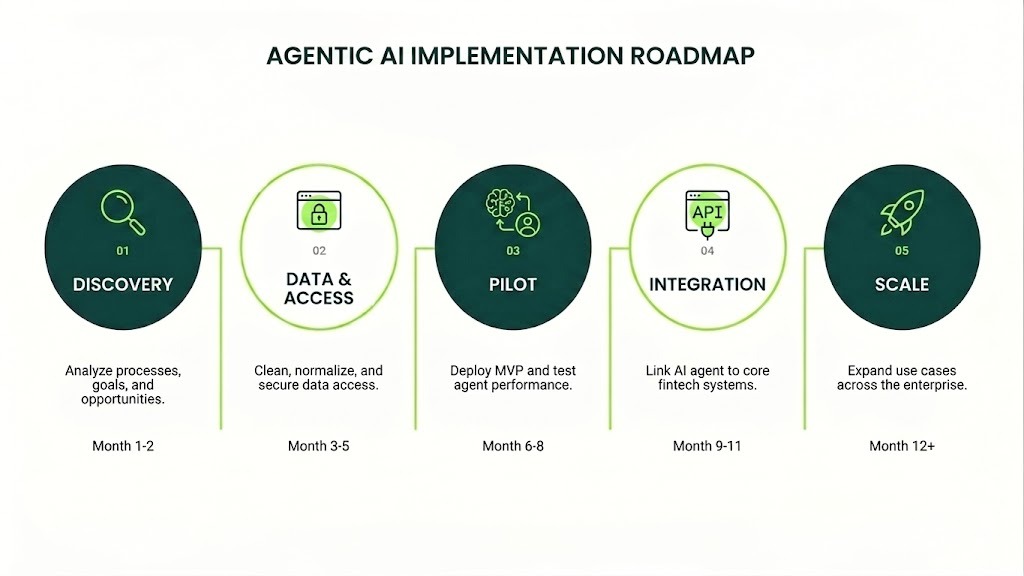
How can fintech companies implement agentic AI?
Pick one high-value workflow, keep people on exceptions, then grow agent by agent. Teams that scale start narrow and prove the numbers early.
A five-step framework that holds up
- Choose a bounded use case. Fraud triage or document onboarding works well as a first move. Each has clear inputs, a measurable result, and savings a CFO can see.
- Wire up data and guardrails. Give the agent permissioned access and hard limits. Sandboxed testing and scoped permissions come before any live action, in line with Anthropic’s own guidance.
- Deploy with a human in the loop. Let the agent prepare and act, while a person approves anything material. Ruya’s production model is the local reference to follow.
- Measure against a baseline. Track cost per case, time to resolve, and error rate against the pre-agent numbers. Hard metrics settle debates that opinion cannot.
- Scale the supervision ratio. As accuracy holds, one reviewer safely oversees more agents. That widening ratio is where the economics start to compound.
The mistake that kills pilots
Most failed projects try to automate a whole department at once. The winning pattern is the opposite: one narrow agent, measured hard, expanded only on proof. It keeps risk small and builds internal trust the next phase needs.
Want to see how our AI automation agency in Dubai can build and ship fintech agents for you?
What are the challenges of agentic AI in banking, and how do you overcome them?
The main risks are data quality, model drift, weak oversight, unclear liability, and new attack surfaces. Each has a practical response, and ignoring any one sinks the project.
A reality check first. Gartner expects more than 40% of agentic AI projects to be scrapped by the end of 2027, often for cost and weak risk controls. Only 10% of financial firms run agents at scale today.
Challenge and fix
Messy data
Agents inherit the quality of what they read. Scope one clean data domain first, prove the agent there, then widen the reach.
Model drift
Performance decays as fraud patterns and customer behaviour shift. Monitor outputs against a baseline, set retraining triggers, and route edge cases to a human reviewer.
Prompt injection
The IMF warns that adversaries can hijack an agent through crafted inputs, triggering unauthorised financial operations. Input validation, permission scoping, and signed instructions form the defence.
Herding risk
The same IMF note flags that many agents reading identical signals could act together and amplify a market swing. Model diversity and circuit-breaker checks lower that exposure.
Liability grey zones
Someone must own an autonomous decision. Name an accountable human for each agent, in writing, before it goes live. The CBUAE expects exactly this clarity.
The cultural challenge
Staff fear replacement, and fear breeds quiet resistance. The banks that succeed reframe the role early: agents take the repetitive load, and people move to oversight and judgment. Openness on that shift matters as much as the technology.
How is agentic AI governed and regulated in the UAE?
Agents in the UAE operate under Central Bank guidance, DIFC and ADGM data law, and the National AI Strategy 2031. Human accountability runs through all of it.
The CBUAE guidance note
In February 2026, the Central Bank issued a Guidance Note on the responsible adoption of AI and machine learning by licensed financial institutions. It rests on five principles: governance and accountability, fairness, transparency, human oversight, and data management. Its core message is that AI risk belongs inside existing risk frameworks, not in a silo.
Its most useful idea for agentic systems is a three-tier oversight model (MENA Fintech):
- Human in the loop. The agent recommends, and a person makes the call. This fits high-stakes decisions such as large credit approvals.
- Human on the loop. The agent acts while a person monitors and can intervene. This suits high-volume work like transaction screening.
- Human out of the loop. Full autonomy, allowed only for low-risk, non-material processes with strong controls. Most money-movement decisions do not qualify.
That framework maps almost one-to-one onto how you set an agent’s autonomy. It gives UAE fintechs a clear rule for where a human must stay in the chain.
Data protection built for autonomous systems
DIFC Regulation 10. The DIFC wrote the world’s first data-protection rule aimed at autonomous and semi-autonomous systems, with full enforcement from January 2026. It adds certification and stronger obligations for high-risk AI systems.
ADGM. The ADGM regime follows a GDPR model. It gives customers a right not to be subject to solely automated decisions with legal or similar effects. That right sets a hard boundary on pure agent autonomy in credit and claims.
The wider strategy
The UAE government issued a Charter for the Development and Use of AI in 2024, listing 12 principles that include human oversight, bias mitigation, and accountability. It sits under the National Strategy for AI 2031, launched in 2017, the year the UAE became the first country to appoint an AI minister.
What are the ethical and data-privacy concerns with agentic AI in fintech?
Agents raise real questions on bias, consent, data residency, and accountability. Handling them early earns customer trust and regulatory goodwill at the same time.
The ethical side
- Bias in decisions. An agent can inherit bias from its training data, then repeat it at scale. Regular fairness testing on credit and fraud outcomes keeps it in check, a duty the UAE AI Charter names outright.
- Accountability for autonomous calls. When an agent declines a loan, the customer deserves a reason. An explainable audit trail turns a black-box decision into a defensible record a regulator will accept.
- Role change for staff. Agents move people from processing to supervision. Managed in the open, that raises skill and morale. Handled behind closed doors, it breeds resistance.
How does agentic AI handle customer data privacy?
- Keep data on home ground. Ruya runs its agents inside its own private cloud, with no customer PII leaving the bank. Sovereign deployment answers the residency question UAE regulators press hardest.
- Minimise what the agent sees. Give an agent only the fields a task requires. Less exposure means less to leak, and the IMF names data leakage as a central risk in agent systems.
- Scope consent tightly. Tie each agent’s data use to a clear customer permission. Where consent ends, access ends, which keeps the deployment inside DIFC and ADGM rules.
- Log everything. Every agent action against customer data should leave a record. That log is both a privacy control and the evidence a regulator will ask to see.
What is the future of agentic AI in UAE fintech (2026–2030)?
Expect autonomous finance, agent-to-agent payments, and supervised agent workforces across UAE banks. The direction is set; the pace is the only open question.
Deloitte projects agentic pilots rising from 25% of generative-AI companies in 2025 to 50% by 2027. The World Economic Forum describes banking moving from AI assistance to agents with transactional authority, working as supervised digital co-workers.
Three shifts worth watching
Agent workforces
Banks will run teams of agents under a small group of human supervisors. The supervision ratio becomes a board-level metric, tracked like cost-to-income.
Agent-to-agent payments
The IMF is already studying how autonomous agents will reshape payments, including the systemic risks. Protocols like AP2 will let a customer’s agent transact with a merchant’s agent, and UAE rails will adapt to carry that traffic.
Sovereign AI as standard
More UAE banks will follow Ruya and keep models and data inside national infrastructure. Government backing through Hub71+ AI and Core42 makes that path practical for smaller players.
The banks that treat 2026 as a build year will own the ratio advantage by 2030. Our enterprise guide to fintech in the Middle East tracks where this heads next.
Why choose Code Brew Labs for agentic AI in the UAE
Code Brew Labs builds agentic systems for UAE fintech: onboarding agents, fraud-triage agents, and payment workflows that run on live banking data. We wire agents into core systems through APIs, add the guardrails a regulator expects, and keep a human on every material decision.
The work spans scoping the first use case, engineering the orchestration, and scaling once the numbers hold.
Alfardan Exchange and Du Pay are live products with a combined user base of over 1.1 million. Browse the proof across our UAE fintech case studies, then judge us on what already runs.
Our work as an AI automation agency in Dubai covers agent design, orchestration, and the guardrails a regulator will ask about. Agents get scoped, tested, and supervised, not shipped raw.
As an AI development company in Dubai, we build the models, retrieval, and tooling behind an agent. UAE finance runs on Islamic products, and agents must respect that. Our approach to Shariah-compliant fintech app development keeps profit-sharing logic and Riba rules inside the agent’s decision path.
An agent that moves money is a target. Our guidance on cybersecurity for fintech apps shapes how we handle encryption, access control, and audit trails from day one.
We start with one bounded, high-value agent and prove the numbers before scaling. It is how a project survives past the pilot and reaches production.
Build your first production agent with a team that ships UAE fintech products.
Conclusion
The shift is simple to state and hard to overstate. AI that once advised now acts. UAE regulators drew the guardrails early, and banks like Ruya and FAB already operate inside them.
That 14% PwC assigned to the UAE’s AI-driven GDP is not a number to admire from a distance. It is being built now, one supervised agent at a time, inside real banks with real customers.
The institutions that win will not wait for perfect certainty. They will ship a first agent, measure it against a baseline, and scale what works while the rest are still writing policy.
Frequently asked questions
What is agentic AI in fintech?
Agentic AI in fintech is software that pursues a goal on its own across financial systems. It plans, uses tools, acts, and adapts from feedback. Rather than answering a question, it completes a task such as screening a payment or onboarding a client, with a human supervising the exceptions.
How is agentic AI different from AI agents?
The terms overlap. An AI agent is a single unit that performs a task with some autonomy. Agentic AI is the broader approach where one or more agents plan and act toward goals. Every agentic system is built from agents, though a simple scripted agent is not always fully agentic.
Is agentic AI legal for banks in the UAE?
Yes, within clear rules. The CBUAE guidance of February 2026 sets governance, human oversight, and transparency expectations. DIFC Regulation 10 and ADGM law add data-protection duties. Ruya Bank already runs agents in production under these expectations, which shows the path is open and workable.
How much does agentic AI cost to implement in the UAE?
A bounded pilot typically starts in the low hundreds of thousands of dirhams. Full multi-agent deployments run higher, driven by integration depth and scale. Our AI development cost in the UAE guide breaks the ranges down phase by phase.
Can agentic AI replace human finance teams?
No, and that is not the aim. Agents take routine processing off the desk. People move to supervision, exceptions, and judgment. The economic gain comes from one supervisor overseeing many agents, not from cutting the humans out.
Which UAE banks use agentic AI?
Ruya Bank runs three agentic use cases in production. FAB applies agentic AI to payment processing and relationship management. Emirates NBD leads the regional Evident AI Index, and Wio Bank is building agentic platforms with Alibaba Cloud.
How does agentic AI detect fraud differently from older systems?
Rule-based systems check transactions against fixed thresholds and need reprogramming for each new pattern. An agent builds a behavioural baseline per customer, scores risk in real time, and runs the investigation from alert to case file. It adapts to new fraud without waiting for a manual rule update.
Let's Convert Your Business Idea Into Success!
Free Consultation from Top Industry Experts
Let’s Build Your Dream App!
Share article on :



 No commitment required
 NDA on request
 24-hour response


