
Quick Summary:
- UAE e-commerce should reach AED 48.8 billion by 2028, per EZDubai research.
- Cash now covers only about 23% of UAE transactions, according to Visa 2025 data.
- Think of agentic AI as the engine and agentic commerce as one vehicle.
- Protocols such as ACP, UCP and AP2 let agents check out across merchants.
- Agent-ready stores need structured product data and open checkout APIs to qualify.
- UAE PDPL governs consent when an agent buys on a customer's behalf.
- Bilingual Arabic and English feeds help agents read UAE catalogs with fewer errors.
- Early UAE movers can win agent citation share before rivals fix their catalogs.
Agentic commerce lets AI agents find and buy products for UAE shoppers with approval.
A shopper in Dubai no longer opens ten tabs to buy a coffee machine. She asks an assistant, and the assistant does the rest. It reads the specs, checks stock, weighs three sellers, and pays within the limit she set. This is agentic commerce, and it changes who your product page has to convince first.
For most UAE retailers, that first reader is now a machine. Adobe recorded generative AI-referred retail traffic rising 693% year on year during the 2025 holiday season (DigitalCommerce360). The buyer behind that traffic often never sees your homepage.
This guide covers what agentic commerce is, how the agent shopping journey runs, and where it already operates in the UAE. You also get the payment rails, the consent rules under local law, a readiness scorecard, and real costs in dirhams.
Want to see where your store stands?
What is agentic commerce?
Agentic commerce is online buying and selling handled by autonomous AI agents. These agents act on a shopper’s goal, find suitable products, and complete an approved purchase without step-by-step human clicks.
The word agentic points to agency. An agent holds a goal, reasons about options, uses tools such as search and checkout, and remembers context. IBM describes it as software that can plan and act toward an outcome (IBM).
Traditional ecommerce waits for a person to browse and click. Agentic commerce sends a capable proxy to do the browsing and the buying. The store still sells. The road to the sale looks different.
Agentic AI vs Agentic Commerce: the difference that matters
People blur these two terms, so here is the clean split. Agentic AI is the broad capability. Agentic commerce is that capability pointed at a purchase.
Picture agentic AI as an engine. It can power a coding assistant, a support agent, or a research tool. Agentic commerce is one vehicle that engine drives, the one built for buying and selling.
Every agentic commerce system relies on agentic AI. The reverse does not hold, since most agentic AI never touches a checkout.
What sets commerce apart is the money and the permission behind it. An agent that buys has to prove the shopper agreed, respect a spending cap, and leave an audit trail. That payment and consent layer is the real subject of this guide.
How does agentic commerce work? The agent shopping journey
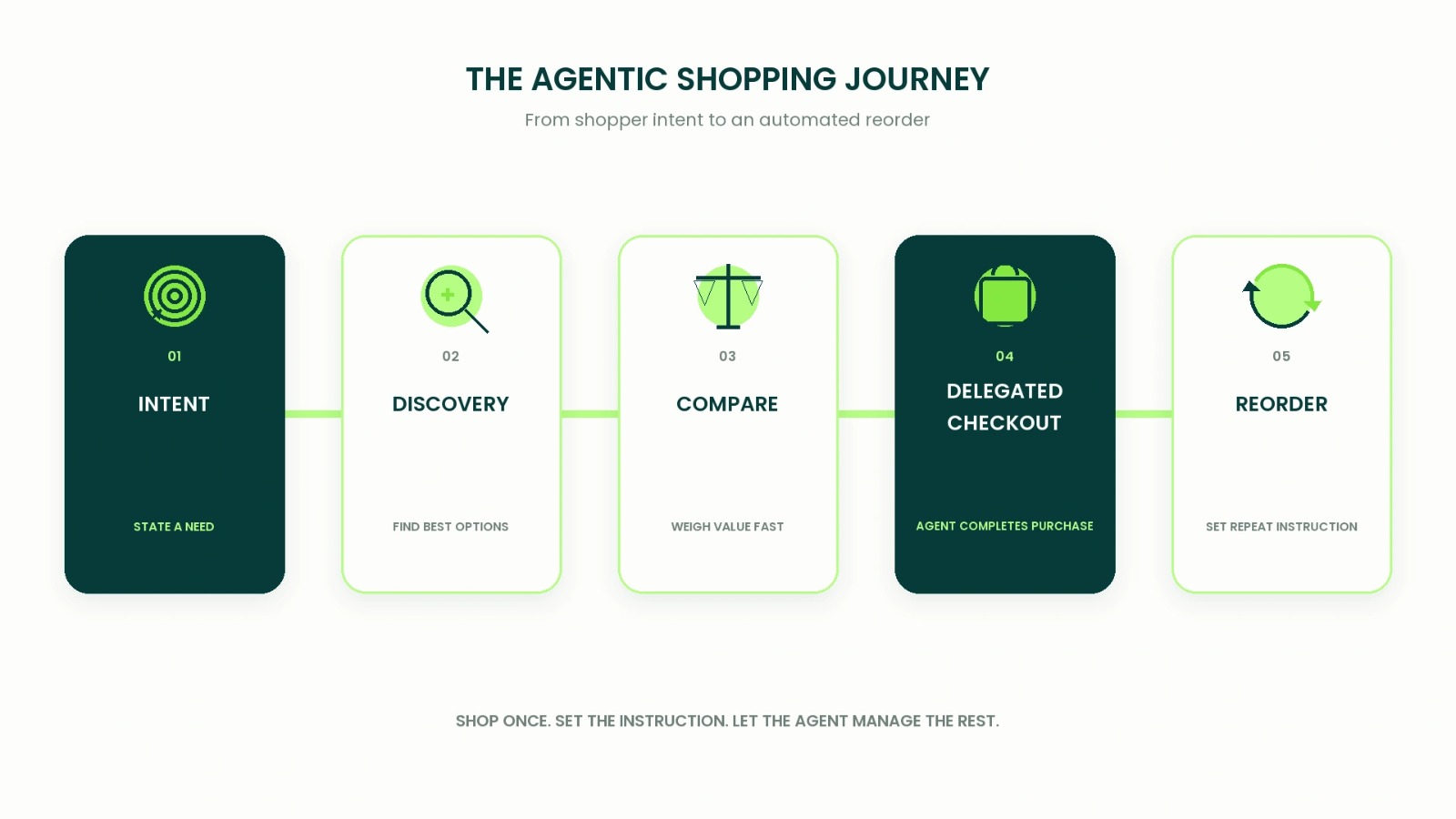
Most agentic purchases move through five stages. Each one leans on data your store already holds, or should.
Intent
A shopper states a goal in plain words, such as a gift under 300 dirhams that ships before Friday. The agent turns that sentence into structured criteria.
Discovery
The agent searches catalogs and feeds, then reads product attributes to judge fit. Stores with thin or messy data drop out here, because the agent cannot tell what it is looking at.
Comparison
The agent weighs price, stock, delivery, ratings, and return terms across sellers. A retailer-owned agent can favor first-party stock. Third-party agents will not.
Check out
With permission and a cap in place, it completes payment through an agent-aware checkout. Visa and Mastercard both route this through tokenized credentials (Visa).
Post Purchase
The last stage is what happens after the sale. An agent tracks the order, manages a reorder, and can start a return. A repeat purchase becomes a standing instruction rather than a fresh hunt.
Types of agentic commerce, from third-party agents to on-site AI agents
Agentic commerce is not one model. It splits along a few useful lines, and each split decides how much control you keep.
The first line is who the agent works for. Buyer agents represent the shopper and chase the best deal. Merchant agents represent the store, answer questions, suggest add-ons, and resolve issues.
A second line is reach. Some agents shop inside a single store. Others cross many merchants in one task, which is where cross-merchant checkout and open protocols come in.
The line that matters most to a UAE brand is where the agent lives. Third-party agents such as ChatGPT, Gemini, and Perplexity shop the open web, outside your control.
On-site AI agents run on your own store, so the customer, the data, and the checkout stay with you. Code Brew Labs built exactly this kind of agent for the Marketing Pro AI command center and the Kaizan reporting assistant, both of which reason and act inside a client’s own systems.
Autonomy is the last line. Some agents suggest and wait for a tap. Others buy within rules you set in advance. Deloitte maps this as a move from assisted shopping toward delegated shopping (Deloitte).
Agentic commerce vs traditional ecommerce
The store does not vanish. The interface and the reader change. A short contrast makes the shift concrete.
| Traditional ecommerce | Agentic commerce |
| A person types in a search box | An agent acts on natural-language intent |
| A person clicks and compares | An agent evaluates and shortlists |
| Tuned for SEO and human eyes | Tuned for GEO and machine reads |
| A person completes the cart | Delegated, agent-native checkout |
| The retailer owns discovery | A third-party agent may own discovery |
The best agentic commerce products and AI shopping assistants in 2026
A handful of platforms now carry most agentic shopping traffic. Knowing where your buyers sit decides where your product data has to appear.
| Product | What it does | Best for | Pricing |
| ChatGPT Shopping (OpenAI) | Discovery and Instant Checkout through ACP-connected feeds, around 800M weekly users | Brands reaching AI-chat shoppers | Free for shoppers; reported 4% merchant fee |
| Google AI Mode (UCP) | Agentic discovery and checkout in Search and Gemini; Google Pay live, PayPal coming | Brands with a strong Google Merchant Center presence | Standard Google Shopping fees |
| Perplexity “Buy with Pro” | One-click checkout inside search, Shopify-powered product cards | Research-driven buyers | Free discovery; Pro checkout for members |
| Amazon Rufus / “Buy for Me” (now Alexa for Shopping) | Agentic purchasing, including from other brands’ sites | Brands on or near Amazon.ae | Amazon account-based |
| Walmart Sparky | Generative AI assistant inside the Walmart app | Large-format retail reference | Not applicable regionally |
| Microsoft Copilot Checkout | In-chat purchase via product cards; PayPal, Shopify, Stripe | Windows and Edge audiences | Standard merchant fees |
| On-site AI agents (retailer-owned) | The assistant a UAE brand runs on its own store | Brands protecting their customer relationship | Build cost (see AED table) |
Two details deserve care. OpenAI described only a small fee at launch in September 2025. The 4% figure surfaced later, reported by The Information and re-reported by PYMNTS in 2026. Amazon also folded Rufus into Alexa for Shopping in May 2026 (CNBC).
| For the UAE, the third-party layer already runs. Noon and Amazon.ae carry AI-assisted discovery, and Careem keeps extending its super app assistant. Your on-site agent stays the one lever you own outright. |
How big is the agentic commerce market in 2026?
The numbers are large and moving fast. Bain expects US agentic commerce to reach 300 to 500 billion dollars by 2030, around 15 to 25% of ecommerce (Bain). A joint ICSC and McKinsey estimate puts US B2C agentic sales near one trillion dollars by 2030 (Retail Dive).
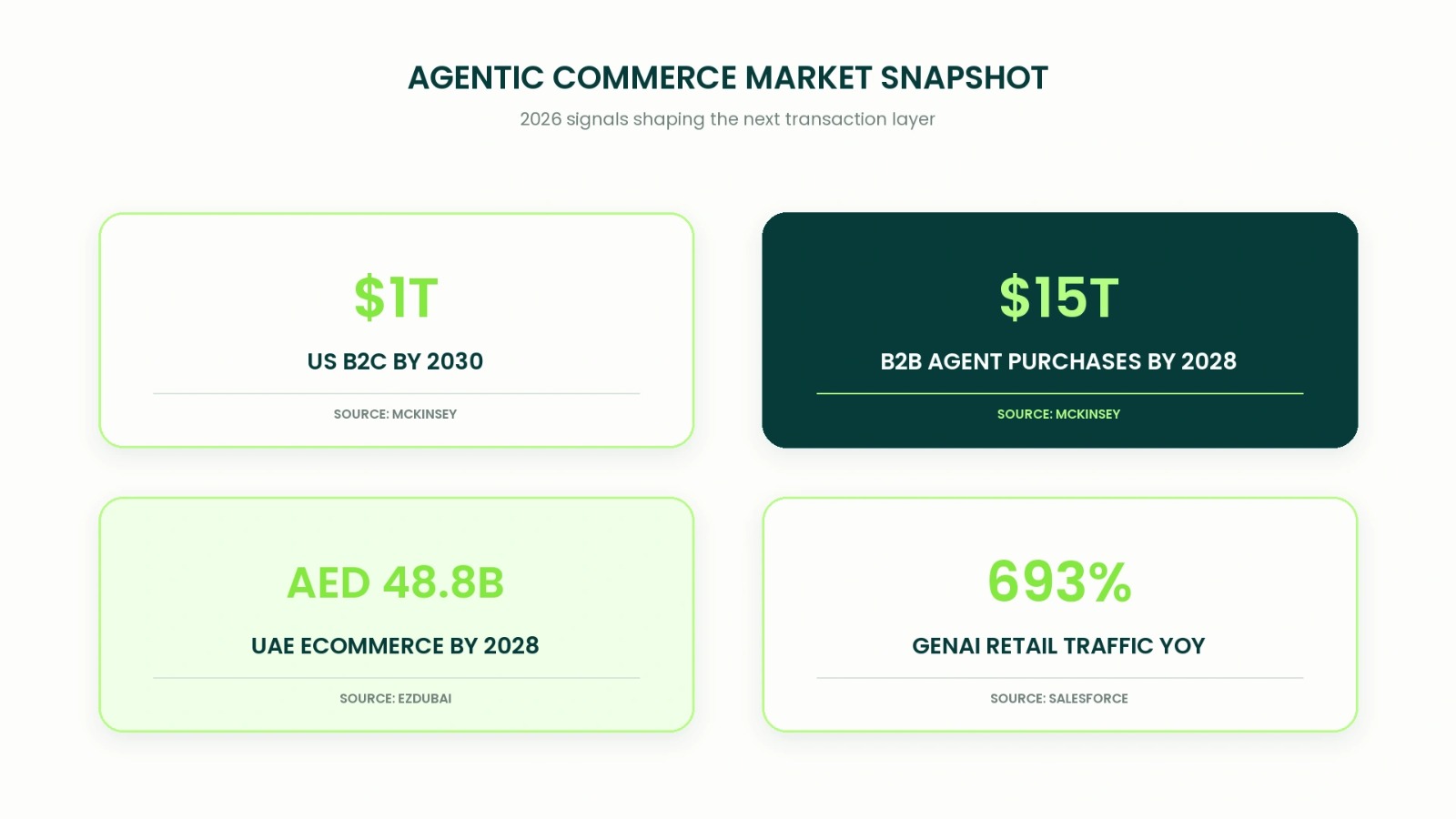
Business buying may move faster still. Gartner projects that AI agents will intermediate about 15 trillion dollars in B2B purchases by 2028 (DigitalCommerce360).
Live data backs the forecasts. During Cyber Week 2025, Salesforce found AI and agents drove 67 billion dollars in sales and shaped 20% of global orders (Salesforce). Adobe logged the 693% jump in AI-referred retail traffic noted earlier. Together they show demand, not just projection.
Turn your agent traffic into orders.
Agentic commerce in the UAE: market context and readiness
The UAE is well placed for this shift. Cash now sits at about 23% of consumer transactions, so paying through an agent feels ordinary to local shoppers (Visa). Internet reach touches 99% of the population, with mobile connections at 195% (DataReportal).
The commerce base keeps growing underneath it. UAE ecommerce stood at 27.5 billion dirhams in 2023 and should reach 48.8 billion by 2028 (EZDubai). Noon and Amazon.ae dominate discovery, while Talabat and Careem set the pace on quick commerce.
Policy sits behind the momentum. The country launched a national AI strategy in 2017 and targets AI worth 335 billion dirhams to the economy by 2031 (CSIS). An e-commerce app development market in the UAE provides digital hands agents clean rails to run on.
Benefits show up on both sides of the counter. Retailers gain a discovery surface, higher intent visits, and reorders that need no fresh search. Shoppers save time and compare across sellers in seconds. They also see the real price without the usual hunt. Code Brew Labs has shipped this scale of retail platform before, from REDTAG fashion ecommerce to the Yummy super app.
How agentic commerce personalizes product discovery with AI shopping agents
Discovery is where sales are won or lost now. An agent does not scroll a category page. It reads your structured data, matches it to a stated goal, and ranks you against rivals.
Good personalization rests on signal quality. Rich attributes, honest stock counts, clear images, and genuine reviews give the agent something to trust. Sparse feeds get skipped.
Conversational search reshapes the query too. Shoppers ask full questions, such as a quiet washing machine for a small apartment. Your data has to answer that whole sentence, not a single keyword. Multimodal input raises the bar again, since agents now read photos and voice alongside text. Getting this right is the core of any serious AI development brief in the UAE.
Agentic payments and intelligent checkout in the UAE
An agent that recommends is useful. An agent that pays is a different order of change, and it is the harder half to build. Payment needs proof of consent, a spending cap, and a secure token that stands in for card details.
Global rails already support this. Visa Intelligent Commerce and Mastercard Agent Pay issue tokenized credentials that agents use inside limits. Google’s AP2 protocol adds signed mandates that prove a shopper authorized the buy (Google Cloud).
The UAE brings its own rails to plug into. The central bank’s Aani service moves money between accounts in real time. Network International and Magnati handle the card side for most local merchants. A delegated fintech app in Dubai can ride these rails once consent and identity are in place.
This is where regulated fintech engineering earns its keep. Weak controls invite fraud and disputes, so the checkout has to log intent, verify the agent, and hold the cap on every transaction. Code Brew Labs built Du Pay, a regulated UAE wallet, and the Alfardan remittance app, so this compliance bar is familiar ground.
The protocols powering agentic commerce: ACP, UCP, AP2, MCP and A2A
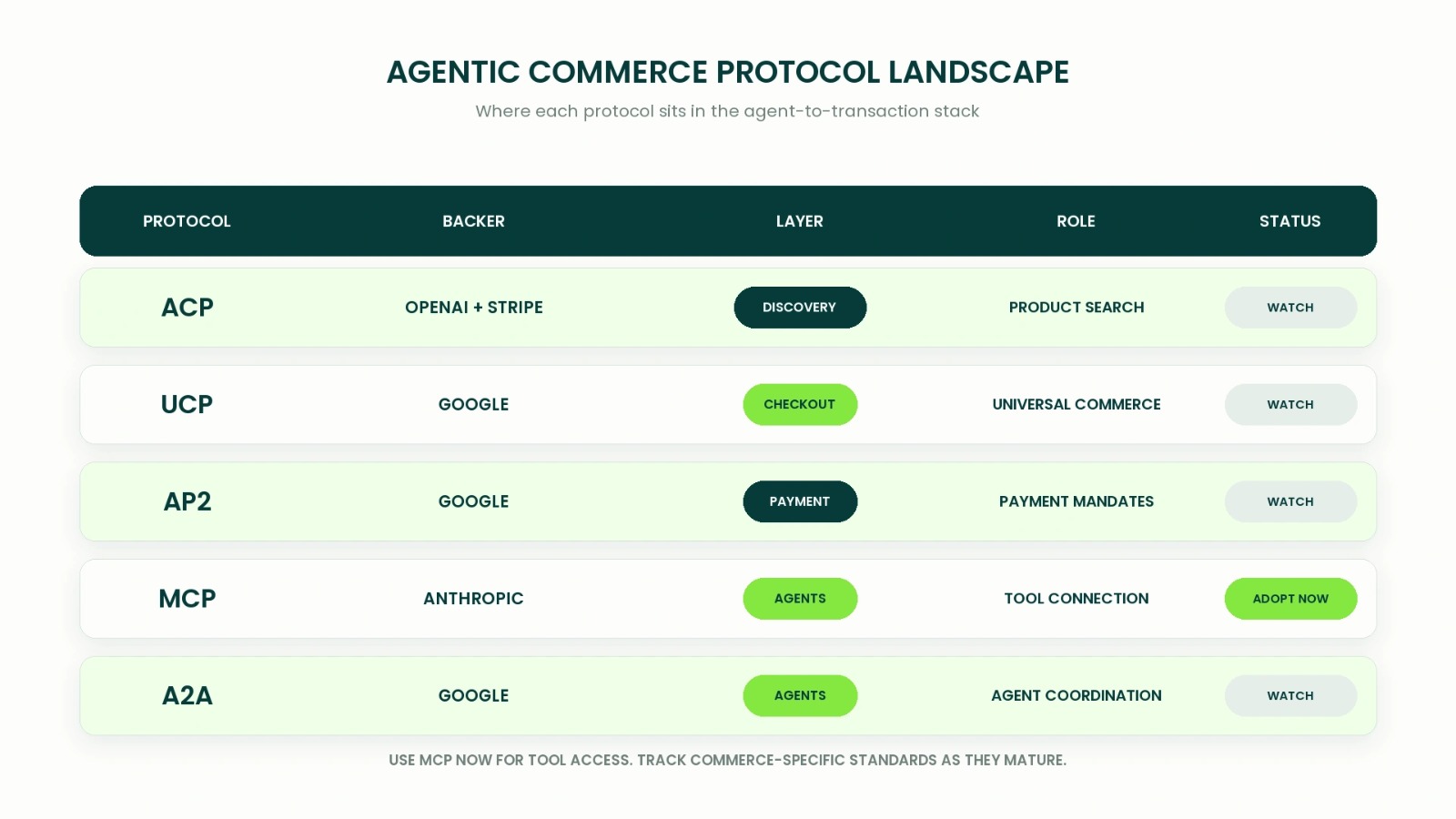
Protocols are the plumbing that lets agents and stores speak. Five matter in 2026, and each covers a different layer.
ACP, from OpenAI and Stripe, handles programmatic checkout while the merchant stays merchant of record (agenticcommerce.dev). UCP, led by Google and built with Shopify, Etsy, and others, spans discovery through payment (Google). AP2, also from Google, authorizes agent-led payments with signed mandates.
MCP, created by Anthropic and now under the Linux Foundation, connects an agent to external tools and data (Anthropic). A2A lets agents from different vendors coordinate a task between themselves.
Which one first? A UAE merchant selling through ChatGPT should give ACP priority. Brands leaning on Google Shopping need to track UCP. Any team building its own on-site agent will meet MCP early, since it wires the agent into catalog, inventory, and order systems. Our Royal Airlines travel assistant runs on MCP for that reason. Treat AP2 and A2A as the direction of travel, worth watching across this year.
Is agentic commerce safe? Consent, privacy and liability under UAE law
Safety is the question every board asks first, and it is fair. An agent spending money for someone raises real exposure. IBM found 83% of consumers worry about how their data is used (IBM). The answer sits in consent, data handling, and clear liability.
UAE law gives a starting frame. The Personal Data Protection Law, Federal Decree-Law 45 of 2021, requires a lawful basis and clear consent to process personal data. An agent purchase needs that consent on record, plus limits the shopper can set and revoke.
Data movement needs equal care. Many agents run on models hosted outside the UAE, so cross-border transfer rules apply. Sensitive shopper data should stay inside agreed boundaries, with an audit trail on every action.
Liability is the messy part. When an agent buys the wrong item, who owns the refund or the chargeback? Mastercard has raised the question without settling it. A UAE retailer should write these terms into its agent policy before launch, covering the shopper, the platform, and the payment provider.
Fraud changes shape as well. Prompt injection and fake product signals can push an agent toward a bad buy. Sensible defenses include agent identity checks, spending caps, and human review above a set value.
How to make your UAE store agent-ready for agentic commerce
Agent readiness comes down to whether a machine can read, trust, and transact with your store. Most UAE catalogs fail on the first count today. The fix is structural, and it pays back across every AI channel at once.
Begin with the data an agent reads. Product titles, attributes, prices, and stock have to be structured and current, never buried in images or PDFs. Schema markup then helps search, and AI systems parse each field.
Connections come next. An agent-aware checkout needs open APIs so an approved purchase can complete without a human session. Real-time inventory and a link into your PIM and order systems stop the agent selling what you cannot ship.
Language is the UAE-specific piece. Arabic reading models need Arabic product data, written for right-to-left display, sitting beside the English. Bilingual feeds widen who the agent can serve and how well it reads your range.
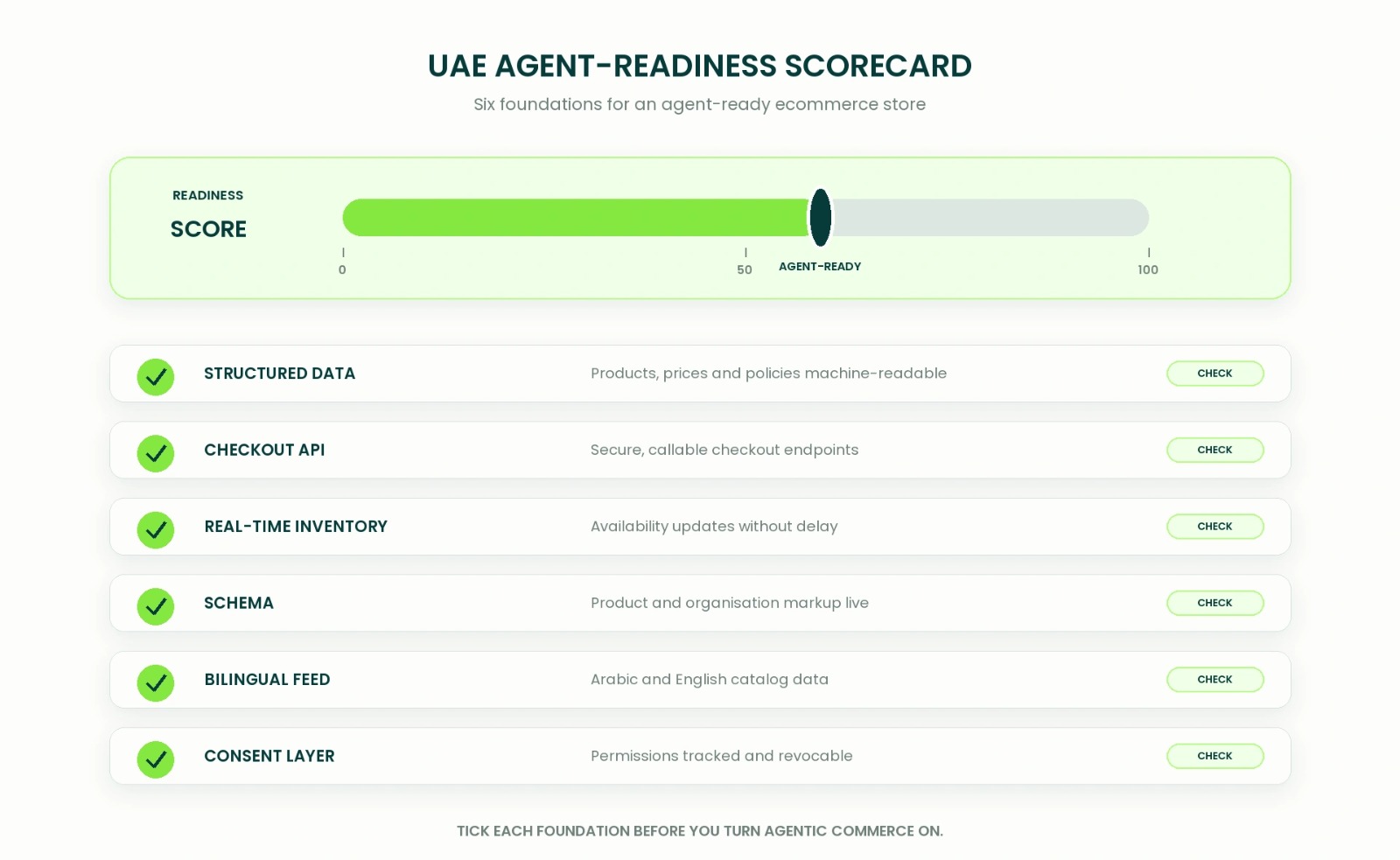
The scorecard below shows where you stand. Six fields decide most of the outcome.
- Structured product data: attributes a machine can read
- Checkout API: agent aware, no human session required
- Real-time inventory: stock the agent can trust
- Schema markup: fields tagged so AI can parse them
- Bilingual feed: Arabic and English, right-to-left ready
- Consent layer: recorded permission and spending limits
Score three or fewer and an agent will struggle to sell you. This is the practical brief behind any ecommerce build in Dubai aimed at agent traffic.
What agentic commerce development costs in the UAE
Cost tracks how far you take the build. A feed cleanup is modest. A full multi-agent platform is a serious program. The table gives honest dirham ranges for planning.
| Scope | Indicative cost |
| Agent-ready feed and schema optimisation | AED 40,000 to 90,000 |
| AI shopping assistant on an existing store | AED 90,000 to 250,000 |
| Custom agentic checkout and payment integration | AED 180,000 to 450,000 |
| Enterprise multi-agent platform (MCP or ACP, multi-merchant) | AED 450,000 to 1,200,000+ |
| Ongoing model, hosting and maintenance | AED 8,000 to 40,000 per month |
Two things move the figure most. Integration depth into your PIM, ERP, and payment stack drives the effort. Model and hosting fees then run every month, so plan for a full year of running costs, not the launch alone. A closer look at AI development cost in the UAE breaks these drivers down further.
Why Code Brew Labs for agentic commerce development in the UAE
Agentic commerce sits at the junction of AI, ecommerce, and regulated payments. Few UAE teams have built all three. Code Brew Labs has.
Our engineers build AI systems in Dubai and run an AI automation practice that wires agents into live business systems. On the commerce side, we deliver ecommerce platforms in Dubai and custom software built to carry real traffic.
Regulated payments are the harder test, and it is one we pass. The team shipped Du Pay and Alfardan through fintech app development in Dubai, so consent, tokens, and audit trails are familiar work.
We also read the local demand curve. Recent projects cover AI mobile app trends in Dubai and food delivery platforms in the UAE.
The MCP-enabled Royal Airlines assistant, plus the Kaizan and Marketing Pro agents, show the agentic layer is not theory here. It is code we have built and deployed.
Have an idea to build an agent-ready e-commerce store in the UAE?
The future of agentic commerce in the UAE
Agent-to-agent commerce
The next phase is agents talking to agents. A shopper’s buyer agent will negotiate with a store’s merchant agent over price, stock, and delivery. The person approves the result and steps back.
Arabic-native shopping agents
Arabic reading agents sit close behind. As Gulf models mature, discovery in Arabic becomes first class. Brands with clean bilingual data now hold the early edge.
Procurement agents for enterprise and government
Routine buying is next in line. Government bodies and large enterprises will hand repeat orders to buying agents. Approvals stay human, while search and reorder run on their own.
The first-mover window for agent citation share
The window is the real point here. Agent citation share behaves like early search ranking, where first movers with readable catalogs get quoted while others wait. UAE brands that prepare this year set the default the agents learn. Enterprises planning that groundwork can start with enterprise AI development in the UAE.
Getting ready for agentic commerce in the UAE
A machine reads your product page first now. That single change decides whether an agent quotes you or skips you when a UAE shopper asks for what you sell.
The retailers who win this phase are not the biggest. They are the ones whose data is clean, whose checkout is open, and whose Arabic reads as well as their English. That work is doable inside a year.
Code Brew Labs engineers agent-ready stores, AI shopping assistants, and agentic payment flows for UAE brands.
FAQs
What is agentic commerce in the UAE?
Agentic commerce in the UAE is online shopping where an AI agent acts for the buyer. The agent reads a goal, searches products, compares sellers, and completes an approved purchase within set limits. It runs on the digital rails UAE shoppers already use, from card networks to the central bank’s Aani instant payments.
Agentic commerce vs conversational commerce: what is the difference?
Conversational commerce is a chat that helps a person decide, and then the person buys. Agentic commerce goes further, since the agent can complete the purchase itself once you approve the limits. A chatbot answers a question. An agent finishes the task.
Is agentic commerce safe for UAE shoppers?
It can be, with the right controls. Safe agent buying rests on recorded consent, spending caps, tokenized payment, and an audit trail. UAE PDPL sets the consent and data rules. Retailers should also agree who covers a wrong purchase before they launch an agent.
How do I make my Shopify or Magento store agent-ready in the UAE?
Give agents clean, structured product data, current stock, and schema markup they can parse. Open a checkout API so an approved purchase completes without a human session. Add Arabic data beside the English for local reach. Shopify and Magento both support the feeds and APIs this needs.
What does agentic commerce development cost in the UAE?
A feed and schema project starts at around AED 40,000. An on-site AI shopping assistant sits between AED 90,000 and 250,000. A custom agentic checkout with payments runs higher, and an enterprise multi-agent platform begins around AED 450,000. Running costs are monthly on top.
Which agentic commerce protocol should a UAE retailer use?
It depends on your channel. Selling through ChatGPT points you to ACP. A heavy Google Shopping presence favors UCP. A store building its own agent will use MCP to connect catalog and orders. Keep AP2 and A2A in view as payment and agent-to-agent standards mature.
Will agents replace ecommerce websites?
No, though they change the website’s job. Your store becomes a data source an agent reads and buys from, as well as a place people visit. Sites that stay human-only will lose the agent-driven traffic already growing across the Gulf.
Let's Convert Your Business Idea Into Success!
Free Consultation from Top Industry Experts
Let’s Build Your Dream App!
Share article on :


 No commitment required
 NDA on request
 24-hour response


