
Quick Summary:
- Emirates NBD and Techstars launched an AI FinTech accelerator on 6 July 2026, giving early-stage founders direct access to a bank serving nine million active customers.
- The programme uses an "Acceleration-to-Enterprise" model, moving startups into live deployment instead of a pilot-and-goodbye format.
- Emirates NBD already runs 50+ active AI use cases and ranked first in the Evident AI Index for Banks across the Middle East and Africa.
- Techstars brings a global founder network of 11,000+ into Emirates NBD's compliance, wealth management, SME banking, and capital markets environment.
- Dubai already hosts nearly 60% of GCC fintech companies, and this accelerator is positioned inside the Dubai Economic Agenda D33.
- A separate Dubai Chamber programme just confirmed the same pattern at the startup level: 60% of 32 newly launched apps are AI-powered.
- UAE PDPL compliance becomes mandatory on 1 January 2027, making AI architecture and data compliance a single decision, not two.
- An AI fintech app development company that builds compliance and adaptive AI from day one is now a founder's fastest route to both a bank pilot and a fundable product.
Emirates NBD’s Techstars partnership is a market signal for every UAE founder looking for AI fintech app development in the UAE, digital wallet, remittance platform, or compliance-heavy financial product.
As per Middle East AI News reports, UAE fintechs now need AI-ready products, bank-grade infrastructure, strong compliance design, and clear enterprise use cases before the market gives them serious attention.
Check if your fintech product is AI-ready for the UAE market
What Happened in the Emirates NBD and Techstars AI Fintech Partnership?
On 6 July 2026, Emirates NBD partnered with Techstars to launch an AI and FinTech accelerator across the Middle East, North Africa, and Türkiye.
The programme is built on what both parties call an “Acceleration-to-Enterprise” model. Selected founders get direct access to Emirates NBD’s cloud-native infrastructure and its base of nine million active customers.
That structure is unusual. Most bank accelerators end in a pilot and a press release. This one is designed for commercial deployment from the first cohort.
Four sectors sit at the centre of the programme: compliance, wealth management, SME banking, and capital markets. Agentic finance applications are explicitly what both organisations are looking for.
Emirates NBD is not a passive brand partner here. The bank already runs more than 50 active AI use cases and recently topped the Evident AI Index for Banks across the Middle East and Africa, the only bank in the region to place in the top three for talent, innovation, and leadership.
Techstars adds its own weight. Its global founder network exceeds 11,000, and this partnership plugs that pipeline directly into a live enterprise banking environment instead of a generic mentorship track.
Why This News Matters for UAE Fintech Founders
This partnership matters because it changes what “fundable” and “bank-ready” mean for a UAE fintech app in 2026.
A pilot used to be the finish line for most bank-accelerator startups. Now the finish line has moved. Emirates NBD wants founders who can plug into a live AI enterprise application from day one.
An app that only digitizes payments, transfers, or onboarding feels incomplete now. Or, an MVP built on a no-code AI app builder will not survive due diligence against a bank’s compliance, wealth management, or capital markets requirements.
Founders need AI automation in Dubai, AI integration, intelligent support, risk controls, and user journeys built around real financial behavior.
The partnership also brings enterprise distribution into the accelerator model. Startups are not just being mentored. They are being tested against real banking infrastructure and real customer needs.
Dubai already hosts close to 60% of all GCC fintech companies, according to Emirates NBD’s own framing of the partnership. Competition for a limited number of accelerator seats will be intense.
Founders who show up with a production-grade AI fintech app, not a prototype, have a real edge. That is the gap between an app that impresses a demo panel and one a bank can actually deploy.
97% of Emirates NBD’s financial transactions and requests already happen outside its branches. The bank’s customer base is digital-first already, which is exactly the environment an AI-native fintech app needs to prove itself in.
Dubai’s AI Wave Isn’t Isolated: What the 32-App Milestone Confirms
This is not an isolated bank initiative. A separate Dubai Chamber of Digital Economy programme confirmed the same shift at the startup level, one day after the Emirates NBD news broke.
Its Create Apps Accelerator Programme launched 32 new mobile applications in Dubai in June 2026. 60% of those apps are AI-powered, built by founders from 22 countries across 13 sectors in a 45-day sprint.
Fintech was one of the sectors represented in that cohort. Read the full breakdown of the 32-app AI wave for sector data, funding benchmarks, and the production gaps most early apps still face.
The pattern across both stories is the same. Whether the source is a global bank or a 45-day startup sprint, AI is no longer a differentiator. It is the baseline that UAE product teams are expected to ship.
UAE AI Strategy 2031 Gives This Fintech Wave Its Policy Context
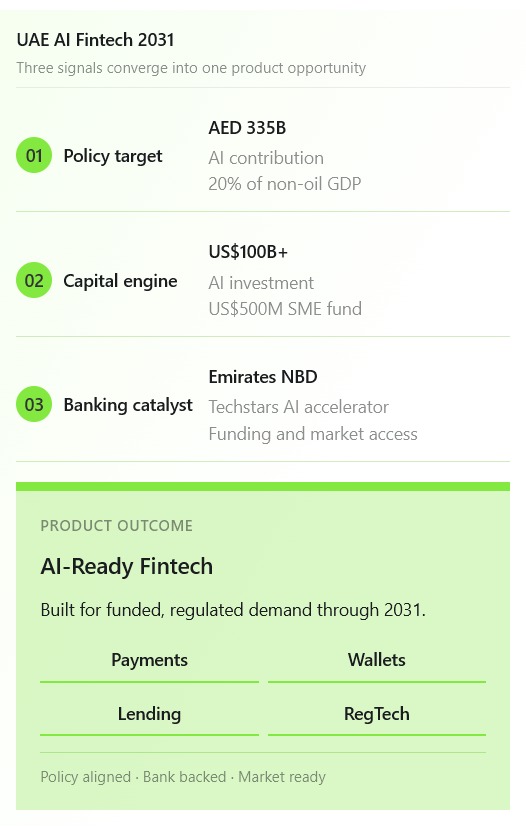
Launched by the UAE AI Office, the strategy targets AED 335 billion in AI-driven economic contribution, with AI reaching 20% of non-oil GDP by the UAE AI Office’s own target.
The government capital backs that target directly. The UAE has committed more than $100 billion in investment to AI development in Dubai, and the Ministry of Economy runs a dedicated $500 million AI fund for SMEs and early-stage companies building AI into their products.
Banking sits inside this push deliberately. For a bank the size of Emirates NBD to build a public AI accelerator is a policy-aligned move, not a marketing exercise, and it signals where regulatory and funding priorities will keep flowing through 2031.
For founders, that alignment matters practically. Building an AI-ready fintech app is not betting against a trend. It is building toward a target the federal government has already funded and dated.
The AI Fintech Trends UAE Businesses Should Watch in 2026
The best AI fintech apps in 2026 will not win by adding one chatbot to a wallet.
They will win by making financial journeys faster, safer, more personal, and easier to govern.
| AI fintech trend | What it means in product terms | Code Brew Labs build angle |
| AI fintech chatbot | A chatbot that helps with onboarding, wallet queries, transfer status, KYC guidance, and support escalation | AI chatbot development with financial workflows and multilingual UX |
| AI automation | Automated checks for KYC, transaction review, reconciliation, reporting, and support tickets | AI automation and backend workflow integration |
| Agentic finance | AI assistants that can monitor financial goals, trigger alerts, and recommend actions with controls | Agentic AI architecture with human approval layers |
| AI wealth intelligence | Portfolio insights, investor education, risk explanations, and goal-based recommendations | AI integration for wealth and investment platforms |
| Adaptive AI development | AI models that improve fraud detection, personalization, and risk alerts with live product data | Adaptive AI development with monitoring and retraining logic |
| AI virtual companion | Personal finance assistants that help users budget, save, transfer, and understand spending | AI virtual companion features for wallet and banking apps |
| Digital wallet intelligence | Wallets that personalize offers, flag risk, simplify remittance, and guide daily payments | Wallet app development with AI-powered engagement layers |
A 2026 survey on agentic artificial intelligence in finance frames agentic AI as systems that reason, plan, and make adaptive decisions in financial environments.
A 2026 paper on trustworthy AI in fintech highlights finance-specific risks across training, deployment, monitoring, prompt injection, KYC, and model robustness.
The practical takeaway is clear. UAE fintech apps need AI features, but they also need controls that make AI safe enough for financial use.
Shariah-Compliant Islamic Fintech: Where Does AI Fit?
Shariah-compliant Islamic fintech app development is one of the fastest-growing niches inside this same AI wave, and it needs its own compliance layer on top of PDPL.
AI-powered Shariah screening, automated zakat calculation, and profit-sharing models built for Islamic finance structures are all active build categories in the UAE market today.
The compliance requirements are specific enough that they deserve their own treatment. Read the complete guide to Shariah-compliant Islamic fintech app development for the full framework.
What matters for this story is simpler. Any founder building toward an accelerator like Emirates NBD’s, in a market where Islamic finance is a core UAE banking segment, should scope Shariah compliance at the architecture stage, not after a pilot request comes in.
How Does an AI-Ready Fintech App Help Raise Funding in the UAE?
Investors in 2026 are not funding AI features. They are funding fintech apps with three measurable qualities that AI-native architecture makes possible.
Retention depth
AI-driven personalisation increases mobile app retention by up to 40% against 2026 UX benchmarks, a number that separates a fundable user story from an average one.
Lower cost per user
AI automation and chatbot development cut support costs by 30 to 60% in UAE consumer fintech apps, a margin story investors trust more than a growth story alone.
Data moat depth
An app built on adaptive AI accumulates proprietary transaction and behaviour data with every session, a barrier that new entrants cannot quickly copy.
MENA fintech raised approximately $1.14 billion in 2025, representing 26% of all regional VC deal volume. Dubai-based companies alone captured 93% of the UAE’s H1 tech funding, a 133% jump over the prior half-year.
Real rounds back this pattern. CNTXT AI raised AED 220.35 million ($60 million) in June 2026, and Alaan, an AI-powered B2B fintech, closed one of the region’s largest-ever Series A rounds at $48 million in 2025.
Both companies had production-grade AI architecture and measurable outcomes before they raised. That is the standard an Emirates NBD-Techstars applicant, or any UAE fintech founder, is now being measured against.
What AI-Ready Fintech Apps Need Before UAE Market Launch
An AI-ready fintech app needs more than a model.
It needs a product system where data, compliance, security, payments, support, and AI behavior work together from the first sprint.
Use this checklist before building:
- Clear user problem: remittance delay, wallet support, SME finance, investment guidance, Islamic finance access, or fraud review.
- Data readiness: clean transaction data, user segments, risk events, support history, and consent handling.
- Compliance flow: KYC, AML checks, audit trail, role access, data retention, and regulator-facing reports.
- AI safety layer: human review points, model monitoring, fallback rules, and explainable outputs.
- Integration plan: payment gateways, bank APIs, CRM, core systems, analytics, and notification tools.
- UX localization: Arabic and English flows, RTL support, expat journeys, and UAE payment habits.
- Scale plan: cloud architecture, uptime goals, app store readiness, and support operations.
This is the difference between an AI app and a production-grade AI fintech app.
How Code Brew Labs Helps UAE Fintechs Build AI-Ready Products
Code Brew Labs is an AI fintech app development company based in Dubai, building compliant, production-grade fintech products for UAE banks, exchange houses, and startups.
Two live deployments show what that looks like in practice.
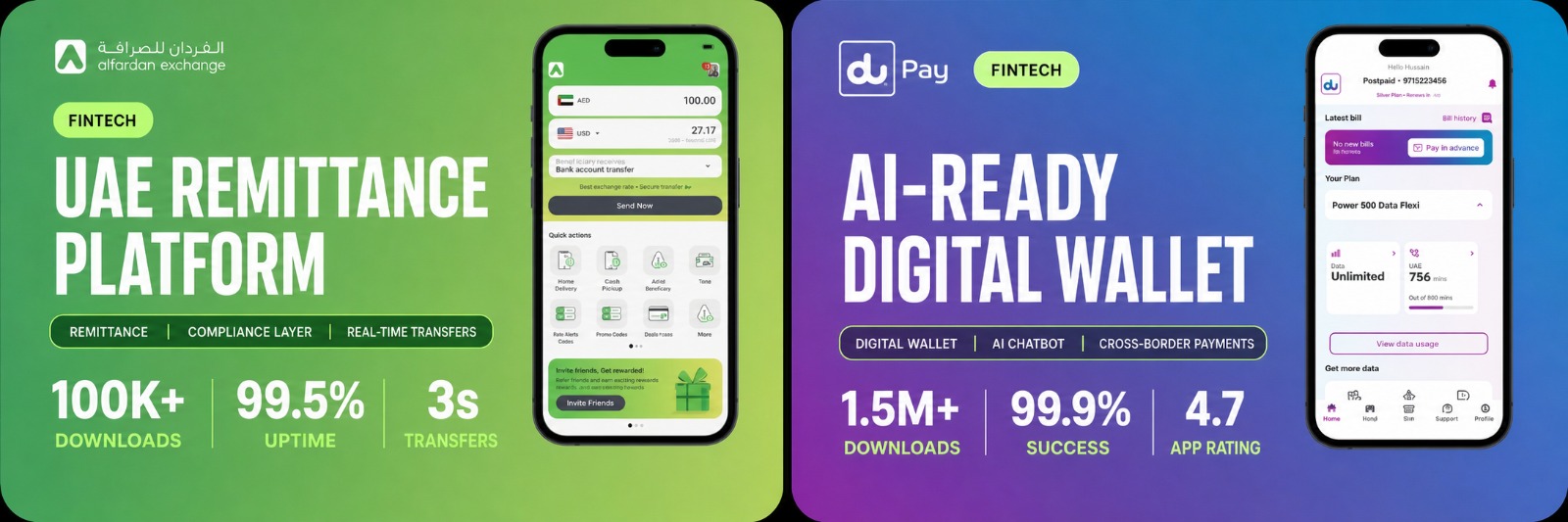
Alfardan Exchange, one of the UAE’s largest exchange houses, runs on a real-time international transfer platform built for compliant, high-frequency expat remittance use. It has passed 100,000+ user downloads, holds 99.5% platform uptime, and completes transfers in an average of 3 seconds.
duPay, a UAE-regulated digital wallet and cross-border transfer app built for the region’s expat community, has also passed 100,000+ downloads, runs a 99.9% transaction success rate, and holds a 4.7 App Store rating.
Both apps were built compliant from the architecture stage, not audited into compliance after launch. That is the same standard; PDPL’s January 2027 deadline is about to make mandatory for every fintech app processing UAE user data.
Code Brew Labs pairs that fintech delivery record with a full AI service line:
- AI enterprise consulting for strategy and architecture decisions
- AI integration for connecting models to live data
- AI chatbot development
- Adaptive AI development
- AI automation
- AI virtual companion builds for consumer-facing products.
We are not entering AI fintech because it is trending; we have the UAE fintech delivery proof.
That proof can now expand through AI fintech chatbots, AI automation, adaptive AI development, and AI integration.
How Code Brew Labs Helps UAE Fintech Businesses Ride This Wave
Code Brew Labs can help UAE fintech businesses at four stages.
1. AI Fintech Consulting and Readiness Mapping
Code Brew Labs can audit a fintech idea, existing app, or enterprise system to identify high-value AI use cases.
This includes support automation, fraud review, transaction monitoring, remittance personalization, onboarding assistance, Islamic fintech screening, and wealth intelligence.
2. AI Fintech App Development
Code Brew Labs can build AI fintech apps for wallets, remittance, lending, personal finance, wealth, insurance, banking, and payment platforms.
The goal is a product that works across customer experience, operations, compliance, and integrations.
3. AI Integration for Existing Fintech Products
Many UAE businesses already have fintech apps, but the architecture was not built for AI.
Code Brew Labs can add AI integration layers for chatbots, analytics, support, risk alerts, transaction categorization, and workflow automation without forcing a full rebuild first.
4. Adaptive AI and Post-Launch Optimization
Fintech AI must improve with live usage.
Adaptive AI development helps products respond to changing user behavior, fraud patterns, support questions, and payment habits while keeping monitoring and human oversight in place.
Turn your wallet, remittance, or fintech idea into an AI-ready UAE Fintech product.
What Should UAE Fintech Founders Build After This News?
The strongest AI fintech app ideas sit where customer demand, bank infrastructure, and regulation meet.
Five product directions stand out for UAE founders:
- AI-powered remittance app for expat workers
- AI fintech chatbot for digital wallets and exchange houses
- Shariah-compliant Islamic fintech app for halal investing and sukuk access
- SME finance app with AI-led cash flow insight and document automation
- AI-powered wealth intelligence app for UAE investors
Each idea needs the same foundation: data access, compliance controls, payment integrations, secure user identity, Arabic-English UX, and a clear monetization model.
This is why a custom AI fintech app development company is stronger than a generic AI app builder for regulated finance.
Why This Matters for Startups, Enterprises, and Exchange Houses
Startups need AI readiness because investors and bank partners now expect stronger product depth. For enterprises, AI integration is crucial because legacy systems cannot serve digital-first users without smarter automation.
Exchange houses require AI-powered remittance journeys because UAE users expect speed, clarity, low friction, and reliable support.
Banking partners must have AI products that can plug into enterprise environments without creating new compliance or operational risks.
Code Brew Labs sits across these needs as an AI fintech app development company, AI consulting partner, and AI integration team.
Conclusion:
Emirates NBD’s Techstars partnership shows where UAE fintech is heading.
The next wave of fintech apps will be AI-ready, compliance-aware, integration-friendly, and built for bank-grade use cases from day one.
Dubai’s 60% AI app milestone confirms that AI is already entering the startup baseline.
For UAE founders, startups, enterprises, exchange houses, and Islamic fintech businesses, the next move is practical. Identify the AI use case, validate the data, design the compliance layer, and build the product with a team that understands fintech execution.
Code Brew Labs can help turn that signal into a working AI fintech product.
FAQs
What is the Emirates NBD and Techstars AI fintech accelerator?
It is an AI and FinTech accelerator for startups targeting MENAT markets. The programme gives selected founders access to Emirates NBD’s enterprise banking environment, cloud-native infrastructure, and customer scale.
Why should UAE fintech startups build AI-ready products now?
UAE banks, investors, and users now expect fintech apps to be intelligent, secure, fast, and useful beyond basic transactions. AI readiness is becoming a product credibility signal.
What AI fintech app ideas can work in the UAE?
Strong ideas include AI remittance apps, AI fintech chatbots, SME finance tools, Islamic fintech platforms, wealth intelligence apps, fraud monitoring systems, and digital wallets with personalization.
What is Shariah-compliant Islamic fintech app development?
It is a fintech product development that supports Islamic finance rules. Key features include halal investment screening, sukuk workflows, scholar review, transparent fees, and explainable financial recommendations.
How can Code Brew Labs help fintech businesses become AI-powered?
Code Brew Labs can support AI consulting, product strategy, fintech app development, wallet development, AI integration, AI chatbot development, adaptive AI development, and post-launch optimization.
Is an AI app builder enough for fintech products?
An AI app builder can help test an idea. Regulated fintech products need secure infrastructure, payment integrations, KYC workflows, data controls, audit trails, and AI monitoring.
What makes the best AI fintech apps different in 2026?
The best AI fintech apps combine useful automation with trust. They support real financial tasks, explain outputs clearly, protect data, connect with existing systems, and improve through monitored usage.
Let's Convert Your Business Idea Into Success!
Free Consultation from Top Industry Experts
Let’s Build Your Dream App!
Share article on :


 No commitment required
 NDA on request
 24-hour response


