
Quick Summary:
- Dubai and Abu Dhabi vendor overheads sit close together, so scope sets the budget more than location.
- Planning budgets run from about AED 25,000 for a focused tool to AED 1 million plus.
- The regulator your data answers to, such as DIFC, ADGM, DoH or CBUAE, reshapes architecture and testing scope.
- Over three years, maintenance, hosting and enhancements can exceed the original build fee on a mid-size platform.
- Firms earning AED 50 million or more must appoint an e-invoicing provider by 30 October 2026.
- Arabic right-to-left support designed in from sprint one costs less than retrofitting layouts after launch.
- Shortlisted vendors should price the same brief, acceptance criteria, and support period before any quote comparison.
Custom software development cost in Dubai and Abu Dhabi runs from AED 25,000 to AED 1 million+. A one-workflow tool sits at the floor. Regulated multi-entity platforms with legacy integrations clear the top.
Location moves that number less than most buyers expect. Cushman & Wakefield put Q2 2026 average office rents at AED 205 per sq ft in Dubai. Abu Dhabi averaged about AED 203.
So why can two vendors in the same tower quote AED 100,000 and AED 400,000 for one brief? Their assumptions differ on scope, integrations, testing depth, and the regulator that governs the data.
How Custom Software Costs Are Calculated in Dubai and Abu Dhabi
Most Dubai and Abu Dhabi vendors price custom software as estimated hours multiplied by a blended team rate. Discovery, design, development, QA, and deployment each get their own hour estimate.
A risk buffer then covers integrations, compliance work, and unclear requirements. Senior-heavy teams raise the blended rate, and offshore hours pull it down.
Want to see what your project would cost in Dubai or Abu Dhabi before vendors start pitching numbers?
How Much Does Custom Software Development Cost in Dubai and Abu Dhabi in 2026?
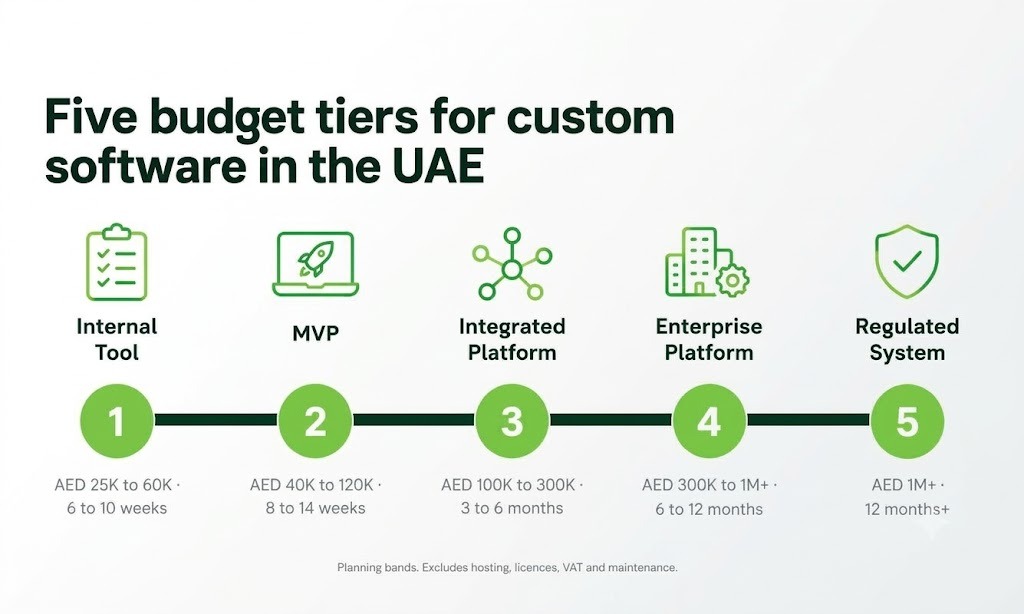
Custom software development cost in the UAE falls into five planning tiers for 2026. A focused internal tool needs about AED 25,000 to AED 60,000.
Integrated business platforms with several roles and integrations need AED 100,000 to AED 300,000. Regulated or multi-entity systems with legacy connections start near AED 1 million.
Custom Software Development Pricing by Project Tier
Each band assumes a professional vendor, a written scope, and production deployment. Bands overlap on purpose. An MVP with two difficult integrations can cost more than a plain business application with none.
| Project tier | Planning budget (AED) | Typical timeline | Typical scope |
| Focused internal tool | 25,000 to 60,000 | 6 to 10 weeks | One workflow, two or three user roles |
| MVP or small business app | 40,000 to 120,000 | 8 to 14 weeks | Core features, login, admin panel |
| Integrated business platform | 100,000 to 300,000 | 3 to 6 months | Several roles, workflows and integrations |
| Complex enterprise platform | 300,000 to 1,000,000+ | 6 to 12 months | Multiple modules, security reviews, scale tests |
| Regulated or multi-entity system | 1,000,000+ | 12 months+ | Legacy integration, audit trails, high availability |
What Does Each Budget Tier Include?
Tier labels mean little until the scope behind them is written down.
-
Focused internal tool
One workflow, such as leave approvals or stock requests, runs on a responsive web interface. Reporting stays basic, and integrations stay at one or none.
-
MVP or small business app
Core features reach a first set of customers, with login, admin, and analytics. Testing covers core journeys, and hosting stays outside the fee.
-
Integrated business platform
Four to eight user roles share workflows and dashboards. Three to six integrations follow, such as ERP, payments, or UAE PASS, with Arabic and English interfaces.
-
Complex enterprise platform
Several modules share one data model, with role segregation, audit logs, and peak-load testing. A penetration test forms part of acceptance.
-
Regulated or multi-entity system
Legacy migration, multi-zone hosting and evidence for auditors drive this tier. Budgets here are set per phase after paid discovery.
None of the bands include hosting, third-party licences, VAT or post-launch maintenance unless a quote lists them.
Why Do Software Development Quotes in the UAE Vary So Much?
Quotes for the same brief can differ fourfold in the UAE. Rates explain a small part of that gap, and scope assumptions explain the rest.
Five factors drive the spread:
-
Project definition
One vendor reads “MVP” as a clickable prototype. Another reads it as a launch-ready product with payments and admin.
-
Phases included
Some quotes cover development alone and bill discovery, QA, and deployment later as change requests.
-
Team seniority and location
A senior hybrid team costs more per hour and needs fewer hours to reach production quality.
-
Risk buffer
Vague briefs push careful vendors to add contingency, while others leave the risk with the buyer.
-
Exclusions
Integrations, warranty, and deployment left “as needed” make a quote look cheaper on paper.
The illustrative comparison shows how two honest quotes for one brief reach AED 100,000 and AED 400,000.
| Line item | Quote A scope | Quote A (AED) | Quote B scope | Quote B (AED) |
| Discovery and architecture | Skipped | 0 | Two-week workshop, costed architecture | 40,000 |
| UX/UI design | Template screens, English only | 10,000 | Bilingual design system | 45,000 |
| Development | Junior offshore team | 75,000 | Senior hybrid team | 200,000 |
| Integrations | “As needed,” unpriced | 0 | Four named APIs | 45,000 |
| QA and security | Developer self-testing | 15,000 | Automated tests plus penetration test | 50,000 |
| Deployment and warranty | Excluded | 0 | Production setup, 90-day warranty | 20,000 |
| Total | 100,000 | 400,000 |
Quote A buys a smaller product. Its missing lines tend to return later as change requests, often at higher rates.
Dubai vs. Abu Dhabi: Is Custom Software Development Cheaper in Either Emirate?
Abu Dhabi does not cost more than Dubai for custom software as a rule. Office rents and published developer pay show no consistent gap between the two emirates.
Budgets diverge when a project inherits a different regulator, hosting rule, or government platform. An ADGM fintech and a Dubai retail app can share a vendor and still carry very different budgets.
Does Abu Dhabi Cost More Than Dubai for Custom Software Development?
Buyers tend to blend three separate questions into one.
-
Where the client operates
An Abu Dhabi company can hire a Dubai vendor, a hybrid team or an offshore firm. Its registered address decides the regulator, while the contract sets the rate.
-
Where the vendor sits
Abu Dhabi office rents rose 33% year on year to reach Dubai’s level, according to Cushman & Wakefield.
-
What the software must do
Requirements carry the real price difference. A health app in Abu Dhabi falls under ADHICS, while a Dubai retail app faces no sector regulator.
Pay evidence is mixed. Indeed’s small samples put senior Java developers at about AED 12,113 a month in Dubai. The same role shows AED 16,392 in Abu Dhabi.
Software Development Cost in Dubai: What Pushes a Budget Up?
Dubai’s demand leans toward customer-facing platforms in retail, hospitality, property, and logistics. The D33 agenda targets AED 100 billion a year in new value from digital transformation.
-
DIFC data protection
Firms inside DIFC follow Data Protection Law No. 5 of 2020 in place of the federal PDPL. Regulation 10 adds notice and certification duties for high-risk AI processing.
-
Government security rules
Dubai government systems must meet DESC’s Information Security Regulation, which spans 13 control domains. Hosting must come from certified cloud providers.
-
Health data
DHA policy PP-11 bars moving protected health information abroad outside listed exemptions.
-
Customer-facing scale
Sales and events create traffic spikes. Load testing, caching, and Arabic search add hours that internal tools never need.
Software Development Cost in Abu Dhabi: What Pushes a Budget Up?
Energy, financial services and government-adjacent contracts shape much of Abu Dhabi’s software demand. The emirate is committing AED 13 billion to its 2025 to 2027 digital strategy.
- ADGM data protection
ADGM’s Data Protection Regulations 2021 carry fines of up to about AED 103 million. Records of processing and 72-hour breach notices need system support.
- ADHICS for health data
ADHICS V2 covers web and mobile apps that touch health information, and keeps patient data in the UAE.
- TAMM and sovereign hosting
Government services may connect to TAMM, which served 3.8 million users in 2025. Every government operation is due to move onto sovereign cloud under the strategy.
- Fewer availability zones
Azure UAE North in Dubai runs three availability zones. Its paired Abu Dhabi region, UAE Central, has none and restricts access.
A workload that must stay inside Abu Dhabi can cost more to keep online through a data-centre failure. That is the one city-level cost difference this research confirmed.
Dubai vs Abu Dhabi Cost Inputs Compared
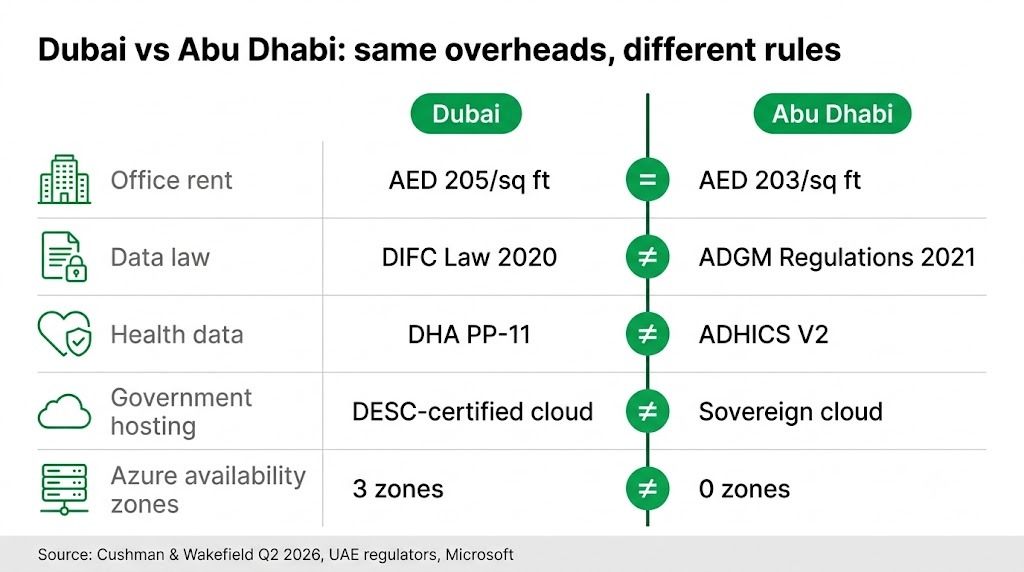
Put side by side, the overhead rows match, and the rule rows split.
| Cost input | Dubai | Abu Dhabi | Budget effect |
| Average office rent, Q2 2026 | AED 205 per sq ft | About AED 203 per sq ft | Negligible gap |
| Free-zone data law | DIFC Law No. 5 of 2020 | ADGM Regulations 2021 | DPIAs, records, transfer controls |
| Health data standard | DHA policy PP-11 | ADHICS V2 from DoH | In-UAE hosting, security controls |
| Government security | DESC ISR, certified cloud | Sovereign cloud target | Certified hosting and audits |
| Government platform | UAE PASS | UAE PASS and TAMM | Integration and assessment work |
| Azure availability zones | Three in UAE North | None in UAE Central | Costlier failover design |
Software Development Hourly Rates in the UAE: Local, Hybrid or Distributed Teams
Hourly rates in the UAE depend more on seniority and delivery model than on emirate. A blended rate mixes architects, developers, QA, and project management into one figure.
Senior talent is expensive in both cities. Michael Page’s 2026 UAE salary guide puts AI roles at AED 25,000 to AED 75,000 a month.
- All-UAE team
Workshops and security reviews happen in person, which suits government projects. Rates are highest and coordination overhead lowest.
- Hybrid team
A UAE-based architect runs discovery, and distributed developers build against that plan at a lower blended rate.
- Distributed team
Most hours sit offshore. Rates fall, but buyers absorb more management time and handover risk.
The table compares the three models on the factors that move a blended rate.
| Delivery model | Where the hours sit | Effect on blended rate | Fits best when |
| All-UAE team | Dubai or Abu Dhabi office | Highest | Government, regulated or onsite-heavy work |
| Hybrid team | UAE architect, distributed developers | Mid-range | Enterprise builds with local stakeholders |
| Distributed team | Offshore, with remote workshops | Lowest | Well-documented scope with few workshops |
Custom Software Development Cost by Project Type in the UAE
Four projects with equal screen counts can differ by hundreds of thousands of dirhams. Modules, integrations, and data rules set that gap.
How Much Does a Custom CRM Cost in the UAE?
A custom CRM for a UAE sales team tends to cost AED 80,000 to AED 300,000. Pipelines with contacts, deals and email sync sit near the bottom.
Territory rules, commission logic, multi-entity reporting and WhatsApp integration push the price up. Integration count is the first figure to pin down when scoping custom CRM development.
Enterprise Software Development Cost: ERP With UAE E-Invoicing Built In
Custom ERP estimates in the UAE run from about AED 150,000 to over AED 1 million. Module dependencies decide the figure, since finance touches procurement, inventory, payroll, and tax.
Gartner expects more than 70% of new ERP rollouts to miss their original business goals by 2027. Buyers weighing custom ERP software development against a packaged suite should model e-invoicing first.
Firms with AED 50 million or more in revenue must appoint an accredited provider by 30 October 2026. Their ERP must send Peppol-format invoice data from 1 January 2027.
Setco’s order-to-cash platform, built by Code Brew Labs, processes invoices 70% faster. Manual finance tracking fell by 45%.
SaaS Platform Development Cost: What Does Multi-Tenancy Add?
A SaaS product serves many customer organisations from one codebase. Four workstreams come on top of a single-company build:
-
Tenant isolation
Schema design or row-level security keeps each customer’s data apart, and tests must prove it.
-
Billing and entitlements
Plans, trials, and seat limits connect to a payment gateway and invoicing.
-
Usage metering
API calls or transactions get counted per tenant for usage-based pricing.
-
Per-tenant recovery
Restoring one customer’s data without rolling back others needs its own design.
GCC-focused SaaS application development also needs Arabic tenant settings and regional hosting choices.
Mobile App With a Custom Backend: Native vs Cross-Platform
A mobile app is the visible tip of a larger system. Backend APIs, the admin panel, push notifications, and offline sync often cost as much as the screens.
Flutter shares one codebase across iOS and Android, while native builds suit apps that lean on device hardware. Neither route carries a fixed saving, since store releases and OS updates recur every year.
A tier-by-tier view of mobile app development cost in Dubai helps set that run budget. Many mobile app projects commissioned in Abu Dhabi also add UAE PASS login.
How Much Does AI-Enabled Business Software Cost?
AI software costs depend on how deep the AI sits in the workflow. Four levels carry different budgets:
-
Hosted model API
A chatbot sends prompts to a hosted model. Build cost stays modest, but usage fees grow with every conversation.
-
Retrieval-augmented generation (RAG)
The system searches company documents before answering. Indexing, access controls, and accuracy testing add weeks.
-
Document AI
Invoices, contracts, or Emirates ID scans get read and checked against business rules, including Arabic handwriting.
-
Autonomous agents
AI Agents raise purchase orders or update records in other systems. Permission limits and audit logs become core scope.
DIFC’s Regulation 10 covers personal data processed by autonomous systems. The CBUAE’s 2026 guidance note asks licensed financial institutions to explain AI use in Arabic and English.
For DCT Abu Dhabi, Code Brew Labs built an AI heritage assistant that makes heritage lookups 45% faster. Deeper pricing for AI development across UAE enterprises sits in a companion guide.
Custom Software Development Cost by Industry in the UAE
Industry rules change the estimate before a single screen is designed. Each sector brings its own regulator, data rule, or must-have integration. Seven sectors show the effect in Dubai and Abu Dhabi.
Fintech and Financial Services Software Cost
Fintech builds face some of the strictest data rules in the UAE. Under the CBUAE Outsourcing Regulation, banks keep their master system of record inside the country.
Consumer Protection Standards extend that rule to customer and transaction data held by licensed institutions. Hosting, disaster recovery, and vendor choice follow from it on day one.
Payment work adds its own hours for any team doing fintech app development in Dubai. Gateways need reconciliation, refund states, and retries, while wallets add Emirates ID checks and sanctions screening.
A wallet that stores card tokens inherits PCI DSS scope across its backend. Code Brew Labs built Alfardan Exchange’s remittance platform, which has passed 100,000 downloads.
Healthcare Software Cost
Health software development carries a federal data-location rule that few other sectors face. Article 13 of Federal Law No. 2 of 2019 keeps health data inside the UAE unless an exception applies.
Breaches can cost AED 500,000 to AED 700,000, according to Latham & Watkins. Records must be kept for at least 25 years.
Each emirate adds a layer. ADHICS V2 governs EMR vendors and health apps in Abu Dhabi, and Malaffi integration needs ADHICS compliance first. Dubai’s DHA policy requires encryption in transit.
Telehealth, lab, and pharmacy apps fall inside these rules, even for small clinics. Hosting, logging, and offshore support access all need in-UAE answers before design starts.
Code Brew’s healthcare work starts with Ingeni, a voice-AI companion for older adults. The same planning applies to healthcare app development in Dubai.
Real Estate and PropTech Software Cost
Property platforms connect to government systems that carry their own fees. Dubai Land Department API Gateway pages list AED 30,000 plus VAT a year for individual APIs.
Each property advert needs a Trakheesi permit costing AED 1,020. Abu Dhabi listings follow ADREC rules, so a two-emirate platform needs two compliance flows.
Escrow tracking and off-plan payment schedules add workflow branches that a listings app never touches. Aradi, a Code Brew Labs build with RERA, ADREC, and Trakheesi checks, coordinates viewings 65% faster.
Fee-by-fee detail sits in a guide to real estate app development costs across the UAE.
Logistics and Supply Chain Software Cost
Logistics software earns its budget in the field. Driver apps must work offline in basements and remote sites, then sync orders, photos, and signatures without duplicates.
Dispatch logic adds route rules and delivery windows. Customs and free-zone movements add document checks and status codes.
B2B freight invoices fall inside the e-invoicing mandate, so billing modules need provider integration before 2027. Trukker, a MENA freight marketplace built with Code Brew Labs, connects 12,000+ verified drivers with 5,000+ shippers.
A separate guide covers logistics app development costs in the UAE.
Energy and Industrial Software Cost
Abu Dhabi’s energy groups commission asset management, maintenance planning, and inspection tools. Those systems pull readings from SCADA historians and plant databases never designed for open APIs.
Integration discovery takes longer because data formats are often undocumented and plant access needs safety approval. Operational technology security also enters scope.
Field inspection apps also need offline forms, photo evidence, and Arabic and English reports for contractors.
Code Brew Labs has delivered digital transformation work for ACWA Power, a Saudi utility developer. Airbus uses a Code Brew Labs’ push-to-talk app for secure group communication.
Government and Public-Sector Software Cost
Government work brings the longest checklists. UAE Design System rules require Arabic and English interfaces on every government website and app.
Federal entities must meet WCAG 2.1 Level AA, adding accessibility tests to each release. Sign-in runs through UAE PASS, which passed 12 million registered users in July 2026.
DESC-certified hosting applies in Dubai, while Abu Dhabi government work targets sovereign cloud. Procurement cycles and vendor registration stretch timelines, and longer timelines raise costs.
Retail and Ecommerce Software Cost
Retail platforms spend their budget on traffic and payments. Sale events push load far above normal, so caching and load tests sit in scope.
Checkout needs card gateways plus buy-now-pay-later options, each with refunds and reconciliation. B2C sales sit outside the e-invoicing mandate until a further ministerial decision.
Arabic product search, size guides and promo engines add catalogue logic beyond a basic storefront. REDTAG’s fashion app, a Code Brew Labs’ build, has passed one million downloads and lifted mobile revenue 35%.
| Sector | Rule or integration that moves the estimate |
| Fintech | CBUAE outsourcing and consumer protection data rules |
| Healthcare | Federal Law No. 2 of 2019, ADHICS V2, DHA PP-11 |
| Real estate | DLD API fees, Trakheesi permits, ADREC rules |
| Logistics | Offline sync, courier APIs, B2B e-invoicing |
| Energy | SCADA and legacy integration, OT security |
| Government | UAE PASS, WCAG 2.1 AA, bilingual interfaces |
| Retail | Peak-load testing, BNPL reconciliation |
What Drives Custom Software Development Cost? A Technical Breakdown
Two projects with the same feature list can differ in cost by a factor of three. Business rules, integration depth, migration quality, and test coverage explain most of that spread.
Business Logic, Roles and Approval Paths
Screens are cheap to count and a poor guide to cost. A basic order flow has a customer order, a staff confirmation, and an invoice.
Adding credit checks, two approval levels and partial fulfilment can triple build and test effort. Eight roles across twelve screens can need close to a hundred permission checks.
How Complex Are UAE Software Integrations?
Integration count says little on its own. A documented REST API might take three days, while an undocumented legacy system can take six weeks.
UAE PASS shows how process adds time. Onboarding runs through four phases, and private entities sign a Service Provider Agreement before production access.
| Integration type | UAE example | Main work | Effort (1 to 5) |
| Standard REST API | Maps, SMS gateways | Authentication, field mapping | 1 |
| Payment gateway | Network International, Telr | Reconciliation, retries, PCI DSS scope | 3 |
| Government identity | UAE PASS | Onboarding, assessment rounds | 4 |
| Legacy enterprise system | Old ERP, SCADA historian | Undocumented behaviour, migration | 5 |
Data Migration and Data Quality
Migration is a line that first briefs often leave out. Old records carry duplicates, blank fields, and codes nobody remembers.
- Profiling: The team samples every source table for duplicates and gaps before quoting.
- Mapping and cleansing: Old fields get matched to the new schema, and the business decides what to fix or drop.
- Rehearsal and cutover: Two trial migrations run in staging, and finance signs off balances before go-live.
- Reconciliation: Record counts and balances get matched after go-live, with a rollback plan ready until sign-off.
Migration effort scales with the number of source systems, record volume, and how messy the data is.
Architecture, Security and Testing
A well-structured monolith suits most first releases, and microservices suit large teams with independent release cycles. Multi-zone hosting adds cost and removes a single point of failure.
Security inside the build differs from external audits, and quotes should price them apart. The UAE Information Assurance Regulation binds government and critical entities and recommends its controls to everyone else.
Late fixes cost far more. NIST’s 2002 study cites data showing a defect costing 1X at requirements can cost 90X in system testing.
Which UAE Compliance and Localization Rules Change the Budget?
UAE compliance adds cost through specific build tasks, and a flat surcharge hides them. Quotes that add a fixed percentage for PDPL work rest on no law or study.
UAE PDPL: What Applies, What Is Excluded and What Is Still Pending
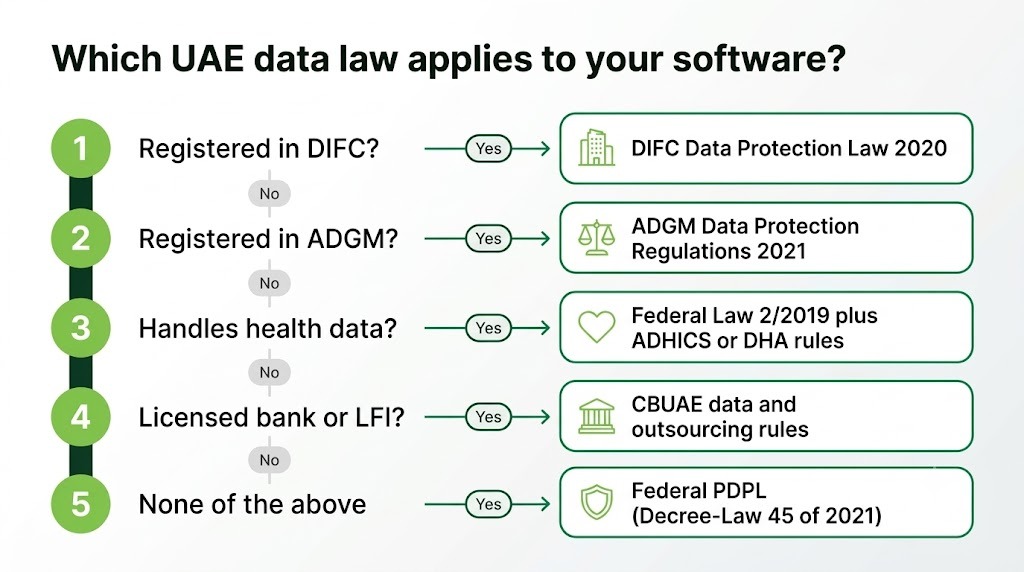
Federal Decree-Law No. 45 of 2021, the PDPL, came into force on 2 January 2022. Several areas sit outside it:
- Government data: Government entities and security or judicial authorities follow other rules.
- Health and banking data: Sector laws apply where they already protect this data.
- DIFC and ADGM entities: Both free zones run their own data protection regimes.
Executive regulations were still unissued in mid-2026, according to Morgan Lewis. No fine amounts appear in the law. Vendor claims of an AED 5 million PDPL fine have no legal source.
Budgets should still fund data inventory, consent records, access limits, retention rules, and breach response. Hosting choices are covered in a guide to PDPL-compliant app development with UAE data residency.
DIFC and ADGM: Two Free-Zone Data Regimes
Both regimes draw on GDPR. Software for entities in either zone needs features that a mainland app may skip:
- Records of processing: The system logs what personal data it holds, why, and who can reach it.
- Impact assessments: Profiling or AI decisions need a DPIA before launch.
- Breach alerts: ADGM expects notice within 72 hours, so monitoring must surface incidents fast.
DIFC’s law sets per-contravention maximums of about AED 92,000 to AED 367,000, plus a general fine.
Arabic and English Localization Beyond Translation
CSA Research found that 76% of consumers prefer product information in their own language. Translation is the smallest part of a bilingual build:
-
Right-to-left layout
W3C guidance sets direction on the HTML tag, never through CSS, so icons and navigation mirror.
-
Bidirectional text
Arabic sentences with English names, numbers, or emails need isolation to stay in order.
-
Dates and numbers
Hijri dates, Arabic-Indic digits, and AED formatting change per user setting.
-
Arabic search
Queries must match words with and without diacritics.
-
PDFs and reports
Invoices and exports must render Arabic glyphs and right-to-left tables.
Adding Arabic after design reopens navigation, layouts, and every test script. The same rules apply to an Arabic-first chatbot build for UAE customers.
Do UAE Businesses Need UAE Data Residency?
Data residency is a legal requirement for banks, healthcare, and Dubai government systems. Many other companies choose UAE regions for latency, client contracts, or board comfort.
| Provider | Region | Location | Availability zones |
| Microsoft Azure | UAE North | Dubai | Three |
| Microsoft Azure | UAE Central | Abu Dhabi | None, restricted access |
| AWS | me-central-1 | UAE, city not stated | Three, opt-in |
| Oracle Cloud | UAE East and UAE Central | Dubai and Abu Dhabi | One domain each |
| Google Cloud | No UAE region | Doha and Dammam | Outside the UAE |
Itemized Custom Software Development Cost Breakdown by Phase
An AED 300,000 build spends its largest share on backend logic and integrations. The allocation that follows is an illustrative budgeting model.
-
Discovery and architecture (12%)
Workshops, user journeys, and integration checks produce a fixed, costed scope.
-
UX/UI design (12%)
Wireframes and a bilingual design system get approved before coding starts.
-
Frontend development (22%)
Developers build screens, RTL layouts, and accessibility fixes.
-
Backend and integrations (28%)
APIs, business rules, and every third-party connection sit here.
-
QA and security testing (16%)
Tests run in both languages, alongside a vulnerability scan.
-
Deployment and handover (10%)
Production setup, monitoring, and documentation close the build.
| Phase | Share | Example amount (AED) |
| Discovery and architecture | 12% | 36,000 |
| UX/UI design | 12% | 36,000 |
| Frontend development | 22% | 66,000 |
| Backend and integrations | 28% | 84,000 |
| QA and security testing | 16% | 48,000 |
| Deployment and handover | 10% | 30,000 |
Hosting, licences, VAT and maintenance sit outside this model. A contingency reserve of 10% to 15% belongs on top.
What Will Custom Software Cost Over Three Years?
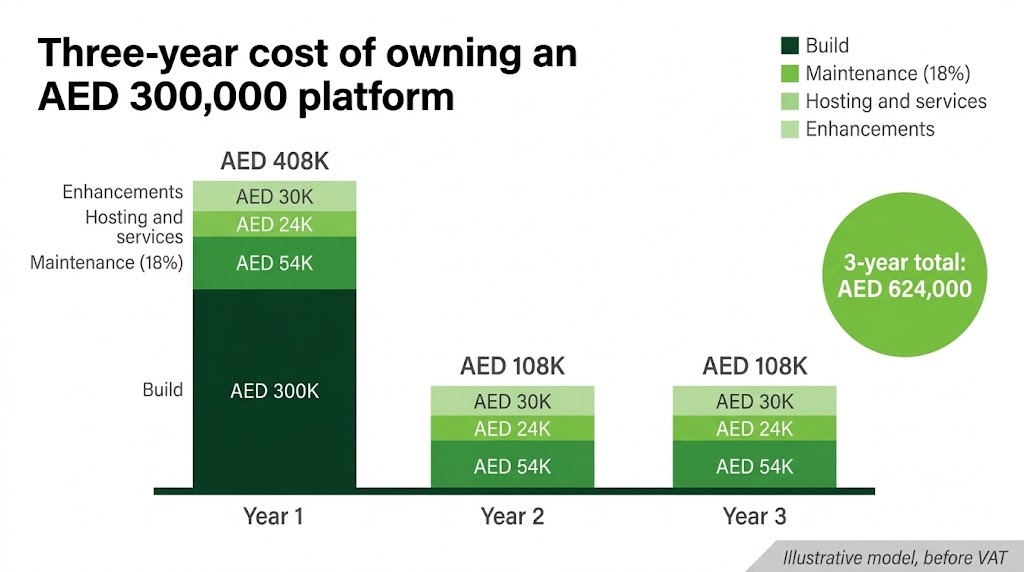
A custom platform built for AED 300,000 can cost about AED 624,000 to own over three years. Maintenance, hosting, and planned enhancements make up the difference in this illustrative model.
Worked Three-Year TCO for an AED 300,000 Platform
Four stated assumptions drive the model, and each can be swapped for a real quote.
- Maintenance at 18%: AED 54,000 a year covers bug fixes, security patches, and library updates.
- Hosting and services: AED 2,000 a month pays for cloud, monitoring, SMS, and map APIs.
- Enhancements: AED 30,000 a year funds features users request after launch.
- Taxes: VAT sits outside the totals and gets its own section.
| Cost component | Year 1 (AED) | Year 2 (AED) | Year 3 (AED) |
| Initial development | 300,000 | 0 | 0 |
| Maintenance (18%) | 54,000 | 54,000 | 54,000 |
| Hosting and services | 24,000 | 24,000 | 24,000 |
| Enhancements | 30,000 | 30,000 | 30,000 |
| Annual total | 408,000 | 108,000 | 108,000 |
The 18% figure is a planning heuristic, since no primary study sets an annual maintenance rate. Robert Glass’s IEEE Software research found maintenance consumes 40% to 80% of lifetime software cost. At 10% maintenance, three-year ownership falls to AED 552,000. A 25% rate lifts it to AED 687,000.
VAT and Reverse Charge: The Tax Lines Buyers Miss
VAT applies at 5% to software development services. Registered buyers recover it, while VAT-exempt firms carry it as a real cost.
Offshore vendors do not charge UAE VAT, and buyers self-account under the reverse-charge mechanism.
Custom Software vs Off-the-Shelf SaaS: Where Is the Break-Even?
SaaS wins on speed, and its cost grows with every seat. Zylo’s 2026 research found companies use 54% of their licences, leaving 46% idle.
Take AED 624,000, subtract an assumed AED 60,000 SaaS implementation, then divide by 36 months. Above about AED 15,700 a month all-in, SaaS costs more than the custom platform over three years.
At 150 users, that threshold equals about AED 105 per user per month.
What Happens When the Original Developer Leaves?
Vendor exits turn into budget problems when nobody else can run the system. A handover clause should name four deliverables:
- Source code and history: The full repository sits in an account the client owns.
- Infrastructure ownership: Cloud accounts, domains, and app store listings belong to the client from day one.
- Automated tests: A test suite lets a new team change code without guessing what breaks.
- Runbooks: Deployment steps, backup restores, and design decisions are written down.
Need a three-year cost model your CFO can test line by line before approving the build?
Why Do Software Projects Go Over Budget in the UAE?
McKinsey and Oxford studied more than 5,400 IT projects. Large ones ran 45% over budget and delivered 56% less value than planned.
PMI found scope creep in 52% of completed projects. Six failure mechanisms recur in UAE projects, and each one can be priced before signing:
-
Late compliance
Audit logs or in-UAE hosting added after database design force rework across data models and APIs. A regulator named during discovery costs far less than one found at acceptance testing.
-
Unscoped integrations
A line saying “integrate with ERP” hides undocumented APIs and slow access approvals. Sandboxes that do not match production add another round of fixes.
-
Deferred Arabic
Treating Arabic as a late translation task means mirroring layouts, rebuilding navigation, and rerunning every test. That rework lands when budgets have the least room.
-
Uncontrolled change
Each change request needs an impact note on hours, cost, and timeline before approval. Without that step, small additions pile up into the scope creep PMI measured.
-
Demo-grade delivery
A demo shows features working on a good day. Monitoring, backups, tested recovery, and load testing are what production needs, and cheap quotes leave them out.
-
No post-launch owner
Security patches, release management, and cloud bills need a named owner. With no support contract, those tasks fall to whoever still answers email.
Fixed Price, Time and Materials or Dedicated Team: Which Pricing Model Fits?
Fixed price works when scope is stable, and time and materials fits evolving requirements. A dedicated team makes sense for continuous product work.
No model protects the buyer by itself. A fixed price helps when exclusions and the change process are written down. Teams that hire dedicated developers in Dubai should track idle capacity each sprint.
Hybrid contracts price paid discovery as a fixed phase. The build then moves to fixed price or time and materials. That route suits enterprise buyers whose requirements firm up during workshops.
| Model | Fits when | Budget risk to examine |
| Fixed price | Scope and acceptance criteria are stable | Exclusions and change-request rates |
| Time and materials | Requirements are still evolving | Uncontrolled hours |
| Dedicated team | Product work runs a year or more | Idle capacity and turnover |
| Hybrid | Discovery is uncertain; later phases can be scoped | Pricing changes between phases |
What Should a UAE Software Development Contract Include?
The contract carries more budget protection than the pricing model. Eight clauses matter most:
- Milestones and deliverables: Each payment ties to a working output the client can test.
- Acceptance criteria: Written pass conditions decide when a milestone is complete.
- Change-request procedure: Added scope goes through an impact note and written approval.
- IP ownership: All code and designs transfer to the client on payment.
- Warranty period: Defects found in the first 60 to 90 days get fixed at no charge.
- Support response times: Severity levels map to response targets in hours.
- Exit assistance: Handover help is priced upfront, so a vendor exit does not stall operations.
- Governing law: The clause names onshore courts, DIFC Courts or ADGM Courts.
How Do You Compare Quotes From a Custom Software Development Company in Dubai or Abu Dhabi?
Comparable quotes come from one written brief sent to every vendor. Scoring each proposal against the same weighted criteria then exposes scope gaps hidden inside low prices.
Prepare a Scope Document Before Contacting Vendors
A short brief removes most of the guesswork vendors price in as risk. It should cover:
- Business outcome: The metric that proves success, such as invoice cycle time.
- Users and permissions: Every role and what each can approve.
- Integrations: Each system to connect and whether API documentation exists.
- Data migration: Sources, record counts, and known quality issues.
- Arabic and accessibility: Languages at launch and the WCAG level required.
- Security and hosting: The regulator, hosting region, and audit evidence expected.
That brief, sent to each custom software development company in Dubai on the shortlist, sets an equal baseline.
Score Proposals With a Weighted Matrix
Price alone hides scope gaps, so a weighted scorecard turns proposals into comparable numbers.
| Criterion | Weight |
| Scope coverage | 25% |
| Technical approach and integration plan | 20% |
| Security and applicable compliance | 15% |
| Delivery plan and team | 15% |
| Three-year ownership cost | 15% |
| Support and exit terms | 10% |
What Are the Red Flags in a Low Software Development Quote?
A low bid can be honest, since some vendors run leaner teams. Five signs suggest the scope does not match:
- Missing discovery and testing. The quote jumps straight to development.
- Vague integration count. “API integrations as needed” leaves every connection open to change requests.
- Unclear code ownership. Vendor-held repositories lock the client into one supplier.
- Hidden run costs. Hosting, SMS, maps, and licences are excluded without saying so.
- Unnamed team. The vendor cannot say who will lead the build.
A wider checklist appears in a guide to shortlisting an AI app development company in Dubai.
Will AI Make Custom Software Cheaper in 2026 and 2027?
AI coding assistants speed up routine code, yet review, testing, and integration still set most of the bill.
Gartner expects 90% of enterprise developers to use AI code assistants by 2028. Speed and stability do not move together, though. Google’s 2024 DORA report linked a 25% rise in AI adoption with 7.2% lower delivery stability.
Stack Overflow’s 2025 survey found 84% of developers using or planning to use AI tools. Almost half, 46%, distrust the accuracy of the output.
Token spending adds a new budget line. Gartner predicts AI coding costs will overtake the average developer’s salary by 2028. Buyers planning enterprise AI development in Dubai should ask how AI-assisted code is reviewed.
How Code Brew Labs Builds Production-Ready Custom Software Within Agreed UAE Budgets
Code Brew Labs builds compliance-led custom software for UAE enterprises, government-adjacent entities, and high-growth companies in both emirates. Regulators, integrations, and three-year run costs are priced in discovery, before sprint one.
Our work spans AI, finance automation, and customer platforms, each tied to a measured result. A national flag carrier’s AI concierge resolves passenger requests 60% faster.
Kaizan AI turns plain-English questions into charts and produces reports 70% faster. AW Rostamani’s AWR Connect app recorded 40% faster service booking for vehicle owners.
Our MCP Nexus framework for governed AI-assisted coding delivered releases 35% faster with 40% fewer defects. Every build also maps to the rules that govern its data.
Those include the federal PDPL, DIFC and ADGM law, ADHICS, CBUAE outsourcing rules, and DESC’s ISR. Arabic right-to-left design and WCAG 2.1 AA checks enter the backlog in sprint one.
Whether the brief needs a budget audit, an ERP roadmap, or a product squad, estimates arrive itemized. Our custom software development team in Dubai then replaces spreadsheet workarounds with software leadership can measure.
Holding two quotes that look alike but sit AED 200,000 apart on the final page?
What Should a UAE Business Budget for Custom Software in 2026?
Most UAE businesses should budget AED 100,000 to AED 300,000 for an integrated platform. Running it adds about 30% to 40% of the build cost each year.
Location matters least of all the inputs, while regulator, integration depth, and exit terms matter most. With one brief and one scorecard, the gap between two quotes stops being a mystery.
Frequently Asked Questions
How much does custom software development cost in Dubai in 2026?
Custom software development in Dubai costs about AED 25,000 to AED 1 million plus in 2026. Integrated business platforms tend to land between AED 100,000 and AED 300,000.
Is custom software development cheaper in Dubai or Abu Dhabi?
Neither emirate is cheaper by default. Office rents differed by about AED 2 per sq ft in Q2 2026. Budgets split on regulations, such as ADGM rules, ADHICS, and sovereign cloud.
What is the minimum budget for a custom business application in the UAE?
A focused internal tool with one main workflow needs about AED 25,000 to AED 60,000. Customer-facing apps with payments and Arabic interfaces start higher, often above AED 100,000.
How much does an MVP cost compared with a production-ready platform?
An MVP costs about AED 40,000 to AED 120,000. A production-ready platform with monitoring, backups, and several integrations costs AED 100,000 to AED 300,000 or more.
What affects software development hourly rates in the UAE?
Seniority, delivery model, and onsite needs set the rate. An all-UAE team costs the most per hour, and a distributed team the least.
How much does a custom ERP or CRM cost?
A custom CRM runs about AED 80,000 to AED 300,000. Custom ERP estimates range from about AED 150,000 to over AED 1 million, depending on modules and migration.
How much should businesses budget for annual maintenance?
Plan for 10% to 25% of the build cost each year. An AED 300,000 platform at 18% needs about AED 54,000 a year, with hosting on top.
Does software development cost include hosting and third-party licences?
In most UAE quotes, no. Hosting, APIs, payment gateway fees, and SaaS licences sit outside build estimates unless a vendor lists them.
Do UAE businesses always need UAE-based data hosting?
No single rule covers every business. Banks and healthcare providers face in-country storage rules. Many other firms choose Azure UAE North or AWS me-central-1 by preference.
How do Arabic and English interfaces affect development costs?
Bilingual builds add work for right-to-left layouts, bidirectional text, Arabic search, and PDF output. Designing Arabic in from sprint one keeps that cost contained.
Is a local software development company better than a hybrid or offshore team?
Local teams handle workshops, security reviews, and government onboarding with less friction. Hybrid teams pair a UAE-based architect with distributed developers to lower blended rates.
What should be included in a software development contract?
A sound contract covers acceptance criteria, change requests, IP ownership, warranty, support response times, and exit assistance. It also names the onshore courts, DIFC Courts, or ADGM Courts.
Let's Convert Your Business Idea Into Success!
Free Consultation from Top Industry Experts
Let’s Build Your Dream App!
Share article on :



 No commitment required
 NDA on request
 24-hour response


