
Quick Summary:
- A logistics management system connects shipment, inventory, fleet, and carrier data into a single, operational flow.
- UAE enterprises need customs, free-zone, and multimodal support that generic global platforms rarely handle well.
- The UAE freight and logistics market sits near AED 85 billion in 2026, by Mordor Intelligence estimates.
- Build cost in the UAE runs from AED 60,000 for a focused app to AED 1.5 million for an enterprise ecosystem.
- Integration count, more than feature count, drives both cost and project risk.
- PDPL compliance, data residency and audit logging belong in the design, not in a later patch.
- Returns show up in on-time delivery, cost per shipment, fleet utilisation and order-to-delivery time.
- Pilot launch and full rollout are separate milestones, so phase the cutover across routes and depots.
A logistics management system gives UAE enterprises one live view of shipments, inventory, fleets, and carriers. It connects what today runs across separate, disconnected tools. Most large operations still split transport, warehousing, orders, and fleet onto different platforms. Each one holds part of the truth.
So dispatchers chase updates by phone, and finance reconciles freight by hand. Move cargo through Jebel Ali, a free zone and three emirates, and the blind spots cost real margin. The UAE freight and logistics market sits near AED 85 billion in 2026, by Mordor Intelligence estimates.
This guide covers the system types, the core features, and the UAE rules that shape a build. It also walks through integration, an AED cost model, the build process, and how to measure returns. For teams weighing a build now, custom logistics software development in Dubai starts with these same decisions.
Planning a logistics platform that works across UAE ports, free zones, and customs corridors?
What is a logistics management system?
A logistics management system is software that coordinates the movement, storage, and delivery of goods. It links shipment planning, transport execution, inventory data, tracking, documentation, and operational reporting. Depending on its scope, it may connect to separate transportation, warehouse, fleet, and enterprise resource planning systems.
The purpose stays practical. An enterprise wants one place to plan a shipment, assign a carrier, watch it move, prove delivery, and reconcile the cost. When that happens inside a single platform, exceptions surface early, and decisions get faster.
Logistics management system vs logistics management information system
These two terms get mixed up often. A logistics management information system collects, processes, reports, and analyses logistics data. It exists to inform decisions, not to run the operation.
A broader logistics management platform does both. It executes the workflow and reports on it. Many enterprise products combine the two functions under one roof, which is why buyers should ask vendors to separate execution capability from reporting capability.
How does it differ from supply chain management software?
Supply chain management covers a wider set of processes. It can reach into sourcing, procurement, demand planning, and production. Logistics management stays closer to the physical flow of goods: how they move, where they rest, and when they arrive.
Think of logistics as the execution layer inside the larger supply chain picture. The global supply chain management market reached USD 25.67 billion in 2024 and should hit USD 48.59 billion by 2030, per Grand View Research.
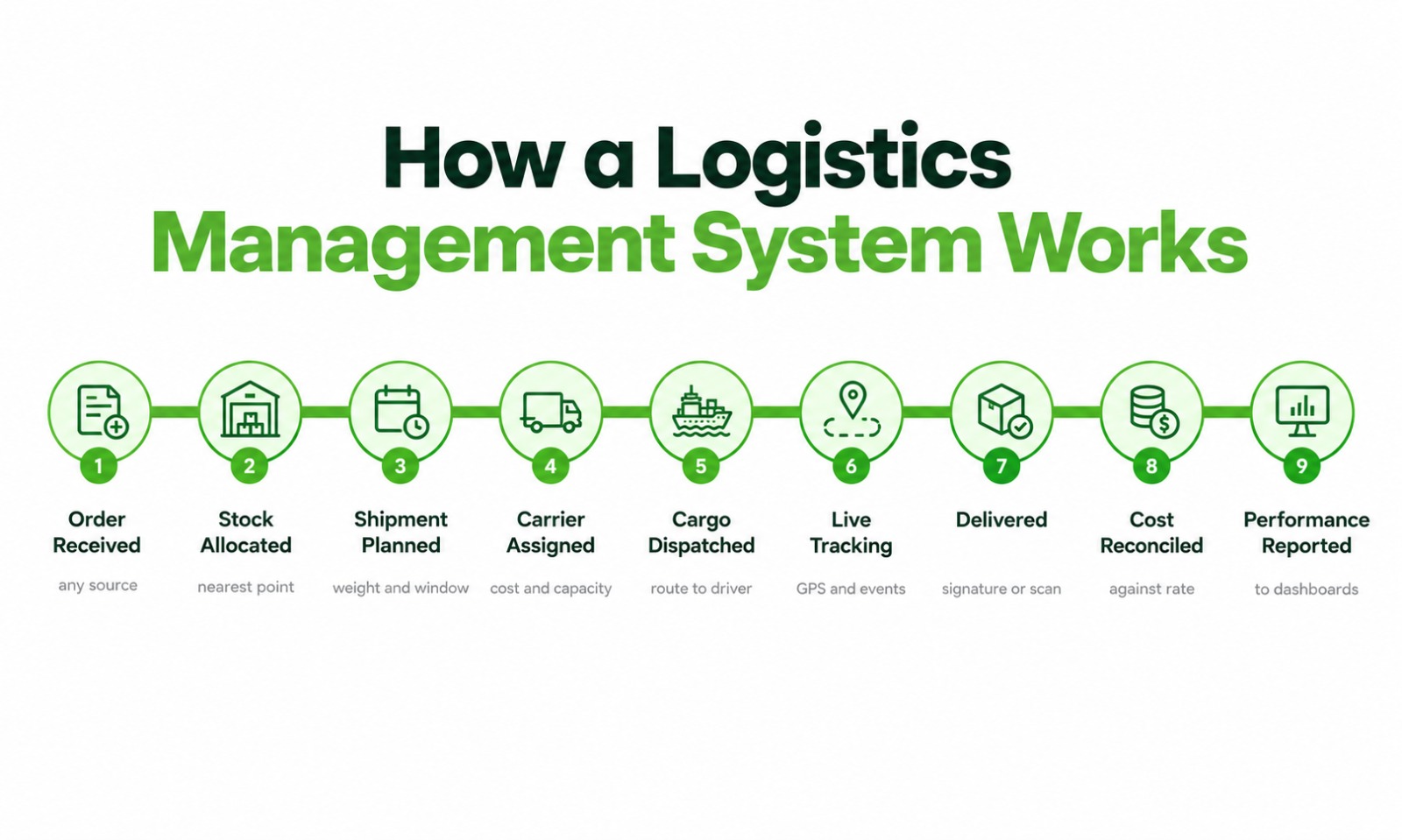
How a logistics management system works
An order sets off a chain of events, and the platform ties those events together. Seeing the sequence helps a buyer judge what the software must own at each stage. The flow splits into four phases.
Order intake and allocation
-
Order capture
An order arrives from a customer, an e-commerce store, or the ERP. The platform logs it in one place, whatever the source.
-
Availability check
The system confirms stock or cargo availability before committing. It then reserves what the order needs.
-
Allocation
The order gets assigned to the right warehouse, branch, or cargo pool. Nearest and fastest usually wins.
Planning and carrier selection
-
Shipment planning
A plan forms around weight, volume, delivery window, and destination. Constraints get checked up front, not at the dock.
-
Carrier or vehicle selection
The platform picks a carrier or assigns a vehicle based on cost, capacity, and service level. The cheapest reliable option beats the cheapest option.
-
Route building
Multi-stop routes get sequenced for distance and delivery windows. Load plans match the vehicle to the cargo.
Dispatch and live tracking
-
Dispatch
The driver receives the route and the paperwork on a mobile app. No printed manifests, no phone calls.
-
Tracking
GPS and carrier events feed a live view of the shipment. The ETA recalculates as traffic and conditions shift.
-
Exception alerts
Delays, route deviations, and failed attempts raise a flag. The right person sees it while there is time to act.
Proof, reconciliation and reporting
-
Proof of delivery
On arrival, the driver captures a signature, a photo, or a scan. The record closes against the order.
-
Freight reconciliation
The cost gets matched to the contracted rate. Disputes shrink because the numbers already agree.
-
Performance reporting
Every step writes a record, and those records flow into dashboards. Operations and finance read the same truth.
Each record feeds the next decision. That loop, running across thousands of shipments, is the real work of the platform.
What are the types of logistics management systems?
Buyers rarely need one monolithic tool. They need the right combination of systems for their operation. Each type owns a distinct job, and most enterprises run two or three of them together. The descriptions below explain what each one does and who depends on it.
Transportation management system (TMS)
This plans transport, selects carriers, and controls freight cost. It runs dispatch, rate management, and multi-stop routing against capacity. Manufacturers and distributors rely on it to move volume at the lowest reliable cost.
Warehouse management system (WMS)
This runs the facility itself: receiving, put-away, picking, packing, and dispatch. It tracks stock location down to the bin and directs labour across shifts. Fulfilment centres and 3PLs depend on it for accuracy and throughput.
Fleet management system (FMS)
This keeps vehicles tracked, maintained, and well used. It pulls telematics for location, fuel, and engine health, then schedules servicing before breakdowns. Fleet owners use it to cut downtime and extend asset life.
Cargo logistics management system
This handles bookings, consignment records, and shipment milestones for freight forwarders. It manages documentation and multi-leg journeys across sea, air, and road. Cargo agents rely on it to keep every consignment traceable.
Order and delivery management system
This allocates orders, schedules deliveries, and captures proof of delivery. It also runs returns and reverse flows. Retailers and last-mile firms use it to hit delivery promises.
Yard and dock management system
This controls gate appointments, vehicle queues, and dock scheduling. It removes the waiting that clogs busy sites. Distribution centres and industrial facilities use it to keep trucks moving.
Supply chain control tower
This sits above the other systems for cross-system visibility, alerts, and risk. It watches the operation rather than running it. Enterprises with many partners use it to catch problems while there is time to act.
Logistics management information system
This collects, processes, and analyses logistics data for decisions. It reports instead of executing. Operations and supply chain leaders use it to see patterns across cost and performance.
| System type | Primary job | Who relies on it |
| Transportation Management System (TMS) | Transport planning, carrier selection, freight cost | Manufacturers, distributors, freight operators |
| Warehouse Management System (WMS) | Receiving, picking, packing, stock movement | Warehouses, fulfilment centres, 3PLs |
| Fleet Management System (FMS) | Vehicle tracking, maintenance, utilisation | Fleet owners, delivery operators |
| Cargo Logistics Management System | Bookings, consignments, milestones, documents | Freight forwarders, cargo agents |
| Order & Delivery Management | Allocation, scheduling, proof of delivery, returns | Retailers, distributors, last-mile firms |
| Yard & Dock Management | Gate slots, vehicle queues, dock scheduling | Distribution centres, industrial sites |
| Supply Chain Control Tower | Cross-system visibility, alerts, risk | Complex multi-partner networks |
| Logistics Management Information System | Data collection, reporting, analysis | Operations and supply chain leadership |
Standalone system or integrated platform?
A focused TMS or WMS works well when one problem dominates. A growing freight business might start with transport planning alone.
The case for a unified platform grows with complexity. When cargo passes through several systems and several hands, an integrated platform prevents the data from splintering. The decision rests on how many handoffs the operation has, and how much they currently cost.
Which type of logistics management system is right for your business?
A 3PL needs multi-client visibility and complex billing. A manufacturer needs tight ERP-linked inbound and outbound flow. A last-mile operator needs dispatch and proof of delivery above all. Match the system to the dominant workflow first, then add the next layer once the first one proves itself.
Why UAE enterprise supply chains should build a logistics management system now
UAE enterprises face a clear timing question on logistics software. Trade volume, new compliance rules, and regional growth all point the same way. Several forces make this the moment to act.
Trade and ecommerce volume keep climbing
- A growing freight base: The UAE freight and logistics market sits near AED 85 billion in 2026, per Mordor Intelligence. More volume strains manual processes faster.
- Ecommerce at scale: UAE online retail reached AED 42 billion in 2025, per EZDubai and Euromonitor. It should reach AED 67 billion by 2030, and order counts outgrow spreadsheets.
- Port throughput to match: Jebel Ali handled 15.5 million TEUs in 2024, its highest since 2015, per DP World. Cargo at that scale needs connected tracking.
Digital trade and compliance are moving fast
- E-invoicing from 2027: National e-invoicing starts on 1 January 2027 for businesses above AED 50 million revenue, per the Ministry of Finance. Freight billing has to feed clean data to the ERP.
- Digital customs: Dubai Customs runs Shahin with satellite tracking and smart seals. MAKASA now moves online through the Dubai Trade portal, so connected platforms clear cargo faster.
- Data protection in force: The PDPL has governed personal data since January 2022. Driver and customer data needs consent, retention, and audit built in.
GCC expansion raises the cost of fragmentation
- Cross-border magnifies gaps: Operators expanding into Saudi Arabia and the wider GCC find every inefficiency multiplied. One connected platform keeps growth from turning into chaos.
- Multi-entity complexity: New branches, warehouses, and markets stretch disconnected tools past breaking. A platform built for scale absorbs them without a rebuild.
The payoff is measurable
- Lower cost per shipment: Route optimisation and load consolidation cut empty miles and fuel. Small savings compound across thousands of movements.
- Fewer blind spots: One live view ends the phone calls to depots. Exceptions surface while there is still time to act.
- Cleaner finance and faster delivery: Billing reconciles against contracted rates. Traffic-aware routing shortens the order-to-delivery cycle, and failed deliveries drop.
The timing favours action. The return still depends on adoption and clean data. Software earns its keep once drivers, dispatchers and warehouse teams use it every shift.
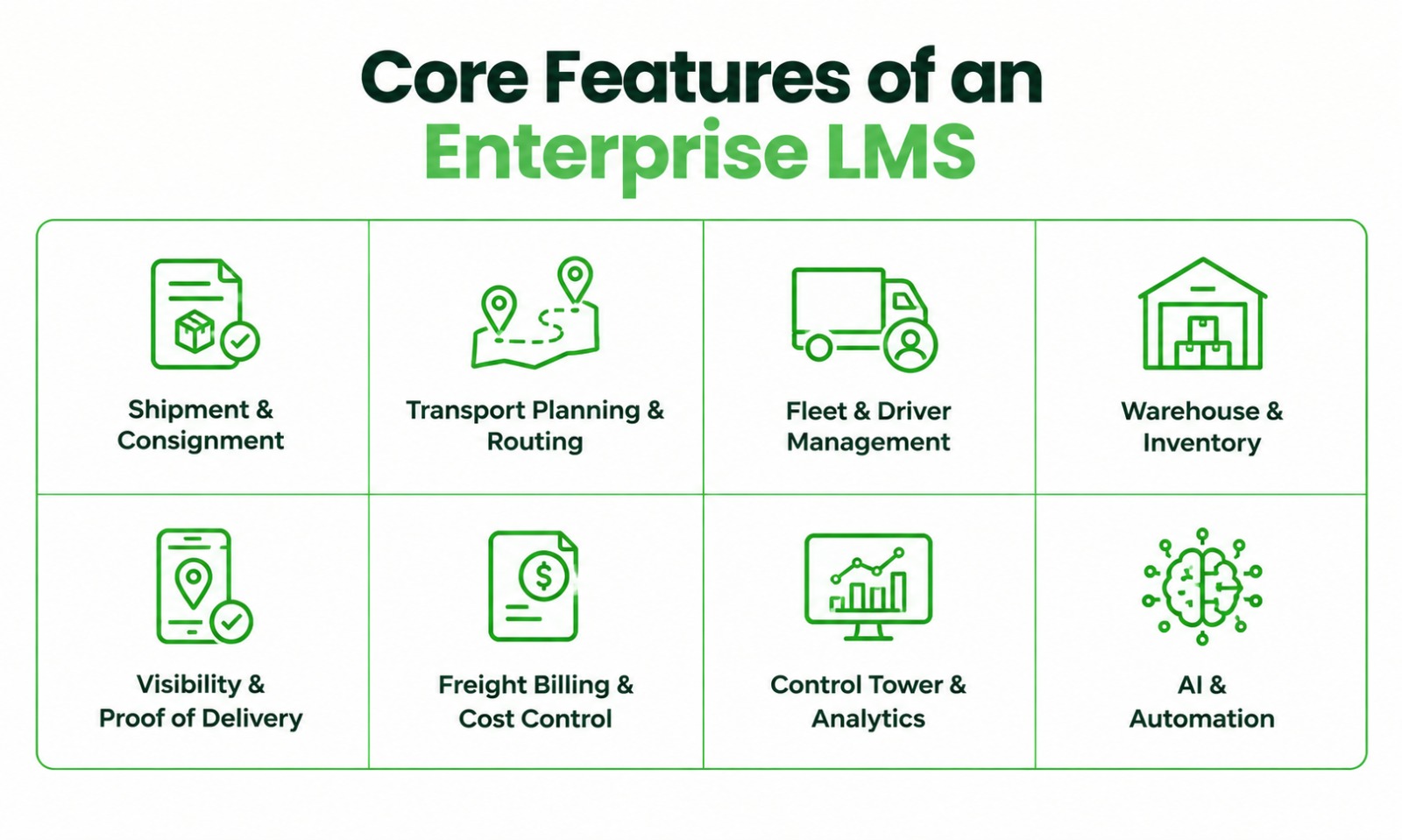
Essential features of an enterprise logistics management system
Features matter most when grouped by the problem they solve. The list below describes what each cluster does and why an enterprise buyer should care.
Shipment and consignment management
Create bookings, assign consignment IDs and track milestones from pickup to delivery. Attach documents for a clear chain of custody. Handle split shipments, consolidation and multi-leg journeys without losing the thread.
Transport planning, dispatch and route optimisation
Assign vehicles and carriers against capacity and delivery windows. Sequence multi-stop routes and recalculate ETAs as traffic shifts. A strong transport and logistics management system turns dispatch from a whiteboard into a live, optimised board.
Fleet and driver management
Pull telematics for location, fuel, and maintenance. Track vehicle utilisation and schedule driver shifts. Give field teams a mobile app that works on the move, including weak-signal zones.
Warehouse and inventory coordination
Watch stock availability and movement in real time. Book dock appointments and align loading with dispatch. Reconcile inventory between the WMS, the ERP, and shipment records so the numbers match.
Real-time visibility and proof of delivery
Track events and milestones as they happen. Capture electronic proof of delivery through signatures, photos, or exception codes. Alert the right people on delays, route deviations, and failed attempts.
Freight billing and cost control
Store carrier rates and contract rules. Generate quotes, apply surcharges, and reconcile invoices. Report profitability by route, customer, shipment, or business unit.
Analytics, dashboards and the control tower
Surface on-time delivery, cost per shipment, and SLA adherence. A control tower adds cross-system visibility, risk alerts and escalation paths above the individual tools. It answers one question fast: what needs attention right now?
AI, automation and predictive logistics
Predict ETAs, score delay risk and forecast capacity. Recommend routes and optimise loads. These gains arrive only where the data is clean, and the use case is measurable, so treat AI as an outcome of good data. Teams exploring this often pair the platform with custom AI software development for logistics once the data foundation holds.
Logistics management system for different industries
No two sectors move goods the same way. The platform that suits a 3PL looks different from the one a hospital network needs. The sections below explain how real UAE verticals use an LMS, and what shapes each build.
Retail and e-commerce fulfilment
UAE online retail has grown fast, reaching AED 42 billion in 2025 and heading toward AED 67 billion by 2030, per EZDubai and Euromonitor. That volume demands order orchestration across warehouses, stores and couriers.
Retailers want split deliveries, fast returns and accurate ETAs at checkout. The system has to reserve stock across locations and route each order to the nearest point that can fulfil it. During peak campaigns, the same engine must scale without dropping orders. Many retailers tie this layer into e-commerce app development in Dubai so the storefront and the fulfilment engine stay in step.
Manufacturing and industrial supply chains
Factories care about inbound and outbound flow in equal measure. Raw materials arrive on schedule, finished goods ship on time, and both tie back to production plans. An LMS here syncs with the ERP for purchase orders and inventory. It coordinates supplier deliveries against line schedules so machines never wait. For UAE manufacturers serving regional markets, it also manages export documentation and GCC movement.
Third-party logistics and freight forwarding
3PLs and forwarders run other companies’ logistics for a living, so visibility is the product. They juggle many clients, carriers, and consignments at once.
A cargo logistics management system gives them booking, consolidation, milestone tracking, and client portals. Each customer sees their own shipments without touching anyone else’s data. Billing complexity runs high, since every client has different rates and accessorial rules.
Distribution and wholesale
Distributors move large volumes to many retail points on tight delivery windows. Route density decides their margin. The platform plans multi-stop routes, manages van loading and tracks proof of delivery at each drop. It also handles returns and credit notes, which run heavy in fast-moving consumer goods.
Food, grocery and quick commerce
Speed and freshness define the food delivery & quick commerce in Dubai. Quick commerce promises delivery in minutes, so dispatch and routing must act in near real time. Cold chain adds a second layer, since temperature has to hold from warehouse to doorstep.
Sensor data and exception alerts protect the goods, and geofencing keeps riders in assigned zones. Operators scaling this model often build on on-demand delivery app development in Dubai to balance load across a live fleet as orders surge.
Healthcare and pharmaceutical logistics
Medicines and medical supplies carry strict handling rules. Some advanced therapies need ultra-low temperatures throughout transit.
The system logs temperature, chain of custody, and batch data for every consignment. Audit trails matter here, because regulators and hospitals both demand proof. A failed cold chain is not a delayed parcel; it is a destroyed product.
Oil, gas and project logistics
Heavy industry moves oversized cargo, spare parts and project equipment across sites and borders. Movements are fewer but far more complex and costly. An LMS tracks high-value assets, coordinates heavy-lift and breakbulk handling, and manages customs for project cargo. Jebel Ali’s dedicated breakbulk and Ro-Ro terminals make the UAE a hub for this traffic.
Government and public sector logistics
Public bodies run fleets, stores and distribution for services from health to municipal work. Data residency and procurement rules shape every decision. These buyers want strong access control, audit logging and local hosting. Integration with national trade and customs platforms often sits at the centre of the brief.
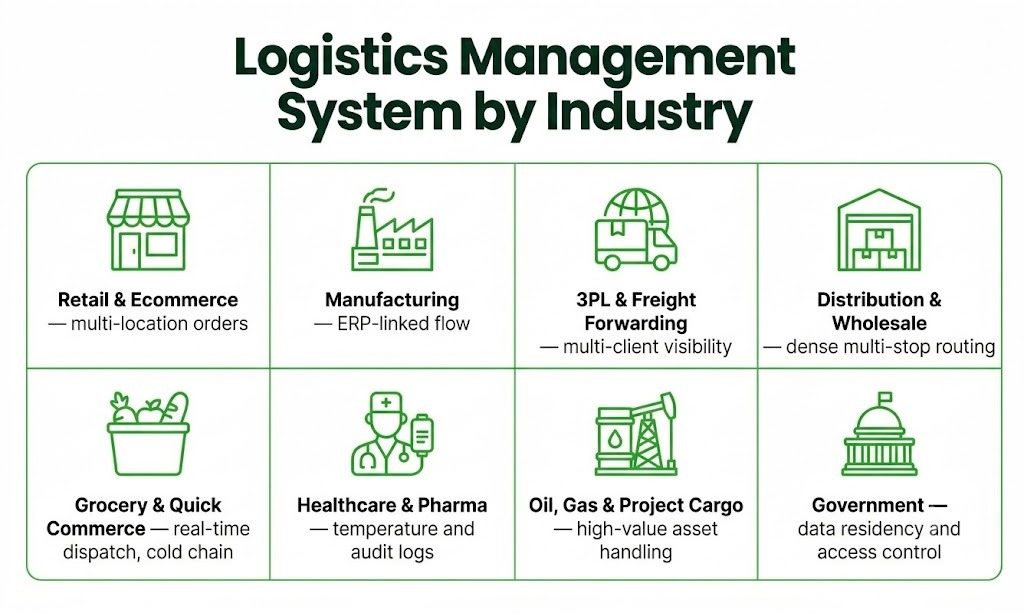
The table below supports the section with a compact view of each vertical’s priority.
| Industry | Primary LMS priority |
| Retail & ecommerce | Multi-location order orchestration and returns |
| Manufacturing | ERP-linked inbound and outbound flow |
| 3PL & freight forwarding | Multi-client visibility and complex billing |
| Distribution & wholesale | Dense multi-stop routing and proof of delivery |
| Food, grocery, quick commerce | Real-time dispatch and cold chain |
| Healthcare & pharma | Temperature logging and audit trails |
| Oil, gas & project cargo | High-value asset and heavy-lift coordination |
| Government | Data residency, access control, customs links |
UAE-specific requirements for logistics software
This is where a UAE build separates from an imported template. The emirates run trade processes that global platforms rarely cover out of the box. Each requirement below reflects a real rule or operating condition, and most shape an enterprise software development for supply chains scope from day one.
Customs and trade-platform integration
Declarations flow through Dubai Customs via the Mirsal 2 system. Dubai Customs also runs Shahin, which uses satellite tracking and electronic smart seals to watch cargo through virtual customs corridors, per the Dubai Media Office. A platform must handle declaration data and status sync, and recognise which exchanges use APIs versus file-based or manual steps.
Multimodal transport across sea, air and land
Dubai connects ports, airports, free zones and road corridors into one trade flow. Jebel Ali Port handled 15.5 million TEUs in 2024, its highest volume since 2015, against a 19.4 million TEU capacity, per DP World. Software has to track handoffs between these modes and show who owns the cargo at each one.
Dubai, Abu Dhabi and free-zone operations
Operations span multiple emirates and free zones with different processes. Jebel Ali and JAFZA anchor a trade ecosystem worth USD 194 billion and handle around 80% of UAE trade, per Gulf News reporting on DP World. A platform needs multi-branch visibility and inter-emirate movement without treating every site as identical.
GCC cross-border and duty offset
Goods moving within the GCC can face duty twice without the right process. MAKASA, the automated transfer of customs duty, prevents that double charge, and it now runs through the Dubai Trade portal. Exporters and re-exporters to Saudi Arabia, Kuwait and beyond depend on it.
Arabic and English interfaces
Dispatchers, drivers and customers work in both languages. The platform should support right-to-left layouts, bilingual documents and localised notifications. Usability for a warehouse team matters as much as the admin console.
Data protection and auditability
The UAE Personal Data Protection Law, Federal Decree-Law No. 45 of 2021, has governed personal data since 2 January 2022, per the UAE government portal. Logistics platforms hold driver details, customer contacts, and location data. Consent, retention, access control, and audit logs all need design attention, with the UAE Data Office as the federal regulator.
VAT, e-invoicing and finance integration
UAE VAT runs at 5% under the Federal Tax Authority, while international transport of goods is zero-rated under the law. National e-invoicing starts on 1 January 2027 for businesses above AED 50 million in revenue, per the Ministry of Finance rollout. Freight billing has to exchange clean data with the ERP to stay compliant.
Want a cost and integration plan built around your current ERP, WMS, and carrier stack?
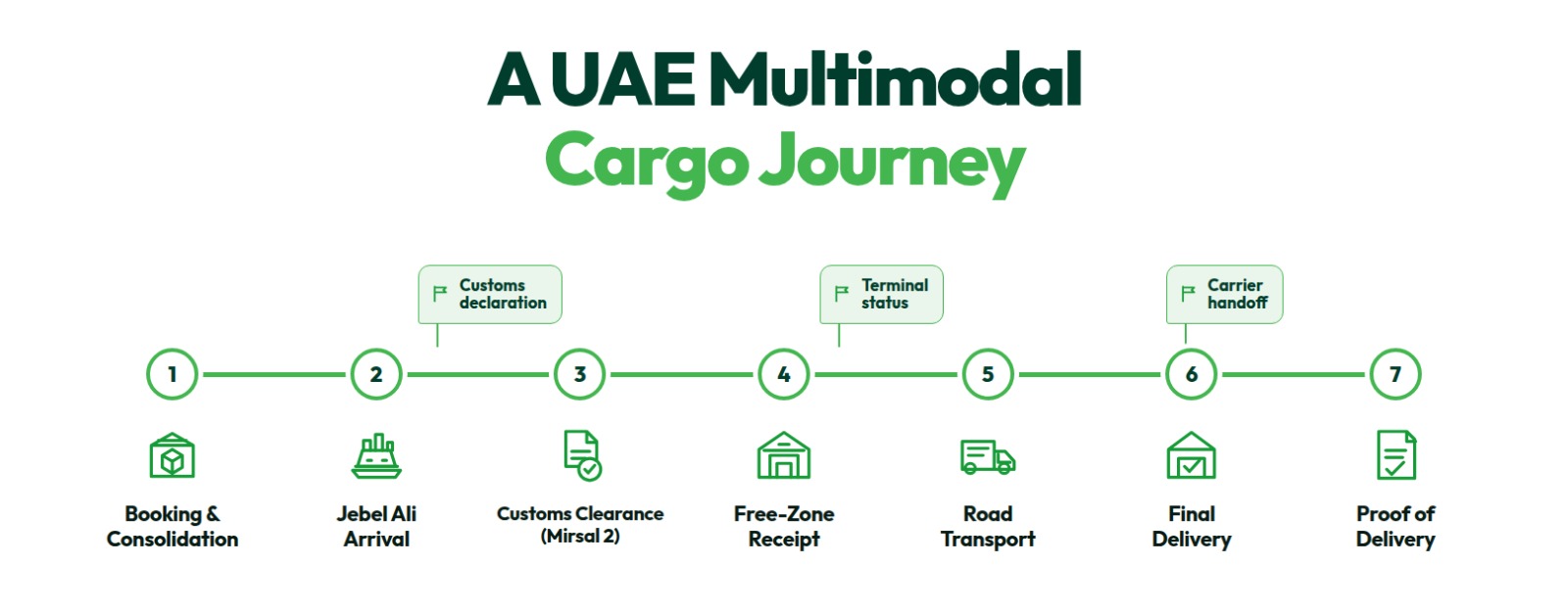
A UAE multimodal cargo journey, end to end
A worked example makes the cargo logistics management system concrete. Picture a consignment arriving by sea for onward delivery inland.
The forwarder books the shipment and consolidates it with other cargo. The vessel berths at Jebel Ali, and the container discharges. Customs clearance runs through Mirsal 2, with documents and duty handled online. The cargo moves into a free-zone warehouse, where it gets received and recorded.
Road transport then carries it to the final site across one or two emirates. The driver captures proof of delivery on arrival. Finance reconciles the freight cost against the contracted rate, and the margin on the job becomes visible.
At three points, external integration earns its keep: the customs declaration, the port or terminal status, and the carrier handoff. Milestone ownership shifts at each boundary, and the platform has to record exactly where responsibility passed. Lose that thread, and a dispute later has no evidence to settle it.
How to integrate a logistics management system with enterprise software
Integration decides whether a platform helps or just adds another screen. The hard questions sit here, not in the feature list. Each integration below carries its own ownership and failure risk.
ERP integration
Orders, inventory, purchase orders, and invoices live in the ERP, often SAP, Oracle or Microsoft Dynamics. The LMS reads and writes against it so finance and operations agree. Done well, one order has one status across both systems.
TMS, WMS, fleet and telematics
Each system owns part of the shipment record. The build must define which one holds the master value and how events flow between them. Without that rule, duplicate shipments and mismatched stock appear within weeks.
E-commerce, CRM and customer service
Orders enter from storefronts, and delivery status flows back to customers and agents. Returns and escalations route to the right team. The customer sees one consistent story from checkout to doorstep.
Customs, carrier, and third-party links
These use a mix of APIs, webhooks, EDI, and secure file exchange. Some partners expose no public API at all. A resilient design plans fallback procedures for when an interface goes dark.
System-of-record ownership and failure modes
Decide early who owns shipment status, inventory quantity, orders, rates, and transactions. Then plan for trouble: duplicate events, stale records, and reconciliation when a feed fails. Recovery logic separates a platform that survives real conditions from one that only works in a demo.
Build, buy or customise
Packaged software, configurable SaaS and custom builds each fit different needs. A hybrid path often wins, with a core product extended where the operation is unique. Custom development is the right call only when no fit-for-purpose product covers the requirement.
Logistics management system architecture and technology stack
Architecture choices shape scalability, reliability, and lifetime cost. A buyer should grasp the big decisions, even without the engineering detail.
Core system components
The platform usually splits into layers that scale on their own. An operations console serves planners and managers. Mobile apps serve drivers and field teams. Portals serve customers and carriers. Behind them sit backend services, a database, an integration layer, and analytics.
Deployment: cloud, on-premises, or hybrid
Deployment comes down to three options. Cloud brings elastic capacity and faster rollout. On-premises or hybrid suits buyers with strict data-residency needs. For UAE government and regulated enterprises, local hosting often moves from preference to requirement.
Real-time data and event processing
Real-time data runs on event processing. Location updates and milestones stream through message queues and get handled without blocking. REST and GraphQL APIs connect the services, and microservices keep one failure from taking down the whole system.
Security and resilience
Security wraps all of it. Role-based access, encryption, secrets management, and backups protect the data. Disaster recovery and defined recovery objectives keep the operation running when something breaks. Audit trails record who did what, which the PDPL and enterprise buyers both expect.
The table below supports the sub-sections with a view of a common stack.
| Layer | Example technologies | What it handles |
| Frontend | React, Angular, TypeScript | Operations console and web portals |
| Mobile | React Native, Flutter, Kotlin, Swift | Driver and field apps, offline capture |
| Backend | Node.js, Java, Python, .NET | Core services and business logic |
| Data | PostgreSQL, MongoDB, Redis | Transactional storage and caching |
| Events | Apache Kafka, RabbitMQ | Live location and milestone streams |
| Integration | REST, GraphQL, EDI, webhooks | ERP, carrier and customs connections |
| Cloud & infra | AWS, Azure, GCP, Docker, Kubernetes | Hosting, scaling and deployment |
| Analytics & AI | BigQuery, TensorFlow, PyTorch | Dashboards, forecasting, optimisation |
How much does it cost to build a logistics management system in the UAE?
The cost of developing a logistics app depends on scope, and vague ranges help no one. The bands below are our scope-based planning framework, grounded in UAE project experience and stated in AED. They are estimates for planning, not fixed quotes.
A focused application that records shipments, runs basic dispatch, and shows dashboards starts near AED 60,000. A mid-level platform with fleet workflows, routing, a customer portal, and a few integrations moves into the low hundreds of thousands.
An advanced enterprise platform with many modules and deep integrations climbs higher. A full enterprise-wide ecosystem with multi-entity operations and governance sits at the top. Most of this is a custom software development in Dubai decision before it is a budget line.
The table supports these figures with scope and timeline for each tier.
| Project tier | Indicative budget (AED) | Timeline | Typical scope |
| Focused logistics application | 60,000–120,000 | 2–3 months | Shipment records, basic dispatch, tracking, dashboards |
| Mid-level logistics platform | 120,000–300,000 | 3–6 months | Fleet workflows, routing, customer portal, selected integrations |
| Advanced enterprise platform | 300,000–600,000+ | 6–10 months | Multiple modules, complex integrations, analytics, multi-branch |
| Enterprise-wide ecosystem | 600,000–1,500,000+ | 9–15+ months | Multi-entity operations, advanced optimisation, governance |
What affects the cost most?
Integration count tops the list. Every external system adds design, testing and maintenance work, so three integrations cost far more than one. Real-time tracking, telematics and offline mobile raise the figure too.
Data migration from messy legacy records often surprises buyers, since cleaning takes longer than expected. Arabic localisation, AI agents and automation, and strict security each add scope.
Hidden and ongoing costs
The build is only part of the number. Cloud infrastructure, maps and routing APIs, telematics connectivity and messaging all bill monthly. Monitoring, support SLAs and upgrades continue for the life of the system. A realistic total cost of ownership spans three to five years, and a low build cost does not guarantee a low total. Plan for the running cost before the budget gets signed off.
Step-by-step process to build a logistics management system
A phased process keeps a live supply chain running while the new platform comes in. These eight steps describe what each stage delivers. Teams that treat building a logistics management platform in the UAE as a phased programme, not a big-bang launch, tend to land it without disruption.
1. Audit the current workflows
Map the order-to-delivery flow, the handoffs, and the manual workarounds. Find where data gets re-keyed and where exceptions pile up. This audit sets the baseline you will measure against later.
2. Define the requirements
Agree on user roles, volumes, integrations, availability needs, and acceptance criteria. Separate the must-haves from the nice-to-haves before a single screen gets designed.
3. Choose the approach
Decide what to buy, configure, customise, or build. Pick the deployment model against your data-residency position.
4. Design the architecture and experience
Create the data models, interface flows, API contracts, and security controls. Design for the dispatcher and the driver, not only the admin.
5. Build the core and migrate data
Develop the critical workflows first. Clean and migrate master data for customers, products, warehouses, vehicles, routes, and carriers. Dirty data breaks a good system faster than any bug.
6. Test operational scenarios
Run integration, load, security, and reconciliation tests. Check offline behaviour and user acceptance against real cases, not happy paths.
7. Pilot on a controlled scope
Launch on one route, warehouse, or business unit. Run it in parallel with the old process, then cut over depot by depot once it holds.
8. Roll out in phases and optimise
Expand across the operation while watching KPIs, incidents, and adoption. Pairing rollout with AI automation for logistics operations in Dubai works best once the core workflows are stable.
Implementation best practices
The process above succeeds or fails on execution. These practices come from logistics builds that reached production and stayed there.
Start with one module on live operations
Prove value on real freight before expanding. A working tracking portal that drivers trust beats a half-built platform that no one uses.
Involve the people who will use it
Dispatchers, drivers, and warehouse staff know where the real friction sits. Bring them in during design, and adoption climbs after launch.
Clean the data before migration
Reconcile customer, vehicle, route, and carrier records up front. Validate them in a parallel run so errors surface in testing.
Plan the exceptions and the fallbacks
Decide what happens when an integration fails, or a delivery goes wrong. Manual fallbacks keep the operation moving while the system recovers.
Measure business outcomes
A finished sprint is not a result. Track on-time delivery and cost per shipment, so the platform earns its budget in numbers.
Train for roles, then support the transition
Give each role a workflow it can learn in a shift. Keep support close during cutover, when old habits and new tools collide.
How long does logistics management system development take?
Timeline tracks scope, and the two move together. A focused operational app can reach production in two to three months. A multi-module platform with integrations runs three to six months. A complex enterprise implementation with migration and rollout spans nine to fifteen months or more.
Several factors stretch a schedule. Integration surprises top the list, since a partner system rarely behaves as its documentation claims. Dirty data, scope creep, and slow procurement all add weeks. Low user involvement shows up late as rework.
A pilot launch is not the finish line. Getting one route live proves the concept. Rolling out across every depot and market is a separate milestone with its own risk, so plan them as two distinct phases.
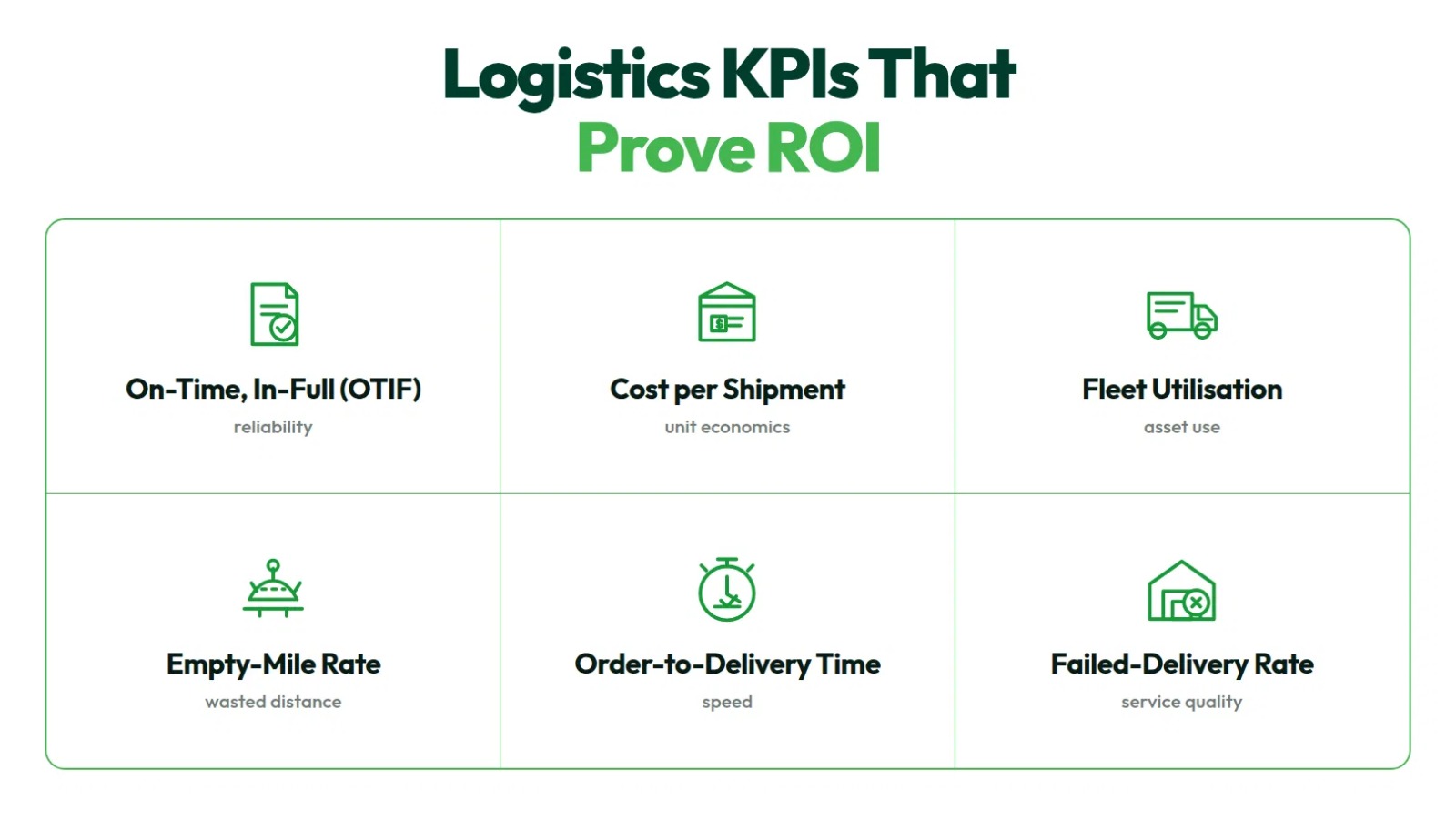
How to measure logistics management system ROI
A platform has to pay for itself in measurable terms. Round claims like “cuts cost by 40%” help no one. Build the case on before-and-after indicators you already track.
Core operational KPIs
Watch on-time, in-full delivery, cost per shipment, and cost per delivery. Track vehicle utilisation, empty-mile rate, and order-to-delivery cycle time. Add failed-delivery rate and warehouse dispatch time for a full picture.
Calculating expected ROI
Take the annual savings from lower freight cost, fewer failed deliveries, and reduced manual effort. Divide the net gain by the total investment, including the running cost. A worked example with labelled AED figures keeps the maths honest.
Measuring after go-live
Compare the baseline against results at 30, 60 and 90 days. Adjust for seasonality and shipment-volume changes, so a quiet month does not flatter the numbers. Real gains hold across quarters, not just launch week.
Common mistakes to avoid when building logistics software
Most failed builds share the same handful of errors. Spotting them early protects budget and credibility.
- Automating a broken workflow. Software built on a messy process preserves the mess. Redesign the workflow first, then build it.
- Underestimating integration and data cleaning. Both run deeper than they look. Scope them early, or they wreck the timeline.
- Trusting tracking data blindly. Check how often each feed updates. Stale data produces confident, wrong ETAs.
- Building everything before proving value. A long feature list drains budget on things no one uses. Ship the core, then expand.
- Ignoring frontline adoption. Drivers and dispatchers decide whether the system lives. Leave them out, and it sits idle.
- Skipping exception handling. The first real problem needs a path to resolution. Plan the fallbacks before launch.
- Measuring code shipped, not outcomes. A finished sprint hides whether the operation improved. Track business KPIs instead.
The future of enterprise logistics management systems
The next phase of logistics software leans hard on prediction and autonomy. UAE enterprises sit well placed to adopt it, given the trade volume and the appetite for digital trade.
From tracking to prediction
Platforms move past showing where cargo is toward forecasting where it will stall. Predictive ETAs and delay-risk scoring let teams act before a problem spreads. Prescriptive analytics then suggests the fix, not just the alert.
Control towers as standard
The cross-system control tower shifts from enterprise luxury to baseline expectation. It gives one risk-aware view across every partner and mode. More mid-size operators will run one as the tooling matures.
AI agents in dispatch
Automated agents will handle routine dispatch and exception triage under human oversight. They take the repetitive decisions, so planners focus on the hard ones. Adoption will stay cautious until trust and data quality catch up.
Deeper customs digitisation
Dubai Customs keeps extending digital trade through systems like Shahin and the Dubai Trade portal. Platforms that plug into these channels gain a real edge in clearance speed. The direction is set, and it favours connected software.
Autonomous and drone delivery
Pilots for autonomous vehicles and drone delivery continue across the region. These will reshape last-mile economics over time, though regulation and infrastructure set the pace. Build for an architecture that can absorb them later.
The global transportation management system market reflects this momentum, rising from USD 18.5 billion in 2025 toward USD 37 billion by 2030, per MarketsandMarkets. Enterprises that build on a flexible core will adopt each shift without a rebuild.
How to choose a logistics software development partner in the UAE
The partner decision carries as much weight as the feature list. The right firm understands logistics and the UAE context together, which is why many buyers look for a software development partner for supply chain systems rather than a generic shop.
Questions worth asking
Probe their logistics domain experience with real projects. Test their integration capability against your ERP, WMS, and carrier stack. Ask how they handle security, data residency, and PDPL compliance.
What belongs in the proposal
Look for a clear architecture, source code and IP ownership, and defined SLAs. Check for documentation, support terms, and exit provisions. A proposal that skips ownership and exit is a warning sign.
How to test their claims
Ask for references and named outcomes, not adjectives. Verify security practices and data-ownership terms in writing. A partner confident in its work will give you the evidence without friction.
Why choose Code Brew Labs to build your logistics management system
Code Brew Labs builds logistics platforms as a core practice, not a side project. Our work spans freight, fleet, delivery, and enterprise operations across the UAE, GCC, and wider MENA.
Logistics is a home domain for us
We have built a freight management platform connecting shippers with a large regional driver network, plus fleet and last-mile systems. Each one shipped into live operations, not a pitch deck.
We build for scale and live volume
Our delivery and fleet systems handle high daily shipment loads with tracking, dispatcher routing, and geofencing built in. Growth across new branches and markets does not force a rebuild.
We connect to the systems you already run
Our teams integrate platforms with ERP, WMS, carrier APIs, payment gateways, and third-party logistics providers, so records stay in sync across the stack.
We ship production systems
We own discovery, data migration, security, QA, and phased rollout. Source code and IP transfer to you, with support through cutover and beyond.
Relevant work includes Trukker, Logisty, Zajel, and Setco across freight, fleet, last-mile, and order-to-cash operations.
Ready to move from scattered logistics tools to one connected supply chain system?
Conclusion
A logistics management system earns its place when it turns fragmented tools into one connected operation. For UAE enterprises, the real test is local fit: customs, free zones, multimodal flow, data rules, and cross-border trade. Get the system scope, the integrations, and the total cost of ownership right, and the platform scales with the business.
The decision comes down to a few questions. What should you build, what should you integrate, how much should you budget, and how will you prove the return? Answer those with evidence, phase the rollout, and ensure the system holds up under live supply chain pressure.
Frequently asked questions
What is a logistics management system?
It is software that coordinates the movement, storage, and delivery of goods. It links shipment planning, transport execution, inventory, tracking, and reporting. Larger platforms connect to transportation, warehouse, fleet, and ERP systems, giving one operational view across the supply chain.
What are the different types of logistics management systems?
The main types include transportation management, warehouse management, fleet management, cargo management, order and delivery management, yard and dock management, and the supply chain control tower. Most enterprises run two or three together rather than one single tool.
What is the difference between a logistics management system and a TMS?
A TMS focuses on transport: planning, carrier selection, dispatch, and freight costs. A logistics management system is broader. It can cover warehousing, orders, fleet, and visibility as well, often with a TMS as one module inside it.
What is a logistics management information system?
It collects, processes, reports, and analyses logistics data to support decisions. It informs rather than executes. A broader logistics platform does both, running the workflow and reporting on it, which is why the two terms get confused.
How much does it cost to build a logistics management system in the UAE?
Cost depends on scope. A focused application starts near AED 60,000. A mid-level platform runs AED 120,000 to 300,000. An advanced enterprise platform reaches AED 300,000 to 600,000 or more. These are scope-based planning estimates.
How long does logistics software development take?
A focused app can go live in two to three months. A multi-module platform takes three to six months. A complex enterprise build with migration and rollout runs nine to fifteen months or more, shaped by integrations and data quality.
Which features should an enterprise logistics system include?
Core features include shipment management, transport planning and routing, fleet and driver management, warehouse coordination, real-time visibility, proof of delivery, freight billing, and analytics. Larger operations add a control tower and predictive AI where the data supports it.
Can a logistics management system integrate with SAP, Oracle, or Microsoft Dynamics?
Yes. A well-built platform reads and writes against these ERPs for orders, inventory, invoices, and reconciliation. The work lies in defining which system owns each record and handling failures, so data stays consistent across both.
How does a logistics management system support customs operations in the UAE?
It handles declaration data and status sync with Dubai Customs through Mirsal 2, and works alongside systems like Shahin and the Dubai Trade portal. It also supports GCC duty offset through MAKASA for cross-border movement.
Should a business build or buy logistics management software?
It depends on how unique the operation is. Buy or configure when a fit-for-purpose product covers the need. Build custom when no product fits the workflow. A hybrid approach, extending a core product, often balances cost and fit.
How can AI improve logistics management?
AI predicts ETAs, scores delay risk, forecasts demand, and optimises routes and loads. It also reads documents and prioritises exceptions. The gains depend on clean historical data, so AI rewards operations that already record their events well.
How do you measure the ROI of a logistics management system?
Track on-time delivery, cost per shipment, fleet utilisation, and order-to-delivery cycle time. Compare the baseline against results at 30, 60, and 90 days, adjusted for seasonality. Divide the net annual gain by the full investment, including running costs.
Let's Convert Your Business Idea Into Success!
Free Consultation from Top Industry Experts
Let’s Build Your Dream App!
Share article on :





 No commitment required
 NDA on request
 24-hour response


