
Quick Summary:
- The right e-commerce partner in Dubai proves AI depth, architecture, and delivery.
- Architecture decisions should come before any talk of platforms or frameworks.
- AI quality rises and falls with your catalogue and customer data.
- Autonomous shopping agents need permissions, transaction limits, and human sign-off.
- Integration depth carries more weight than a polished storefront.
- UAE e-commerce crossed AED 45 billion, with 11 million active shoppers.
- PDPL breaches can cost up to AED 5 million in fines.
- Judge a partner on outcomes they can measure and prove.
Picking an e-commerce website development company in Dubai used to be a platform question. That era has closed. Search, personalisation, and autonomous agents now sit at the centre of the decision.
We have led enough of these builds to know where they break. A slick storefront means little when search cannot read intent. Worse still, the data underneath often sits in three disconnected systems.
What follows is the view from inside an engineering team.
Get your architecture, data, and AI gaps reviewed in one working session.
The decision to choose an e-commerce website development company now hinges on AI
Ten years ago, e-commerce enterprises would have asked one thing about a build. Magento or custom? The question today sounds different.
Can the e-commerce website development team make search understand what a shopper means? Will the store learn each customer? Is the platform ready when an AI agent arrives to buy?
The stakes are large. UAE e-commerce crossed AED 45 billion in 2026, with 11 million shoppers, per Grand View Research. Noon and Amazon.ae set the traffic pace, and shoppers judge every store against them.
Most of that spend happens on a phone. Roughly 79% of UAE transactions run on mobile. A search that stalls loses the sale before the page settles.
Here is the part boards underestimate. The visible storefront is the cheapest thing you will build. Relevance, clean data, and agent control cost more, and they matter more.
Getting the brief right before you shortlist an E-commerce website development company
Most doomed builds trace back to a single line in the RFP. Someone asks for an AI-powered e-commerce platform and stops there. An e-commerce website development company reads that and learns nothing about how the business makes money.
Your commerce model changes the build
A D2C brand and a B2B seller want different machines. So does a marketplace.
Multi-brand groups run separate storefronts on shared infrastructure. B2B needs quotes, contracts, and account pricing. Anyone selling across the GCC needs multi-currency and Arabic from the first release.
The problems worth putting in writing
Every retailer has a short list of real pain. Customer records scattered across systems tops it. Product discovery comes a close second.
After that, the usual suspects appear. Disconnected inventory, manual order handling, and high search abandonment. Weak recommendations and thin Arabic support drain revenue in quieter ways.
Turning problems into measurable targets
A problem you cannot measure is a problem you cannot fix. So pin each one to a number.
| Business objective | Metric to move |
| Better product discovery | Search conversion rate |
| Bigger baskets | Average order value |
| Fewer drop-offs | Checkout completion % |
| Better availability | Stockout rate |
| More customer value | Repeat-purchase rate |
| Sharper personalisation | Revenue from recommendations |
| Stronger reliability | Uptime and error rate |
Watch how a vendor reacts to this table. A strong one turns each metric into architecture and data work. The weaker firms jump to features and skip the economics.
AI-powered search in e-commerce website development: the capability shoppers feel first
Type a lazy query into most stores and watch them fail. “Cotton kandura under 200” returns noise, because the engine matches strings and misses meaning. AI search closes that gap.
Search is also where buying intent runs highest. A shopper who searches has decided to spend. Lose them here, and the rest of the funnel never matters.
The features that make search intelligent
- Semantic understanding, so “office kurta” surfaces formal wear.
- Full questions handled, like “gift for a five-year-old”.
- Typos forgiven when thumbs slip on a phone.
- Synonyms linked, so “sofa” and “couch” behave the same.
- Autocomplete that guides a half-formed query.
- Visual search from an uploaded photo.
- Voice search across Arabic and English.
- Filters for size, price, and availability.
- Out-of-stock items pushed down the results.
- Merchandising rules a business team controls.
- Ranking shaped by each shopper’s history.
What better search does for the e-commerce business
The payoff shows up in numbers a CFO respects.
Shoppers who search convert far more often than those who browse. Dead-end searches shrink, so fewer visitors leave empty-handed. Every query the store rescues is revenue it keeps.
Baskets grow when results carry the right add-ons. Search for running shoes, and the socks appear alongside. Support tickets fall as customers answer their own questions.
There is a quieter benefit too. Search logs expose demand you are missing. A wave of zero-result queries names the products worth stocking next.
Arabic and English in one search box
This is where most vendors come undone. Gulf dialect, transliteration, and mixed-language queries break engines built for English.
A shopper in Dubai might type “abaya” in Latin or Arabic script. The engine has to read both and land on the same product. Arabizi, the numbers-and-letters chat style, has to work too.
Ask for a live Arabic demo on real catalogue data. A translated slide proves nothing.
Google built Vertex AI Search for Commerce around this problem. Its own guidance keeps returning to one point. Relevance depends on clean catalogue and behavioural data.
Three questions cut through most sales pitches. How do you measure relevance? Who controls ranking and merchandising, the vendor or my team? What happens when a search returns nothing?
We tune this for Arabic and English as an AI app development company in Dubai.
Personalization in e-commerce websites that shows up in revenue
Personalisation earns its keep when the data behind it is clean and consented. McKinsey puts a number on the upside. Leaders pull 40% more revenue from these efforts. Shoppers now assume it, and about 71% expect it as standard.
The features doing the work
Personalisation is rarely one feature. It is a set of them, running together beneath the surface.
- Recommendations drawn from history and lookalike shoppers.
- A next-best-product nudge at the right moment.
- Category pages reordered per visitor.
- Search results ranked around what someone tends to buy.
- Bundles built from what people buy together.
- Offers and pricing set by segment.
- Churn signals flagged before a customer disappears.
- Segments grouped by value and behaviour.
- Cart-recovery and reorder messages that fire on cue.
- Banners and copy that shift by audience.
Where the returns come from
The gains spread across the funnel.
Baskets grow when a suggestion fits real intent. A returning shopper lands on their staples in seconds. Repeat orders climb because the store remembers.
Churn softens when the platform reads the warning signs early. A well-timed offer holds a customer who was drifting. Marketing money stretches further once segments get sharp.
Large catalogues gain the most. A shopper sees a relevant handful instead of ten thousand SKUs. McKinsey ties strong personalization to 10 to 30% better marketing efficiency.
Personalisation and the PDPL
None of this works outside UAE law. The PDPL governs consent, storage, and how personal data moves. Build personalisation on first-party data that customers agreed to share.
Give people a clear view of what you hold. Trust and retention travel together in this market. And a recommendation engine cannot rescue broken customer identity.
We have seen this fail in one specific way. The models were fine. Customer profiles sat split across four systems, so every recommendation stayed generic.
Push an e-commerce website development company on identity. How do they stitch one shopper across web, app, and store? Then ask how they measure revenue from recommendations. A vague reply tells you the depth is not there.
Agentic commerce and the e-commerce website development partner it demands
An AI agent that shops on a customer’s behalf is no longer a thought experiment. It researches, compares, and can complete a purchase across several steps. Choosing a partner ready for that protects revenue you have not earned yet.
The trend already carries real money. Salesforce logged AI and agents shaping about $67 billion of Cyber Week 2025 sales. Google Cloud shipped agentic retail tooling for the same reason.
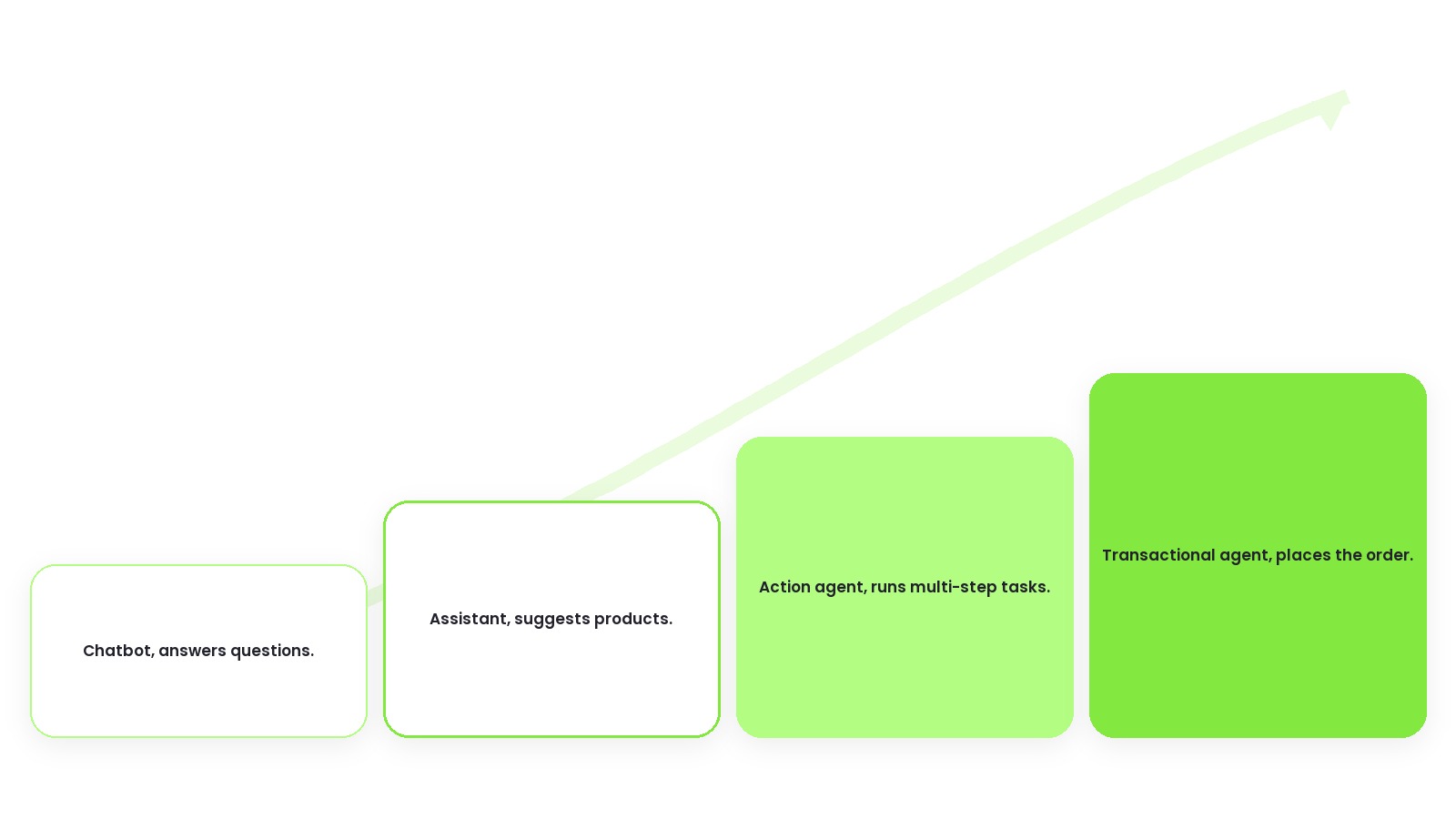
People stretch the word agent; those have separate four rungs.
- A chatbot answers questions.
- An assistant suggests products.
- An action agent runs multi-step tasks.
- A transactional agent places the order and pays.
That last rung changes the risk profile. It needs permissions, identity checks, payment limits, and a human in the loop.
Before a single agent touches checkout, you need these seven answers:
- Which data can it reach?
- Which actions can it take?
- When does it pause for customer sign-off?
- How is every action logged?
- How does a wrong move get reversed?
- How does it handle an out-of-stock item?
- How is payment risk contained?
One answer can end the meeting for you. A vendor that calls its agent fully autonomous, with no guardrails, has not thought about failure.
Agent-ready data and protocols
Agents read data, and they ignore your interface. Expose a clean product feed with price, stock, and attributes. Emerging agent protocols read those feeds to compare and buy. A catalogue full of gaps stays invisible to them.
The automation running underneath
Long before an agent talks to a customer, quieter automation earns its place. Catalogue enrichment, demand forecasting, and order routing run without a hand on them. Fraud checks and return sorting cut the manual review pile. Product copy gets drafted at scale.
We build these agents and automations as an enterprise AI development team in the UAE.
Every capability above shares one weakness. Each one falls apart without solid foundations under it.
The foundations that keep AI standing in e-commerce website development
AI features sit on top of architecture. Get the base wrong, and every clever feature becomes a liability.
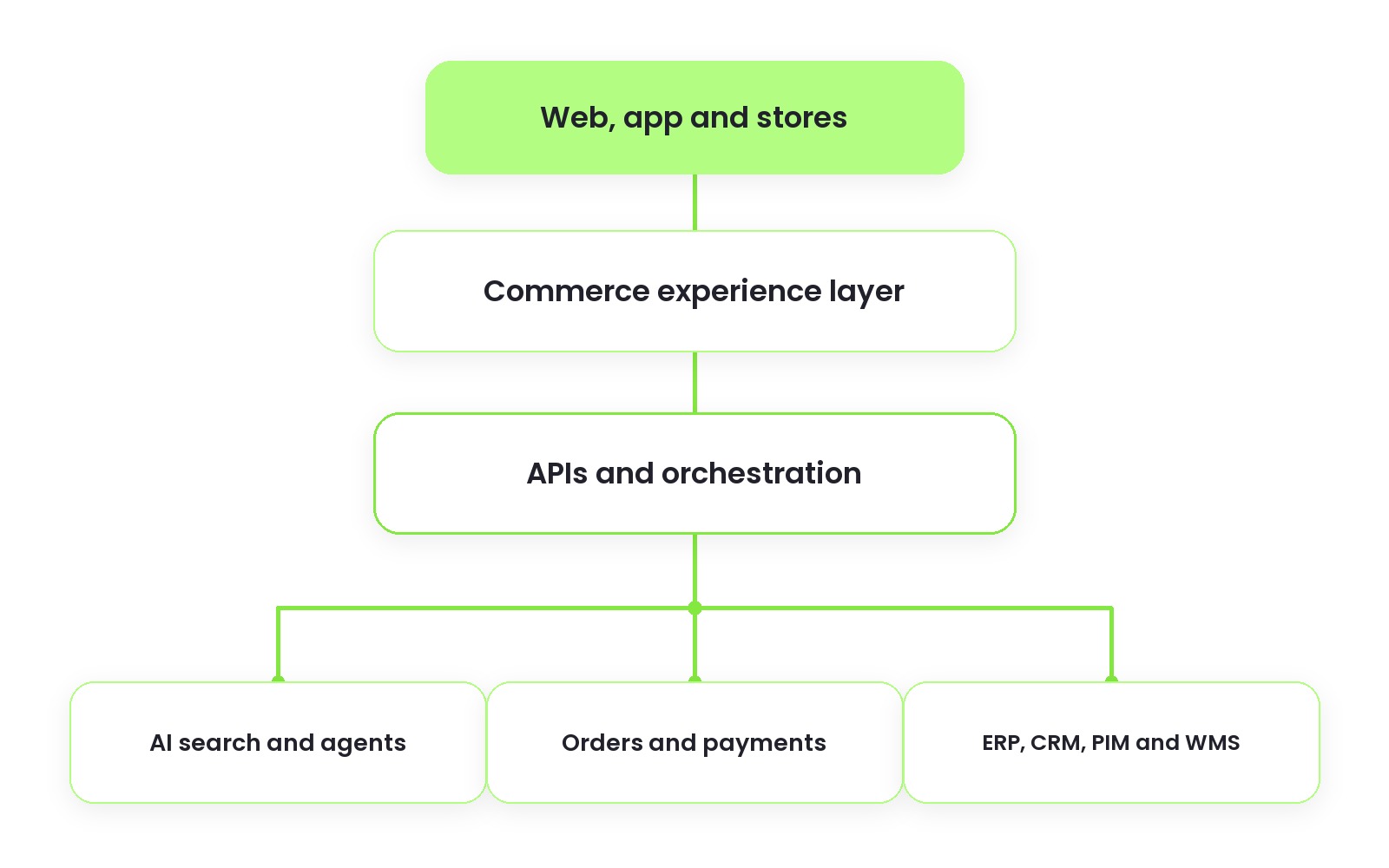
A good e-commerce website development company fits the architecture to your scale and roadmap. Each model below carries a cost as well as a benefit.
| Architecture | Best fit | Trade-off |
| Monolithic | Small, simple catalogues | Hard to scale parts |
| Headless | Custom front-end, omnichannel | More moving parts |
| Composable | Best-of-breed at scale | Integration overhead |
| Microservices | Independent scaling | Operational complexity |
| API-first | Many channels and partners | Governance effort |
| Event-driven | Real-time, high volume | Harder to debug |
Headless gets oversold. We have watched mid-size retailers take on complexity they had no reason to carry. Pick the model your roadmap needs, and leave the fashion to someone else.
Enterprise commerce is rarely a single store. More often it is several brands, currencies, and languages sharing one platform.
Peak traffic is the real exam. Ramadan and Eid campaigns, flash sales, and an influencer post all spike within minutes. Auto-scaling, caching, a CDN, and queued order processing keep the store upright.
Put the reliability numbers in the contract. Uptime SLAs, recovery-time and recovery-point objectives, and a disaster-recovery plan you have tested. Good observability catches a fault before a customer notices one.
Data and integration decide whether any of it works
Enterprise stores rarely fail at the storefront. They fail in the plumbing behind it, where data moves between systems. AI only sharpens that truth, because every model reads the same tables.
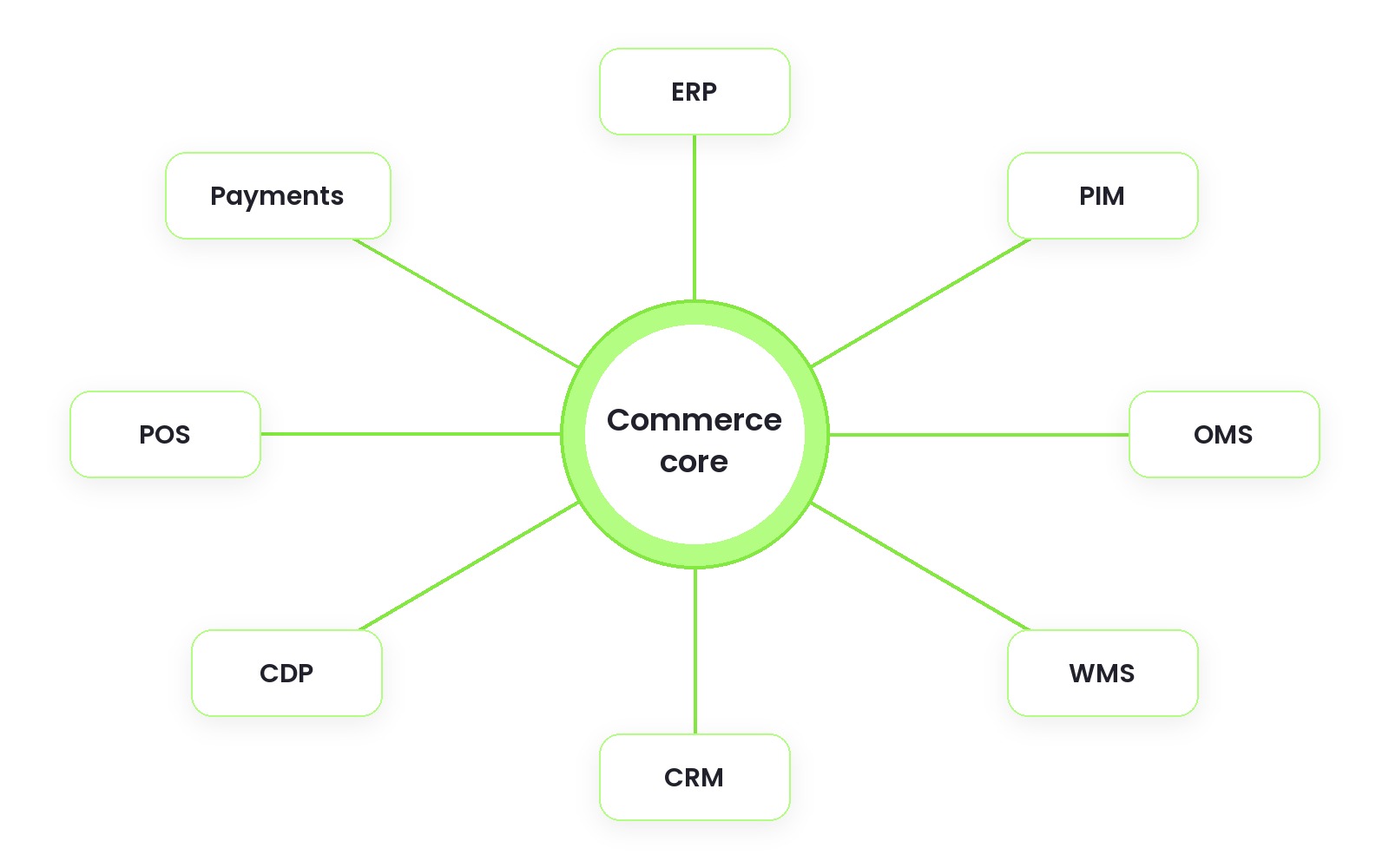
| Enterprise system | E-commerce responsibility |
| ERP | Finance, procurement, pricing, product records |
| PIM | Product descriptions, attributes, media |
| OMS | Order lifecycle and fulfilment |
| WMS | Warehouse inventory and picking |
| CRM | Customer history and service |
| CDP | Unified profiles and behavioural data |
| POS | Store sales and inventory |
| Payments | Authorisation, capture, refunds, settlement |
A serious e-commerce website development company will answer the awkward questions. Which system owns each piece of data? How do conflicts get resolved? What happens the moment your ERP or payment gateway goes dark?
Run a data-readiness check before a single model ships. Catalogue completeness, identity resolution, and event quality set the ceiling on what AI can do. Clean the data first, and the AI improves on its own.
This integration work is our core as a custom software development company in Dubai.
Security, UAE law, and control over your AI
Three things protect the platform at once: security, compliance, and control over the AI.
The UAE rules you cannot skip
UAE law shapes every store that sells here. The PDPL sets the terms for consent, storage, and cross-border data transfer. Breaches are expensive, with fines from AED 50,000 to AED 5 million.
Consumer-protection rules, 5% VAT, and Arabic disclosures round out the list.
Security controls worth checking
Security belongs in the build from day one. Encryption, role-based access, and payment tokenisation form the floor. MFA, secure API gateways, and privileged-access management sit above it. Penetration tests and audit logs show the controls hold.
Keeping the AI on a leash
AI brings a governance layer most vendors gloss over. Models need oversight, monitoring, and firm limits. For agents, the guardrails matter most of all.
Set permissions, transaction ceilings, rollback, and complete action logs. Test for prompt injection and hallucination before launch, never after.
One claim always worries. A vendor selling AI that runs itself, with no human sign-off, has missed the risk.
We wire this governance into daily operations as an AI workflow automation agency in Dubai.
Proof of delivery and life after launch
A polished pitch and a delivered platform are different things. Ask for evidence, then find out who sticks around once the invoice clears.
Request work that mirrors your scale. Comparable builds, real transaction volume, large catalogues, and messy integrations tell the story.
Study the named team behind the logo. An enterprise build needs a solution architect, AI and data engineers, and security specialists in the room.
Delivery governance is a maturity tell. Who owns the architecture calls? How do scope changes get controlled? And how often does working software ship?
What a real first 90 days looks like
A credible partner walks in with a 90-day plan. Discovery and architecture fill the first weeks. A pilot then proves one high-value flow on live data. Production follows before any advanced AI lands.
Launch is a milestone, never the finish line. SLAs, monitoring, model tuning, and a roadmap keep the platform earning. A partner who disappears at go-live leaves you carrying the risk.
Cost, build-versus-buy, and the ROI that matters
The lowest quote rarely wins at enterprise scale. Real cost lives in ownership, long after the build ships.
Total cost of ownership runs well past launch. Cloud, AI-service usage, integrations, security testing, and model monitoring all keep billing.
Some things deserve a custom build, and plenty do not. Buy the commodity pieces. Reserve custom work for what sets you apart.
| Capability | Buy or configure | Custom build |
| Standard checkout | Usually buy | Rarely needed |
| Payment processing | Integrate | Leave it alone |
| Business-specific order workflow | Limited fit | Often justified |
| AI product search | Managed platform works | Custom rules may help |
| Recommendation engine | Managed service works | Useful for proprietary data |
| Agentic workflows | Early managed options | Custom guardrails often needed |
| ERP orchestration | Connector may work | Custom integration often needed |
Dubai budgets track scope, so a fixed rate tells you little. The tiers below give a planning reference in AED.
| Build scope | Planning reference (AED) | Fit |
| Standard enterprise storefront | 250,000 to 700,000 | Single brand, core integrations |
| AI-enabled commerce platform | 700,000 to 1,800,000 | AI search, personalisation, ERP and CRM |
| Agentic, multi-brand enterprise suite | 1,800,000+ | Agents, multi-entity, full governance |
Figures are planning references for scoping, not fixed quotes.
Model the return before you fixate on the spend. Higher search conversion, bigger baskets, and fewer abandoned carts pay the build back. Fewer stockouts, less manual work, and stronger retention pile on top. A serious partner will build this case with you, in your numbers.
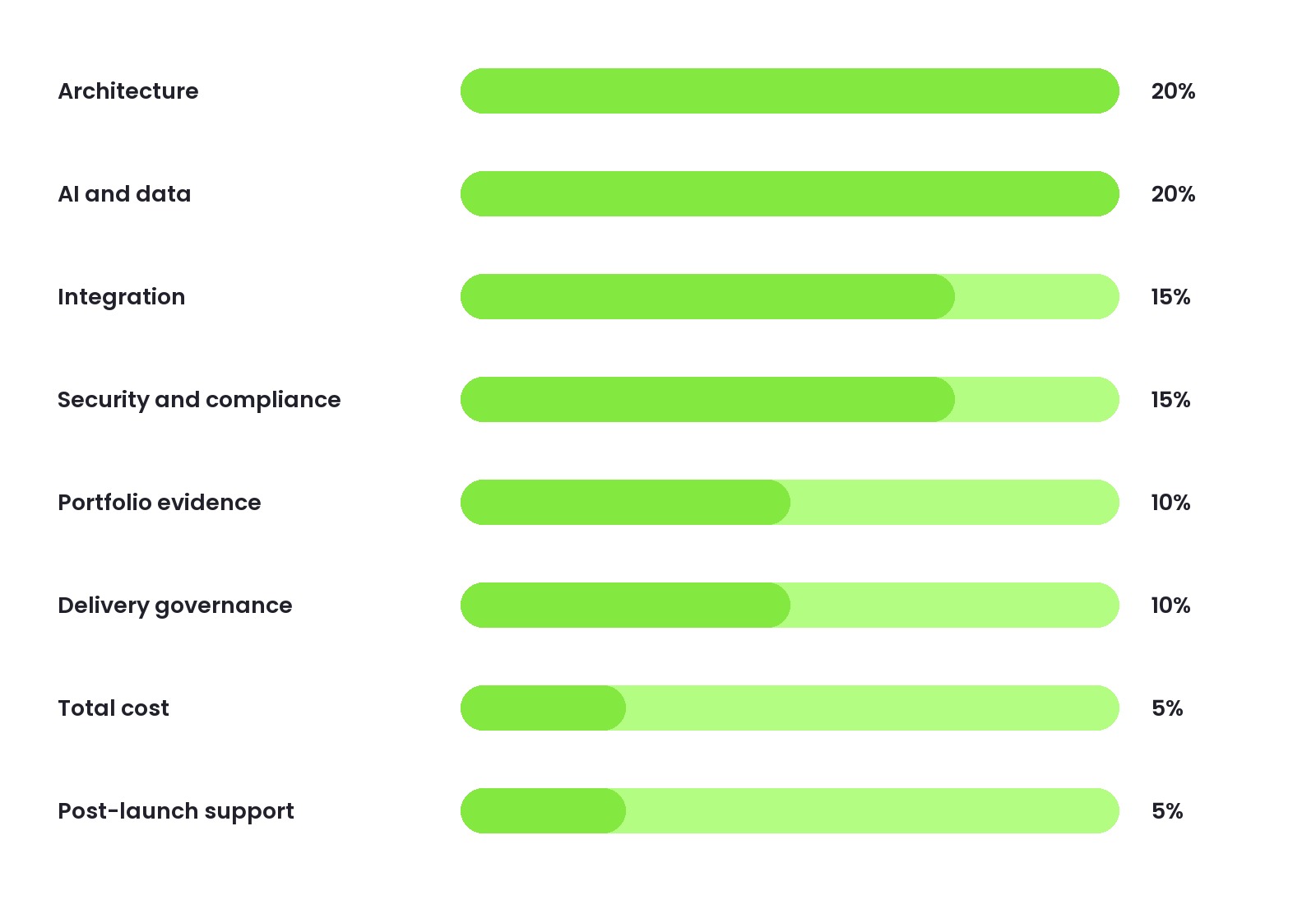
A grouped checklist to shortlist an e-commerce website development company in Dubai
Run every shortlisted company through the same questions. Score them by group, then compare side by side.
Business and strategy fit
- Did the company understand your commercial and operational goals?
- Can it tie each AI feature to a business metric?
- Can it say when custom development is unnecessary?
Architecture and scale
- Does the proposed architecture fit your scale?
- Can it handle peak events like Ramadan and Eid?
- Are performance and uptime targets in the contract?
AI and data capability
- Can it explain the data behind each AI capability?
- Has it shown real AI search and personalisation work?
- Are agent actions permissioned and auditable?
Integration and data
- Will it integrate with your ERP, CRM, and OMS?
- Has it named a source of truth for each data entity?
- Does it have a tested data-migration plan?
Security and compliance
- Are its security and compliance controls provable?
- Does it meet UAE PDPL and consumer-protection rules?
- Can it show penetration testing and audit logs?
Delivery and ownership
- Is the delivery team named, with a senior architect?
- Does the quote cover the full cost of ownership?
- Is post-launch ownership defined in writing?
A partner that clears every group is rare. That is the point of the exercise.
Why businesses choose Code Brew Labs as an e-commerce website development company
Code Brew Labs is an enterprise-grade AI app development company. We have shipped AI-first products since 2013, across the UAE, the Middle East, and global markets. Our work covers more than 35 industries, retail and e-commerce among them.
On a commerce build, we handle search, personalisation, and agent-ready platforms. Compliance and enterprise integration come baked in.
REDTAG, retail at scale across the Middle East
REDTAG needed a store that could scale across the region. We built the retail app behind it. It passed 1 million downloads and holds a 4.3-star rating.
Aybiz, a one-stop marketplace in Kuwait
Aybiz set out to be a one-stop marketplace in Kuwait. We engineered the catalogue, storefront, and checkout end-to-end. Local and international brands now sit in one place, with a 5-star rating.
Livspace, AI-driven home commerce
Livspace sells home interiors, a slow and complex purchase. We built AI-led discovery and a guided buying flow. Browsing turns into a structured, personalised project.
We stay from architecture through post-launch support. You keep the source code, the data, and control at handover. The rest of our commerce work sits in the ecommerce portfolio.
REDTAG, Aybiz, and Livspace show AI search, marketplace scale, and personalization in production.
Conclusion:
An enterprise store is revenue infrastructure. The company you pick will own your search, data, integrations, and AI for years. Judge them on architecture and outcomes, and test every claim against evidence.
Begin with the business problem, and let the technology follow. The right team in Dubai builds for 2026 and stays long after go-live.
Frequently asked questions
How do I choose an ecommerce website development company in Dubai?
Begin with your commercial goals ahead of any feature wishlist. Weigh each company on architecture, AI depth, integration experience, and UAE compliance. Ask for comparable work and a named delivery team. Get code ownership and post-launch support in writing. The right partner designs against your metrics, then backs it with evidence.
How much does enterprise ecommerce website development cost in Dubai?
Cost tracks scope, integrations, and AI depth. A standard enterprise storefront starts near AED 250,000. AI-enabled platforms with search, personalisation, and ERP ties run higher. An agentic, multi-brand suite starts around AED 1,800,000. Cloud, AI services, and support keep billing after launch. Scope the workflows before you ask for a quote.
What is the difference between headless and traditional ecommerce?
Traditional commerce couples the front-end and back-end in one system. Headless splits them, so the front-end calls the back-end through APIs. That flexibility suits custom experiences and omnichannel selling. It also adds moving parts and cost. Go headless when the roadmap genuinely calls for it.
Can AI improve ecommerce search and conversion rates?
Yes. AI search reads intent, forgives typos, and understands Arabic and English. Shoppers reach products faster, so conversion climbs. Personalised ranking lifts basket size and repeat orders. Clean catalogue and behavioural data drive the results. Poor data caps the gains, whatever the model.
What is agentic commerce?
Agentic commerce lets AI agents act on a shopper’s behalf. An agent can research, compare, and complete a purchase across steps. It goes well beyond a chatbot that only answers questions. Safe agents need permissions, identity checks, payment limits, and human confirmation. The technology is young, so guardrails outrank raw autonomy.
How should AI agents be secured before they complete transactions?
Give agents clear limits and full visibility. Define which data the agent reads and which actions it may take. Require human confirmation for payments and high-risk steps. Log every action, and build a fast rollback path. Test for prompt injection before the agent touches a live checkout.
Which enterprise systems should an ecommerce platform integrate with?
An enterprise store leans on several core systems. ERP runs finance and pricing, while PIM manages product data. OMS and WMS handle orders and warehouse stock. CRM and CDP hold customer history and unified profiles. Payments and POS complete the picture. Each connection needs one clear source of truth.
How long does an enterprise ecommerce implementation take?
Timelines follow scope and integration depth. A standard enterprise storefront runs about four to six months. An AI-enabled platform takes six to ten months. A multi-brand, agentic suite runs longer. Phased delivery ships a working core first, then layers on AI and automation.
How does UAE PDPL affect ecommerce personalization?
The UAE PDPL governs how you use personal data. Personalisation has to run on consented, lawfully held data. Shoppers can ask what you hold and why. Serious breaches carry fines up to AED 5 million. Work from first-party, consented data, and keep clear records.
Should an enterprise use Shopify, Magento, or custom ecommerce development?
It comes down to scale, control, and AI ambition. Shopify suits quick launches and standard needs. Magento fits larger catalogues and deeper control. Custom development wins when workflows, integrations, or AI turn complex. Many enterprises run a hybrid, buying the commodity and building the differentiator.
Let's Convert Your Business Idea Into Success!
Free Consultation from Top Industry Experts
Let’s Build Your Dream App!
Share article on :



 No commitment required
 NDA on request
 24-hour response


