
Quick Summary:
- AI-driven mobile app development puts machine learning, generative AI and AI agents at the core of an app. They are not add-on features.
- A sound MVP strategy ships one validated user journey in about 9–17 weeks, on an architecture that can later carry enterprise load and new AI features.
- We are Code Brew Labs, headquartered in Dubai since 2013. We have delivered 300+ enterprise AI solutions and 5,000+ apps across iOS, Android, Flutter, React Native and PWA.
- The same Code Brew Labs team covers enterprise AI automation, custom AI agents, and blockchain and tokenization engineering, so your MVP can grow into an enterprise platform without changing partners.
Businesses in Dubai and across the GCC rarely ask anymore whether a new app should use AI. They ask three practical questions: which AI features belong in the first release, how quickly that release can reach real users, and whether the team that builds it can grow it into an enterprise platform.
This guide answers those questions in the order we follow on most projects:
- Choose the AI features the app needs, based on the industry and the problem it solves.
- Launch them as an MVP (minimum viable product): the smallest version that proves real users want the product.
- Scale AI across the business with automation, AI agents and, where it fits, blockchain.
Code Brew Labs is an AI software and mobile app development company headquartered in Dubai World Trade Centre Tower on Sheikh Zayed Road, with delivery hubs in India, the UK, the USA and Mexico. Since 2013, our teams have built products for Airbus, duPay, REDTAG, Alfardan Exchange, and ACWA Power, and Clutch named us a Top AI Development Company in Dubai and a Top Generative AI Company in the UAE for 2026.
AI-Powered Mobile App Development
AI-powered mobile app development means designing an app around models that predict, generate, recognize or act for the user, instead of adding a chatbot at the end. At Code Brew Labs, we provide AI software development services that integrate machine learning, generative AI, and AI agents into iOS and Android apps. The aim is less manual work, a more personal experience for each user, and lower operating costs for the business behind the app.
Which AI capabilities belong in a mobile app?
| AI capability | What it does inside the app | Typical use |
| Machine learning and predictive analytics | Scores, ranks and forecasts from user and transaction data | Fraud scoring, churn prediction, demand forecasting |
| Generative AI and large language models (GPT family, Claude, LLaMA) | Writes, summarizes and answers in natural language | In-app assistants, report summaries, content generation |
| AI agents | Plans and completes multi-step tasks through connected systems | Bookings, claims, account servicing |
| Arabic and English language AI | Understands bilingual text and voice, including Gulf dialects | Customer support, search, voice ordering |
| Computer vision and document reading (OCR) | Reads documents and images | ID checks during sign-up, skin analysis, damage inspection |
| AI voice agents | Handles spoken requests from start to finish | Answering calls, hands-free ordering |
Most production apps combine two or three of these capabilities. The right mix depends on the job the app has to do.
How AI improves engagement in fintech and healthcare apps
Fintech. Users return to a finance app when it saves them effort. An AI fintech app can:
- Categorize spending and show personal insights.
- Verify identity in minutes by reading ID documents and matching a selfie.
- Score every transaction for fraud in real time.
- Answer account questions in Arabic and English, at any hour.
In the UAE, these features have to operate within Central Bank of the UAE (CBUAE) licensing and the UAE Personal Data Protection Law (PDPL). We built duPay’s UAE-regulated digital wallet and cross-border transfer app, which has more than 1.5 million downloads, and Alfardan Exchange’s real-time remittance platform, which runs at 99.5% uptime.
Healthcare. AI shortens the path from symptom to care. Typical features include:
- Symptom triage that directs patients to the right service.
- Smart scheduling and reminders that reduce missed appointments.
- Automatic summaries of clinical notes for doctors.
- Alerts based on data from wearable devices.
- Arabic-language assistants that answer patient questions.
Apps that share patient records in Dubai connect to NABIDH, the Dubai Health Authority’s health information exchange. In Abu Dhabi, the equivalent is Malaffi. The UAE’s health data law (Federal Law No. 2 of 2019) generally requires patient data to stay in the country, so where the app’s data is hosted is decided at the design stage. See healthcare app development in Dubai.
How we build AI into real estate, beauty and fitness apps
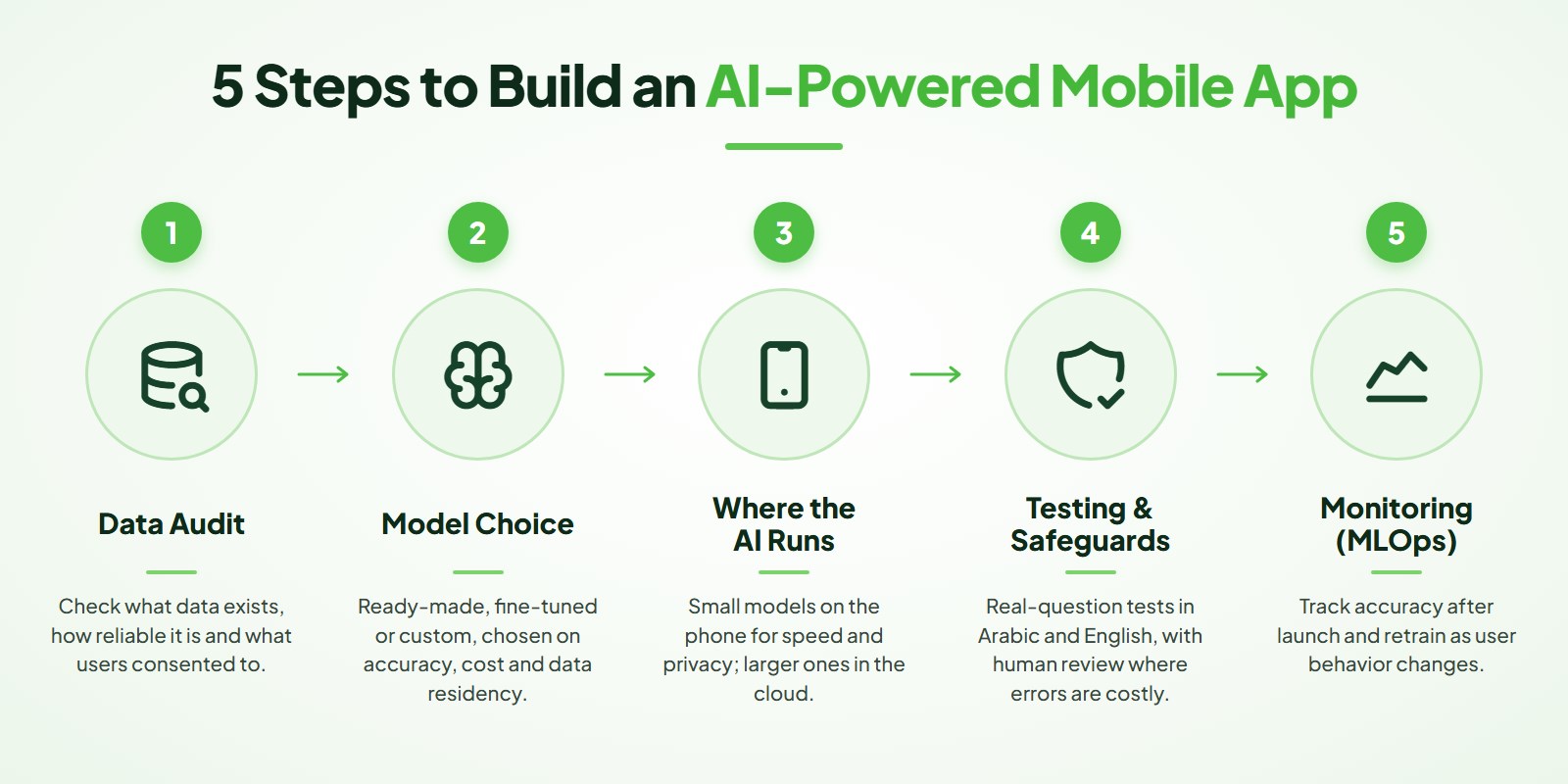
Every AI-powered app we build follows the same five technical steps:
- Data audit. Check what data exists, how reliable it is and what users have consented to.
- Model choice. Use a ready-made AI model through an API, adapt (fine-tune) an existing model, or build a custom one. The choice depends on accuracy, running cost per request and where the data must be stored.
- Where the AI runs. Small models run on the phone (Core ML on iOS, TensorFlow Lite on Android) for speed and privacy. Larger models run in the cloud.
- Testing and safeguards. Test answers against a fixed set of real questions, check accuracy in Arabic as well as English, and add human review wherever a wrong answer is costly.
- Monitoring after launch (MLOps). Track accuracy in production and retrain models as user behavior changes.
The features built on top depend on the sector:
- Real estate: property matches based on each user’s search behavior, price and rental-yield estimates, lead scoring for brokers, bilingual chatbots that qualify enquiries around the clock, and automatic listing checks. See AI real estate app development.
- Beauty and salons: skin and hair analysis from the phone camera, virtual try-on, product and routine recommendations based on the brand’s own catalog, and smart booking that matches each service to the right stylist and predicts no-shows. See AI beauty app development in Dubai.
- Fitness and wellness: training plans that adapt to each user’s progress, nutrition guidance, a conversational AI coach, and wearable data through Apple HealthKit and Google Health Connect. See AI fitness and wellness app development.
Our AI development services for Dubai and UAE businesses
We offer these AI services to clients in Dubai and across the UAE:
- Generative AI development
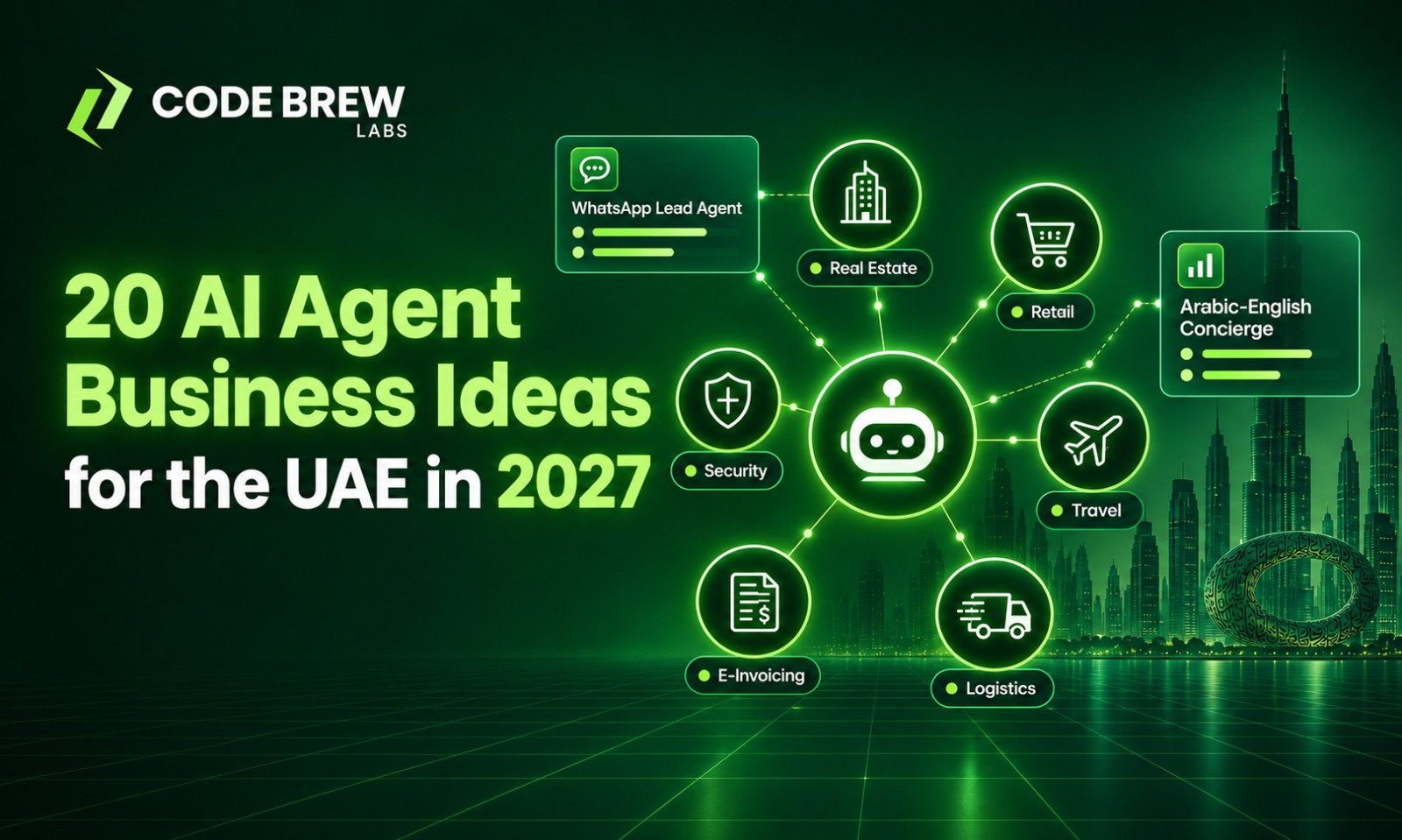
- AI agent development and multi-agent orchestration
- AI assistants, chatbots and AI voice agents
- Arabic language AI
- Custom AI and AI product development
- Machine learning, predictive analytics, computer vision and OCR
- Intelligent process automation (RPA) and AI copilots
- AI integration, model monitoring (MLOps) and model governance
- AI cybersecurity
Our team of 120+ AI specialists delivers this work across 35+ industries. For architecture, compliance and cost in more depth, read our guide to AI-powered mobile app development in the UAE.
Custom Mobile App Development and MVP Strategy
Once the AI features are clear, the next decision is how to launch them. At Code Brew Labs, we use expert-led strategy to take custom mobile apps in Dubai from first concept to scale on iOS, Android, Flutter, React Native, and progressive web app (PWA) platforms. Our 750+ app developers have delivered more than 5,000 apps, and our MVP strategy follows one rule: release the smallest version that proves value, built on foundations that will not need rebuilding once it works.
Choosing the right platform for an MVP
| Platform | Best for | Trade-off |
| Native iOS (Swift) and Android (Kotlin) | Heavy use of device features, on-device AI, top performance (banking, AR) | Two codebases, higher cost |
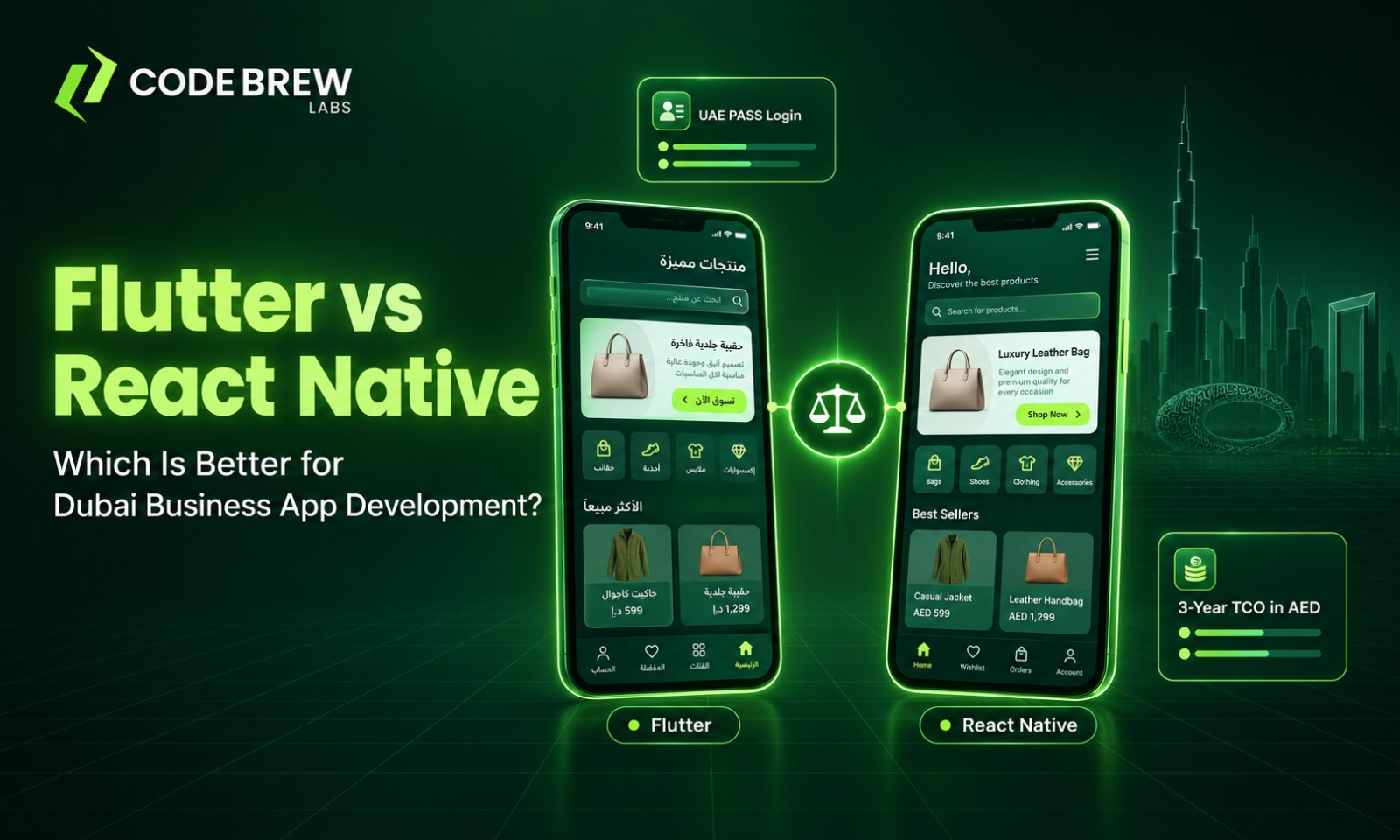
| Flutter | One codebase for both app stores with a consistent design; fast MVPs | Some device features need extra native code |
| React Native | Teams that already work in JavaScript or TypeScript, or that want to share code with a web app | Performance-critical screens may need native code |
| PWA (an app that runs in the browser) | Testing demand quickly through a shareable link, with no app store approval | Limited device access and weaker push notifications on iPhone |
For most MVPs that must reach iPhone and Android users quickly, Flutter or React Native gives the best balance of speed and cost, because one codebase serves both app stores. Native development makes sense when the product depends on device hardware or on-device AI.
How an MVP is built to scale
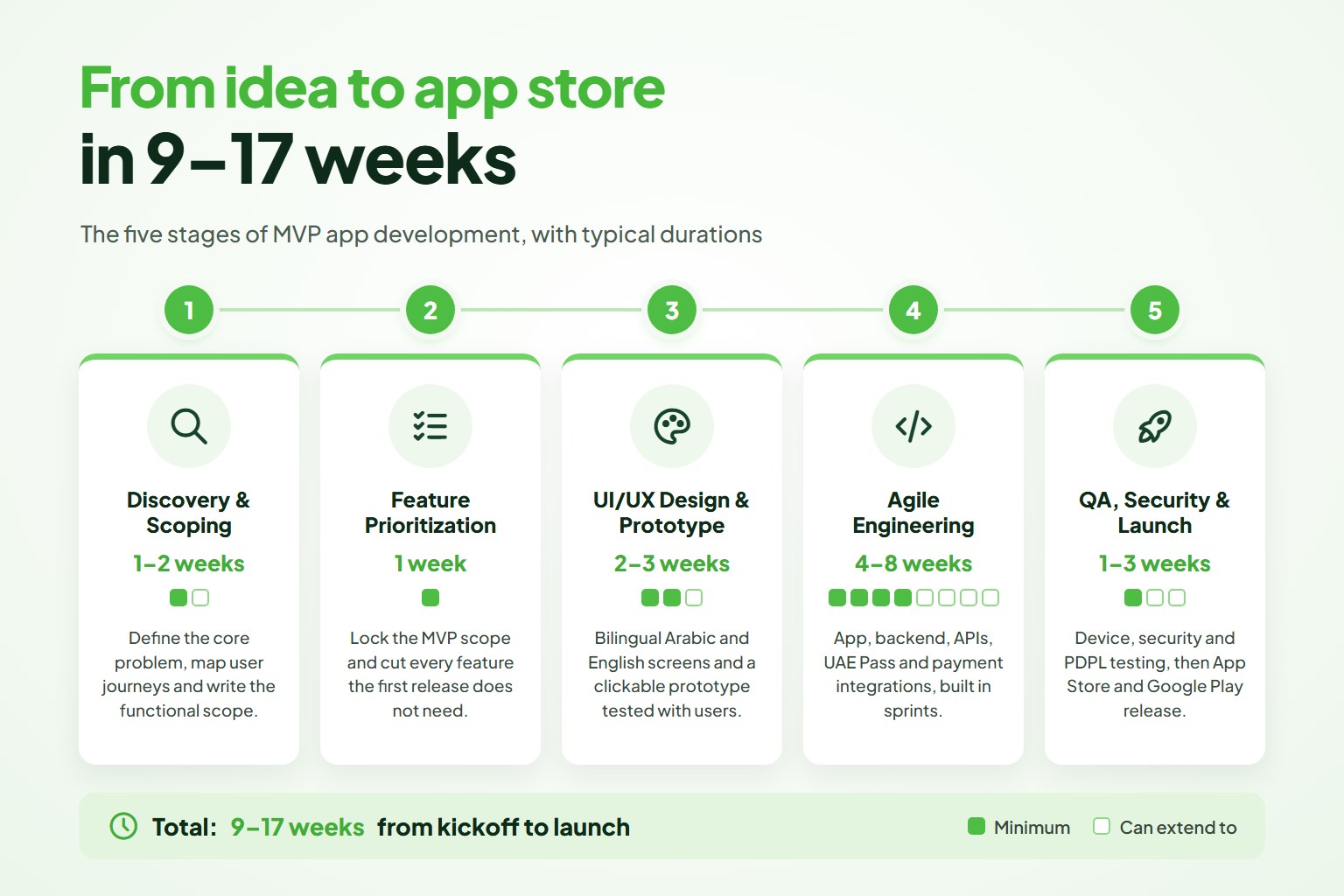
Most MVPs reach the app stores in 9–17 weeks, in five stages:
- Discovery and scoping (1–2 weeks). Define the core problem, map user journeys, write the functional scope and agree on how success will be measured.
- Feature prioritization (1 week). Lock the MVP scope and cut every feature the first release does not need.
- UI/UX design and prototyping (2–3 weeks). Wireframes, bilingual Arabic and English screens with right-to-left (RTL) layouts, and a clickable prototype tested with real users before coding starts.
- Agile engineering (4–8 weeks). The app, backend, APIs and regional integrations such as UAE Pass and local payment gateways, built in short sprints with regular demos.
- QA, security and launch (1–3 weeks). Device, performance, security and PDPL testing, followed by submission to the App Store and Google Play.
A scalable MVP differs from a throwaway prototype because of a few decisions made in the first release:
- A modular backend that exposes each feature through APIs, so new features and new apps plug in without rewriting the core.
- A separate AI layer, so the AI provider can be switched as prices and accuracy change.
- Analytics from day one, so the next feature is chosen on real usage data, not opinion.
- Cloud infrastructure that adds capacity automatically as users grow, hosted in UAE data centers where data residency rules apply.
- Feature flags (switches that turn a feature on for selected users), for staged rollouts and A/B tests.
- An admin panel with role-based access, ready for operations teams.
For an AI MVP, we start with a ready-made AI model connected to your own content through retrieval-augmented generation (RAG), a method that lets the model answer from company documents and data. We measure accuracy and cost per request with real users, and move to fine-tuned or custom models only when usage data justifies the investment.
In Dubai, our starter MVPs with one core user journey on iOS and Android begin at AED 4,999. Full-featured MVPs range from AED 70,000 to AED 180,000. Our MVP app development guide for Dubai breaks down timelines and cost factors in detail.
Planning an AI MVP? Get a free scoping session with Code Brew Labs.
Talk through your platform, core features, timeline and budget with our MVP team.
Building specialized apps: Islamic fintech and beauty and salon management
The same MVP approach applies to specialized products. These add their own rules from day one.
Islamic fintech. Shariah compliance is a product requirement, defined before any code is written. Our method for building Shariah-compliant Islamic fintech apps covers:
- Shariah board review first. A Shariah supervisory board approves each product structure before development begins. Common structures include murabaha (cost-plus sale), ijara (leasing), musharakah (partnership), wakala (agency) and takaful (Islamic insurance).
- No interest in the system. Pricing and ledger logic are built on profit rates, fees and asset ownership.
- Screening and purification. Investments and merchants are screened against Shariah criteria. Any income from non-compliant sources is set aside automatically for charity, a step known as purification.
- Zakat and audit tools. Built-in zakat calculators and complete audit trails for Shariah audits.
- UAE licensing. Alignment with CBUAE rules and, for digital-asset products, with Dubai’s Virtual Assets Regulatory Authority (VARA).
Beauty and salon management. A salon app has to run the business behind each booking, not just take appointments. Core modules include:
- A booking engine that accounts for service duration, stylist skills and calendars across branches.
- Staff scheduling, commissions and payroll exports.
- Inventory and retail product sales linked to the point of sale (POS).
- At-home service dispatch with live tracking.
- Packages, memberships, loyalty programs, and WhatsApp or SMS reminders.
- An AI layer for no-show prediction, rebooking prompts, skin analysis and personalized product recommendations.
Our beauty app development guide covers features and costs for UAE salon brands.
Enterprise AI Automation and Digital Transformation
After launch, the focus shifts from one app to the whole organization. Code Brew Labs works as an AI-driven digital transformation partner for enterprises. We deliver custom AI agents, generative AI solutions, machine learning and blockchain engineering that modernize operations end to end. Our enterprise AI practice in Dubai has built 180+ custom AI models for enterprises and 55+ AI integrations into business workflows.
How custom AI agents automate complex business processes
An AI agent is software that combines an AI language model with access to business systems, a memory of earlier steps and clear rules. A chatbot answers one question; an agent can plan and finish a task that takes several steps. Enterprises use custom AI agents for:
- Finance operations: reading invoices, matching them to purchase orders in the ERP, flagging exceptions and routing approvals.
- Customer service: resolving requests in Arabic and English, taking action directly in back-office systems, and handing over to a person with the full context when needed.
- Sales and CRM: qualifying leads, updating records and drafting follow-ups.
- HR: screening applications, scheduling interviews and answering policy questions. HireDesk, an AI hiring-automation project from our portfolio, is one example.
- IT operations (AIOps): detecting incidents, grouping related alerts and running fixes from approved playbooks.
Agents are only safe to scale with enterprise controls in place:
- Connections to existing ERP, CRM and core systems through APIs.
- Role-based permissions that limit what each agent can see and do.
- Human approval for high-value actions.
- A full audit log of every action.
- PDPL-compliant data handling.
- Monitoring of cost and accuracy for each task.
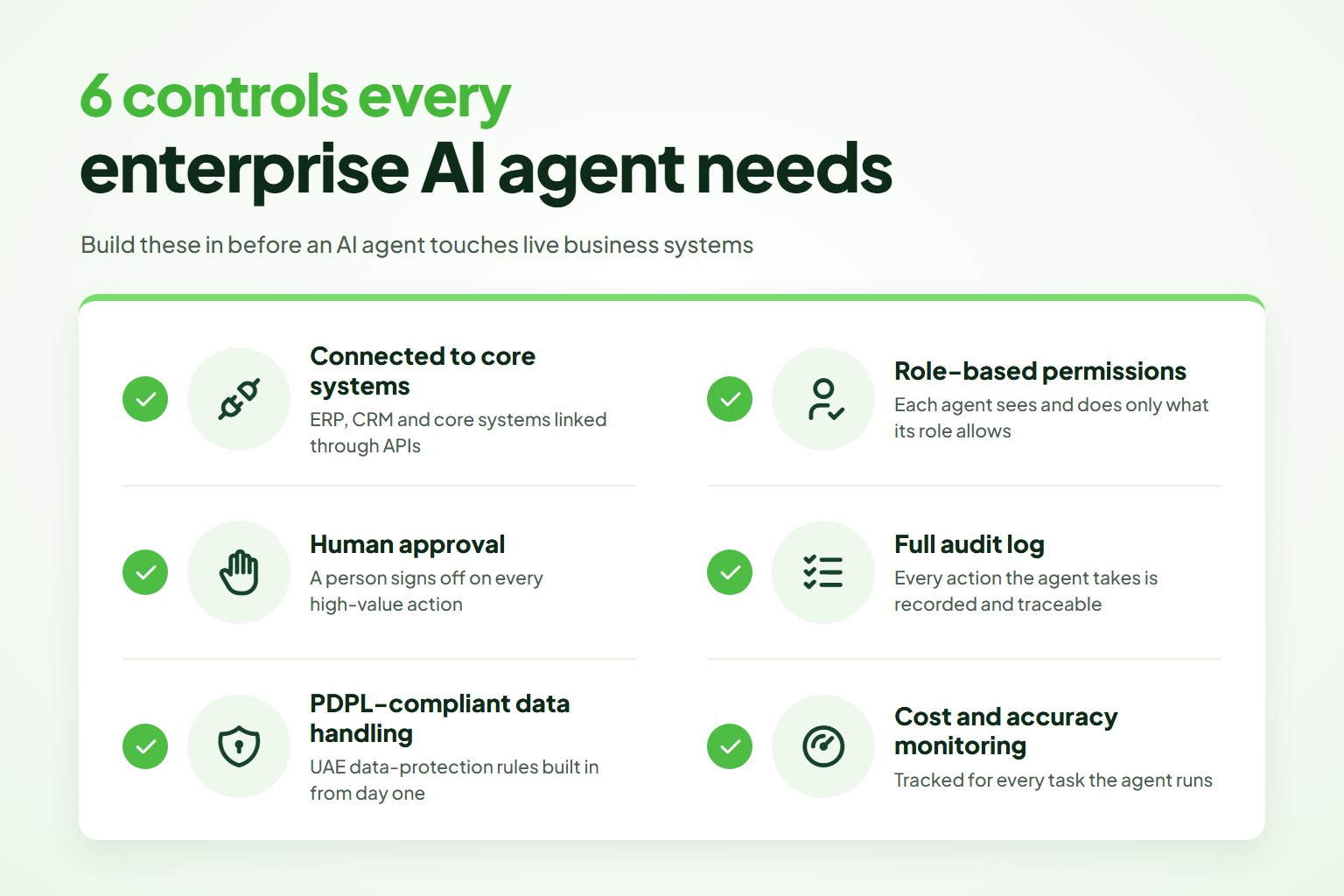
We build these controls into our AI automation services in Dubai.
How machine learning supports long-term digital transformation
Machine learning delivers lasting value when it runs as a program, not a string of one-off pilots:
- Prioritize use cases by business value and how ready the data is.
- Build the data foundation: data pipelines, quality checks and clear ownership of data.
- Run models with MLOps: keep a version history for each model, watch for drops in accuracy and retrain on a schedule.
- Measure outcomes against a baseline agreed before the project starts.
For Airbus, we built an enterprise AI decision support system that reads fleet maintenance sensor data. It cut unscheduled downtime by 28%, with 92% prediction accuracy. For ACWA Power, we supported digital transformation across utility-scale energy and water operations.
Scaling AI across your organization? Book a free enterprise AI readiness assessment.
Get a clear view of your architecture, data and delivery plan before you commit budget.
Blockchain and tokenization services for enterprise clients
Some transformation programs also need a shared record that no single party can alter, for example to sell fractional ownership of property or to track assets across partners. This is where blockchain fits. We have offered blockchain development since 2016, and our enterprise scope includes:
- Smart contracts (code that runs automatically on the blockchain), with security audits.
- Multi-chain development on Ethereum and compatible networks, Polygon, Solana, Avalanche, Hyperledger Fabric and Polkadot.
- Asset tokenization platforms that turn real-world assets (RWAs) into digital tokens investors can buy in fractions. This covers tokenization consulting, token design, security token offering (STO) platforms and white-label platforms.
- Secondary marketplaces where investors can trade tokens, plus custody and wallet integration.
- Investor and compliance tools: KYC/AML checks, investor accreditation, automated dividend and revenue payouts, and regulatory reporting.
Assets that can be tokenized include real estate, funds and treasuries, private credit, commodities and gold, equities, bonds, art, carbon credits and intellectual property. We structure these platforms for licensing through VARA in Dubai, ADGM, the DFSA and the UAE Securities and Commodities Authority (SCA). Rules on who may buy or sell each token are written into the smart contracts themselves. For Al Saeed Properties, we built PropertEase, a platform that tokenizes premium commercial and residential property across Dubai and Abu Dhabi valued at more than USD 300 million.
What to look for in an AI app development or AI automation partner
Whether the starting point is an MVP or an enterprise program, the same checks apply:
- Production evidence: live systems with measured results, not demos.
- UAE compliance: PDPL, sector regulators (CBUAE, DHA, VARA) and data residency built into the architecture.
- Arabic AI capability: bilingual models, right-to-left interfaces and testing in Gulf dialects.
- One accountable team: strategy, MVP, scale-up and ongoing model monitoring handled by the same partner.
- Integration depth: proven work with the ERP, CRM and core systems the business already runs.
- Clear IP terms: you own the source code, models and data.
For a detailed evaluation framework, read our guide on how to choose an AI app development company in Dubai. To compare providers side by side, see our list of the top AI automation companies in Dubai.
At Code Brew Labs, we bring AI software development, end-to-end mobile app development, and integrated digital transformation services together under one roof in Dubai. You can validate an AI MVP in weeks, then scale it into an enterprise platform with the same team.
Let's Convert Your Business Idea Into Success!
Free Consultation from Top Industry Experts
Let’s Build Your Dream App!
Share article on :


 No commitment required
 NDA on request
 24-hour response


