
Quick Summary:
- About 8 in 10 UAE adults now use AI to research products and compare prices, per Visa.
- Dubai startup Ayan’s AED 2.2 million raise shows investors now back AI search visibility as a standalone retail investment.
- Ayan reads what AI says about a brand, then fixes product content and briefs in-store sales advisers.
- Adobe found AI-referred shoppers converted 31% better than other traffic during the 2025 US holiday season.
- McKinsey found that just 16% of brands track AI search performance, leaving first movers a clear opening.
- Stale AED prices, image-locked specs and weak Arabic pages keep many UAE retail brands out of AI answers.
- An Ayan-style platform links AI answer tracking to PIM, ERP, Merchant Center, CRM, and store adviser apps.
- Custom AI visibility platforms built in the UAE cost AED 90,000 to AED 750,000, depending on integrations.
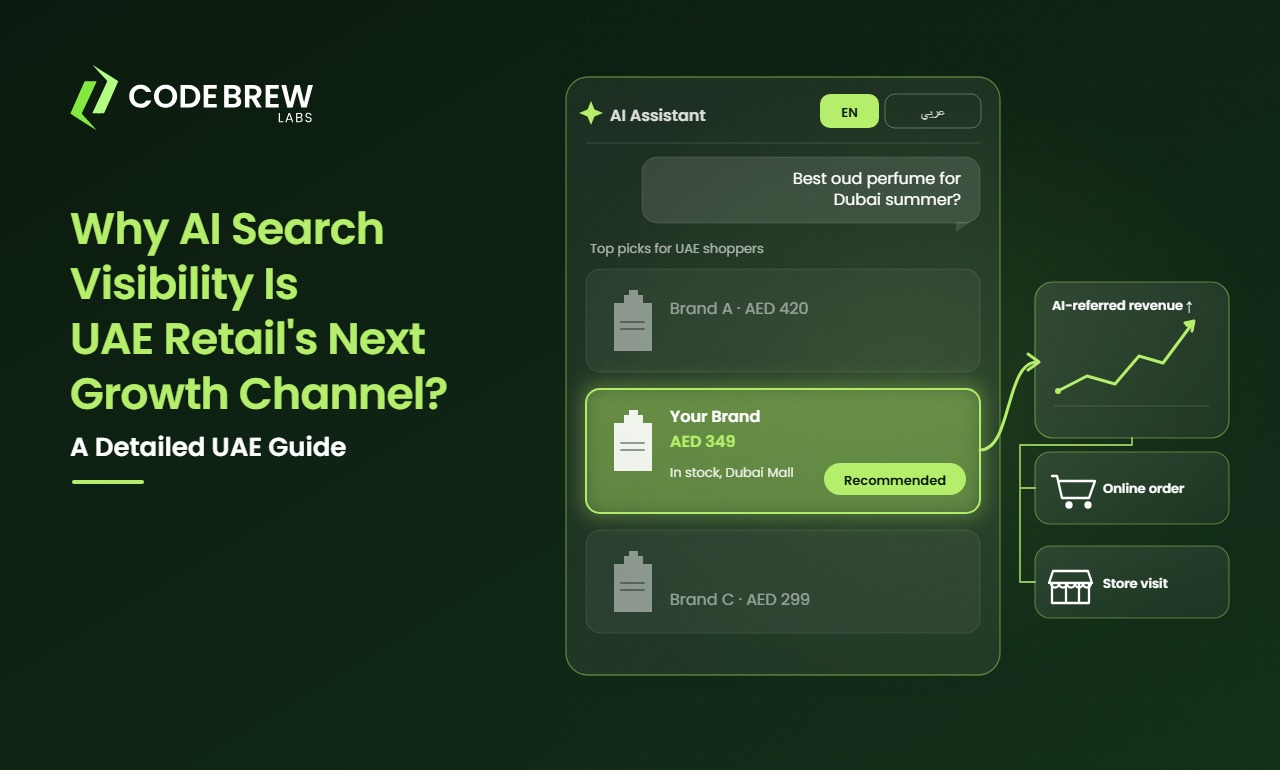
AI search visibility is UAE retail’s next growth channel because shoppers now ask AI assistants what to buy. Brands that the assistants mention win the visit.
The proof is arriving from investors as well as shoppers. Dubai-based Ayan raised AED 2.2 million on 19 October 2026 for one job.
Its platform reads what AI tells shoppers about a brand, then fixes gaps online and in-store. Most retail groups still have no view of that conversation.
For e-commerce enterprises in the UAE, the blind spot costs market share no report can show. Fast-growing D2C brands face a sharper question: does AI know they exist at all?
AI search visibility is how often AI assistants mention, recommend, or cite your brand in shopping answers. It covers ChatGPT, Gemini, Perplexity, Copilot, and Google’s AI Overviews and AI Mode.
What do ChatGPT, Gemini, and Google AI Mode tell UAE shoppers about your brand in Arabic and English?
Why Is AI Search Visibility UAE Retail’s Next Growth Channel?
Three forces meet in the UAE: AI-led shoppers, higher-value AI traffic, and Arabic AI answers. Few markets have all three at once.
Each force alone would justify attention. Together, they make AI answers a channel worth its own budget line.
1. UAE Shoppers Already Buy With AI’s Help
Visa surveyed 1,000 UAE adults in October 2025, and about 8 in 10 use AI to guide shopping. Product research, price comparison and gift ideas topped the list.
Adyen put the UAE figure at 70% in 2025, more than double the 34% EMEA average. DHL’s 2026 report found 51% of UAE online shoppers use AI chat tools while buying. Use has spread beyond Gen Z. Adyen found 59% of UAE Gen X shoppers use AI, a 49% jump in one year.
2. AI-Referred Visitors Spend More Per Visit
Adobe tracked over one trillion US retail visits during the 2025 holidays. AI referrals grew 693.4% and converted 31% better than other traffic.
By July 2026, AI referrals converted 60% better and brought 53% more revenue per visit. Digital Commerce 360 reported those Adobe figures in August. Shoppers compare options before they click, so they land closer to checkout.
3. The UAE Market Is Large Enough to Reward the Effort
UAE e-commerce reached AED 42.2 billion in 2025 and should hit AED 67.2 billion by 2030, WAM reported. Online sales already make up 15.7% of retail sales. Microsoft’s Q2 2026 diffusion report ranks the UAE first in AI adoption, at 73.3% of working-age adults.
Apparel and footwear lead at AED 11.4 billion, followed by consumer electronics. Those are the categories where AI comparison questions run deepest.
4. Google Answers UAE Shoppers in Arabic and English
Google brought AI Overviews to Arabic in May 2025 and Arabic AI Mode in October 2025. AI Mode passed one billion monthly users by July 2026.
For a Dubai retailer, the AI answer now sits above many product searches in both languages. AI Mode also splits one question into many sub-searches, a process Google calls query fan-out. A sofa query can trigger searches on size, delivery, and reviews.
5. Clicks Now Flow to Brands Named Inside the Answer
Ahrefs measured a 58% drop in position-one click-through when an AI Overview appeared. Brands cited inside the answer earned 35% higher organic click-through, Seer Interactive found.
Ranking first is no longer enough. Being named is the new shelf position.
6. AI Answers Shape In-Store Decisions Too
Adyen found 34% of UAE shoppers prefer physical stores, against 27% who prefer online. Many research with AI first, then buy at the counter. That puts store teams inside the AI channel, whether they know it or not.
7. UAE Data on AI Referral Revenue Is Still Thin
No public dataset tracks AI referral revenue for UAE retail, and most conversion data comes from the US. Retailers who baseline in 2026 will own the comparison their rivals lack.
That baseline also shows where AI already favours your brand and where it names rivals.
What Does Ayan’s AED 2.2M Raise Tell UAE Retailers About AI Search Visibility?
The problem Ayan targets matters more to retailers than the size of its round. Brands cannot see what AI says about them, and Ayan sells the fix. That pairing of problem and fix is why the round matters to retail buyers.
1. A Dubai Pre-Seed Round Backed by Global Angels
Middle East AI News reported on 19 October 2026 that Ayan raised AED 2.2 million in pre-seed funding. Strategic global business angels backed the round, and the company plans to expand beyond MENA.
Pablo Charron leads Ayan as founder and CEO, with Chakir El Messaoudi as co-founder and Chief Growth Officer. The company says it serves more than 50 brands across MENA, Europe, and North America.
2. The Problem: Brands Cannot See What AI Says
A shopper asks ChatGPT which oud perfume lasts longest in Dubai heat. The answer names three brands, quotes two prices, and cites a review site the brand never checks. None of that appears in Google Analytics or social listening tools. Ayan describes its category as front-office intelligence for AI-led buying.
Multiply that across every category, language, and assistant your shoppers use. The brand cannot tell which version of itself shoppers heard.
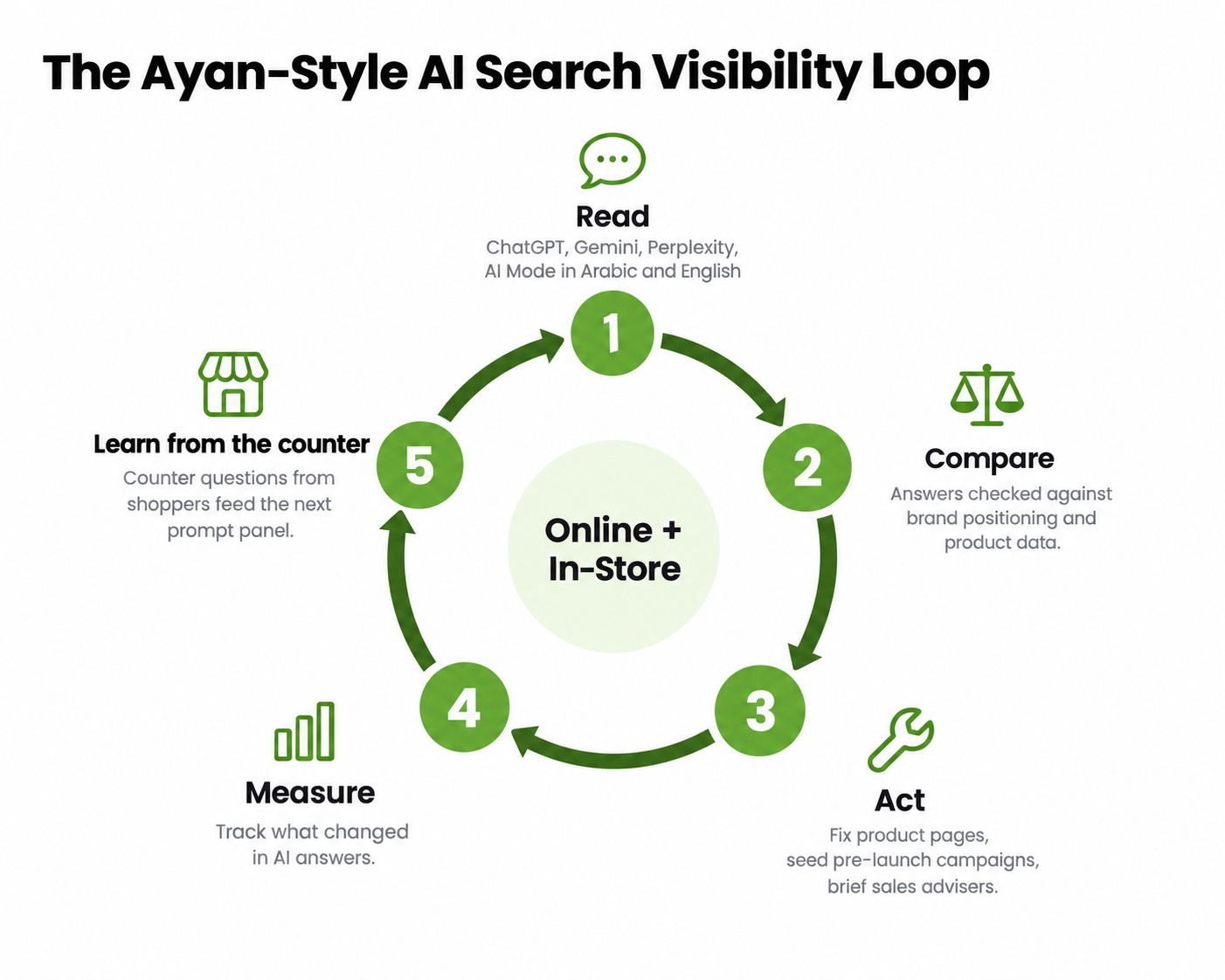
3. The Loop: Read, Act, Measure, Learn From the Counter
Ayan’s agentic platform has analysed millions of data points on how AI describes brands against each brand’s positioning. Gaps trigger action across product pages, pre-launch campaigns, and sales advisers’ phones.
The platform then measures what each action changed in AI answers. Questions shoppers ask at the counter feed back in as the next thing to fix.
4. Why Screen-Only Tools Leave a Gap
Most AI visibility trackers stop at a dashboard. In-store clienteling tools, meanwhile, never learn what an assistant told the shopper an hour before. A tracker might flag that ChatGPT calls a perfume discontinued. The store team still sells it daily and never hears about the error.
Ayan’s bet is that the money sits between those two systems. With 34% of UAE shoppers preferring stores, the counter matters.
5. What the Funding Signals for Retail Buyers
MENA AI startups raised about AED 2.49 billion in H1 2026, up 81%, per MAGNiTT. UAE companies took 93% of it. Ayan’s round is a pre-seed bet on a thesis, and it proves no market-wide adoption yet. McKinsey found just 16% of brands track AI search performance.
Semrush reports 45% of marketing leaders cannot measure AI visibility at all. Adoption is at its first stage, which is the case for moving now.
6. What Retail Buyers Should Copy From Ayan’s Model
The lesson is the loop, whichever vendor runs it. Monitoring has to connect to the systems that change content, feeds, and staff behaviour. Retailers can buy that loop as a service or build it around their own PIM, ERP, and stores.
How Does AI Search Visibility Turn a Retail Brand Into a Growth Engine?
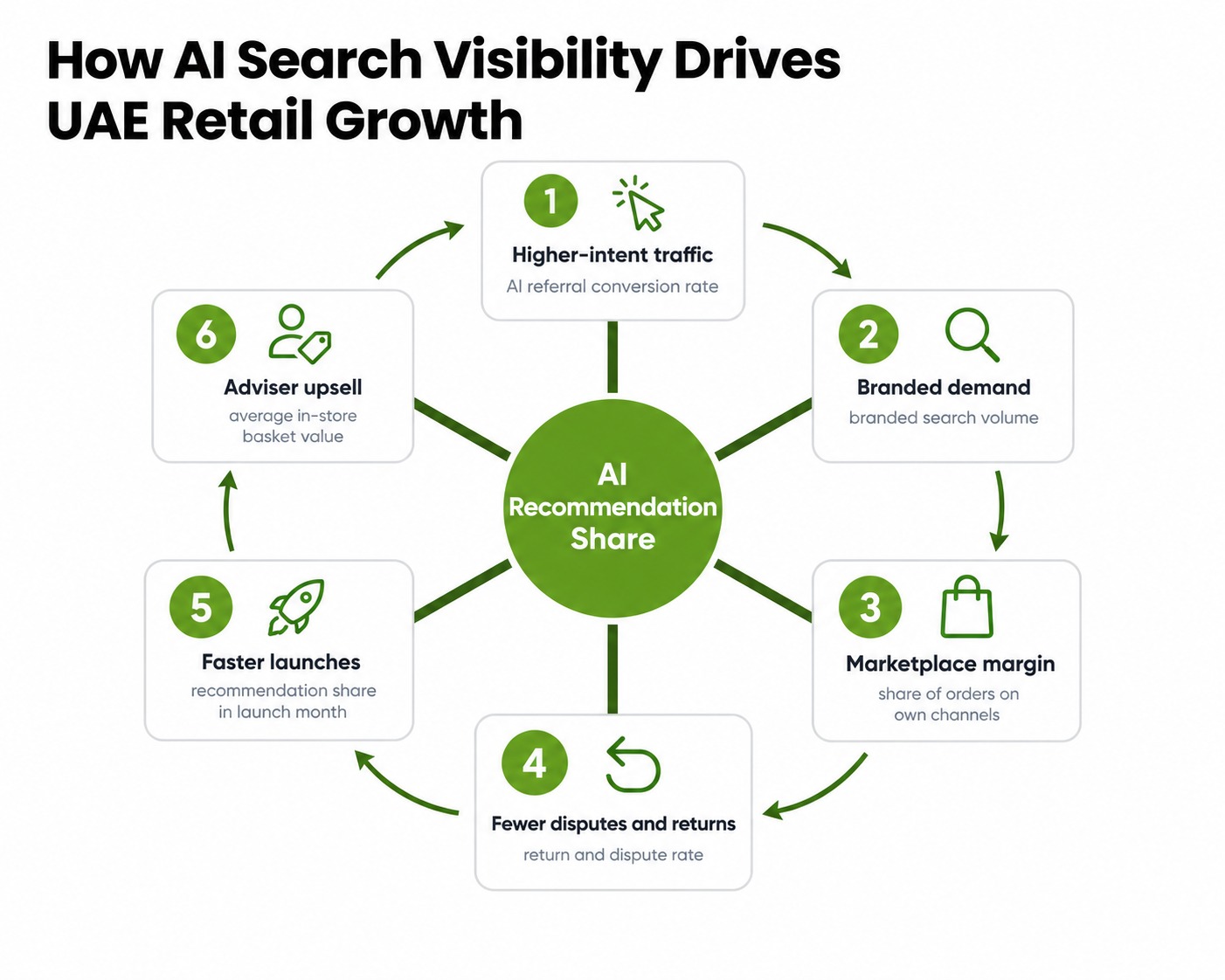
AI search visibility becomes a growth engine when each recommendation feeds revenue, data, and the next recommendation. Six mechanisms drive that flywheel for UAE retailers.
1. Higher-Intent Traffic at Lower Acquisition Cost
Shoppers who arrive from an AI answer have compared options before they click. That shows up in Adobe’s 60% conversion premium for AI referrals.
In March 2026, Adobe saw AI visitors stay 48% longer on site than other traffic. Unlike a paid click, a recommendation carries no per-visit media cost once earned.
2. Branded Demand That Shows Up in Search and Stores
Many shoppers read an AI answer, then search the brand name or walk into a branch. Branded search volume and store visits become the signals to watch. Track both against recommendation share each month. When all three rise together, the channel is working.
3. Margin Recaptured From Marketplaces
When AI names your own store as the seller, the order skips a marketplace commission. You also keep the customer record for CRM and loyalty.
Assistants name a seller when product pages state stock, AED price, and delivery in plain text. Missing seller facts push the answer toward a marketplace listing.
4. Fewer Price Disputes and Returns
Accurate AI answers set the right expectations on price, size, and delivery before checkout. Wrong ones create disputes at the till and returns after delivery.
In fashion and furniture, a wrong size or dimension in an AI answer often turns into a return.
5. Faster Launches Through Pre-Launch Seeding
Ayan’s platform also acts on pre-launch campaigns, where AI forms its first view of a product. Seeding accurate specs and reviews before launch shapes the first answers shoppers see.
For Ramadan, White Friday, and Dubai Shopping Festival, advance seeding decides who appears in gift and deal prompts.
6. Sales Advisers Who Close More Conversations
Advisers who know what AI told a shopper can confirm the facts and move to the upsell. Chalhoub Group reported 2.5 times higher conversion when shoppers used its Layla AI beauty coach.
Some 79% of those chats ran in Arabic, Chalhoub added, which shows where demand sits.
| Growth lever | What changes | KPI to watch |
| Higher-intent traffic | AI referrals convert above average | AI referral conversion rate |
| Branded demand | Shoppers search your name after an answer | Branded search volume |
| Marketplace margin | Your store named as the seller | Share of orders on own channels |
| Fewer disputes | Accurate prices and sizes in answers | Return and dispute rate |
| Faster launches | Specs seeded before launch | Recommendation share in launch month |
| Adviser upsell | Staff know what AI said | Average in-store basket value |
Consider an illustrative Dubai electronics retailer. Its laptops appear in 13% of AI answers, and 41 answers quote an old price.
Fixing the feed lifts accuracy first. Recommendation share follows as reviews and advisers reinforce the corrected facts.
Why Is 2026 the Right Time to Invest in AI Search Visibility?
The window is open because AI answers are scaling faster than brands are preparing. Five signals make 2026 the year to move.
1. AI Consensus Forms Early and Then Hardens
Assistants repeat what the web already agrees on, so first descriptions tend to stick. Semrush found the top three consumer electronics brands hold 76.9% of AI visibility in that category.
Just 36 of more than 1,200 brands stayed in the top 100 on all four platforms every month. Late entrants face a crowded answer.
2. Arabic AI Answers Still Have Few Sources
Arabic makes up 0.6% of websites with a known content language, according to W3Techs. With so thin a pool, clean Arabic pages can win citations faster.
Google launched Arabic AI Mode in Modern Standard Arabic, while shoppers type in Gulf dialect and Arabizi. Brands that cover both registers face few rivals today.
3. Agentic Checkout Is Reaching the UAE
Mastercard and Majid Al Futtaim ran Agent Pay’s first transaction outside the US in November 2025. Visa launched Agentic Ready in the UAE in May 2026 with Tabby and Wio.
Agents will buy from catalogues they can read and trust. Payment rails for agentic commerce in the UAE are moving faster than most retail product data.
Google’s Universal Commerce Protocol runs agent checkout for eligible US retailers, with global expansion promised.
4. Shoppers Will Let AI Switch Brands
Checkout.com found 79% of UAE consumers comfortable letting AI complete a purchase. Asked about loyalty, 71% would let an agent switch brands for better value.
Just 2% said nothing would motivate them to try it. Brand loyalty becomes something an agent weighs against price and delivery.
5. Measurement Tools Finally Exist
Bing Webmaster Tools added a free AI Performance report in February 2026, with Citation Share following in June. Retailers can now baseline what was invisible a year ago.
GA4 custom channels and Search Console add the traffic side of the picture.
What Happens to Your AI Search Visibility If Rivals Move First?
AI answers have limited room, often three to five products per question. Every slot a rival claims is a slot your brand cannot hold that week. Doing nothing is also a decision, and it compounds.
1. Their Version of the Category Becomes AI’s Default
A rival that fixes its specs, reviews, and Arabic pages becomes the reference answer. Assistants then describe your category in that rival’s terms. Displacing an established answer later takes more reviews, coverage, and content than claiming it first.
2. Wrong Facts About Your Brand Go Uncorrected
Without monitoring, nobody sees ChatGPT quoting an old price or a discontinued model. Shoppers arrive expecting that offer, and staff absorb the friction.
In luxury and electronics, one wrong warranty claim can also raise consumer protection questions.
3. Shoppers Switch at the Moment of Choice
With 71% open to agent-led brand switching, a missing answer hands over the sale. Winning that shopper back costs paid media the rival never needed. Agents that compare on price and delivery will skip brands with missing data.
4. Clicks Keep Draining From Classic Rankings
Pew found users clicked a result 8% of the time beside an AI summary, against 15% without one. McKinsey warns unprepared brands could lose 20 to 50% of search traffic.
Brands missing from AI answers lose on both fronts: fewer clicks and no recommendation.
5. Store Teams Lose the Conversation
Shoppers walk in quoting an answer the adviser has never seen. Without a brief, staff contradict the assistant and the sale stalls.
Where Are UAE Retailers Going Wrong With AI Search Visibility?
Most UAE brands miss AI answers through fixable data and process gaps. Eight mistakes recur across the retail catalogues we review. Each one costs less to fix than to ignore.
1. Treating Monitoring as the Finish Line
A dashboard that shows ChatGPT quoting the wrong price fixes nothing. Someone still has to correct the feed, update the page, and brief the store. Ayan’s model exists because this gap is common.
2. Letting AED Prices and Stock Go Stale
Overnight feed exports leave a gap of up to 24 hours. During Dubai Shopping Festival, prices can change several times inside that window. Event-driven sync from the ERP closes that gap.
3. Locking Specs in Images and Variant Pickers
A size chart saved as a JPEG is invisible to most crawlers. Adobe found about 34% of retail product pages cannot be read in full by AI.
4. Machine-Translating Arabic Product Pages
Literal translation keeps the words and loses the intent behind Gulf shopping queries. Mixed Arabic spellings of one brand name split its identity. Native copywriters writing for Gulf shoppers fix both problems.
5. Blocking AI Crawlers by Accident
Many CDN and firewall presets block unknown bots, OAI-SearchBot and PerplexityBot included. Blocking GPTBot opts out of model training, while blocking OAI-SearchBot removes you from ChatGPT search.
6. Leaving Delivery, Returns and Payment Options Off Product Pages
UAE shoppers ask about Tabby, Tamara, cash on delivery, and next-day delivery to Al Ain. Answers skip those details when they sit inside checkout flows. Rivals who state them on product pages win the comparison.
7. Letting Channels Contradict Each Other
Your site says 10 pm closing while Google Business Profile says 11 pm, and Noon shows another price. Assistants respond to conflict by hedging or dropping the brand.
Multi-brand groups solve this with enterprise AI solutions built for UAE retail groups that sync at source.
8. Chasing AI SEO Myths
Google’s July 2026 guide says sites need no LLMs. txt-style files or special markup for AI search. Product schema still helps merchant listings, though Google says it is not required. Time spent on myths is time taken from feeds and reviews.
How Can a UAE Retail Brand Get Ready to Appear in AI Search? A Step-by-Step Guide
Readiness for AI search visibility comes down to eight steps across data, content, access, and people. The order matters, because feed and access fixes help every answer.
1. Run a Bilingual Baseline Audit
A useful audit covers 50 to 100 buying prompts across discovery, comparison, purchase, and local intent. Each runs in English and Arabic across ChatGPT, Gemini, Perplexity, and AI Mode.
Three runs per prompt smooth out session variance. The log of brands, sources, prices, and errors becomes your baseline. Prompts should mirror real questions from search data, customer service logs, and store advisers.
2. Rewrite Product Pages as Answerable Specs
Product pages need the facts an assistant would quote: materials, dimensions, AED price, variants, warranty, and returns. All of it belongs in HTML text.
A short paragraph on who each product suits helps assistants match it to conversational queries. Teams rebuilding a storefront through ecommerce app development in Dubai can bake this into templates at launch.
3. Add Product and Offer Schema in AED
Core properties cover name, brand, GTIN, image, and an Offer with price, priceCurrency set to AED, and availability. The shippingDetails and hasMerchantReturnPolicy properties add UAE delivery and returns.
Markup must match the visible page. Google’s merchant listing documentation lists every supported property.
4. Clean Merchant Center and Business Profile Data
Merchant Center feeds supply AI Mode’s shopping layer, while Business Profiles supply branch hours and local stock. Google’s John Mueller advised keeping both up to date.
Local inventory data also helps near-me answers name the right branch.
5. Sync Prices and Stock From ERP and POS
Event-driven syncing updates feeds, schema, and marketplace listings whenever the ERP or POS changes a price. Legacy stacks often need ERP software development in the UAE to expose those events.
Delivery promises by emirate belong in the same sync, since shoppers ask about them often.
6. Publish Buying Guides That Take a Position
Google asks for “unique, non-commodity content,” and generic guides seldom earn citations. A Dubai summer fragrance guide deserves a ranked answer, tested by your own staff.
Comparison pages that admit trade-offs earn more trust than pages that praise every product.
7. Earn Reviews and Keep Marketplace Listings Identical
Post-delivery review requests build the volume assistants weigh. Identical names, specs, and images on Noon, Amazon.ae, and your store help assistants treat them as one product.
Reviews that mention delivery times, sizing, and authenticity give assistants quotable detail.
8. Open Crawler Access and Brief Your Store Teams
Robots.txt, firewall rules, and CDN presets must admit OAI-SearchBot, PerplexityBot, Bingbot, and Googlebot. Store advisers then need a weekly brief on what AI says about top products.
Some retailers give advisers a bilingual answer tool through AI chatbot development in Dubai.
| Area | What ready looks like | Owner |
| Crawler access | AI bots allowed, pages server-rendered | IT and security |
| Product data | Specs in text, schema priced in AED | E-commerce tech |
| Feeds | Event-driven sync from ERP and POS | Data team |
| Arabic | Native copy, one brand spelling | Content team |
| Reputation | Reviews and identical marketplace listings | Marketing and CX |
| Store | Weekly adviser brief on AI answers | Retail operations |
Ready to turn product feeds, Arabic content, and store systems into answers AI assistants trust and cite?
What Does a 90-Day AI Search Visibility Roadmap Look Like for UAE Retailers?
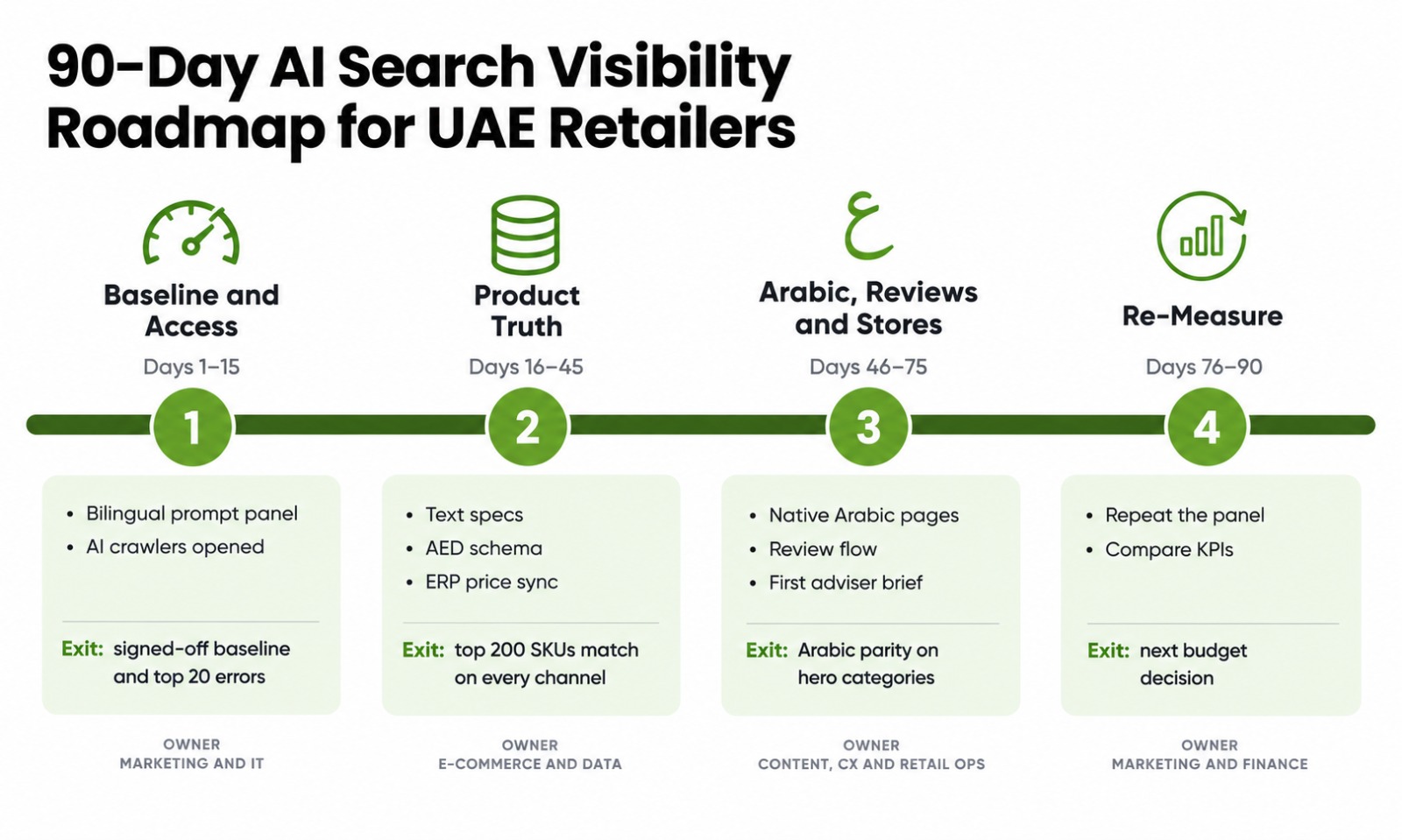
A 90-day AI search visibility roadmap sequences the eight readiness steps into four phases. Each phase ends with a number leadership can sign off on.
1. Days 1 to 15: Set the Baseline and Open Access
Marketing runs the bilingual prompt panel and logs every brand, AED price, and cited source. Recommendation share per category becomes the day-one number.
IT opens robots.txt, firewall, and CDN rules to AI crawlers at the same time. Leadership then signs off on the baseline and the 20 costliest errors.
2. Days 16 to 45: Fix the Product Truth
E-commerce teams move specs out of images and add Product and Offer schema priced in AED. Merchant Center feeds and Business Profiles get cleaned in the same sprint.
Event-driven price and stock sync from the ERP starts with the top 200 SKUs. This phase closes once those SKUs match across site, feeds, and marketplaces.
3. Days 46 to 75: Build Arabic Parity, Reviews and Store Briefs
Native writers rebuild Arabic pages for the top categories under one brand spelling. Post-delivery review requests go live, and marketplace listings are matched to the site.
Store advisers receive their first weekly brief on what AI says about hero products. Questions they log at the counter join the prompt panel, closing Ayan’s loop in miniature.
4. Days 76 to 90: Re-Measure and Choose the Next Investment
Rerun the same prompt panel and compare answer accuracy, recommendation share, and AI referral sessions with day one. Holding prompts fixed ties any change to your own fixes.
Accuracy tends to improve first, while recommendation share moves slower as reviews and citations build. The results set the next budget. Options run from a SaaS tracker to a hybrid data layer or custom platform.
| Phase | Days | Lead owners | Exit metric |
| Baseline and access | 1 to 15 | Marketing, IT and security | Signed-off baseline and top 20 errors |
| Product truth | 16 to 45 | E-commerce tech, data team | Top 200 SKUs match on every channel |
| Arabic, reviews and stores | 46 to 75 | Content, CX and retail operations | Arabic parity on hero categories, first adviser brief |
| Re-measure | 76 to 90 | Marketing and finance | Before-and-after report and next budget |
What Does an Ayan-Style AI Search Visibility Platform Look Like Under the Hood?
An Ayan-style platform joins three worlds that seldom share data: AI answers, product systems, and store teams. Seven layers make that possible.
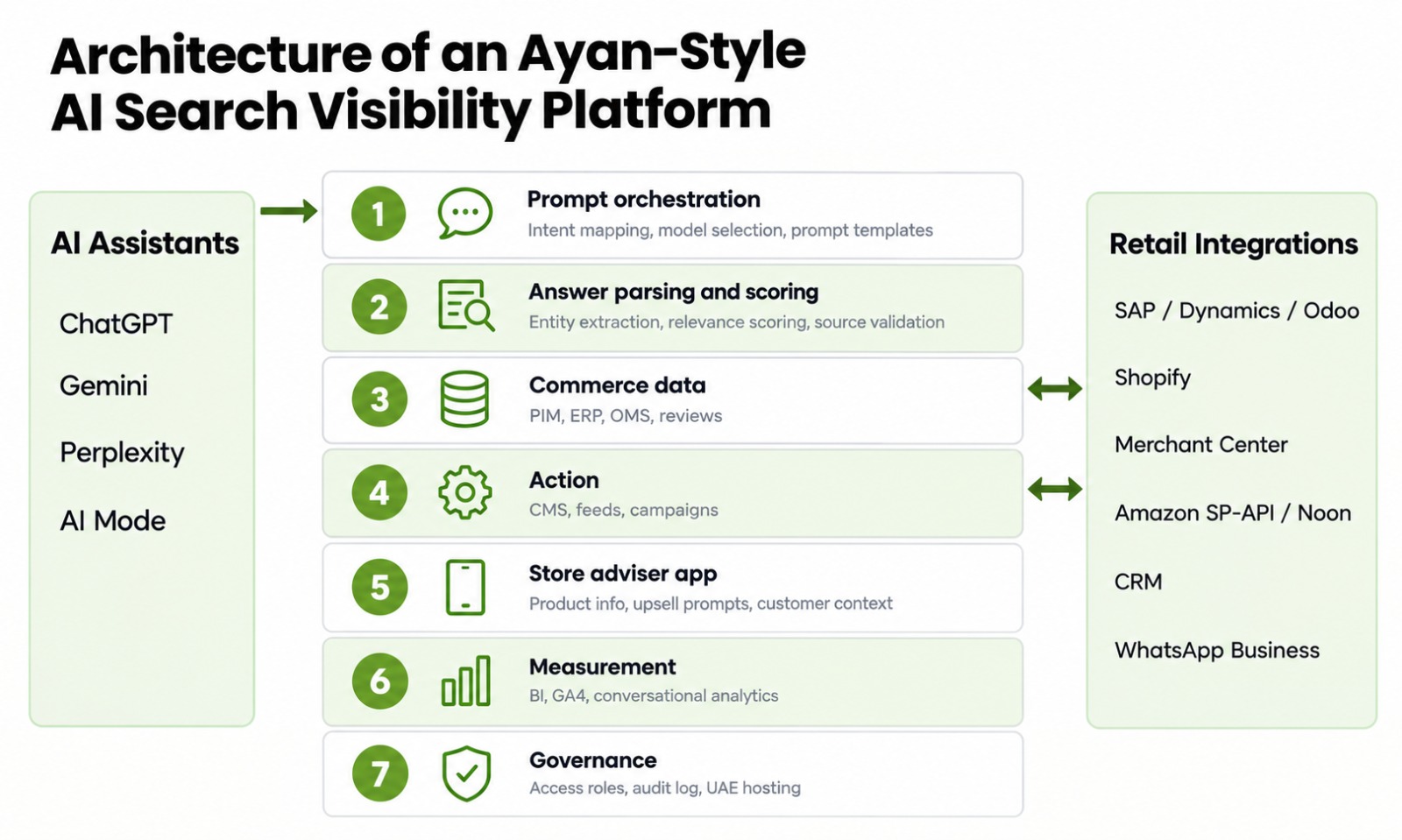
1. Prompt Orchestration Layer
A scheduler runs the bilingual prompt panel across assistants each week, by category and emirate. API outputs can differ from consumer apps, so good platforms also sample logged-out sessions within each platform’s terms.
The panel stays fixed for a quarter, so changes reflect your fixes. New prompts come from adviser logs and search data.
2. Answer Parsing and Scoring Layer
Each answer is parsed for brands named, products, prices, claims, and cited URLs. A scoring model then checks those facts against your PIM and a written positioning brief.
Human reviewers audit a sample, since automated judges miss nuance in Arabic. Scores roll up into accuracy and positioning-fit metrics per product.
3. Commerce Data Layer
This layer holds the truth: PIM attributes, ERP prices and stock, order data and reviews. Every AI claim gets compared with it.
Without it, the platform can spot a wrong answer but cannot prove the right one.
4. Action Layer
Detected gaps become tasks: a CMS update, a feed correction, a schema fix, or a campaign brief. Low-risk fixes can be pushed by the platform, while price and claim changes need human approval.
Each task carries the source answer, the proposed fix, and the expected change. Routing work to owners is where AI automation for Dubai retail teams earns its keep.
5. Store Adviser Layer
A mobile app gives advisers the latest AI answers for their category in Arabic and English. Advisers log the questions shoppers ask, and those feed the next prompt panel.
The app shows the answer a shopper may have heard, next to the correct facts. Teams already building Arabic-first AI chatbots for UAE retailers can reuse that stack for the adviser app.
6. Measurement Layer
Dashboards track share of recommendation, answer accuracy, citations, AI referral sessions, and AI-assisted revenue as separate numbers. A conversational layer lets managers query that data in English or Arabic.
Each metric answers a different question, so blending them hides problems.
7. Governance Layer
Role-based access, audit logs, and UAE hosting keep customer questions within PDPL expectations. Every automated change carries a record of who approved it and why.
Teams planning PDPL-compliant app development in the UAE should settle hosting before choosing models.
| Layer | Job | Typical components |
| Prompt orchestration | Run bilingual prompts on schedule | Job scheduler, LLM APIs, session sampling |
| Parsing and scoring | Extract and score claims | Entity extraction, LLM judge, human QA |
| Commerce data | Hold product truth | PIM, ERP, OMS, reviews |
| Action | Push fixes | CMS, feed manager, campaign tools |
| Store adviser | Brief staff, log questions | Mobile app, clienteling tool |
| Measurement | Report KPIs | BI dashboard, GA4, conversational analytics |
| Governance | Control and audit | Access roles, audit log, UAE hosting |
Which Integrations Does an AI Search Visibility Platform Need?
Integrations decide whether a platform reports problems or fixes them as well. Most UAE retailers need connections in five groups.
1. Product and Inventory Systems
PIM and ERP platforms such as SAP, Oracle, Microsoft Dynamics 365, and Odoo hold the source of truth. Event hooks or scheduled APIs push price and stock changes into the platform.
The platform reads from these systems and never overwrites them, so finance and merchandising keep control.
2. Commerce Platforms and Marketplaces
Shopify, Salesforce Commerce Cloud, and Adobe Commerce expose product and content APIs for page fixes. Amazon’s Selling Partner API and marketplace seller feeds keep Noon and Amazon.ae listings aligned.
Without write access, the platform can do no more than raise tickets.
3. Google and Microsoft Surfaces
Merchant Center and Business Profile APIs carry feed and branch corrections. Search Console and GA4 APIs supply search and referral data, and Bing’s AI Performance report adds Copilot citations.
Teams often export Bing’s report on a schedule for the dashboard.
4. AI Model and Search APIs
OpenAI, Gemini, and Perplexity APIs run the prompt panel at scale. Costs depend on prompt volume, languages, and how often the panel runs.
Model API fees for a weekly bilingual 100-prompt panel stay under AED 2,000 a month in most setups. Scoring and human review cost more than the runs themselves.
5. CRM, Clienteling and Messaging
Salesforce, HubSpot or Dynamics CRM records link AI-referred visits to customers, within consent rules. WhatsApp Business and clienteling apps carry briefs to advisers and capture their questions.
MCP endpoints come next, letting shopping agents query live stock and prices. Consent logs matter, since PDPL treats linked customer data as personal data.
| Integration | Systems | Why it matters |
| Product truth | PIM, ERP (SAP, Oracle, Dynamics, Odoo) | Checks every AI claim |
| Storefront | Shopify, Salesforce Commerce Cloud, Adobe Commerce | Pushes page and schema fixes |
| Marketplaces | Amazon SP-API, Noon seller feeds | Keeps listings identical |
| Google and Microsoft | Merchant Center, Business Profile, Search Console, GA4, Bing | Feeds, branches, referral and citation data |
| AI assistants | OpenAI, Gemini, Perplexity APIs | Runs the prompt panel |
| Store and CRM | CRM, clienteling app, WhatsApp Business | Briefs advisers, captures questions |
How Much Should UAE Retailers Invest in AI Search Visibility?
Investment in AI search visibility scales with catalogue size, languages, and how deep the integrations go. Five paths cover most UAE retailers, from a one-off audit to a full Ayan-style platform.
1. Bilingual Audit: AED 15,000 to AED 40,000
A one-off audit covers the prompt panel, crawler checks, schema review, and a prioritised fix list. It suits brands that need a baseline before committing budget.
The output should rank fixes by effort and revenue impact, with owners named.
2. SaaS Trackers: AED 100 to AED 2,500+ a Month
Entry-tier trackers cost about AED 100 to AED 700 a month for 15 to 100 prompts. Mid-tier plans run AED 700 to AED 1,850, and enterprise platforms start near AED 2,500.
These tools report well but stop at the screen, with limited Arabic support and no ERP link. Prompt limits matter more than headline price, since a bilingual panel doubles the count.
3. Hybrid Data Layer: AED 45,000 to AED 120,000
A custom data layer connects a SaaS tracker to your PIM, ERP, and feeds, so gaps become fixes. The subscription runs on top. It suits mid-size retailers who want fixes without a full build.
4. Custom Monitoring Dashboard: AED 90,000 to AED 260,000
A custom dashboard includes the prompt panel, scoring, and reporting, hosted in the UAE. Model APIs and hosting add AED 3,000 to AED 9,000 a month.
Scoped as custom software development in Dubai, the code and data stay your assets. It suits groups whose security teams require UAE data residency.
5. Full Ayan-Style Platform: AED 250,000 to AED 750,000
The full build adds the action layer, adviser app, marketplace sync, and governance controls. Running costs, including model APIs and support, sit near AED 10,000 to AED 30,000 a month.
That budget suits multi-brand groups with dozens of categories, several marketplaces, and large store teams.
Benchmarks on AI development cost in the UAE and AI agent development costs in AED set the context. Internal effort sits on top: content writers, a merchandiser, and an analyst for a few hours each week.
| Path | Upfront (AED) | Monthly (AED) | Best for | Time to launch |
| Bilingual audit | 15,000 to 40,000 | None | First baseline | 3 to 4 weeks |
| SaaS tracker | None | 100 to 2,500+ | Small catalogues | About one week |
| Hybrid data layer | 45,000 to 120,000 | Subscription plus hosting | Mid-size retailers | 6 to 10 weeks |
| Custom dashboard | 90,000 to 260,000 | 3,000 to 9,000 | Groups with residency needs | 10 to 16 weeks |
| Full Ayan-style platform | 250,000 to 750,000 | 10,000 to 30,000 | Multi-brand retail groups | 16 to 28 weeks |
These ranges reflect Code Brew Labs planning estimates for UAE builds in 2026. A useful rule: buy a tracker to learn, then build once integrations and store loops matter.
Vendor choice shapes the outcome, so the checklist for choosing an ecommerce development partner in Dubai applies here.
What Will AI Search Visibility Look Like for UAE Retail in 2027?
The next phase moves from answers to actions. Assistants will compare, reserve, and pay, which rewards retailers whose product data is clean.
1. Agent Checkout Spreads Beyond US Pilots
Google’s Universal Commerce Protocol runs agent checkout for eligible US retailers, with global expansion promised. UAE pilots from Mastercard with Majid Al Futtaim and Visa’s Agentic Ready programme point the same way.
Checkout.com found 72% of UAE consumers would use an agent for event tickets. Routine categories like tickets, groceries and replenishment look set to move first.
2. Merchant Feeds Become the Agent’s Catalogue
OpenAI moved ChatGPT shopping toward merchant feeds in March 2026, and Google’s protocol works alongside AP2 and MCP. Catalogues that agents can query in real time will win more of those answers.
3. Gulf Arabic Voice and Dialect Search
TII in Abu Dhabi released Falcon-H1 Arabic in January 2026 and reports it leads open Arabic model rankings. As Arabic models improve, voice shopping in Gulf dialect will grow.
Brands with dialect-aware FAQ content will be ready for it.
4. Camera-Led Product Discovery
AI Mode already accepts images alongside text in Arabic and English. A shopper can photograph a lamp in a Jumeirah café and ask where to buy it.
Clean product images, descriptive alt text, and consistent names raise the odds of a match.
5. Paid Placements Inside AI Answers
Google already runs ads inside its AI search experiences, and retail media budgets will follow shoppers there. Organic visibility stays the base, since paid units sit beside answers built from organic sources.
6. Stores Join the AI Loop
LuLu Retail signed in October 2026 for 62 AI-enabled robots across 30 UAE stores. Physical stores are gaining AI touchpoints, and adviser loops like Ayan’s will spread with them.
7. Tighter Scrutiny of AI Product Claims
UAE Consumer Protection Law 15 of 2020 requires accurate product information. Decree-Law 14 of 2023 governs modern technology-based trade. If an assistant repeats an inflated claim from your page, the exposure sits with you.
How Can Code Brew Labs Build an Ayan-Style AI Search Visibility Platform for You?
Code Brew Labs builds AI search visibility platforms for UAE retail groups, D2C brands, marketplaces, and mall operators. We connect prompt testing, scoring, product systems, and store teams in one closed loop.
Marketing Pro, our AI marketing command centre, includes AI SEO visibility tracking and delivers 4X faster campaign execution. Its users saw a 45% increase in ROI tracking accuracy.
Kaizan AI, our conversational reporting product, turns plain-English questions into charts and cuts report generation time by 70%. That same pattern powers the measurement layer managers query.
Our Arabic-first chatbot work covers Gulf dialect handling, which the adviser app and scoring layer both need.
An MCP-enabled concierge we delivered for a national flag carrier resolved passenger requests 60% faster across enterprise systems. REDTAG’s fashion e-commerce platform, built by our team, holds 1M+ Google Play downloads and a 4.3 rating.
Delivery aligns with the UAE PDPL, Consumer Protection Law 15 of 2020, and Google’s product structured data rules. Every build ships with Arabic and English parity, UAE hosting options, and human approval on sensitive changes.
Our 650+ specialists bring 13+ years of UAE delivery. More retail and e-commerce case studies from the UAE and GCC sit in our portfolio.
As an AI development company in Dubai, we build that loop around your catalogue, systems, and stores.
Planning an AI brand intelligence platform that connects AI answers to your PIM, ERP, and store teams?
Is AI Search Visibility Worth the Investment for UAE Retailers?
Yes, for any UAE retailer whose shoppers compare before they buy. Demand, conversion data, and Arabic AI answers are already in place in 2026.
Ayan’s raise shows investors expect brands to pay for the closed loop. Retail groups should own that loop, with baselines, owners, and monthly reporting.
Fast-growing D2C brands should start with an audit, clean feeds, and Arabic parity, then add tooling. The brands AI names in 2026 will set the terms for 2027.
FAQs
What is AI search visibility?
AI search visibility is how often AI assistants mention, cite, or recommend your brand in shopping answers. It covers ChatGPT, Gemini, Perplexity, Copilot, and Google’s AI Overviews and AI Mode. Retailers measure it with share of recommendation, citation rate, and answer accuracy across a bilingual prompt panel.
Why is AI search visibility a growth channel for UAE retail?
AI search visibility is a growth channel because 8 in 10 UAE adults use AI to shop. AI-referred shoppers also convert better, with Adobe reporting a 31% lift over the 2025 holidays. Google now serves these answers in Arabic and English.
What does Ayan do for retail brands?
Ayan reads what AI assistants say about a brand and compares it with the brand’s positioning. It then fixes product pages, briefs sales advisers, and measures what changed in AI answers. Counter questions from shoppers feed back in as the next fix.
How much does AI search visibility cost in the UAE?
A bilingual audit costs AED 15,000 to AED 40,000. SaaS trackers run AED 100 to AED 2,500+ a month. Custom dashboards cost AED 90,000 to AED 260,000, and full closed-loop platforms reach AED 750,000.
How can a retail brand appear in ChatGPT and Google AI Mode answers?
Allow OAI-SearchBot and Googlebot, publish specs as text, and add Product schema with AED prices. Keep Merchant Center feeds and Business Profiles current, and earn reviews on sites assistants cite. Google confirms AI Mode has no extra technical requirements beyond these fundamentals.
Does Arabic content improve AI search visibility in the UAE?
Yes. Google runs AI Overviews and AI Mode in Arabic, so Arabic pages give assistants a source to cite. Arabic makes up 0.6% of websites with a known content language, leaving room for brands that invest. Native copy and matching schema in both languages outperform literal translation.
Should UAE retailers build or buy an AI visibility tool?
Buy a SaaS tracker to learn what AI says, then build once integrations and store loops matter. Custom platforms suit groups that need UAE hosting, ERP links, and adviser apps. Small catalogues can start with a tracker and an audit.
Why should UAE retailers invest in AI search visibility in 2026?
UAE retailers should invest in AI search visibility in 2026 because AI consensus about brands is forming now. Just 16% of brands track AI search performance, McKinsey found, so first movers face little competition. Agentic payments from Mastercard and Visa are already live in UAE pilots.
Let's Convert Your Business Idea Into Success!
Free Consultation from Top Industry Experts
Let’s Build Your Dream App!
Share article on :



 No commitment required
 NDA on request
 24-hour response


