
Quick Summary:
- Building an AI-powered mobile app in Dubai takes 10 steps, from choosing one job for the AI to running and improving the app after launch.
- An AI MVP takes 6 to 12 weeks and starts at AED 18,000. A mid-level app costs AED 92,000 to 294,000, and each AI feature adds roughly AED 29,000 to 294,000 on top.
- Start with one AI feature and an API-based model. It reaches value faster than a custom-trained model for most UAE business apps.
- Plan UAE requirements before design: PDPL consent and data handling (AED 15,000 to 30,000 if built in from the start), Arabic right-to-left layout, UAE PASS and local payment gateways.
- Test the AI separately from the app, in both English and Arabic, before launch.
- Budget for running costs: AI usage fees of about AED 400 to 11,000 a month and annual maintenance of 15 to 25% of the build cost.
Most AI app projects in Dubai go wrong in the first month, not the last. Teams pick a big AI idea, skip the data check, and find out about Arabic, PDPL, and running costs after the design is done.
This guide walks you through AI-powered mobile app development in Dubai in the order a good team would do it. Each step says what you decide, how long it usually takes, and what it costs in AED. For market background, architecture, and industry examples, see our companion guide to AI-powered mobile app development in the UAE.
Ready to build your AI app in Dubai? Get a free scoping call with Code Brew Labs.
Talk to our UAE team about your idea, your data and your budget. We will give you a clear plan and a straight answer on what it takes. No commitment required. NDA on request. 24-hour response.
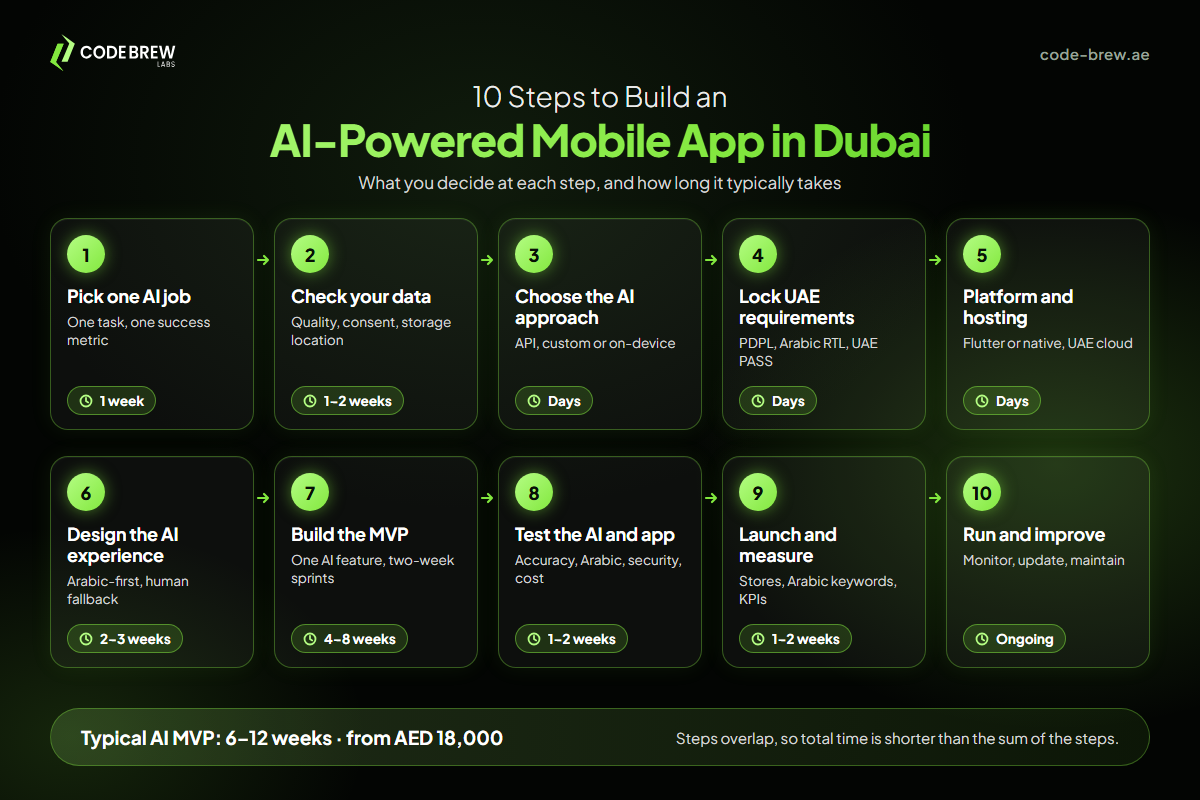
The 10 Steps at a Glance
| Step | What you decide | Typical time |
|---|---|---|
| 1. Pick one job for the AI | The single problem the AI solves and how you will measure it | 1 week |
| 2. Check your data | What data you have, its quality, and whether you may use it | 1 – 2 weeks |
| 3. Choose the AI approach | API-based model, custom model or on-device AI | Days |
| 4. Lock the UAE requirements | PDPL, Arabic, UAE PASS, payments, sector rules | Days |
| 5. Pick platform, stack and hosting | Flutter, React Native or native; UAE-region cloud | Days |
| 6. Design the AI experience | How the AI looks, speaks and hands over to a human | 2 – 3 weeks |
| 7. Build the MVP | One AI feature, shipped in sprints | 4 – 8 weeks |
| 8. Test the AI and the app | Accuracy, Arabic quality, security, cost per user | 1 – 2 weeks |
| 9. Launch and measure | Store release, Arabic keywords, success metrics | 1 – 2 weeks |
| 10. Run and improve | Monitoring, model updates, maintenance | Ongoing |
Steps overlap, so a focused MVP usually reaches the stores in 6 to 12 weeks in total.
Step 1: Pick One Job for the AI
Do not start with “we need an AI app”. Start with one repeated task that is slow, costly or error-prone today.
A good first AI job passes three tests:
- It happens often. Daily or weekly, not once a year.
- You can measure it. Minutes saved, tickets avoided, orders recommended, fraud caught.
- A wrong answer is affordable. The AI suggests, a person can correct it, and nothing irreversible happens.
Typical first jobs in Dubai include a bilingual customer support assistant, product or property recommendations, document and ID checks, fraud alerts, booking and scheduling suggestions, and photo-based search.
Deliverable: one clear sentence that says what the AI will do, for whom, and how you will measure success. For example: “The AI will answer common questions in English and Arabic for app users, and we will know it works when 60% of chats are resolved without a human agent.”
More examples from common Dubai use cases. The numbers are sample targets. Set yours from today’s baseline.
- Healthcare: The AI will suggest open appointment slots for patients, and we will know it works when missed appointments fall by 15%.
- Real estate: The AI will recommend matching properties to buyers, and we will know it works when the share of users who book a viewing rises by 20%.
- Fintech: The AI will flag suspicious transactions for the fraud team, and we will know it works when fraud losses fall by 25% while no more than 2% of genuine payments are blocked.
- Logistics: The AI will suggest the fastest delivery route to drivers, and we will know it works when average delivery time falls by 10%.
A weak version is “use AI to improve the customer experience”. It names no user, no task and no number, so nobody can tell later whether it worked.
Step 2: Check Your Data
AI quality depends on the data behind it. Before you spend on design, answer four questions:
- What data do we have? Customer messages, transactions, images, documents, app usage.
- Is it clean enough? Missing fields, duplicates and mixed Arabic and English text all reduce accuracy.
- Are we allowed to use it? Under the UAE Personal Data Protection Law (Federal Decree-Law No. 45 of 2021), you need a clear basis, usually consent, for personal data.
- Where will it be stored and processed? Some regulated clients and government entities require data to stay in the UAE.
If you have little data, that is fine for a first version. Many API-based features, such as chatbots, work from your content and rules instead of years of history.
Deliverable: a one-page data map. It is a simple table with one row for each type of data the AI will use. For each row, record where the data comes from, who owns it, how good it is, whether you have consent to use it, and where it is stored. For example:
| Data | Source | Owner | Quality | Consent | Stored |
|---|---|---|---|---|---|
| Customer chat messages | In-app chat | Support team | Good, mixed Arabic and English | Yes, accepted at sign-up | UAE cloud region |
| Booking history | Booking system | Operations | Good, some missing fields | Yes | UAE cloud region |
| Customer photos | User uploads | Product team | Mixed | Not yet, add a consent screen | Not decided |
A “Not yet” under consent or “Not decided” under storage is a problem to fix before design starts.
Step 3: Choose the AI Approach
There are three common ways to add AI to a mobile app. Most UAE business apps should start with the first.
| Approach | How it works | Best for | Trade-off |
|---|---|---|---|
| API-based model | The app calls a hosted AI model through an API | Chatbots, summaries, recommendations, document reading | Fastest to launch, but you pay per use and depend on a provider |
| Custom or fine-tuned model | You train or adapt a model on your own data | Unique data, special accuracy needs, fraud and risk scoring | Higher build cost and needs enough quality data |
| On-device AI | The model runs on the phone, without internet | Privacy-sensitive features, offline use, field teams | Limited model size and more device testing |
For most UAE business apps, an API-based model reaches value faster than a custom-trained one. Move to a custom model later, once real usage shows where it pays off.
Arabic needs its own decision. Arabic language processing is the most complex and costly AI feature in this market. Check a model in Arabic, not only in English, before you commit. UAE-built Arabic models such as Jais and Falcon are worth testing; our Arabic-first AI chatbot guide compares the options.
Deliverable: a half-page note that names the AI approach, the model or provider, and the reason for the choice. For example: “We will use an API-based model for the chatbot, because it launches fastest and we do not yet have enough data to train our own. We will test one UAE-built Arabic model and one global model on 50 real Arabic questions, and keep the one with the higher accuracy.”
Step 4: Lock the UAE Requirements Before Design
These requirements change the design and the budget. Adding PDPL compliance after launch, for example, typically costs three to five times more than building it in from the start.
| Requirement | What it means | Added cost (AED) |
|---|---|---|
| PDPL compliance | Consent screens, data deletion, breach handling, data residency records | 15,000 – 30,000 if built in from the start (45,000 – 90,000+ if added after launch) |
| Arabic right-to-left (RTL) | Mirrored layouts and a separate Arabic test pass, not just translated text | +15 – 25% of design cost and +8 – 15% of development hours |
| UAE PASS sign-in | National digital identity; needs TDRA approval | 15,000 – 30,000 |
| Payment gateways | PayTabs, Telr, Network International, Tabby, Tamara | 11,000 – 29,000 per gateway |
| Apple Pay / Samsung Pay | Device wallet payments | 7,000 – 15,000 per wallet |
| Arabic content and review | Translation and cultural review of in-app text | 7,000 – 30,000 |
Sector rules sit on top: fintech apps answer to the Central Bank of the UAE (CBUAE) and often need PCI DSS, and healthcare apps follow health authority rules such as DHA and DoH. Apps run by DIFC-licensed companies fall under the DIFC Data Protection Law rather than the federal law. Since June 2026, oversight of data and AI rules also sits with the new Federal Authority for Artificial Intelligence and Data.
For a deeper look at privacy, read our PDPL-compliant app development guide.
Deliverable: a requirements checklist that the designer and the engineers both sign off before design starts. For example:
- PDPL: consent screen at sign-up, data deletion in settings, breach process written down.
- Arabic: full right-to-left layout and a separate Arabic test pass.
- UAE PASS: not needed in version 1, planned for version 2.
- Payments: card payments through PayTabs, Apple Pay later.
- Sector rules: none for this app. A fintech app would list CBUAE requirements here.
Step 5: Pick the Platform, Stack and Hosting
Platform. Most UAE businesses start cross-platform. Flutter and React Native now power over 60% of new Dubai builds and cut build cost by 35 to 40% compared with two native apps. Choose native only when the AI needs deep hardware access, such as advanced AR or on-device sensors. Read Flutter vs React Native for Dubai businesses to choose between the two.
Backend and AI layer. Keep AI calls on your server, not inside the app. This protects your API keys, lets you cap spending, and lets you switch models later without a new app release.
Hosting. Host in a UAE or GCC cloud region when your clients or sector require data residency. Options include Azure UAE North and UAE-sovereign providers for government and regulated work. UAE-region hosting costs 15 to 25% more than equivalent US-region hosting. A basic backend runs about USD 100 to 400 a month, and high-traffic enterprise apps USD 1,500 to 8,000 or more.
Deliverable: a one-page architecture sketch that shows how the parts connect: the app, the backend, the AI service, the database and the hosting region. For example: “Flutter app, then a backend API hosted in a UAE cloud region, then the AI model API (called from the backend only, never from the app), then a database in the same UAE region.”
Step 6: Design the AI Experience
AI features fail in the interface more often than in the model. Design for the moments when the AI is wrong or unsure.
- Arabic first, not translated later. Design in both languages from day one, including right-to-left layouts and Arabic error messages.
- Tell users when they are talking to AI, and ask for consent before using their personal data.
- Always give a way out. A “talk to a person” button, an edit option or a thumbs-down that sends feedback.
- Keep answers short and checkable. Show the source or the reason behind a recommendation where you can.
- Plan the empty and error states. What the app shows when the AI is slow, offline or cannot answer.
Design typically takes 2 to 3 weeks for an MVP and should be 10 to 25% of the budget, depending on whether the app is for consumers or enterprise staff.
Deliverable: a clickable prototype in English and Arabic, tested with five real users. For example: each of the five users tries to complete the main task in both languages. You record how many finish without help and where they get stuck. If three or more users get stuck on the same screen, redesign that screen before you build it.
Step 7: Build the MVP With One AI Feature
Ship one AI feature that does its job well. Scope the first release to a single high-value user action, then add features once real usage shows what people want. An MVP approach reduces initial investment by 30 to 50%. Our AI-driven MVP strategy guide shows how to scope it.
Practical tips for the build:
- Work in two-week sprints with a demo at the end of each one.
- Set a monthly spending cap on AI usage from day one.
- Log every AI answer (without personal data) so you can find and fix weak spots.
- Use AI coding and testing tools. Teams that use them consistently cut routine development time by 20 to 30%. Ask any partner which tools they use.
- Lock the feature list before sprint one. Adding features mid-project raises the final cost by 30 to 50%.
An MVP build typically takes 4 to 8 weeks.
Deliverable: a working app with one AI feature on a test server, demoed to real users. For example: after two sprints (about four weeks), a staff member or test customer can open the app, ask the assistant a question in Arabic and get a correct answer, with the spending cap and answer logging already switched on.
Step 8: Test the AI, Not Only the App
Normal app testing checks that buttons work. AI testing checks that the answers are good. Add these checks before launch:
- Accuracy set. Prepare 50 to 100 real questions or cases with the right answers and score the AI against them, in English and in Arabic.
- Edge cases. Slang, Gulf Arabic dialect, mixed Arabic and English, typos, and attempts to make the AI say something it should not.
- Speed. Most users expect an answer within a few seconds.
- Cost per user. Multiply the average AI calls by price, to confirm the app stays affordable at 10 times the users.
- Security. A penetration test costs AED 10,000 to 25,000 per audit. Regulated apps such as fintech and healthcare should plan quarterly reviews.
- Compliance. Check consent screens, data deletion and storage location against the Step 4 checklist.
Deliverable: a one-page test report with accuracy scores, known limits and sign-off. Example report (sample numbers only):
- Accuracy: Arabic 88% and English 93% on 80 test questions.
- Speed: average answer time of 2.4 seconds.
- Cost: AI usage of AED 0.90 per active user per month.
- Security: penetration test found two medium issues, both fixed.
- Known limit: the assistant does not answer legal questions and hands over to a person.
- Sign-off: product owner, tech lead and compliance lead.
Step 9: Launch and Measure
Submit to the App Store and Google Play, and allow one to three weeks for review cycles and Arabic localisation checks. A strong launch also needs:
- Arabic app store keywords. Arabic search patterns and spellings differ from English. A professionally managed first-year program typically costs AED 8,000 to 25,000.
- The success metric from Step 1 on a dashboard that the whole team can see.
- A feedback channel inside the app for wrong or unhelpful AI answers.
Plan first-year marketing at 30 to 50% of the build cost to reach a viable number of users. Customer acquisition in Dubai can be costly, so a clear launch plan matters.
Deliverable: a live app, a dashboard and a 30-day improvement plan. For example: the dashboard shows the success metric from Step 1 (such as chats resolved without a human agent), daily active users and the 10 lowest-rated AI answers. The 30-day plan lists the three fixes you will ship first, such as new Arabic phrases and a clearer “talk to a person” button.
Step 10: Run and Improve the App
An AI app is never “finished”. Models change, user questions shift and the phone operating systems update every year.
- Maintenance: 15 to 25% of the build cost each year, covering bug fixes, operating system updates and security patches.
- AI running costs: usage fees depend on the feature (see the table below) and grow with your user numbers.
- Review the AI monthly: read the lowest-rated answers, fix them, and re-run your accuracy set after every model or prompt change.
- Watch compliance: regulated apps should budget AED 5,000 to 15,000 a year for compliance monitoring.
Overall, the first-year total cost of ownership typically runs 1.5 to 2 times the build quote once hosting, marketing and compliance are included.
Deliverable: a one-page monthly AI review. For example: the success metric for the month, the AI usage cost, the 10 lowest-rated answers and the fixes planned for next month.
What Does an AI-Powered Mobile App Cost in Dubai?
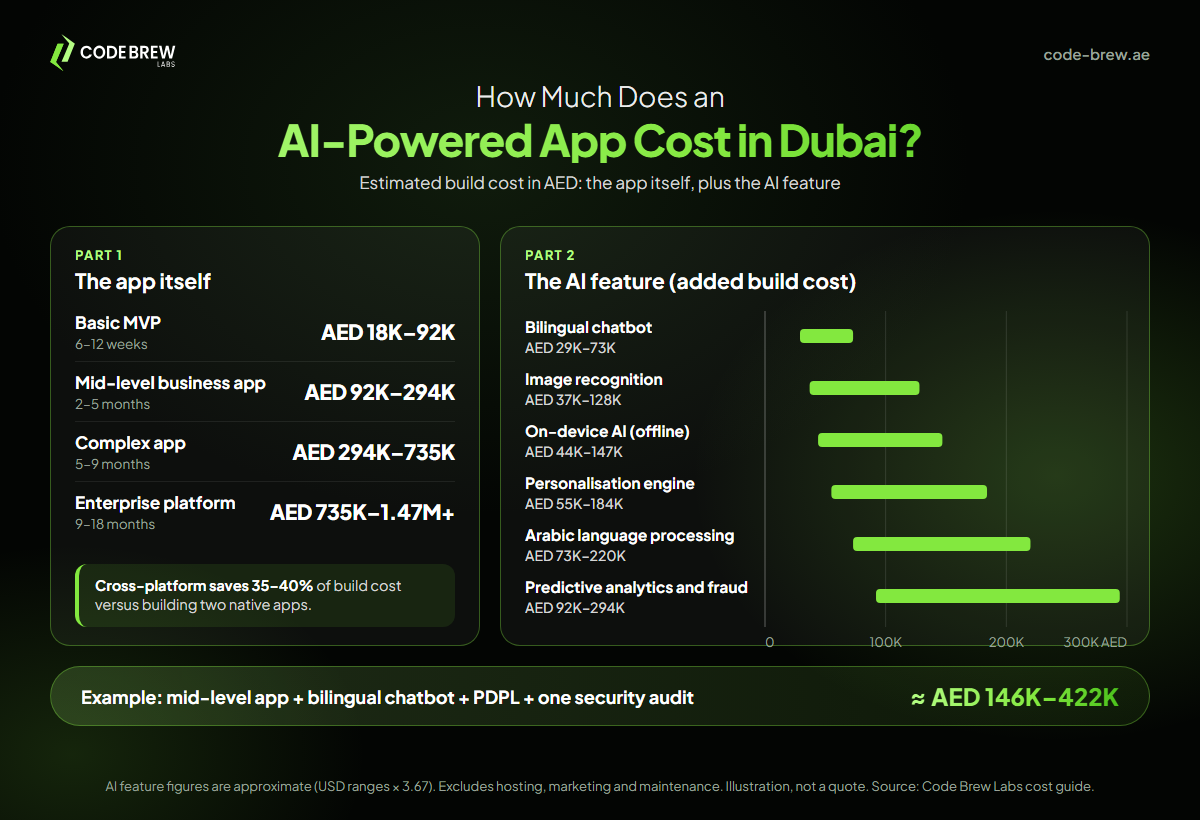
Start with the cost of the app itself, then add the AI feature. These ranges come from our mobile app development cost guide for Dubai.
Part 1: The app itself
| App tier | Estimated cost (AED) | Timeline |
|---|---|---|
| Basic MVP | 18,000 – 92,000 | 6 – 12 weeks |
| Mid-level business app | 92,000 – 294,000 | 2 – 5 months |
| Complex app | 294,000 – 735,000 | 5 – 9 months |
| Enterprise platform | 735,000 – 1,470,000+ | 9 – 18 months |
Part 2: The AI feature
| AI feature | Added build cost (AED, approx.) | Running cost per month (AED, approx.) | Good for |
|---|---|---|---|
| Bilingual chatbot (English and Arabic) | 29,000 – 73,000 | 700 – 7,300 | Most consumer and service apps |
| Personalisation engine | 55,000 – 184,000 | 1,100 – 5,500 | E-commerce, entertainment, on-demand |
| Arabic language processing | 73,000 – 220,000 | 700 – 5,500 | Government, enterprise, news |
| Image recognition | 37,000 – 128,000 | 400 – 2,900 | Real estate, retail, logistics |
| On-device AI (works offline) | 44,000 – 147,000 | None | Fintech, healthcare, field teams |
| Predictive analytics and fraud detection | 92,000 – 294,000 | 1,800 – 11,000 | Fintech, insurance, marketplaces |
AED figures are converted from the USD ranges in our cost guide at about 3.67 AED per USD and rounded.
Example budget
A mid-level business app (AED 92,000 to 294,000) with a bilingual chatbot (AED 29,000 to 73,000), PDPL built in (AED 15,000 to 30,000) and one security audit (AED 10,000 to 25,000) comes to roughly AED 146,000 to 422,000 before hosting, marketing and maintenance. This is an illustration, not a quote. Ask for a scoped estimate for your project.
For deeper AI pricing, see our guides to AI development cost in the UAE and AI agent development cost.
Get your AI app estimate in 48 hours.
Share your idea and we will send a scoped, compliance-aware estimate in AED. It includes PDPL, Arabic and UAE PASS costs, not just the build.
Common Mistakes When Building AI Apps in Dubai
- Starting with five AI features. Launch one, prove it works, then add the next.
- Treating Arabic as a translation job. Right-to-left layout and Arabic AI quality need their own design and testing.
- Leaving PDPL until the end. It costs three to five times more to add after launch.
- No spending cap on AI usage. A popular feature can turn a small monthly bill into a large one.
- Testing only in English. Gulf dialects and mixed-language messages break many models.
- Choosing the lowest quote. Teams that optimise for the cheapest build often rebuild within 18 months at about three times the original cost.
- No plan for after launch. Budget maintenance and AI running costs before you sign.
How to Choose an AI App Development Partner in Dubai
Ask these questions before you sign:
- Which AI features have you shipped to real users in the UAE, and can I speak to a client?
- How do you test Arabic AI quality, and can I see a test report?
- Where will my data be stored, and how do you handle PDPL consent?
- Who owns the code, the prompts and the training data?
- What does the AI cost to run at 10 times my expected users?
- What support do you provide after launch?
Our 12-point checklist for choosing an AI app development company in Dubai goes further. You can also compare providers in our list of the top 15 mobile app development companies in Dubai.
Who Builds AI-Powered Mobile Apps in Dubai? Code Brew Labs
Code Brew Labs is a UAE-rooted AI and mobile app development company, founded in 2013, with an office at the Dubai World Trade Centre.
- Track record: 2,600+ mobile apps delivered across healthcare, real estate, fintech and logistics, with a 95% client retention rate and a 4.8/5 rating on Clutch.
- Certified processes: CMMI Level 3 and ISO 9001.
- Selected work: AI decision intelligence for Airbus, an e-commerce platform for REDTAG, a MENA logistics platform for Trukker, and fintech builds for Alfardan Exchange and duPay.
- After launch: an in-house design studio, Allurive, and a customer analytics tool, Retainlytics, to keep improving the app.
- UAE AI work: Arabic-first AI chatbots, AI agents and healthcare chatbots. See our healthcare AI chatbot work.
Frequently Asked Questions
How much does it cost to build an AI-powered mobile app in Dubai?
A basic MVP costs AED 18,000 to 92,000 and a mid-level business app AED 92,000 to 294,000. Each AI feature adds roughly AED 29,000 to 294,000 depending on type, plus monthly usage fees. Enterprise platforms with full compliance can exceed AED 1.47 million.
How long does it take to build an AI app in Dubai?
An AI MVP usually takes 6 to 12 weeks. A mid-level app takes 2 to 5 months, a complex app 5 to 9 months and an enterprise platform 9 to 18 months. Add one to three weeks for app store review and Arabic testing.
Do I need my own data to build an AI app?
Not for a first version. Chatbots, summaries and many recommendation features work through an API model using your content and rules. You need more data later if you want a custom model, for example for fraud scoring.
Should I use an API model or train a custom model?
Start with an API-based model for most UAE business apps. It launches faster and costs less to build. Consider a custom model once usage shows a clear need, such as unique data or special accuracy requirements.
Can my AI app work in Arabic?
Yes, but test it properly. Arabic language processing is the most complex AI feature in this market, and models behave differently in Gulf dialects. Test accuracy in Arabic as well as English before launch.
Does an AI app in the UAE need to comply with PDPL?
Yes. Any app that processes personal data of people in the UAE must follow the Personal Data Protection Law, Federal Decree-Law No. 45 of 2021. Building consent, data deletion and data residency in from the start costs AED 15,000 to 30,000, against AED 45,000 to 90,000 or more to add it later.
What does it cost to run an AI app after launch?
Plan for annual maintenance of 15 to 25% of the build cost, plus AI usage fees of roughly AED 400 to 11,000 a month depending on the feature and the number of users. Regulated apps should add AED 5,000 to 15,000 a year for compliance monitoring.
Should I hire a local Dubai team or an offshore team?
A hybrid model works best for many projects. Keep product ownership, Arabic UX and compliance planning with a UAE team, and use engineers offshore where it saves money. Local agencies charge about AED 500 to 1,100 per hour and offshore teams with UAE experience about AED 90 to 180 per hour.
Let's Convert Your Business Idea Into Success!
Free Consultation from Top Industry Experts
Let’s Build Your Dream App!
Share article on :


 No commitment required
 NDA on request
 24-hour response


