
Quick Summary:
- The Infrastructure is Already Here: The UAE has moved past AI experimentation; sovereign clouds and ADNOC’s real-time command centers mean the foundation is operational today.
- Preventive Maintenance Pays for Itself: At a scale where a 1% reduction in unplanned downtime saves hundreds of millions of dirhams, a single prevented failure can cover the implementation cost.
- Sovereignty is an Architectural Requirement: Deploying AI for UAE energy operations means prioritizing data residency and CII compliance from day one, not retrofitting them later.
- Data Quality Determines AI Success: Most industrial AI failures are data failures; centralizing historical maintenance records and upgrading legacy SCADA is step one.
- The Window for Advantage is Narrowing: With ADNOC targeting 5 million barrels per day by 2027, companies building AI capabilities in the next 12–24 months will set the industry benchmark.
The UAE’s oil and gas sector does not need another pitch about AI’s potential. Abu Dhabi National Oil Company (ADNOC) has already deployed AI across more than 120 drilling rigs and cut engineering efforts by up to 40%. But when using AI for oil and gas companies in the UAE, the question for decision-makers is not whether AI works. It is where to start, what it costs, and how to measure returns before scaling further.
This guide breaks down the operational realities of AI for oil and gas companies. It focuses on specific use cases with documented outcomes, the compliance requirements that shape architecture decisions, and the economics of predictive maintenance in Gulf operating conditions.
UAE’s Oil and Gas Market Overview
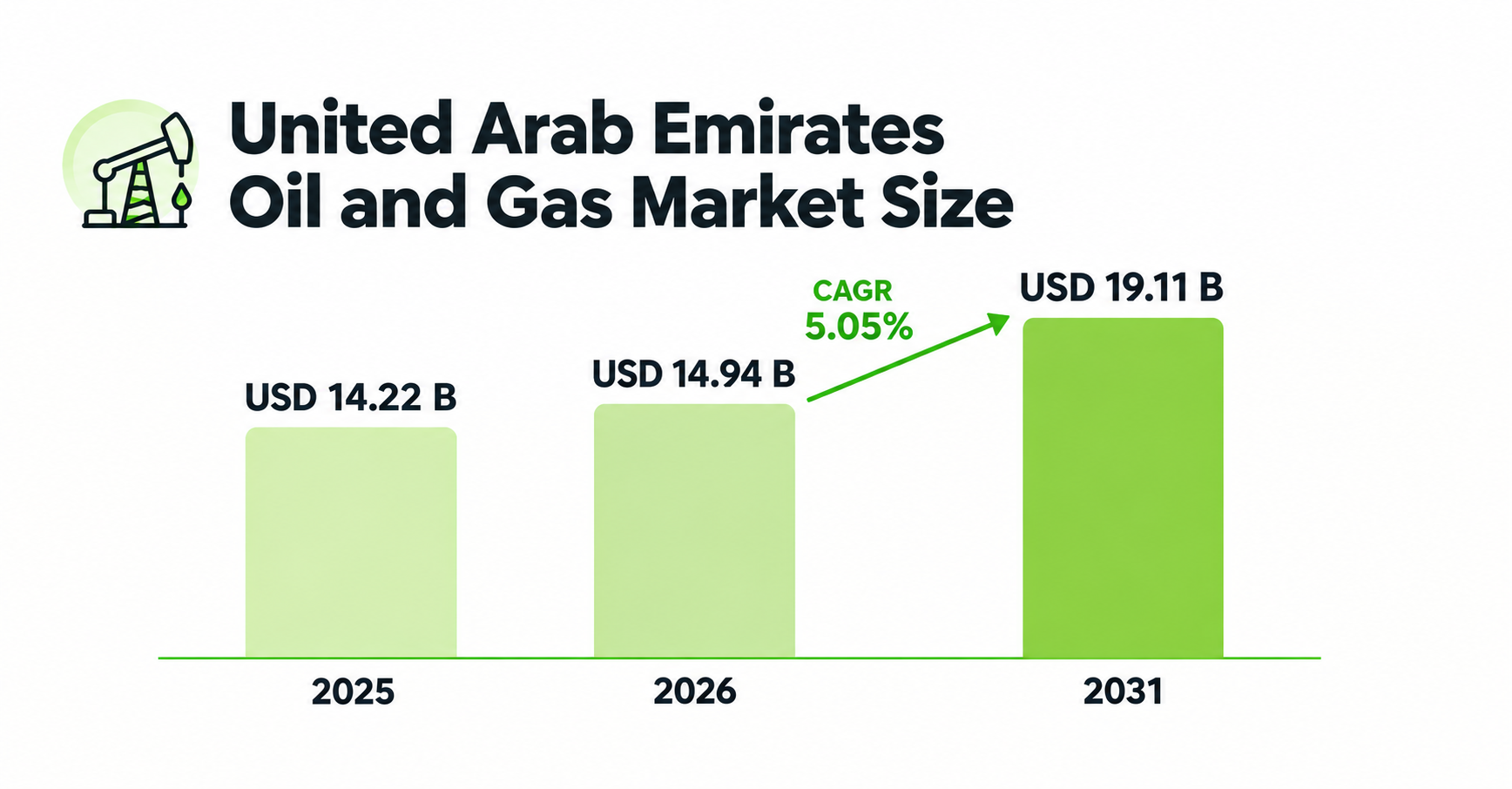
The UAE holds the seventh-largest proven oil reserves in the world, estimated at over 100 billion barrels. ADNOC, the Abu Dhabi National Oil Company, targets production of 5 million barrels per day by 2027, up from approximately 4 million barrels per day in 2023. Thus, oil and gas remain the single largest contributor to the UAE’s federal revenues.
The oil and gas companies in Abu Dhabi collectively form one of the most capital-intensive operational environments in the Middle East. In Dubai, ENOC (Emirates National Oil Company) manages a downstream-heavy portfolio covering fuel retail, aviation refueling, and storage infrastructure.
At this scale, the economics of AI adoption are not marginal. A 1% reduction in unplanned downtime across ADNOC’s production infrastructure represents hundreds of millions of dirhams annually.
Here, predictive maintenance tools that prevent a single major compressor failure can recover their full implementation cost in a single incident. That is why AI investment in this sector is accelerating rather than being evaluated cautiously.
UAE AI Vision 2031: What It Means for Energy Companies?
The UAE National AI Strategy 2031 is one of the most specific government AI commitments in the world. Its stated goal is to make the UAE a global AI hub by 2031, with AI contributing AED 335 billion to the national economy, approximately 13.6% of GDP. The UAE was the first country in the world to appoint a dedicated Minister of Artificial Intelligence, a position currently held by Omar Sultan Al Olama.
For oil and gas companies in the UAE, this has direct operational implications like:
-
Government Procurement and Partnership Pressure
UAE government-linked entities, including ADNOC, ENOC, and their supply chains, are under active pressure to integrate AI into operations as part of national economic strategy. Companies that build AI capabilities now are better positioned for government contracts, joint ventures, and strategic partnerships.
-
UAE Sovereign AI
The UAE has built its own large language model, Falcon, developed by the Technology Innovation Institute (TII) in Abu Dhabi. Falcon 180B, released in 2023, ranked among the top open-source models globally on multiple benchmarks. The significance for UAE energy companies is substantial. Deploying AI built on Falcon means operational data stays within UAE-controlled infrastructure, which simplifies compliance with the UAE’s Data Protection Law.
-
Infrastructure Investment
The UAE government has committed billions to AI infrastructure, including data centers, GPU clusters, and research institutions. Microsoft committed $1.5 billion to G42, a UAE AI holding company with close ties to ADNOC. Also, Google Cloud launched its UAE region in 2023. Therefore, the cloud and compute infrastructure that enterprise AI deployments require is available domestically.
-
Practical Implication for Energy Companies
The policy environment, infrastructure, and sovereign AI tools are in place. The organizations that move in the next 12 to 24 months will define the competitive baseline for the sector. Those that wait will be catching up to a moving target.
Where Is AI Creating Impact Across the Oil and Gas Value Chain?
AI adoption in the UAE energy sector is not concentrated in a single area. It is being applied across the upstream, midstream, and downstream segments of the oil and gas value chain. Each comes with distinct use cases and different return profiles.
1. Upstream: Exploration, Drilling, and Reservoir Management
Seismic data interpretation has historically required months of specialist geophysicist work. AI models trained on historical seismic datasets can now produce initial subsurface maps in days, reducing exploration cycle times and lowering the cost per viable well candidate.
For example, ADNOC has deployed machine learning in its reservoir simulation workflows, using AI to model production decline curves and optimize injection patterns in mature fields. On the drilling side, AI-driven well planning tools analyze formation data in real time and adjust drilling parameters.
Also, ADNOC Drilling has reported using AI-assisted tools to reduce non-productive time (NPT) in drilling operations. Globally, McKinsey has estimated that AI-assisted drilling optimization can reduce NPT by 20 to 30%, which at UAE drilling day rates represents savings of tens of thousands of dollars per well per day.
2. Midstream: Pipeline Monitoring and Corrosion Detection
Pipeline corrosion is one of the highest-cost maintenance problems in the UAE’s midstream infrastructure. Traditional inspection methods require physical access, planned shutdowns, and significant labor. AI changes this in two ways.
- Inline inspection tools now generate terabytes of ultrasonic and magnetic flux leakage data per pipeline run. AI models process that data to identify corrosion hotspots, wall thinning, and crack propagation with higher accuracy.
- Continuous sensor monitoring on critical pipeline segments uses anomaly detection algorithms to flag pressure or flow deviations that indicate leaks, corrosion-related losses, or third-party interference before they become reportable incidents.
For UAE operators running long-distance pipelines across desert terrain, this shift from scheduled inspection to continuous AI-monitored integrity management is a meaningful change in both cost and risk profile.
3. Downstream: Refinery Optimization and Predictive Maintenance
ADNOC Refining operates the Ruwais Refinery complex, one of the largest refining operations in the world, with a capacity of approximately 922,000 barrels per day. At that scale, the economics of AI-driven process optimization are significant.
Advanced process control (APC) systems powered by machine learning continuously adjust refinery operating conditions (temperatures, pressures) to maximize yield of high-value products while staying within safety and environmental limits. These systems operate faster than any human operator can respond to process changes, and they do not tire at all.
Additionally, predictive maintenance on rotating equipment uses vibration analysis, thermal imaging data, and operational history to predict failure windows weeks before a breakdown occurs.
4. ESG, Emissions Monitoring, and Carbon Accounting
The UAE has committed to net-zero emissions by 2050, and ADNOC has its own 2045 net-zero target. AI is being deployed to monitor fugitive methane emissions from wellheads, pipelines, and processing facilities. This uses satellite data, drone footage, and fixed sensor networks analyzed by computer vision models.
For oil and gas companies in Dubai and Abu Dhabi, having AI-verified emissions data is becoming a compliance requirement, not an optional reporting improvement. This is where AI automation can help carbon accounting tools with real-time emission dashboards rather than quarterly estimates.
ADNOC’s Digital Transformation: Key AI Use Cases
ADNOC’s AI success is the most documented case study for enterprise digital transformation in the UAE energy sector. Its AI and digital programs are substantial, publicly reported, and provide a benchmark for what is achievable at scale.
-
Panorama Digital Command Centre
Built at ADNOC’s headquarters in Abu Dhabi, the Panorama Digital Command Centre is reportedly the largest screen room of its kind in the world. It monitors more than 200,000 data points across ADNOC’s integrated operations in real time.
The system consolidates data from disparate SCADA systems, production historians, and ERP software into a single operational view. Decision-making cycles that previously required cross-department coordination over days can now be completed in hours.
-
AI-driven Reservoir Management
ADNOC has deployed AI in its enhanced oil recovery programs, using machine learning models to predict the optimal timing and volume of water and gas injection in mature reservoirs.
These models run continuously against production data, adjusting recommendations as reservoir conditions change; something static simulation models updated quarterly cannot do.
-
Technology Partnerships
ADNOC has signed major AI and cloud partnerships with Microsoft, IBM, SLB (formerly Schlumberger), and Halliburton. The Microsoft partnership covers everything from natural language processing tools for document management to machine learning for predictive maintenance.
IBM has worked with ADNOC on AI-driven supply chain and procurement optimization. SLB’s Delfi cognitive E&P environment is deployed in ADNOC’s upstream operations.
-
Autonomous Operations Trials
ADNOC has piloted autonomous drilling operations at select well sites, where AI systems adjust drilling parameters without direct human input, supervised by remote engineers. These trials are ongoing, with early results showing improvements in both drilling speed and wellbore quality.
Want to replicate ADNOC’s AI success?
See how Code Brew Labs builds enterprise-grade AI for regulated energy environments.
Data Sovereignty and Compliance Laws Applying to UAE Energy
When considering AI for oil and gas companies in the UAE, compliance for operational technology (OT) and information technology (IT) systems involves three distinct layers.
1. UAE Personal Data Protection Law (PDPL)
Federal Decree-Law No. 45 of 2021, the UAE’s PDPL, governs the collection, processing, and transfer of personal data. For energy companies, this applies most directly to workforce data, contractor records, and customer-facing systems.
AI models trained on employee operational data (for example, safety behavior analysis or skills assessment systems) must meet PDPL requirements for data processing consent and purpose limitation.
2. Critical Information Infrastructure (CII) Regulations
The UAE Cybersecurity Council designates energy infrastructure as critical information infrastructure. CII operators are subject to specific requirements around data localization, access controls, incident reporting, and security auditing of AI systems connected to operational networks.
This has direct implications for any cloud-based AI deployment in upstream or downstream operations: data cannot simply be sent to international cloud regions without meeting CII compliance requirements. UAE-domiciled cloud infrastructure (such as AWS UAE, Microsoft Azure UAE North, and G42 Cloud) addresses this.
3. ADNOC Information Security Standards
For companies in ADNOC’s supply chain or joint ventures, ADNOC’s own information security and data governance standards apply. These include requirements around data classification, third-party access controls, and AI model validation before operational deployment. ADNOC’s standards have converged with international frameworks including NIST and IEC 62443 for OT security.
4. Practical Compliance Position for AI Deployments
Use UAE-domiciled cloud infrastructure for data storage and model training. Conduct security assessments of AI systems before connecting them to OT networks. Maintain data lineage documentation for AI models used in safety-critical decisions.
These are not onerous requirements for a well-structured AI deployment, but they need to be designed in from the start, not retrofitted.
The Importance of Oil and Gas Asset Management Software and Digital Tools
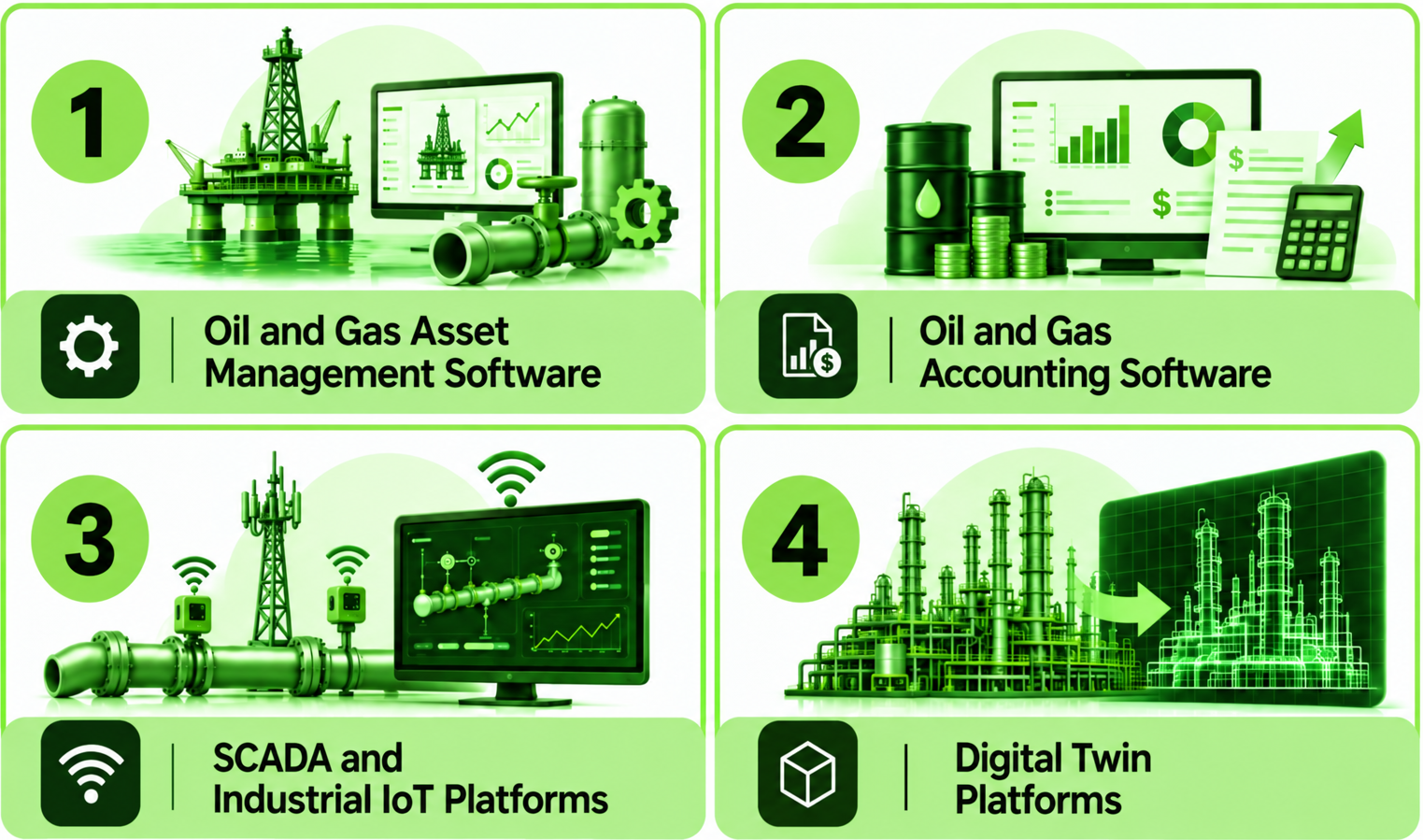
Beyond AI-specific platforms, UAE energy companies managing enterprise digital transformation need to evaluate the broader software layer that AI connects to. A few important tools and custom software solutions to consider are:
-
Oil and Gas Asset Management Software
It manages the full lifecycle of physical assets (wells, pipelines, rotating equipment, facilities) from acquisition through maintenance, inspection, and decommissioning. Enterprise platforms in this category include IBM Maximo, SAP PM (Plant Maintenance), and Bentley AssetWise.
These systems store the historical maintenance records that predictive AI models train on. The quality of the existing asset data directly affects what AI can do with it.
-
Oil and Gas Accounting Software
It tracks production volumes, revenue allocation, joint interest billing, AFE (Authority for Expenditure) management, and royalty calculations. In UAE joint venture structures, accounting software must handle complex production sharing agreements and multi-currency financial reporting.
SAP S/4HANA is the dominant platform among large UAE operators, with Oracle JD Edwards common in mid-tier companies.
-
SCADA and Industrial IoT Platforms
These are the data collection layers that feed AI models in real time. Upgrading legacy SCADA systems to support modern data streaming protocols (such as OPC-UA and MQTT) is often the first step in an AI readiness program for operational technology environments.
-
Digital Twin Platforms
These create virtual models of physical assets that update continuously from sensor data. For refineries and processing facilities, digital twins allow AI models to simulate process changes before implementation, reducing the risk of operational disruptions from process optimization initiatives.
How Code Brew Labs Supports Enterprise Digital Transformation in UAE Energy?
Code Brew Labs delivers enterprise digital transformation projects across the UAE and the wider Gulf region, with a specific track record in regulated, high-stakes operational environments. Our work with ACWA Power, one of the largest energy and water companies in the Middle East, demonstrates the capability required for enterprise AI in the energy sector.
That engagement covered enterprise technology capabilities designed for utility-scale operations, complex asset environments, and data-driven decision-making across energy and water infrastructure portfolios.
For oil and gas companies in Abu Dhabi and Dubai evaluating AI transformation programs, Code Brew Labs provides:
- AI strategy and roadmapping: We work with operational and technology leadership to identify the two or three AI use cases with the clearest business case.
- Custom AI development: We build predictive models, computer vision tools, and conversational AI platforms tailored to specific environments.
- Integration with existing systems: We build integration layers that connect AI outputs to the systems where operational decisions are made.
- Compliance-ready deployments: Every AI system we deploy is designed for UAE PDPL, CII requirements, and client-specific data security standards.
- Governed AI engineering. We hold CMMI Level 3 certification and ISO 9001:2015 accreditation.
The Bottom Line
The UAE’s oil and gas sector is better positioned for AI adoption than almost any other energy market in the world. The sovereign AI infrastructure is built. The cloud regions are operational. The regulatory framework is defined. The country’s largest operator, ADNOC, has already demonstrated what AI can do at scale across the full oil and gas value chain.
When using AI for oil and gas companies in Dubai, Abu Dhabi, and across the UAE, the question is not whether to move. It is where to start and how to structure the first investment to generate returns quickly enough to justify the next one.
Legacy systems holding your AI back?
Discover how Code Brew Labs can help leverage AI for oil and gas companies in the UAE.
Frequently Asked Questions
Why digital transformation matters for oil and gas companies in Abu Dhabi?
Enterprise digital transformation enables AI for oil and gas companies to meet investor demands for strong capital discipline while facilitating compliance with regulatory requirements. The benefits of enterprise digital transformation include:
- Improved operational efficiency
- Enhanced safety and risk management
- Streamlined sustainable development
- Optimized costs
How do UAE oil companies use AI for pipeline corrosion detection?
ADNOC Refining deploys AIQ’s CORROPIPE to optimize inspection intervals and reduce verification excavations, alongside CORROVISION for automated image-based corrosion detection and severity classification. The systems predict corrosion growth and prioritize remediation based on risk rather than schedule.
What are the key ADNOC enterprise digital transformation and AI use cases?
ADNOC’s primary deployments include the Real-Time Operations Center across 120+ drilling rigs with SLB, enterprise-wide generative AI with Microsoft Copilot, corrosion and safety monitoring with AIQ, and agentic AI development for autonomous operations. The RTOC reduces engineering effort by 30-40% and incident response times by 4-12 hours.
What data sovereignty and compliance laws apply to UAE energy AI?
The UAE’s federal Personal Data Protection Law (PDPL) applies alongside sector-specific regulations and separate regimes for DIFC and ADGM. For energy AI, the critical requirements are data residency in UAE facilities, customer-controlled encryption keys, and operational sovereignty, including local audit logging and privileged access controls.
How is ROI measured for predictive maintenance in Middle Eastern refineries?
ROI frameworks include avoided production losses from prevented downtime, reduced emergency maintenance labor, extended equipment life, and decreased safety incident exposure. A comparable refinery deployment documented a 72% reduction in maintenance costs, 4x ROI within six months, and 1,800+ hours of avoided downtime over three years.
Which global tech partners collaborate with UAE oil and gas firms?
Microsoft (enterprise AI and Copilot), SLB (drilling operations AI), AIQ (corrosion and safety monitoring), and Core42 (sovereign cloud infrastructure) are the most active partners in UAE energy AI deployments.
What is the best starting point for enterprise digital transformation in an oil and gas company?
The most effective starting point is a focused assessment of your operational data:
- What you have
- Where it lives
- What format it is in
- Whether it is clean enough to train an AI model on
Most AI failures in industrial settings are data failures, not model failures. Once data readiness is understood, identify the one or two operational challenges where the financial cost of the current state is clearest and most measurable.
Is oil and gas asset management software necessary before deploying AI?
Not always, but the quality of AI outcomes depends directly on the quality of historical operational and maintenance data. If that data is fragmented across spreadsheets, paper records, and disconnected SCADA historians, it needs to be consolidated before AI models can learn from it.
Let's Convert Your Business Idea Into Success!
Free Consultation from Top Industry Experts
Let’s Build Your Dream App!
Share article on :



 No commitment required
 NDA on request
 24-hour response


