
Quick Summary:
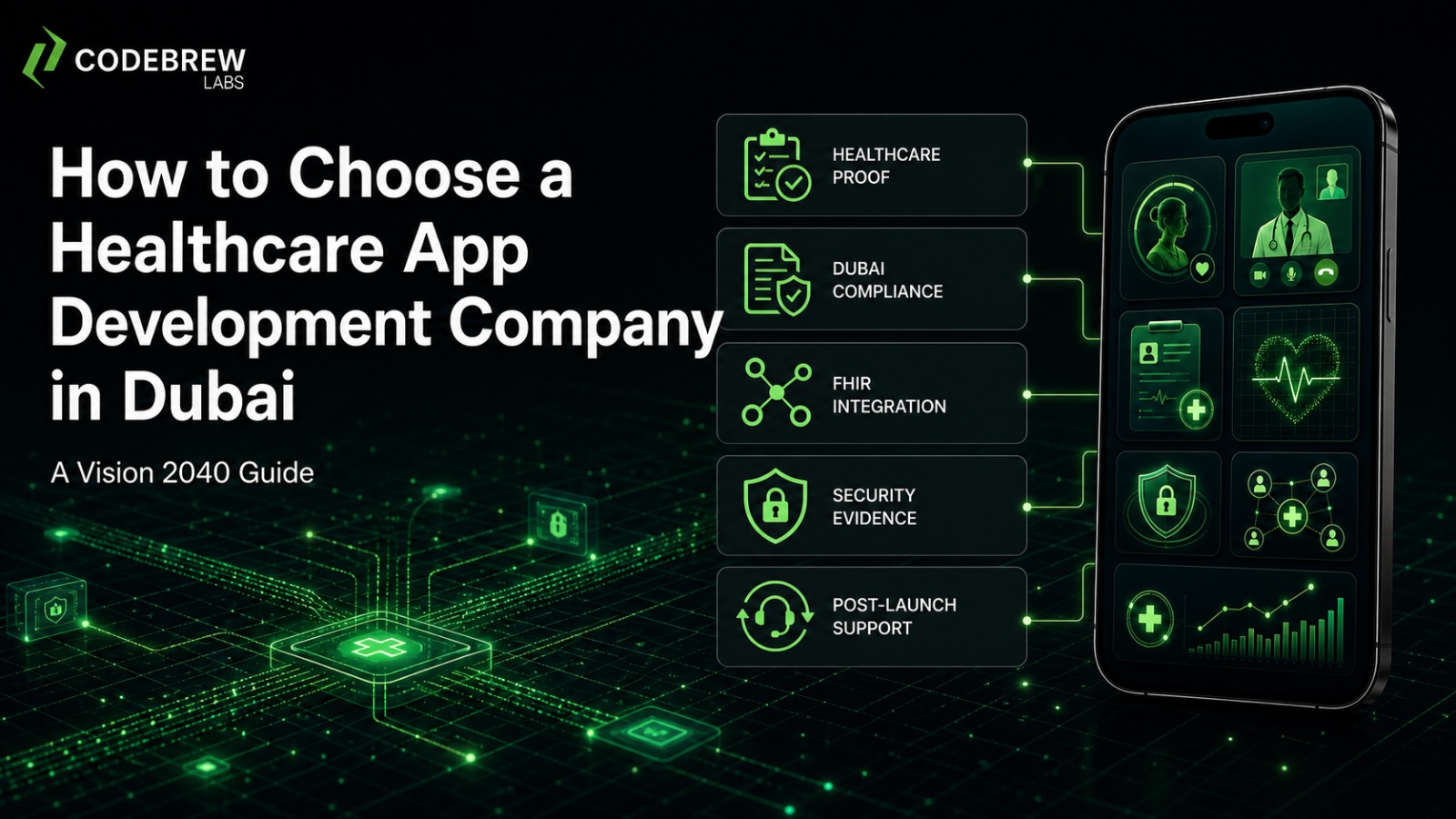
- Choose a healthcare app development company with proven Dubai compliance, clinical workflows, security, interoperability, and post-launch governance.
- Treat Dubai 2040 as urban and healthcare capacity context, not a separate healthcare initiative.
- Confirm whether NABIDH connectivity applies before architecture, budgeting, or vendor selection begins.
- Ask for evidence, including audit reports, test results, references, architecture samples, and named delivery specialists.
- Score every vendor against the same 100-point framework before comparing price or delivery promises.
- Select features by care model, user risk, and integration needs. Avoid copying a generic feature list.
A healthcare app development company should understand care delivery, Dubai rules, and health data risks. Its proposal should connect business goals with clinical workflows, security, integrations, and measurable outcomes.
That standard is higher than normal mobile development. A missed notification may delay care, not merely reduce engagement.
Disconnected records can force clinicians to repeat work. Weak access controls expose sensitive information across several systems.
Price still matters. However, an inexpensive build can create costly compliance or integration work later.
This selection framework helps hospitals, clinics, HealthTech firms, pharmacies, labs, and home-care providers compare partners fairly.
What Does Dubai Vision 2040 Mean for Healthcare App Development?
“Dubai Vision 2040” is not one document. It is shorthand for four connected government programs that together shape what a compliant healthcare app has to do.
The Dubai 2040 Urban Master Plan sets the emirate’s long-range development framework, planning for population growth from 3.3 million to roughly 7.8 million residents
The D33 Economic Agenda targets AED 32 trillion in economic output by 2033, with AED 100 billion earmarked for digital transformation every year.
Social Agenda 33 setshealth outcome targets, including a current life expectancy of 78.8 years. The national We the UAE 2031 vision ties all of it to federal healthcare integration goals.
Digital health direction comes from connected DHA strategies. These priorities include patient journeys, interoperability, data governance, analytics, artificial intelligence, and digital research.
These plans do not prescribe one application design. They establish the operating environment where healthcare products must perform.
A booking app may begin as an administrative tool. It can later connect prescriptions, results, payments, and virtual consultations.
That expansion changes its data exposure and compliance scope. Architecture decisions must therefore support controlled growth.
For buyers, the 2040 context creates four practical requirements:
- Design for a growing and diverse population.
- Connect care across facilities and systems.
- Support Arabic and English patient journeys.
- Protect health information throughout its lifecycle.
Dubai apps serve different languages, ages, abilities, and accessibility needs. Arabic testing must cover layouts, terms, dates, forms, and notifications.
Strong healthcare app development connects the interface with approved operational systems. Each connection needs ownership, error handling, and auditability.
Define Your Healthcare Product Before Shortlisting a Partner
Custom healthcare app development starts with a clear service model. A patient portal differs from a diagnostic product or remote-monitoring system.
Vendors cannot price or design responsibly without that distinction. Product scope determines the team, controls, integrations, testing, and approvals.
Start with six decisions:
- User: Patient, clinician, caregiver, administrator, insurer, or several groups.
- Care setting: Hospital, clinic, pharmacy, laboratory, home care, or virtual care.
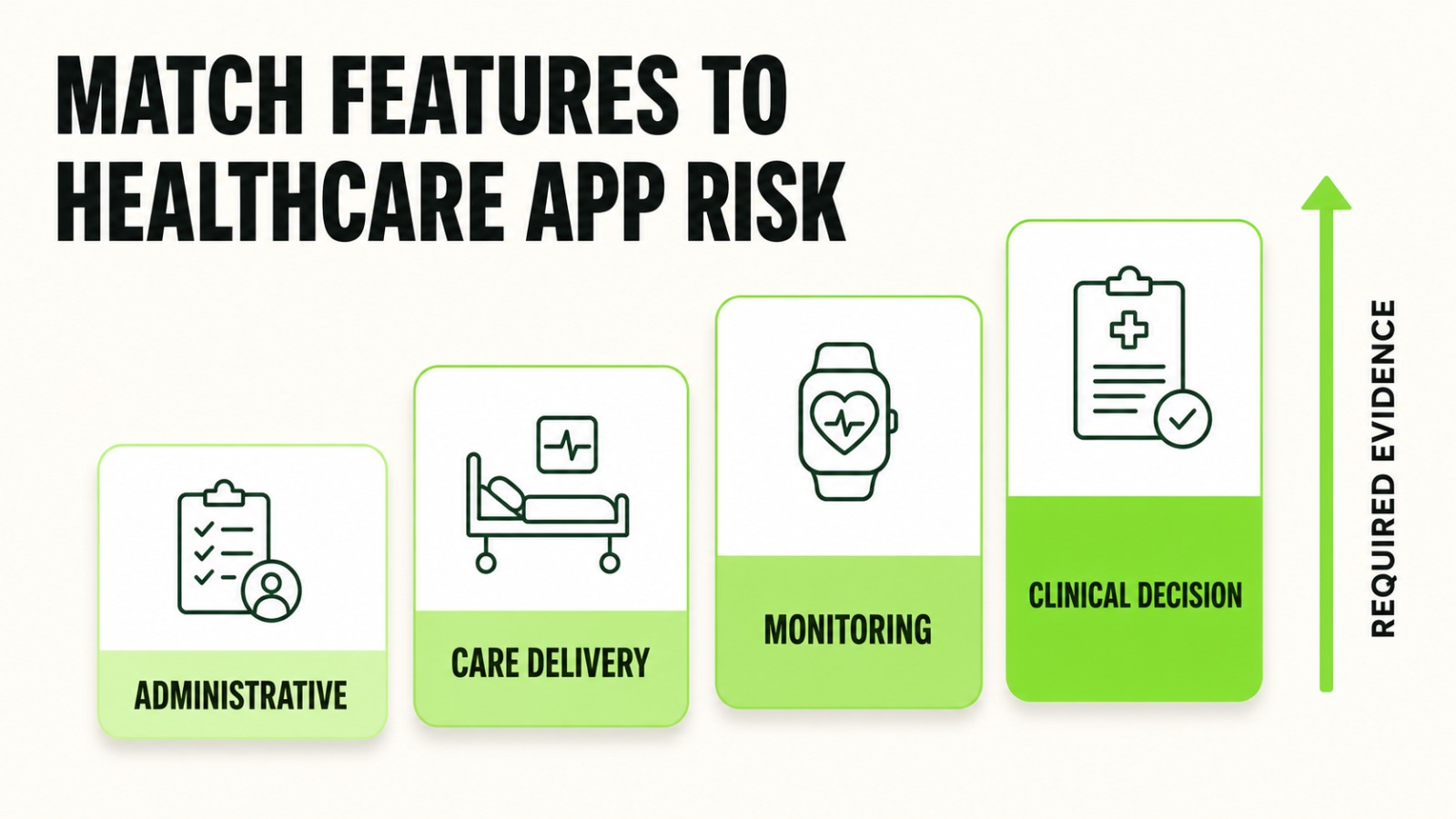
- Clinical role: Administrative, informational, monitoring, diagnostic, or treatment support.
- Data: Identity, appointments, health records, images, prescriptions, payments, or device readings.
- Connections: EHR, EMR, NABIDH, laboratory, pharmacy, insurer, UAE PASS, or wearables.
- Outcome: Faster booking, reduced workload, safer care, better access, or stronger retention.
Users and care settings determine experience, permissions, and workflows. Clinical functions determine risk and required evidence.
Data and integrations reveal legal, security, and delivery dependencies. Outcomes give the project a measurable purpose.
A clinic might target fewer booking calls and fewer missed appointments. Hospitals may target faster results access and reduced duplicate entry.
Document current workflows before discussing screens. Include exceptions, approvals, handoffs, and human escalation points.
For example, map what happens after a patient reports urgent symptoms. The design must show warnings, routing, escalation, and clinician ownership.
A strong healthcare mobile app developer will challenge unclear assumptions. The team should identify clinical, legal, and operational dependencies during discovery.
Platform selection also belongs in discovery. Native applications can offer stronger device integration and platform-specific experiences.
Dedicated iOS app development services and Android app development services address broader device and operating-system variation.
Neither platform is automatically correct. User devices, clinical hardware, offline needs, security policies, and maintenance capacity should decide.
A Useful One-Page Project Brief
Write one sentence for each item:
- Business problem
- Primary user
- Care pathway
- Core transaction
- Sensitive data handled
- Required integration
- Success metric
- First launch market
This brief prevents vendors from pricing different products under one label.
Attach one workflow and one data-flow diagram. Also record unresolved questions before requesting proposals.
What Should a Healthcare App Include?
Essential features depend on the product’s risk and purpose. Avoid copying every feature from a competitor.
| Product type | Essential patient features | Operational features | Common connections |
| Patient portal | Login, booking, records, alerts | Scheduling, consent, support | EHR, UAE PASS |
| Telehealth | Booking, video, chat, payment | Clinician queue, notes, escalation | EHR, pharmacy |
| Home care | Service choice, caregiver profile, booking | Dispatch, availability, visit records | CRM, payment |
| Remote monitoring | Device pairing, trends, alerts | Thresholds, triage, audit trail | Wearables, EHR |
| Pharmacy | Prescription view, ordering, tracking | Verification, stock, fulfilment | EHR, insurer |
| Diagnostic app | Results, images, explanation | Review, annotation, escalation | LIS, PACS, DICOM |
Patient portals need dependable identity, consent, records, booking, and notifications. Higher-risk products add stronger validation and traceability.
Baseline Features for Most Patient-Facing Apps
Baseline features support daily access, communication, and recordkeeping. Each needs a workflow, data owner, and measurable acceptance test.
Identity and Role-Based Access
Registration should verify the correct person without creating avoidable abandonment. Define recovery, failed-attempt, session, and device-change rules.
Permissions must reflect real duties. Receptionists, nurses, physicians, caregivers, and patients should not receive identical access.
Acceptance evidence should include an approved access matrix and tested account-recovery journeys.
Bilingual Accessibility and Consent
Arabic support covers layouts, dates, numerals, medical terms, notifications, and right-to-left navigation. Translation alone cannot prove usability.
Forms should follow WCAG 2.2 guidance for labels, instructions, error identification, and correction support.
Consent records should capture purpose, language, version, timestamp, withdrawal, and affected data uses. Users need understandable choices before approval.
Booking, Communication, and Notifications
Booking needs current availability, rescheduling rules, cancellations, reminders, and timezone handling. Test conflicts and delayed system updates.
Secure messaging requires response expectations, attachment controls, escalation routes, and notification privacy. Lock-screen alerts should not reveal diagnoses.
Records, Support, and Safety Routes
Health records should display their source, date, clinician, and current status. Patients also need a correction-request process.
Audit histories should record sensitive viewing, editing, exporting, and consent changes. Support teams need controlled access and documented escalation.
Emergency guidance must remain visible but cannot imply emergency monitoring. State response limits and direct users toward approved emergency channels.
Features That Require Deeper Review
These features can influence care decisions or move regulated data. Review failure behavior before approving interface designs.
Telehealth and Remote Monitoring
Video, chat, device readings, and threshold alerts need clinical ownership. Define who reviews each signal and within what timeframe.
Test dropped calls, missing readings, duplicate measurements, battery failure, and unsafe values. Every alert needs acknowledgement and escalation rules.
AI and Clinical Decision Support
AI needs a documented purpose, approved inputs, evaluation data, and human oversight. Accuracy alone cannot establish clinical safety.
Require confidence handling, overrides, output logging, and post-launch monitoring. DHA also publishes a dedicated healthcare AI policy.
Payments, Prescriptions, and Pharmacy Workflows
Payment failures should not hide care status or create duplicate charges. Reconciliation and refund ownership must remain explicit.
Prescription features require authorization checks, renewal rules, medication status, and pharmacy exceptions. Insurer workflows also need rejection and resubmission paths.
Release-Readiness Gate
Approve higher-risk features only after clinical, security, compliance, and integration evidence exists. Scenario tests should cover normal and unsafe conditions.
A feature belongs in a later release when owners, dependencies, or evidence remain unresolved.
Compliance Requirements for Healthcare App Development in Dubai
Compliance is not one certificate or checklist. The correct obligations depend on the operator, data, function, and deployment model.
Start With an Applicability Map
Ask the healthcare app development company to document:
- Licensed healthcare entity operating the service
- Governing regulator for that entity
- Health information collected or generated
- Systems receiving or sharing that information
- Countries hosting, accessing, or supporting the data
- Any diagnostic, monitoring, or treatment claims
Legal counsel and the provider should approve the map. Every requirement needs an owner, evidence item, and review trigger.
UAE Health-Data Law
Federal Law No. 2 of 2019 governs information technology use in UAE health fields. It covers electronic health information and related technology services.
Article 13 restricts storing, processing, or creating health information outside the UAE. Defined exceptions and later decisions may apply.
Article 20 requires health-data retention for at least 25 years after the last health procedure. That rule does not cover every analytics event automatically.
The UAE Personal Data Protection Law covers lawful processing, rights, security, and transfer requirements.
DHA and NABIDH Applicability
NABIDH is Dubai’s health information exchange. DHA reported 10.41 million medical records by June 2025.
The update listed 1,888 facilities, 53,659 professionals, and 91 EMR systems.
DHA issued a 2025 circular covering required EMR integration and single sign-on. A supporting document identifies mandated facility categories.
Therefore, do not assume every wellness app needs direct NABIDH integration. Confirm the operator, facility, EMR, and data-sharing scope first.
When connectivity applies, ask for experience with health information exchange workflows. Also request evidence for HL7 FHIR mapping, testing, and error handling.
Integration readiness needs patient matching, consent, terminology, failure handling, and amendments.
Telehealth and Artificial Intelligence
Telehealth products should follow current DHA standards and licensed-provider requirements. Check consultation records, consent, prescriptions, quality, and emergency escalation.
DHA also publishes an AI policy for healthcare services. Its date is July 2021, despite newer publication metadata.
AI governance should cover intended use, human review, validation, monitoring, incidents, and model changes. Clinical tools require stronger evidence than administrative automation.
Need a Dubai compliance map before development?
What Security Features Must a Healthcare App Partner Provide?
Security claims need evidence. “Bank-grade encryption” offers little procurement value without architecture and testing details.
Healthcare security must cover mobile screens, APIs, databases, files, cloud consoles, and support tools.
Identity and Access Controls
Multi-factor authentication should protect privileged roles. Role-based permissions should match real clinical and administrative responsibilities.
Account recovery and session rules should reflect shared devices, attack risks, and clinical urgency.
Data Protection and Traceability
Encryption protects stored and transferred information, but key management determines its strength. Keys need restricted access, rotation, and recovery procedures.
Audit logs should record viewing, changes, exports, and administration. Monitoring should identify unusual access patterns.
Application and API Security
Mobile protections should reduce tampering, insecure storage, and exposed secrets. APIs and third-party components need continuing review.
Resilience and Incident Readiness
Backups need restoration testing. Incident plans need named decision-makers, recovery targets, communication paths, and rehearsals.
The following checklist summarizes the controls that procurement should trace:
- Encryption with controlled key management
- MFA, role-based access, and secure recovery
- Consent controls and tamper-resistant audit logs
- Secure files, mobile storage, and APIs
- Tested backups and disaster recovery
- Vulnerability scanning and penetration testing
- Incident, breach, supplier, and cloud controls
Ask who owns each control. The contract should separate developer, cloud provider, and operator responsibilities.
Evidence to Request
Evidence converts security from a promise into a reviewable capability. Request current documents that match the proposed team and architecture.
- Security architecture and data-flow map
- Penetration summary and remediation policy
- Access matrix and component inventory
- Restoration and incident-exercise evidence
- Security update and support policy
Never accept a logo as sufficient proof. Verify certificate scope, issuing body, validity, and covered locations.
A penetration summary needs scope, date, severity, and remediation status. Backup evidence should show a completed restoration.
What Certifications Should the Right Healthcare App Development Partner Have?
No single certification makes a vendor compliant. Treat certifications as procurement evidence supporting specific risks.
The table provides a quick comparison. Procurement should still examine scope, dates, exclusions, and delivery-team coverage.
| Standard or report | What it supports | When it matters | Buyer check |
| ISO/IEC 27001 | Security management system | Most health-data projects | Scope and validity |
| ISO 27799:2025 | Health-information security | Clinical data environments | Covered processes |
| ISO 13485:2016 | Medical-device quality system | Regulated device software | Product applicability |
| SOC 2 Type II | Control operating evidence | Cloud service delivery | Period and exceptions |
| Penetration report | Technical security testing | Every internet-facing product | Scope and remediation |
Research Sources: ISO/IEC 27001, ISO 27799:2025, and ISO 13485:2016
ISO 27001 and ISO 27799 support security governance. They do not prove that one application has no vulnerability.
ISO 13485 may support regulated device work. SOC 2 Type II provides attestation, while penetration testing provides product-specific evidence.
Ask whether named delivery teams follow the documented system. A corporate certificate may exclude an offshore office or subcontractor.
Ask how these systems affect access approvals, secure reviews, release gates, and incident escalation.
How to Choose the Right Healthcare App Development Company
Use evidence, not presentation quality, to compare vendors. Apply identical questions and scoring across the shortlist.
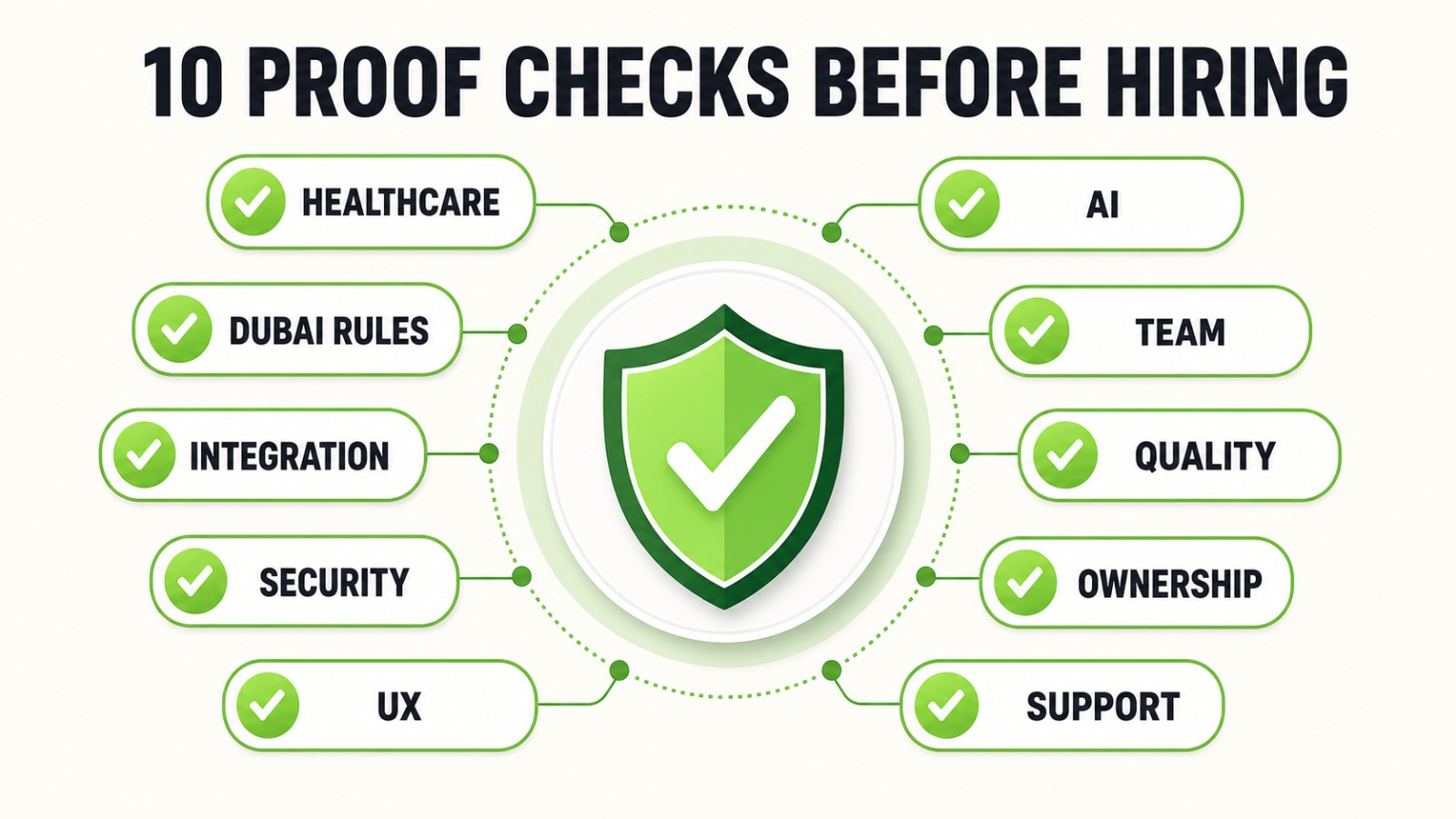
1. Verify Relevant Healthcare Delivery Experience
Request two projects with similar users, workflows, and risks. Ask about launch status, integrations, and measurable results.
Why it matters: General mobile experience does not prove clinical workflow knowledge.
2. Test Dubai Compliance Understanding
Give each vendor one realistic scenario. Ask for the applicable regulator, risks, evidence, and unresolved questions.
Why it matters: Memorized acronyms cannot replace an applicability analysis.
3. Review Interoperability Capability
Ask for sample FHIR mappings, API error flows, test plans, and interface ownership. Include DICOM when imaging is involved.
Why it matters: Integrations often determine operational value and project complexity.
4. Assess Clinical and Patient Experience Design
Review Arabic right-to-left screens, accessibility, consent flows, and error recovery. Include real patients and clinicians during testing.
Why it matters: Attractive interfaces can still fail during care delivery.
5. Examine Security Engineering
Request threat models, security test evidence, and remediation ownership. Confirm controls across mobile, backend, cloud, and support tools.
Why it matters: Patient data travels through an entire service, not one screen.
6. Confirm AI Governance
Ask about training data, evaluation, false results, human review, monitoring, and rollback. Require named owners for clinical validation.
Why it matters: AI errors may affect trust, safety, and regulatory status.
7. Inspect the Proposed Team
Meet the delivery manager, architect, security specialist, QA lead, and UX lead. Ask whether subcontractors will access health data.
Why it matters: Senior sales staff may not deliver the product.
8. Evaluate Delivery and Quality Controls
Review acceptance criteria, test coverage, release approvals, and environment controls. Confirm who signs clinical and compliance decisions.
Why it matters: Healthcare quality needs documented gates, not informal assurance.
9. Review Ownership and Exit Terms
Confirm source code, design files, cloud accounts, documentation, credentials, and data export. Define transition support before signing.
Why it matters: Vendor dependency can restrict future improvements.
10. Check Post-Launch Governance
Ask about security patches, operating-system updates, monitoring, incident support, and change control. Match response times with patient risk.
Which AI and Emerging Technologies Matter for Healthcare Apps?
Technology should solve a measured care or operational problem. Avoid adding innovation labels without ownership, evidence, or monitoring.
AI Agents and Language Models
Use them for scheduling, navigation, summarization, and support. Clinical outputs need approved sources, human review, and escalation.
Code Brew Labs’ AI development services in Dubai cover language models, prediction, computer vision, and custom AI products and AI chatbots.
Predictive Analytics
Risk scoring can support outreach and resource planning. Buyers should validate data quality, bias, drift, and clinical usefulness.
Computer Vision
Image analysis may support screening or documentation. Diagnostic claims require deeper clinical validation and possible device review.
Wearables and Connected Devices
Remote monitoring can extend care beyond facilities. The platform must manage device identity, signal quality, thresholds, and missed readings.
Privacy Intelligence
DHA added AI-driven privacy monitoring within NABIDH during 2025. The system identifies suspicious access patterns around patient records.
AI automation services focused on connected workflows, agents, and operational automation.
Ask each vendor to connect every technology with one outcome, one risk owner, and one success measure.
100-Point Healthcare Vendor Scorecard
Score evidence before the sales presentation. Award full points only when proof matches the proposed scope.
| Category | Weight | Full-score evidence | Warning sign |
| Healthcare experience | 20 | Comparable launched work and references | Generic portfolio |
| Compliance and security | 20 | Applicable map and current evidence | Acronym list |
| Integration architecture | 15 | FHIR, API, and testing samples | Vague integration promise |
| Product and clinical UX | 15 | Tested workflows and Arabic UX | Visual mockups only |
| Delivery and quality | 15 | Named team, gates, and metrics | Unnamed resources |
| Ownership and support | 15 | Clear assets, SLAs, and exit plan | Vendor lock-in |
Set a minimum overall score, such as 75. Also set minimums for compliance, security, and healthcare experience.
Score proposals independently before the evaluation meeting. Reviewers should record evidence links and short reasons for each score.
Use knockout conditions for missing ownership, hidden subcontractors, or absent healthcare proof.
Reference calls should validate the score. Ask previous clients about changes, defects, documentation, support, and escalation.
Compare your shortlist with Code Brew Labs using the same scorecard and evidence standards.
Should You Hire Locally or Outsource Healthcare Mobile App Development?
The best model depends on risk, internal capability, and regulatory coordination. Location alone does not determine quality. Mobile app development services in Dubai use local engagement with broader delivery capabilities.
| Model | Best fit | Main advantage | Main risk |
| Dubai-based team | Regulator-heavy or onsite work | Local access | Higher cost base |
| Offshore team | Defined modules and strong buyer controls | Wider talent pool | Context and oversight gaps |
| Hybrid team | Complex healthcare platforms | Local ownership plus scale | Coordination complexity |
A hybrid model often suits custom healthcare app development. Keep compliance ownership, clinical discovery, and stakeholder decisions close to Dubai.
When a Dubai-Based Team Adds Value
Local presence helps during discovery, facility workshops, regulator coordination, and executive governance. It does not replace healthcare evidence.
When Outsourcing Can Work
Outsourcing can provide specialist capacity. It works best when scope, access, quality, and communication remain controlled.
Why Hybrid Delivery Is Common
Hybrid delivery combines local product ownership with distributed engineering depth. It requires one accountable leader.
Development can use distributed specialists when access, security, and accountability are controlled. Require one delivery owner across locations.
Ask where source code, tickets, logs, backups, and patient data will reside. Also document every support location and subcontractor.
The contract should define time overlap, team changes, new locations, and subcontractor approval.
How Much Does Healthcare App Development Cost in Dubai?
Healthcare app development in Dubai can range from about AED 150,000 to AED 1.5 million. Enterprise platforms may exceed that range.
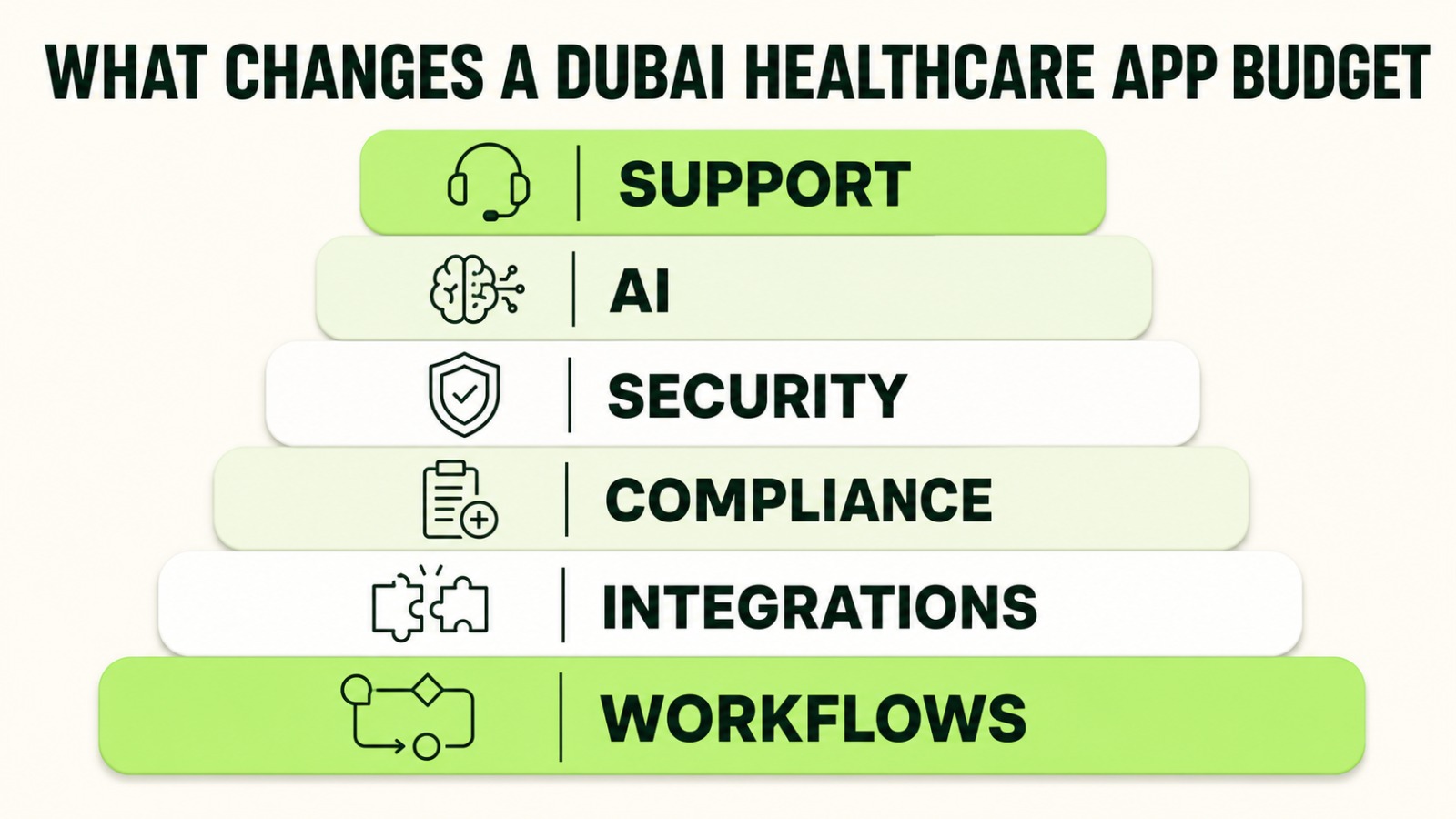
The final amount depends on clinical risk, integrations, platforms, security evidence, AI, and post-launch obligations.
No independent benchmark isolates every Dubai healthcare product. Therefore, buyers should use published data as context, not a fixed quotation.
External Mobile App Pricing Benchmark in AED
Clutch reports that most reviewed mobile projects cost $10,000 to $49,999. Converted to AED, that equals about AED 36,725 to AED 183,621.
Clutch also reported an average project cost near $90,780. That amount converts to about AED 333,390.
These figures cover mobile applications across industries and countries. Healthcare integrations and assurance work can push budgets above typical projects.
Research Source: Clutch Mobile App Pricing Guide, updated July 22, 2026
Practical Planning Ranges for Dubai Healthcare Products
The following bands combine published pricing with common healthcare scope differences. They are planning estimates, not guaranteed proposals.
| Product scope | Planning range in AED | Usually includes | Major exclusions |
| Discovery and prototype | 55,000 to 110,000 | Workflows, architecture, prototype | Production build |
| Focused patient MVP | 150,000 to 300,000 | Booking, profiles, alerts, admin | Deep clinical integrations |
| Integrated care platform | 300,000 to 750,000 | Telehealth, roles, EHR links | Complex AI or devices |
| Enterprise AI or RPM | 750,000 to 1,500,000+ | Advanced integrations and governance | Large migration programs |
Discovery and Prototype
This stage fits teams with an unresolved care model or integration approach. It should produce requirements, workflows, architecture, and risk decisions.
The output may include a clickable prototype and technical proof. It should also define a credible production budget.
Focused Patient MVP
This range can support a limited patient journey with one primary user group. Typical functions include registration, booking, reminders, and basic administration.
Simple external services may fit within the range. Deep EHR, NABIDH, device, or insurance work may not.
Integrated Care Platform
This range suits several roles, telehealth, bilingual workflows, and selected clinical integrations. It may include patient, clinician, and administration surfaces.
Pricing changes with interface readiness and external testing. One difficult EHR connection can require substantial coordination.
Enterprise AI or Remote Monitoring
Enterprise products may combine several facilities, devices, AI, analytics, and complex access models. Governance and operational readiness become major workstreams.
Remote monitoring adds device management, signal validation, alert workflows, and clinical response planning. AI adds evaluation, monitoring, and change control.
What Increases the Cost of Healthcare App Development?
- Compliance discovery adds specialist work. Teams must map laws, regulator requirements, data flows, evidence, and accountable approvals.
- More roles create more workflows. Patients, clinicians, caregivers, pharmacies, and administrators each need permissions, screens, tests, and support.
- Integrations create coordination costs. EHR, laboratory, insurer, pharmacy, payment, and HIE connections require several technical and business owners.
- Native platforms increase separate work. Dedicated iOS and Android builds may require distinct development, testing, and release processes.
- Arabic localization needs proper testing. Translation, right-to-left layouts, terminology, dates, and notifications require specialist review.
- AI needs more than model access. Evaluation data, guardrails, monitoring, human review, and rollback increase delivery and governance effort.
- Security evidence requires independent work. Penetration tests, remediation, restoration exercises, and documentation must be planned and funded.
Hidden Costs to Healthcare App Development
Recurring costs can include cloud, video, messaging, maps, devices, AI usage, and external integration fees.
Content, Arabic review, store accounts, training, migration, monitoring, and maintenance may sit outside the build price.
How Should Buyers Compare AED Proposals?
Request pricing by workstream and release. Every amount needs assumptions, exclusions, dependencies, and acceptance criteria.
Ask vendors to price one common scenario. Consistent scope produces a fairer comparison.
Benefits of Choosing the Right Healthcare App Development Partner
The right partner improves more than delivery speed. It creates clearer ownership across clinical, technical, and commercial decisions.
Lower Compliance Rework
Early applicability checks reduce late architecture changes. Clear evidence also supports internal governance and regulator discussions.
Better Patient Adoption
Tested booking, consent, communication, and accessibility flows reduce avoidable friction. Bilingual design can serve Dubai’s diverse population.
Stronger Operational Value
Useful integrations reduce duplicate entry and disconnected processes. Staff can focus on care instead of manual reconciliation.
Automation can coordinate reminders, follow-ups, routing, and administration. Code Brew Labs’ AI automation offering addresses these connected operational workflows.
Operational value should appear in measured outcomes. Track handling time, duplicate entry, failed messages, missed appointments, and support demand.
Safer Innovation
Clinical review, monitoring, and rollback controls make AI adoption more responsible. Teams can expand functions with measurable safeguards.
More Durable Ownership
Clear documentation, source ownership, and exit terms protect future choices. Another team can maintain or extend the product.
What Questions Should You Ask Before Hiring A Healthcare App Development Company?
Questions should expose how a vendor thinks, not test acronym recall. Ask for evidence, ownership, and decisions behind every answer.
Regulation and Clinical Responsibility
- Which UAE laws and DHA requirements apply to this exact product?
- Does our facility or EMR fall under NABIDH integration requirements?
- Which decisions require legal, clinical, or regulator confirmation?
Proof and Delivery Ownership
- Can you show two comparable healthcare products and their live status?
- Who will own architecture, security, clinical UX, and quality?
- Which team members or subcontractors can access health information?
Integration and User Safety
- How will HL7 FHIR, DICOM, or other interfaces be tested?
- What happens when an external system rejects or delays a message?
- How are Arabic layouts and clinical terms validated?
Security and AI
- Which penetration tests occur before launch and after major changes?
- How will AI outputs be evaluated, monitored, and overridden?
- What evidence will the team deliver with each release?
Ownership and Support
- Who owns source code, designs, cloud accounts, and deployment pipelines?
- What support response applies to a patient-facing incident?
- How can another vendor take over the platform?
Ask follow-up questions whenever answers lack owners, documents, examples, or dates.
Common Healthcare App Development Red Flags
Red flags often appear in connected groups. One vague answer may need clarification, while repeated gaps reveal delivery risk.
Compliance Shortcuts
- A fixed price appears before discovery.
- Every product is described as NABIDH compliant.
- HIPAA is presented as the main Dubai law.
- Certification logos appear without scope documents.
Weak Delivery Proof
- A sales team refuses access to delivery specialists.
- Portfolio entries lack live links or client references.
- AI accuracy claims lack datasets or evaluation methods.
- Arabic support means translation without right-to-left testing.
Security and Ownership Gaps
- Security promises omit testing and remediation evidence.
- The contract excludes source code or cloud-account ownership.
- Support covers bugs but excludes security and platform updates.
- The proposal hides subcontractors or delivery locations.
One red flag may require clarification. Several connected red flags justify removing the vendor.
Why Choose Code Brew Labs as Your Healthcare App Development Partner?
At Code Brew Labs, we build healthcare products around compliance planning, bilingual UX, security, and interoperability. Our experience covers telehealth, patient portals, hospitals, pharmacies, laboratories, and remote monitoring.
Our healthcare app development services in Dubai begin with product and compliance discovery. We assess the requirements of NABIDH, Malaffi, and Riayati wherever they apply.
We also plan HL7 FHIR integrations, Arabic experiences, source ownership, security testing, and post-launch support.
Full Product Delivery Across Mobile, Software, and AI
We combine mobile engineering with custom software development services in Dubai. This approach connects patient applications with portals, APIs, workflows, cloud systems, and operational data.
Code Brew Labs also supports AI features, automation, integration engineering, quality assurance, and continuing product improvement.
Hakeem Care
Our work on Hakeem Care demonstrates experience with a multi-service digital healthcare journey. The Saudi platform connects patients with telemedicine, home visits, appointments, results, messaging, and service discovery.
Google Play lists more than 50,000 downloads. The application brings several care options into one patient-facing interface. Users can access home visits, telehealth, results, and emergency-call guidance.
This work demonstrates our experience with booking, service discovery, telehealth, and home-care journeys.
Hakeem Care operates in Saudi Arabia. For Dubai projects, we assess DHA and NABIDH requirements separately during discovery.
Emirates Home Nursing
Our work with Emirates Home Nursing provides direct UAE healthcare and home-care context. The company offers nursing, childcare, newborn care, elderly care, and related services in Dubai.
We helped translate these services into a structured mobile booking experience. The interface includes caregiver profiles, service details, pricing, quantities, reviews, and booking controls.
These functions support informed service selection before payment or confirmation.
The project demonstrates our experience with service marketplaces, caregiver discovery, transparent pricing, and transaction design.
Conclusion
Choose the healthcare app development company that proves fitness for your exact care model. Evidence should cover clinical workflows, Dubai rules, security, interoperability, delivery, and long-term ownership.
Align scope before comparing prices. Then use one scorecard, workshops, and client references to test important claims.
Strong partners expose difficult decisions early and preserve accountability after launch. Contracts must cover security, support, ownership, governance, and exit.
Code Brew Labs can participate under these standards. Its healthcare work and UAE service range provide relevant evaluation evidence.
Frequently Asked Questions
How Do I Choose a Healthcare App Development Company in Dubai?
Define the product first. Then compare healthcare proof, Dubai compliance knowledge, security, integrations, delivery, ownership, and support. Use one weighted scorecard. Verify every high score through documents, demonstrations, or client references. Meet the proposed specialists before contracting. The delivery team should explain your workflows, risks, evidence, and unresolved decisions.
Does Every Dubai Healthcare App Need NABIDH Integration?
No blanket answer applies to every mobile app. Requirements depend on the licensed facility, EMR, data, and DHA instructions. Review the applicable circular and facility category. Confirm the decision with the provider’s regulatory and legal teams. When integration applies, the provider’s EMR may remain the controlled connection point. Architecture should follow current DHA requirements.
What Laws Apply to Healthcare Mobile App Development in Dubai?
Federal Law No. 2 of 2019 and the UAE PDPL often apply. DHA standards and circulars may also matter. The exact set depends on the operator and function. Medical-device rules may apply to diagnostic or treatment software. Legal and clinical owners should approve the applicability map. Developers can implement requirements but cannot assume professional accountability.
What Security Controls Should a Healthcare App Include?
Core controls include encryption, access management, MFA, audit logs, secure APIs, backups, incident response, and penetration testing. Product risk may require additional controls. Architecture and test evidence should confirm implementation. Buyers should request penetration results, restoration evidence, access matrices, and incident procedures. Security must cover mobile, backend, cloud, and support tools.
Should I Hire a Local Healthcare Mobile App Developer or Outsource?
Local teams suit regulator-heavy discovery and onsite coordination. Offshore teams can provide specialist capacity under strong buyer controls. A hybrid model can combine both advantages. Keep one accountable owner across every location. Document data access, code locations, subcontractors, and communication windows. Local presence should never replace evidence of healthcare delivery competence.
How Much Does Healthcare App Development Cost in Dubai?
Planning ranges often begin near AED 150,000 for a focused patient MVP. Integrated platforms can reach AED 750,000. Enterprise AI or remote-monitoring products may cost AED 750,000 to AED 1.5 million+. Complex programs can exceed that band. These are planning estimates, not guaranteed quotes. Request workstream pricing and compare assumptions, exclusions, integrations, assurance, and support.
Can Patient Health Data Be Stored Outside the UAE?
Federal health-data law restricts overseas storage, processing, and creation. Defined legal exceptions may apply to certain cases. Obtain legal advice before selecting hosting or support locations. Document the approved data-flow decision. Review backups, logs, analytics, and remote support access within that decision. Data exposure can extend beyond the primary database.
Let's Convert Your Business Idea Into Success!
Free Consultation from Top Industry Experts
Let’s Build Your Dream App!
Share article on :



 No commitment required
 NDA on request
 24-hour response


