
Quick Summary:
- A successful Dubai real estate app is a verified property decision platform, not a copy of a large listing portal.
- A focused MVP usually needs property discovery, verified listings, broker or agent workflows, Arabic and English journeys, a secure admin panel, and conversion analytics.
- DLD, RERA, Trakheesi, and Ejari work must begin as a feasibility stream. Access depends on eligibility, approvals, fees, legal scope, and the operating model.
- The first AI features should improve search, listing quality, inquiry qualification, and customer support. Every AI feature needs approved data, a measurable KPI, and human review.
- Dubai's new Digital Twin Platform, launched in July 2026 with 3D models of 195,000+ buildings, signals where buyer expectations are heading. It is not a data source your app can plug into directly.
Dubai’s real estate app development and property market create a clear case for better digital products. The Government of Dubai Media Office reported AED 252 billion in real estate transactions during Q1 2026, up 31% in value from the same period in 2025. The quarter included 60,303 transactions and 48,448 investors.
Market volume alone does not make a Dubai real estate app useful. Buyers need current inventory and a clear context. Brokers require fast follow-up and reliable ownership of each inquiry.
Controlled inventory and reservation workflows are essential for developers. Operations teams function on moderation, permissions, audit records, and accurate reporting.
Real estate app development for the UAE, therefore, begins with product boundaries. The business must decide whose problem the first release solves, which data can be used, which regulated workflows apply, and which result will define success.
Why Does a UAE Real Estate App Need a Different Build Strategy?
A UAE real estate app must account for trust, localization, and transaction readiness from the first release. A generic marketplace template rarely covers those three requirements with enough depth.
Dubai’s market includes residents, overseas investors, tenants, brokers, developers, landlords, and property managers. Each group enters with a different job:
- A buyer wants credible listings, comparable options, location context, and a simple path to a viewing.
- A tenant needs accurate availability, rental terms, renewal support, maintenance access, and clear communication.
- A broker requires owned inquiries, quick qualification, viewing calendars, reminders, CRM records, and source attribution.
- A developer demands unit inventory, project content, payment plans, reservation controls, document workflows, and sales reporting.
- A property manager calls for tenancy records, service requests, vendor workflows, notices, renewals, and portfolio reporting.
- An administrator asks for verification queues, moderation rules, fraud signals, role controls, billing, audit logs, and performance dashboards.
This user separation matters. Copying the visible features of Bayut, Property Finder, or Zillow does not define a viable product.
A new platform must have a narrower advantage, such as:
- verified off-plan inventory,
- a real estate broker app for fast inquiry response,
- an investor comparison workspace,
- or a tenant service experience for one managed portfolio.
What changed in the Dubai Real Estate App market in 2026?
Dubai’s digital property environment is becoming more data-rich. The Dubai Digital Twin Platform now includes three-dimensional models of more than 195,000 buildings, more than 280,000 infrastructure assets, more than 330,000 public facilities and assets, and more than 1,500 geospatial data layers.
Those figures signal a higher standard for location intelligence, planning, and asset visibility. The published scale does not confirm open access for a private real estate mobile app. Any use of government, partner, map, imagery, or property data still requires verified authorization, licensing, and technical access.
Research Source: Government of Dubai Media Office, Dubai Digital Twin Platform launch, 2 July 2026
Choose the Right Real Estate App Model Before You Build
Before any feature discussion, decide what you are actually building. These are five different products with five different MVP definitions.
Most failed launches trace back to picking the wrong one, then trying to retrofit it into something else six months later.
| App Model | Ideal Buyer | MVP Promise | AI Priority |
| Brokerage lead platform | Agencies, broker teams | Turn inquiries into viewings faster | Lead scoring, assistant |
| Property marketplace | Startups, portals, developers | Discover verified properties | Search ranking, listing QA |
| Off-plan sales platform | Developers | Guide buyers from launch to reservation | Buyer matching, concierge |
| Rental and tenant platform | Landlords, PM firms | Simplify rent, maintenance, renewals | Service triage, churn prediction |
| Investment platform | Investment firms | Compare and manage opportunities | Portfolio insight, risk explanations |
Brokerage lead platform
This app type is built for an agency or broker team that already has listings and a pipeline problem. The job is not finding buyers. It is stopping leads from dying in a WhatsApp thread nobody followed up on.
An MVP here is a CRM with a lead inbox, source tracking, and a follow-up alert, not a public-facing search app. Skip this model if your agency has fewer than a handful of agents; the CRM overhead will outweigh the benefit until the team is large enough to lose leads in the first place.
Property marketplace
This is the Bayut or Property Finder model, and it is also the hardest one to make money on as a newcomer, because you are competing for the same supply-side listings the incumbents already have locked in.
It works if you have a genuine wedge, a niche geography, a developer relationship, or a vertical (holiday homes, commercial, off-plan only), the big portals underserve.
Without that wedge, you are building a slower clone of an app buyers already trust. The MVP promise is verified discovery, not volume. Chasing volume before trust is how most marketplace attempts stall at a few hundred listings and never break out.
Off-plan sales platform
Purpose-built for a developer managing unit reservations, payment plan tracking, and investor documentation through a single project launch.
Off-plan properties accounted for 72 percent of Dubai’s residential transactions in the first quarter of 2026, according to global property consultancy Savills, so this is not a niche model.
The MVP has to handle a payment plan structure stretched three to five years, escrow account visibility required under Dubai’s developer regulations, and an investor portal for buyers.
Rental and tenant platform
Landlords and property management firms need this model when leasing, maintenance, and renewals are still running through spreadsheets and phone calls.
The MVP promise is operational simplification, not tenant acquisition. Ejari integration and a maintenance request workflow matter more at launch than a polished tenant-facing search experience.
Property managers rarely need a public marketplace. They need fewer manual steps between a maintenance request and a resolved ticket.
Investment platform
Built for firms or platforms helping investors compare and manage property opportunities rather than search for a home to live in.
This model carries the highest compliance weight because portfolio insight and risk explanations touch financial advice territory, and valuation outputs need explicit confidence bands rather than confident-sounding numbers.
Do not go for this model as an afterthought bolted onto a marketplace. The user, workflow, and regulatory posture are all different from a buyer searching for an apartment.
| Do not launch a hybrid MVP that tries to be a marketplace, a rental manager, and a tokenized investment platform in one release. Pick one audience, one high-frequency workflow, and one measurable outcome. Everything else is phase two. |
UAE Compliance, Data, and Integration Access
Compliance is not a final launch checklist. It shapes the listing model, identity flow, data architecture, admin controls, and integration budget.
RERA and Trakheesi
Every property advertisement published in Dubai needs a Trakheesi permit, an approval issued through the Dubai Land Department’s system and regulated by RERA, the Real Estate Regulatory Agency (Dubai Land Department).
The permit ties a specific ad to a specific verified property, a licensed broker, and an owner’s authorization, and the number has to appear on the ad itself.
Advertising without one is not a gray area. It is a compliance violation that can trigger fines and, for repeat offenses, suspension of a brokerage’s license.
Your app’s listing flow needs a Trakheesi permit number field from the first sprint, not as a later patch.
Ejari
Tenancy contracts in Dubai are only legally enforceable once registered through Ejari.
If your app touches rentals in any way, from a simple property manager panel to a full leasing platform, Ejari registration has to sit inside that workflow. Not as an external link, the user has to leave your app to complete.
DLD data access
Developers routinely promise DLD API connectivity for title verification and transaction data as if it were a standard checkbox. It is not.
Data ownership, authority permissions, and integration feasibility have to be validated during discovery with the Dubai Land Department directly.
PDPL
The UAE Personal Data Protection Law, Federal Decree-Law No. 45 of 2021, has been enforced since January 2022.
It covers how you collect, store, and process personal data for anyone in the UAE, with penalties ranging from AED 50,000 to AED 5 million for violations.
A real estate app collects financial data, document uploads, and location history by default, all of which fall under PDPL.
Map what you collect, why, how long you keep it, and who can access it before you write a line of backend code.
Bilingual by design
Arabic right-to-left and English left-to-right are not two skins on one layout. They require separate navigation logic, separate form validation, and a dedicated Arabic QA pass.
Treating Arabic as a translation layer added at the end is the single most common reason UAE-facing apps feel foreign to half their addressable market.
Trust layer
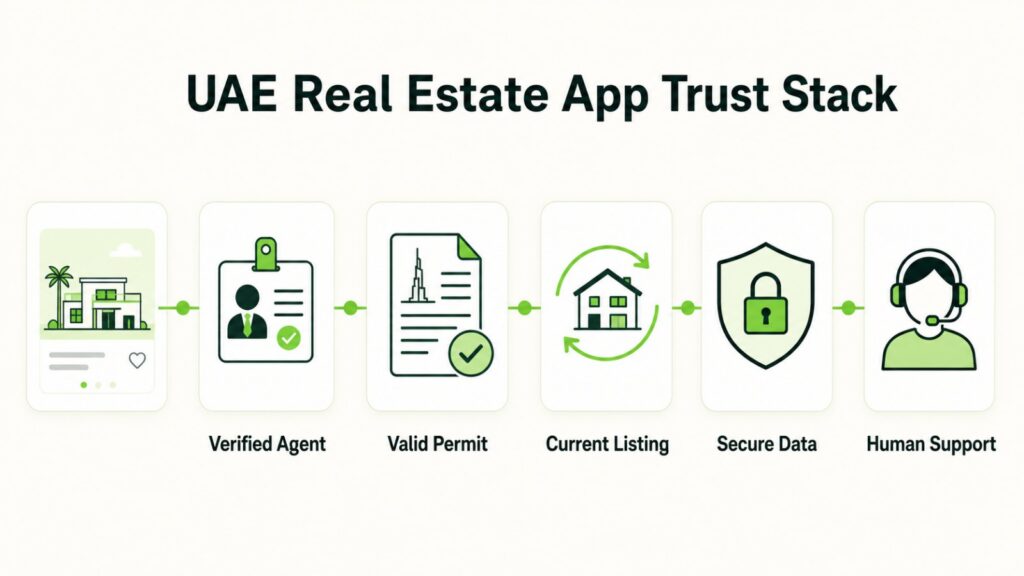
Listing verification, agent credential checks, duplicate and stale-listing detection, and an audit trail are not nice-to-haves in a market where fake and recycled listings were common enough. DLD built an entire permit system specifically to stop them.
Not sure whether your MVP idea already needs a DLD or Ejari integration workstream?
Define the Real Estate Mobile App MVP by User Role
A scannable feature plan separates the product into customer, broker, and operations experiences. Each item below needs an owner, acceptance rule, analytics event, and release priority.
| Buyer or tenant | Agent or developer | Admin or operations | Release test |
| Search, map, filters, save | Listing and inventory control | Listing review and approval | Accurate results and status |
| Compare, media, community | Inquiry inbox and assignment | Agent and role verification | Clear ownership and audit trail |
| Viewing request and calendar | Availability and reminders | Booking oversight | No conflicts or lost requests |
| Chat and contact options | CRM notes and follow-up tasks | Moderation and fraud flags | Response SLA is measurable |
| Alerts and saved searches | Pipeline and source reporting | Billing and analytics | Conversion is attributable |
Buyer and tenant experience:
Build the first customer journey around confidence and action. Search filters should match the chosen niche, not every possible property field.
A family rental app may prioritize schools, commute, furnishing, pet rules, and move-in date. An off-plan platform may prioritize handover, payment plan, developer, unit type, and project phase.
Each listing needs a visible verification state, source, refresh time, permit details where applicable, responsible agent, and a clear next action.
Saved searches and alerts should respect frequency preferences instead of generating notification fatigue.
Real estate broker app and real estate agents app
Broker tools should reduce response time and make the ownership inquiry visible.
Useful MVP functions include automatic assignment, source tracking, qualification fields, viewing calendars, reminders, CRM notes, missed-action alerts, and pipeline stages.WhatsApp or calling integrations need consent, logging, and clear ownership.
A manager should be able to see which inquiries have no owner, which agents missed the response target, and which sources create booked viewings rather than low-quality volume.
Admin and operational controls
The admin panel is the control room for marketplace trust. It includes agent verification, listing moderation, duplicate detection, stale-listing rules, content management, role permissions, audit logs, fraud reports, billing, and operational analytics.
A weak admin layer turns every exception into manual support. A strong admin layer makes the service measurable and recoverable.
Which AI Features Create Business Value in Dubai Real Estate Apps?
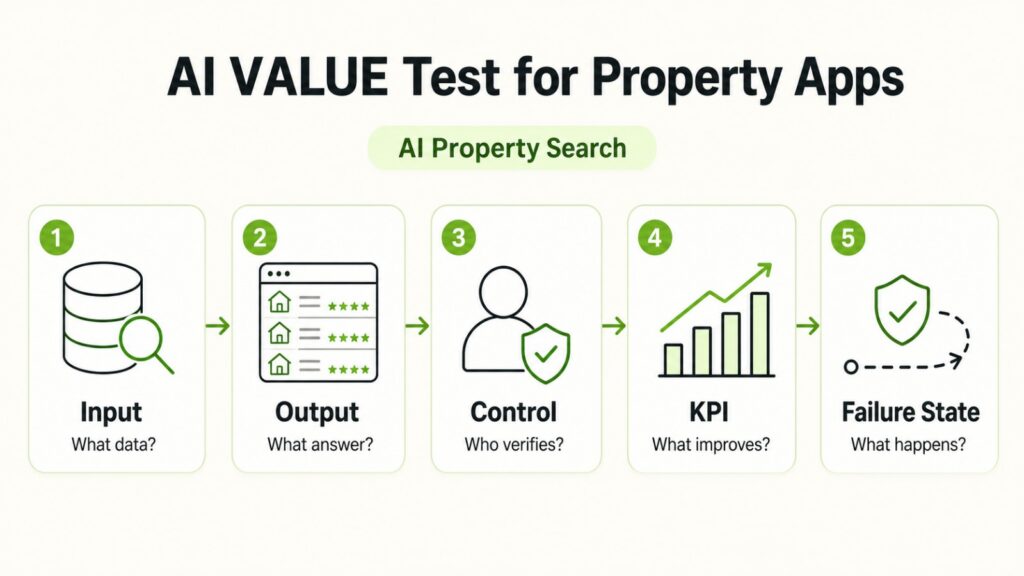
AI development in Dubai is not a feature. Every AI capability worth building needs a defined input, output, a human override, and a metric that proves it is working, or it is not a feature, it is a demo.
AI property matching and semantic search
A buyer may search for “a quiet two-bedroom near the Metro with a flexible payment plan” instead of selecting ten filters. Semantic search can combine that request with structured inventory, location data, browsing context, and declared preferences.
The result should explain why each property appears and allow the user to change the criteria.
Multimodal listing enrichment
Computer vision and document extraction can identify amenities, room types, floor-plan labels, project names, and missing fields from approved images and documents.
The model should flag uncertainty instead of publishing inferred facts as verified property data.
Inquiry qualification and next action
An AI scoring layer can use declared budget, desired location, timing, financing readiness, interaction history, and viewing activity when consent and purpose allow.
The agent keeps final control. Measure whether the feature improves response time and booked viewings, not whether the model assigns many high scores.
Grounded property concierge
A useful property assistant answers from approved inventory, developer brochures, policies, FAQs, and location content.
Retrieval-augmented generation, often called RAG, can connect the response to those sources. Show the source, mark uncertain answers, protect personal data, and offer agent escalation.
The NIST AI Risk Management Framework provides a practical structure for governing AI risks. The OWASP Top 10 for LLM Applications highlights risks such as prompt injection, sensitive information disclosure, and improper output handling. Use both during architecture, testing, and monitoring.
Valuation and investment decision support
Automated valuation should show the date of source data, comparable coverage, assumptions, confidence range, and insufficient-data state. Present the output as decision support, not a guaranteed sale price or financial advice.
AI VALUE test: Approve an AI feature only when the team can name its Input, Output, Human Control, KPI, and Failure State. This five-part test keeps novelty out of the roadmap.
Fraud and anomaly detection
Flag duplicate content, abnormal pricing, and suspicious account behavior automatically, with mandatory human review before any listing gets pulled. Automated takedowns without review create their own support headaches.
See how Code Brew Labs’ AI development team builds property-matching and grounded concierge features
The Digital Twin Opportunity for a Dubai Real Estate App
A digital twin is a continuously updated digital representation of physical assets and environments. A virtual property tour shows a specific space. The two concepts are not interchangeable.
Dubai’s new platform signals future demand for richer spatial and operational experiences. A private property product can be prepared through a modular geospatial data layer, clear source metadata, refreshed timestamps, and replaceable map or 3D services.
Potential experiences include:
- Three-dimensional community context: Help a buyer understand a project’s location, surrounding buildings, access routes, and approved master-plan material.
- Location intelligence cards: Present nearby transport, public facilities, amenities, and community data with source and refresh dates.
- Off-plan visualization: Combine approved developer assets with project phases and unit availability without presenting marketing material as official planning data.
- Asset operations dashboards: Connect building, maintenance, vendor, and SLA information for authorized property teams.
Every data source needs permission, ownership, refresh rules, quality checks, and a removal process. A future-ready architecture is valuable even when direct Digital Twin access is not part of the first release.
Step-by-Step Real Estate App Development Process
A six-stage process gives business, product, legal, and technical teams shared approval points.
Discovery and feasibility
We define the audience, problem, revenue model, geography, competitive wedge, and KPI. Review DLD, RERA, Trakheesi, Ejari, partner data, payment, map, and AI requirements.
Thereafter, deliver a product requirements document, data map, integration register, risk register, and MVP backlog.
User journeys and bilingual prototype
Our team prototypes the highest-value buyer, agent, and admin flows in Arabic and English. Followed by testing search, listing trust, viewing requests, inquiry assignment, moderation, and recovery states with real users.
Architecture and data foundation
It includes defining the inventory model, geospatial search, media pipeline, roles, permissions, audit logs, analytics, integrations, and cloud operations. Designing the AI knowledge base and evaluation plan before building the assistant.
MVP development
Deciding between iOS app development or Android App development, building web front ends, backend services, admin tools, search, listing workflows, inquiry management, and analytics. Restrict AI pilots to data that meets the required quality and permission rules.
QA, security, and launch readiness
It starts with testing device coverage, Arabic right-to-left behavior, search accuracy, map behavior, permissions, integrations, payment failures, performance, accessibility, privacy, security, backups, and rollback. Then our QA team runs user acceptance testing with agents, administrators, and target customers.
Phased launch and improvement
We start the launch with one geography, property category, brokerage group, developer, or managed portfolio. Track response, discovery, viewing, trust, and operational metrics. Expand only after the first workflow performs reliably.
Clutch mobile app development timeline, updated 29 May 2026, places a typical project at 20 to 40 weeks, including planning, design, development, testing, deployment, and post-launch work
Real Estate App Development Process in the UAE, Step by Step
| Phase | What Happens | Duration |
| Discovery and compliance scoping | Audience, MVP, PRD, data map, risk register | 2-4 weeks |
| UX, IA, and prototype | Buyer, agent, and admin flows in Arabic and English | 3-6 weeks |
| Architecture and data foundation | Inventory model, permissions, AI knowledge base plan | 2-4 weeks |
| MVP development | Front end, backend, admin, AI pilot where data quality allows | 10-18 weeks |
| QA and launch readiness | Arabic RTL QA, payment failure paths, security testing | 3-5 weeks |
| Phased launch | One geography or broker group first, then iterate on data | Ongoing |
Do not skip discovery to save two weeks. Every DLD or Ejari integration surprise that derails a timeline traces back to a discovery phase that got compressed or skipped.
How Much Does Real Estate App Development Cost in the UAE?
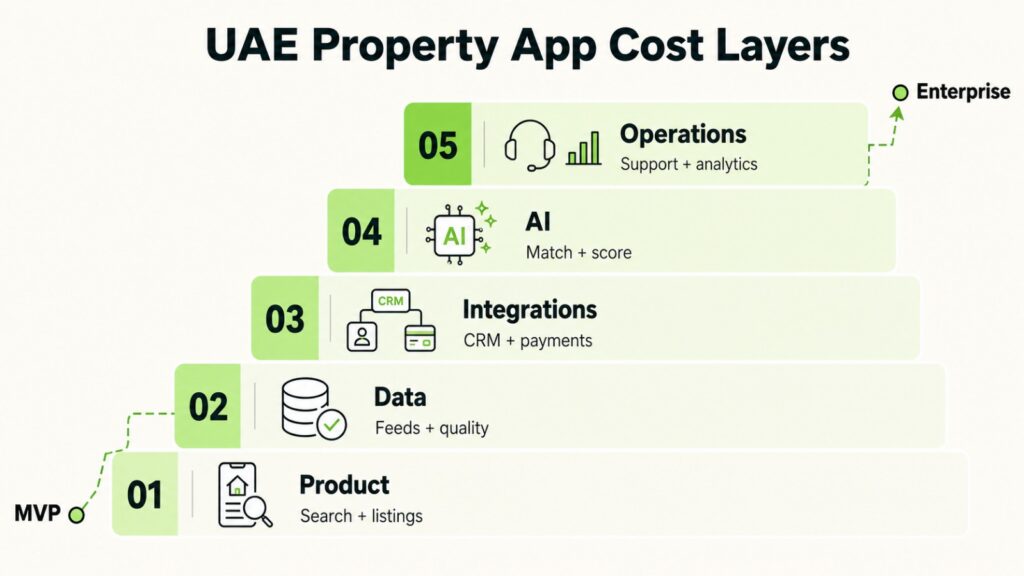
Real estate app development cost depends on the product model, user roles, platforms, integrations, listing volume, Arabic scope, AI depth, security, and launch geography. A price without those boundaries is not a reliable estimate.
Clutch’s July 2026 mobile app pricing guide states that most reviewed projects cost USD 10,000 to USD 49,999, with an average of USD 90,780.11.
| Planning level | Evidence-based reference | Scope signal | Estimate rule |
| Focused MVP | AED 73,450+ company baseline | One main workflow and limited integrations | Price after feature boundary |
| Custom platform | AED 333,390 Clutch average reference | Multiple roles, admin, search, data work | Price after architecture |
| AI or enterprise | AED 293,800 to AED 918,125+ company band | AI, scale, integrations, governance | Price after data assessment |
What increases the budget?
- Product surfaces: iOS, Android, responsive web, broker workspace, and admin panel each require design, engineering, and testing.
- Inventory complexity: High listing volume, media processing, geospatial queries, deduplication, and frequent updates add backend and operational work.
- UAE integrations: DLD, Trakheesi, Ejari, UAE Pass, CRM, payments, messaging, maps, and data partners have separate prerequisites and test needs.
- Bilingual delivery: Arabic interface behavior, search, content, forms, legal copy, and QA need dedicated work.
- AI scope: Data preparation, retrieval, model use, evaluation, monitoring, guardrails, and human review need separate estimates.
- Three-dimensional content: Asset production, map licensing, rendering, and device performance can become a distinct workstream.
- Operating readiness: Security, monitoring, backups, moderation, support, analytics, and release management continue after launch.
Budget for 12-month ownership, not only development
While calculating the mobile app development cost, the first-year budget should include cloud hosting, storage, maps, messaging, email, analytics, monitoring, security, API fees, AI model use, data quality, moderation, app-store operations, support, maintenance, and planned product experiments.
The official DLD API Gateway’s listed AED 30,000 plus 5% VAT annual option demonstrates why third-party and authority fees belong in the total cost of ownership. The fee should be reconfirmed when scoping because eligibility, pricing, and services can change.
Metrics That Prove Your Real Estate App Is Working
Downloads are not a success metric. A UAE real estate app with ten thousand downloads and a two percent lead-to-viewing rate is a worse business than one with a thousand downloads and a fifteen percent rate.
| Business goal | Primary KPI | Diagnostic KPI | Decision use |
| Better discovery | Search-to-shortlist rate | Zero-result searches | Improve inventory and search |
| Better inquiry quality | Qualified inquiry rate | Time to first response | Adjust forms and routing |
| More viewings | Inquiry-to-viewing rate | Cancellation and no-show rate | Improve qualification and calendar |
| Stronger trust | Verified listing rate | Duplicate and stale rate | Improve moderation |
| Better AI | Accurate-answer rate | Escalation and override rate | Retrain, restrict, or remove |
| Higher retention | Saved-search return rate | Alert-to-action rate | Improve relevance and frequency |
Need a scope-based estimate for buyer, agent, admin, integration, and AI work?
Monetization Models for Real Estate Apps
The revenue model should match the app model and operational responsibility.
- Featured listings and advertising: Suitable for marketplaces with strong buyer traffic. Label sponsored positions and preserve relevance and trust.
- Qualified inquiry fees: Suitable for portals that can define, validate, and attribute a qualified inquiry fairly.
- Broker or branch subscriptions: Suitable for a real estate broker app with CRM, inventory, team, and analytics functions.
- Property management software fees: Suitable for landlord, tenant, maintenance, and portfolio workflows with recurring operational value.
- Transaction or service fees: Suitable only when licensing, payment, contracting, refund, and support responsibilities are clear.
- Premium analytics: Suitable for investor, developer, or enterprise tools with reliable data rights and transparent methodology.
Apple’s current App Review Guidelines state that real-time person-to-person services, such as real estate tours, may use payment methods other than in-app purchase.
Digital features or subscriptions consumed inside the app can follow different store rules. Confirm the chosen payment flow during product design.
How to Choose a Real Estate Mobile App Development Company
A real estate mobile app development company should reduce product, compliance, data, and operating risk. Ask each shortlisted partner for evidence in six areas:
- Relevant product work: Marketplace, CRM, property operations, multi-role, or regulated workflow experience.
- UAE feasibility: A written method for DLD, RERA, Trakheesi, Ejari, UAE PDPL, and Arabic requirements.
- AI evaluation: Approved data, model choice, accuracy measures, failure handling, monitoring, and human review.
- Delivery controls: Milestones, acceptance criteria, demos, change control, risk ownership, and escalation.
- Ownership: Source code, cloud accounts, credentials, data, documentation, and exit support.
- Post-launch plan: Monitoring, incident response, updates, compliance changes, support levels, and roadmap capacity.
The best real estate mobile app developers in the UAE will challenge unclear assumptions before agreeing to features. A proposal should state exclusions, dependencies, third-party fees, data responsibilities, and the conditions that change price or timeline.
Why Code Brew Labs for Real Estate App Development in the UAE
Code Brew Labs has built AI-powered mobile apps and enterprise software for the UAE market for 13-plus years, with 500-plus custom real estate app solutions launched and clients spanning Airbus, Sobha Realty, Aradi, and AW Rostamani
Aradi: A compliance-first UAE property marketplace
Aradi is a custom build and adds the product depth behind the public experience: agent onboarding with identity and broker-document checks, permit-validation workflows, synced viewing calendars, reminders, in-app chat, no-show controls, listing moderation, subscriptions, and an operations dashboard.
This demonstrates a useful product principle: trust must be designed across customer, agent, and admin journeys. A verified badge alone is not a trust system.
Sobha Realty: Enterprise property operations with measurable governance
Sobha Realty is a centralized, enterprise-grade facility management platform built for both tenants and building management, designed to bring governance into long-lifecycle property projects and reduce ambiguity around progress and delays.
Real estate apps are not limited to property search. Enterprise products can connect service requests, vendors, approvals, progress records, SLA monitoring, and portfolio visibility. Those workflows require governance, permissions, auditability, and operational reporting from the beginning.
Delivery fit for UAE founders and enterprises
Code Brew Labs can support product discovery, mobile app development, bilingual customer and agent apps, admin panels, marketplace operations, AI search and assistants, CRM connections, DLD or partner integration planning, analytics, security, launch, and post-launch improvement.
Every Code Brew Labs real estate build starts with the same discovery process; compliance scoping before design, not after. Explore the broader portfolio for additional case studies across UAE verticals.
Conclusion:
The UAE real estate app opportunity is not about matching Bayut’s feature list. It is about building a platform that treats compliance as architecture, Arabic as a first-class experience rather than an afterthought, and AI as a tool with a measurable job, not a marketing checkbox.
Dubai’s Digital Twin launch is a signal, not a shortcut. The apps that win the next few years will be the ones that were built ready for richer location data before their competitors even noticed the platform existed.
Build a property platform ready for the UAE’s next data layer. Start with a verified, conversion-focused MVP today, then scale the data, AI, and spatial architecture as Dubai’s smart-city ecosystem matures.
Code Brew Labs can translate these decisions into a phased plan for a Dubai real estate app, real estate broker app, property marketplace, or enterprise operations platform.
FAQs:
How much does it cost to build a real estate app in the UAE?
Most mobile app projects reviewed by Clutch fall between about AED 36,725 and AED 183,621, while its overall average converts to about AED 333,390. A UAE real estate app can exceed those benchmarks when it includes multiple roles, large inventory, Arabic UX, DLD or Ejari work, AI, 3D content, and enterprise controls. Request a scope-based estimate.
How long does it take to develop a real estate app in Dubai?
Clutch places a typical mobile app project at 20 to 40 weeks. A focused single-panel MVP may take about 3 to 4 months. A bilingual property portal with buyer, agent, and admin products, AI, and regulated integrations may take 6 to 10 months. Approve the timeline after feasibility, architecture, integration, and QA scope are defined.
What features should a UAE property app MVP include?
A practical MVP includes credible listings, search and filters, property detail pages, saved items, viewing requests, agent profiles, inquiry assignment, follow-up tasks, an admin moderation panel, role permissions, audit logs, analytics, and Arabic and English support. Add payments, valuation, AI, and 3D functions only when the business model and data plan support them.
Which AI features should a real estate app build first?
Start with semantic search, listing completion checks, inquiry qualification, and a grounded property concierge. These functions improve discovery and operations without presenting an automated estimate as financial certainty. Give agents and moderators control, record failure states, and measure search-to-shortlist rate, inquiry-to-viewing rate, answer accuracy, and human overrides.
Can a real estate app integrate with DLD, RERA, Trakheesi, or Ejari?
Yes, where the business and provider meet the official prerequisites and receive the required access. DLD’s API Gateway publishes Ejari and Trakheesi capabilities with eligibility, licensing, association, local-office, and fee requirements. Confirm legal, commercial, technical, and data conditions before promising an integration in a proposal or product roadmap.
Does a Dubai real estate app need Arabic and English from day one?
Use both languages from the first release when Arabic-speaking customers, brokers, regulators, or operations teams are part of the target journey. Arabic needs right-to-left layout, mirrored navigation, search behavior, form validation, content, legal copy, notifications, and dedicated QA. A later translation layer can create costly design and data rework.
How can a property app verify listings and agents?
Use identity and credential review, role-based onboarding, permit fields, DLD or Trakheesi validation where approved, listing-source records, refresh timestamps, duplicate checks, moderation queues, and audit logs. DLD’s Madmoun QR code gives customers an official path to verify a real estate advertisement’s approved details.
Is a digital twin the same as a 3D property tour?
No. A 3D tour represents a property or development for viewing. A digital twin connects spatial and operational data to a digital representation that can be updated, analyzed, and used for scenarios. A real estate app can use licensed 3D tours without having access to Dubai’s government Digital Twin Platform.
What ongoing costs should be budgeted after launch?
Budget for cloud infrastructure, storage, maps, messaging, analytics, monitoring, security, backups, API fees, AI usage, data quality, moderation, customer support, maintenance, app-store updates, and product experiments. Use a 12-month ownership model and assign an owner to each recurring service before launch.
How can a UAE real estate app make money?
Common models include featured listings, advertising, qualified inquiry fees, broker subscriptions, property-management software fees, transaction or service fees, and premium analytics. Select the model before finalizing the MVP because revenue affects user roles, payments, reporting, contracts, support, and app-store requirements.
Let's Convert Your Business Idea Into Success!
Free Consultation from Top Industry Experts
Let’s Build Your Dream App!
Share article on :


 No commitment required
 NDA on request
 24-hour response


