
Quick Summary:
- A custom AI beauty app for the UAE market costs between AED 128,500 and AED 1.28 million, depending on features, AI depth, and platform scope.
- The UAE beauty and personal care market is worth $3.49 billion in 2026, growing at 6.05% CAGR.
- Basic salon booking apps take three to five months to build; AI-driven, multi-vendor platforms take seven to twelve.
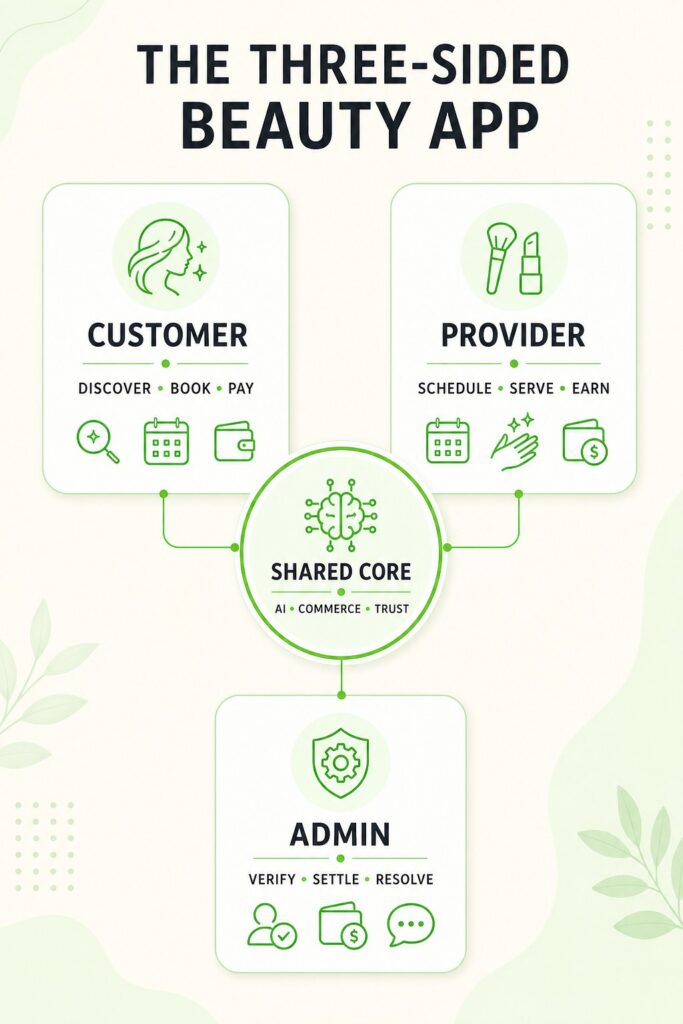
- A complete on-demand AI beauty app usually needs a customer experience, a provider workspace, an admin system, and shared services for identity, payments, notifications, analytics, and support. A single-salon booking tool may need a narrower structure.
- AI in beauty apps should make a measurable decision, such as matching a user to a service, predicting an empty slot, or recommending a suitable product.
- UAE compliance depends on the business model. Platform licensing, personal-data protection, consumer-product registration, payment security, and clinical-service rules should be scoped separately.
- Custom software fits businesses that need differentiated workflows, data ownership, specialized integrations, or multi-market scale. White-label software fits a fast launch with standard booking needs.
The 2026 decision is not whether beauty app development must include bookings for a salon, spa, beauty brand, therapist network, or marketplace founder. The decision is how the product will connect customer intelligence, provider capacity, commerce, AI guidance, compliance, and profitable operations.
Product scope matters more than a long feature list. A commercially useful beauty mobile app in Dubai starts with a precise operating problem, a viable business model, a compliant data plan, and a release path.
This article explains the product models, feature priorities, AI controls, UAE requirements, cost benchmarks, technology choices, monetization options, and partner-selection criteria that shape a custom AI beauty platform in 2026.
Why the Beauty App Market Matters in 2026
Beauty demand is becoming more digital, personalized, and closely connected to commerce. McKinsey’s June 2026 analysis expects the global beauty market to grow by 5 percent per year and reach USD 590 billion by 2030.
Wellness gives the category a wider commercial context. The Global Wellness Institute reports that the wellness economy reached USD 6.8 trillion in 2024 and projects it to approach USD 9.8 trillion in 2029.
The institute also identifies the Middle East and North Africa among the fastest-growing regional wellness economies over the previous five years.
These figures describe broad beauty and wellness markets, not beauty-app revenue.
Their value is strategic: product discovery, appointment access, personalized advice, and commerce are moving into the same customer journey.
The commercial question is therefore not whether to add AI. The better question is where software can remove uncertainty from discovery, availability, suitability, trust, or purchase.
Want a prioritized and AI delivery roadmap for your beauty app?
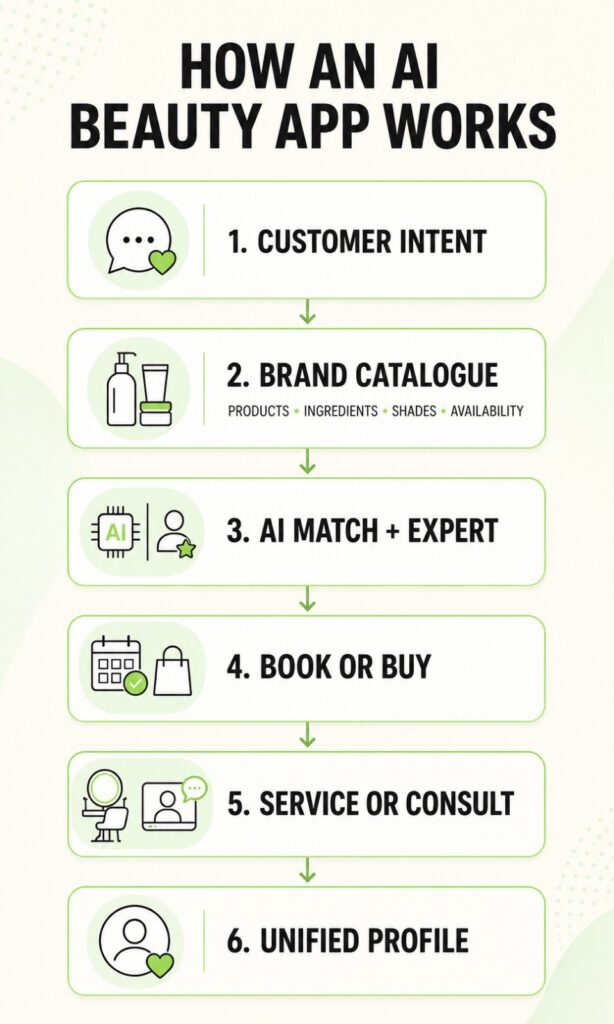
How an On-Demand AI Beauty App Works
An on-demand AI beauty app works as a connected decision and transaction system. It combines brand-approved product knowledge, customer preferences, provider availability, booking rules, location, payments, and service history.
So each interaction can move from intent to a suitable service, professional, product, or expert consultation.
Capture the customer’s intent
The customer selects a concern, desired service, product category, location, preferred time, budget, or expected result. A profile can also store permitted skin, hair, shade, allergy, and preference data.
Interpret the request with brand-specific intelligence
The AI layer evaluates the request against approved services, ingredients, shades, provider skills, catalogue rules, contraindication prompts, and availability. It should not invent product claims or cross a clinical decision boundary.
Match the right option
The system ranks suitable services, products, salons, beauticians, or therapists using relevant filters. The customer can refine the recommendation and understand why an option appears.
Complete real-time booking or purchase
The app checks calendars, service duration, location coverage, inventory, deposits, travel time, and payment rules before confirming the transaction.
Support service delivery
Customers receive preparation notes, reminders, consultation access, provider updates, consent prompts, and post-service instructions.
Providers receive the approved customer context needed to prepare without exposing unnecessary personal data.
Build the next interaction from unified data
Completed bookings, purchases, feedback, loyalty activity, and permitted preferences update the customer profile across mobile, web, and in-store touchpoints.
The next recommendation can use that history while respecting consent and retention rules.
Beauty AI in the product catalogue
The system uses the business’s own product, service, ingredient, shade, usage, price, availability, and policy data. Catalogue updates should change the guidance without waiting for a complete app release.
A proprietary intelligence engine
The engine connects customer concerns with structured catalogue attributes and approved recommendation logic. Brand exclusions, regional availability, compatibility rules, and escalation conditions remain under business control.
Expert guidance adapted to customer expectations
AI can gather context, narrow options, and prepare a consultation. A beautician, therapist, product expert, or clinician should take over when the request needs professional judgment or falls outside cosmetic guidance.
Unified customer intelligence:
A consent-aware customer profile keeps booking, consultation, purchase, preference, and loyalty signals consistent across channels. Staff and automated systems should see only the information required for the current task.
This operating model distinguishes an AI beauty platform from generic scheduling software. The booking engine confirms time and capacity, while the intelligence layer helps decide what should be booked, purchased, discussed, or escalated.
Beauty App vs. Beauty Salon Booking App
An on-AI beauty app manages a wider discovery, recommendation, commerce, and service ecosystem. A Beauty Salon booking app primarily manages appointments and operations for one salon, spa, chain, or professional network.
| Decision point | Beauty app | Beauty Salon booking app | Choose based on |
| Business scope | Marketplace, commerce, advice, or multi-service ecosystem | Appointments and salon operations | Revenue model and target users |
| User groups | Customers, providers, sellers, experts, and admins | Customers, staff, managers, and admins | Workflow ownership |
| Advanced layer | AI analysis, AR try-on, matching, delivery, or content | Scheduling, reminders, POS, CRM, and loyalty | Differentiation required |
| Best fit | New platform, beauty brand, or multi-provider network | Salon, spa, chain, or independent professional | Launch speed and integration depth |
Custom development fits a business with proprietary guidance, differentiated workflows, multi-provider operations, or connected commerce. Standard booking software can remain the better choice when the requirement is dependable scheduling for one business.
AI Beauty App Models
The business model determines the app’s data, revenue, compliance, provider relationship, and daily operating workload. Feature selection should follow that choice.
Single-Salon or Salon-Chain App
This model gives one salon, spa, chain, or independent professional direct control over booking, staff calendars, client history, payments, loyalty, and local inventory.
It works best when the business wants a branded customer channel without marketplace commissions or cross-provider discovery.
Multi-Vendor Beauty Marketplace
A marketplace allows customers to compare and book independent beauticians, therapists, salons, spas, or clinics.
The platform must manage onboarding, credential verification, searchable profiles, service quality, commissions, payouts, refunds, disputes, and provider performance.
The model suits a founder building supply across several providers or locations.
At-Home Beauty Service Platform
An at-home model sends a professional to the customer’s location. The product needs service zones, travel buffers, professional matching, address accuracy, safety controls, live status, portable service requirements, and support for delays or access problems.
Urban Company’s Dubai service demonstrates this flow. Customers select a treatment and time for home delivery, while the platform coordinates service packaging, professional availability, location coverage, quality controls, and support.
Beauty Commerce and Virtual Try-On App
This model connects advice, product discovery, shade or style visualization, catalogue search, inventory, checkout, fulfilment, and returns.
Catalogue accuracy matters because the AI and AR experience depends on structured shades, ingredients, product images, usage instructions, and availability.
Hybrid Beauty, Wellness, and Clinical-Aesthetic Platform
A hybrid product can combine salon services, wellness sessions, cosmetic product commerce, and regulated aesthetic appointments.
The app must separate cosmetic guidance from clinical assessment and route regulated procedures only to authorised facilities and qualified professionals.
Core Features Every Beauty App Needs in 2026
Core features should support the complete transaction, not just the customer interface.
The product needs connected customer, provider, admin, commerce, engagement, trust, and AI capabilities because a booking is only successful when every side can complete its work.
Customer-Side Features:
-
Profile and skin or hair analysis:
Customers should be able to store contact details, preferences, concerns, allergies, shade information, service history, and optional image-based analysis. Consent controls should separate essential booking data from optional personalization data.
-
Service browsing with filters:
Search should support service category, concern, provider skill, location, availability, price, rating, home or in-salon delivery, gender preference where lawful, and language. Useful filters reduce the time between intent and a suitable option.
-
Real-time booking:
The app should display live provider availability, service duration, resource requirements, deposits, cancellation rules, and rescheduling options. Confirmation should occur only after the calendar and required resources are reserved.
-
Geolocation matching:
Customers can find nearby salons or professionals who serve their location. The system should consider travel radius, service zones, travel time, address accuracy, and provider availability rather than distance alone.
-
Secure payments:
Customers need a trusted checkout for deposits, full payments, tips, refunds, memberships, and product purchases. Tokenized payment handling, clear receipts, and visible refund status protect the transaction.
-
Ratings and reviews:
Verified post-transaction reviews should cover service quality, punctuality, hygiene, communication, and outcome satisfaction. Moderation and dispute rules help prevent manipulation or retaliatory feedback.
-
AR try-on and video consultation:
Virtual try-on can support makeup shades, hair colour, nail styles, or other visual choices. Video consultation gives a beautician, therapist, or product expert a route to review concerns before confirming a service or product.
-
Push notifications:
Notifications should cover confirmations, reminders, provider updates, waitlist openings, post-care, rebooking, loyalty, and approved offers. Preference controls prevent operational messages from becoming unwanted promotions.
Provider-Side Features (for Beauticians and Therapists)
-
Booking management:
View new, accepted, rescheduled, cancelled, completed, and disputed appointments in one place. Accept or decline requests within defined rules, update service status, add preparation notes, and report issues with enough context for support.
-
Calendar and availability control:
Set working hours, breaks, holidays, travel buffers, service duration, location coverage, and blocked resources. Calendar synchronization and conflict alerts protect the professional from double bookings and unrealistic travel schedules.
-
Earnings and payouts:
Track gross booking value, commission, tips, refunds, adjustments, taxes where applicable, and the next payout date. Downloadable statements and a clear dispute route help the professional reconcile income.
-
Client communication:
Use secure chat, masked calling, automated arrival updates, consultation forms, and post-care messages. The professional should receive only the customer information needed to perform the booked service safely and well.
Admin-Side Features
-
Provider verification:
Admin teams need workflows for identity, business or professional licences, qualifications, insurance where relevant, service categories, operating areas, expiry dates, and re-verification. Failed or expired credentials should affect listing and booking eligibility.
-
Operational analytics:
Dashboards should show search demand, booking conversion, cancellations, no-shows, service completion, repeat use, provider capacity, refunds, payout status, support volume, and customer satisfaction. Metrics should be filterable by location, service, provider, and acquisition source.
-
Commission management:
Admins need configurable commission rules by service, provider tier, location, campaign, or contract. Every calculation should be visible in booking records, provider statements, refunds, and finance reports.
-
Dispute resolution:
A case workspace should collect booking history, messages, evidence, policies, payment state, previous actions, and resolution deadlines. Role-based controls and audit logs protect both the customer and the provider during review.
Commerce Features
A beauty-commerce layer needs a structured product catalogue, inventory status, search, cart, checkout, fulfilment, returns, seller records, and product-registration fields where applicable.
Shade, ingredient, concern, compatibility, and usage attributes also give the AI layer reliable product data.
When services and products are sold together, the app should connect professional recommendations with available inventory without hiding sponsorship or substituting unavailable items without consent.
Engagement Features
Waitlists, reminders, rebooking prompts, loyalty balances, memberships, referral tracking, saved routines, and customer support help maintain the relationship after the first transaction.
Each message should be tied to a real customer event or permission rather than an indiscriminate campaign.
Provider engagement matters too. Availability prompts, incomplete-profile reminders, training notices, payout alerts, and demand insights help professionals keep their marketplace information accurate.
Trust and Safety Features
Trust features include consent records, privacy controls, provider credentials, verified reviews, clear policies, content moderation, audit logs, role-based access, fraud checks, and safety reporting.
These controls should appear inside the workflow instead of being hidden in legal pages.
For AI-assisted recommendations, the interface should also disclose when AI is used, state important limitations, offer manual choices, and provide an expert or support route for uncertain outcomes.
AI Features Worth Prioritizing
-
Service and provider matching:
Rank results using location, availability, skills, preferences, price, and verified quality signals. The interface should explain important filters and allow manual changes.
-
No-show risk support:
Use booking history and permitted behavior signals to trigger reminders, confirmation requests, waitlist offers, or deposit policies. Avoid hidden penalties based on opaque scores.
-
AI beauty advisor:
Answer catalogue and service questions using approved brand content. Restrict claims, show the source of product information, and provide an expert route for sensitive concerns.
-
Cosmetic skin or hair analysis:
Use camera input only with clear consent, limited retention, and validated performance across relevant skin tones, devices, and lighting conditions.
-
AR virtual try-on:
Help users visualize makeup, hair color, nails, or aesthetic outcomes. Label simulations as visual aids rather than guaranteed results.
-
Demand and staffing forecasts:
Estimate busy periods and service demand from operational data. Managers should be able to review and override recommendations.
UAE Compliance for AI On-Demand Beauty App Development
Compliance depends on what the beauty app sells, stores, recommends, and facilitates. A booking tool, cosmetics marketplace, home-service platform, and aesthetic-clinic app do not share one approval path.
Business and Provider Licensing
Dubai DET states that businesses should use the licensing and approval route relevant to their activities.
Existing licensed retail and trading businesses may extend into digital channels within the applicable framework, but a new marketplace should confirm its exact activity and approvals before launch.
Provider verification should be part of onboarding. The beauty app should collect the relevant licence or permit, service category, expiry date, operating area, and supporting qualifications.
The platform should also define how expired or disputed credentials affect visibility and bookings.
UAE Personal Data Protection
Federal Decree-Law No. 45 of 2021 applies to the electronic processing of personal data inside or outside the UAE when the law’s scope is met. The official UAE portal highlights consent, security, correction rights, processing restrictions, and cross-border transfer requirements.
For a beauty app, face images, skin concerns, location, appointment history, payment details, provider documents, and chat records require clear purposes and access rules.
Keep only the data needed for the feature. Separate optional personalization from the basic booking service.
Montaji and Consumer Products
Montaji is relevant when a Dubai business deals with consumer products such as cosmetics and personal-care goods.
Dubai Municipality’s e-commerce guideline lists a valid e-commerce licence with a consumer-products activity among the service prerequisites for product businesses.
A salon booking-only app should not claim that every service requires Montaji. A commerce module should store registration status, permitted claims, product data, seller identity, and catalogue review records.
DHA-Regulated Aesthetic Services
Dubai Health Authority updated its standards for non-surgical cosmetic procedures on June 4, 2025. The standards distinguish procedures and the professional categories permitted to perform them.
An app that lists injectables, deeper chemical peels, clinical lasers, or related aesthetic procedures should treat the flow as a regulated healthcare service discovery.
Facility and professional verification, informed consent, claims review, and escalation require specialist legal and clinical input.
Payment Security
PCI DSS provides baseline technical and operational controls for entities that store, process, or transmit payment-account data, or that can affect the cardholder-data environment.
Use a compliant payment provider and tokenization so the app handles as little card data as possible
Process to Develop an AI Beauty App
Code Brew Labs develops an AI beauty app around the client’s operating model, customer journey, provider workflow, and commercial priorities.
The engagement is structured to turn business requirements into a controlled release rather than teach the client to manage software development.
Product and Business Discovery
Code Brew Labs begins by defining the target users, service categories, geography, delivery format, revenue model, provider relationship, and success measures.
The team also identifies whether the product is a salon system, marketplace, at-home platform, commerce app, or regulated hybrid.
The output is a shared scope narrative with assumptions, exclusions, dependencies, and the decisions that still need owner approval.
Customer, Provider, and Admin Workflow Mapping
Product specialists map how customers discover and book, how beauticians or therapists manage work, and how admins verify, monitor, settle, and resolve transactions.
Failure paths such as no availability, late arrival, rejected booking, payment failure, refund, unsafe conduct, or expired credentials are included from the start.
AI Use-Case and Data Assessment
Code Brew Labs evaluates each AI feature against user value, available data, accuracy needs, consent, limitations, and human review.
The assessment separates catalogue-grounded advice, matching, forecasting, conversational support, AR, and computer vision because each requires different evidence and controls.
The RADAR framework helps decide which AI capabilities belong in the first release and which should wait for better data or a clearer business case.
Compliance and Integration Scoping
The delivery team maps UAE personal-data requirements, payment boundaries, provider verification, product registration, and regulated aesthetic-service routing to the product design.
Required payment, map, messaging, CRM, POS, inventory, identity, and analytics integrations are scoped with ownership and failure handling.
Specialist legal or clinical advice remains a client-side requirement when the product enters regulated territory.
UX and Prototype Validation
Designers create customer, provider, and admin journeys for the highest-value transactions.
Interactive prototypes are used to review discovery, AI guidance, booking, provider acceptance, payout visibility, rescheduling, refunds, consultation, and support before full engineering begins.
Architecture and Release Planning
We define the mobile, web, backend, data, cloud, integration, security, and AI architecture for the approved scope.
The release plan separates a commercially viable first version from later capabilities so budget and timeline remain tied to measurable outcomes.
Agile Engineering and Quality Assurance
Mobile app developers, backend engineers, AI specialists, designers, and quality teams deliver the product in reviewable increments.
Testing covers functional behavior, device compatibility, accessibility, security, load, integrations, payments, AI accuracy, subgroup performance, fallback behavior, and role permissions.
Controlled Launch and Product Improvement
We support deployment, store submission, production monitoring, analytics, error review, and release stabilization.
A pilot can start with a selected geography, service category, provider group, or customer cohort before broader expansion.
Post-launch decisions use booking quality, provider capacity, conversion, repeat use, support volume, model performance, and unit economics rather than a fixed feature calendar.
Watch Our Video:
Tech Stack for a Scalable AI Beauty App
Code Brew Labs selects technology after the product model, device requirements, AI workload, integration landscape, compliance needs, expected scale, and ownership model are clear. The stack is a delivery decision, not a list of fashionable tools.
Mobile Customer and Provider Apps
Flutter or React Native can support shared development across iOS app development and Android app development when the product needs consistent booking, messaging, payment, and provider workflows.
Native Swift and Kotlin can be considered when camera processing, AR, background location, device performance, or platform-specific behavior justifies deeper native control.
The choice is validated against the actual skin analysis, virtual try-on, video, map, notification, and offline requirements on target devices.
Web Experiences and Admin Operations
React, or Next.js, can support customer web journeys, provider portals, and admin systems.
The implementation should keep public pages search-friendly while giving operational teams responsive workflows for verification, catalogue management, commissions, disputes, analytics, and support.
Backend Services and Booking Logic
Node.js can support real-time APIs and integration-heavy transaction flows, while Python is useful for AI services, data processing, and evaluation.
Java or .NET can fit enterprise environments with established governance and internal engineering standards.
Booking, payment, commission, consent, and eligibility rules should remain separate from replaceable AI components so a model change does not destabilize the transaction engine.
Data, Search, and Media Storage
PostgreSQL is a strong foundation for bookings, payments, provider records, commissions, and other structured transactions.
Search services, cache, analytics stores, and object storage can support discovery, performance, events, portfolios, consented images, and documents.
Permissions, retention, deletion, and audit requirements are defined for each data class, especially facial images, location, chats, and provider credentials.
Cloud and Operational Reliability
AWS, Microsoft Azure, Google Cloud, Firebase, or an approved regional configuration can be selected according to services, residency, security, monitoring, recovery, cost, and the client’s operating model.
Backup, alerting, deployment, access, and incident ownership should be documented before launch.
Payments, Maps, Messaging, & Business Integrations
The app can connect suitable UAE payment gateways, map and geolocation services, Twilio or another approved messaging provider, POS, CRM, inventory, accounting, identity, and analytics systems.
Every integration needs retries, reconciliation, audit records, error visibility, and a manual recovery route.
AI, Machine Learning, and AR
TensorFlow, PyTorch, approved model APIs, retrieval systems, or specialist AR and computer-vision SDKs can support the chosen intelligence layer.
Code Brew Labs evaluates whether the client needs an external API, a configured brand intelligence system, a fine-tuned model, or a custom model trained on proprietary data.
Model providers and SDKs should remain replaceable when accuracy, catalogue coverage, cost, latency, privacy, or policy requirements change.
The table is a short technology recap, not the architecture itself.
| Layer | Typical options | Primary selection test |
| Mobile | Flutter, React Native, Swift, Kotlin | Camera, AR, location, performance, shared code |
| Web and admin | React, Next.js | Search visibility, accessibility, operational complexity |
| Backend and AI | Node.js, Python, Java, .NET, model APIs | Transactions, integrations, AI workload, governance |
| Data and cloud | PostgreSQL, search, object storage, AWS, Azure, Google Cloud | Scale, permissions, residency, recovery |
| Integrations | Payments, maps, messaging, POS, CRM, inventory | UAE coverage, support, reconciliation, auditability |
| Security | Encryption, role controls, secrets, logs, monitoring | Data sensitivity, payment scope, regulated workflows |
How Much Does it Cost to Develop an AI Beauty App in 2026
The cost to develop a beauty app depends on user roles, platforms, integrations, AI App development, AR, catalogue size, data controls, admin operations, and launch geography. A price without a feature boundary is not a reliable estimate.
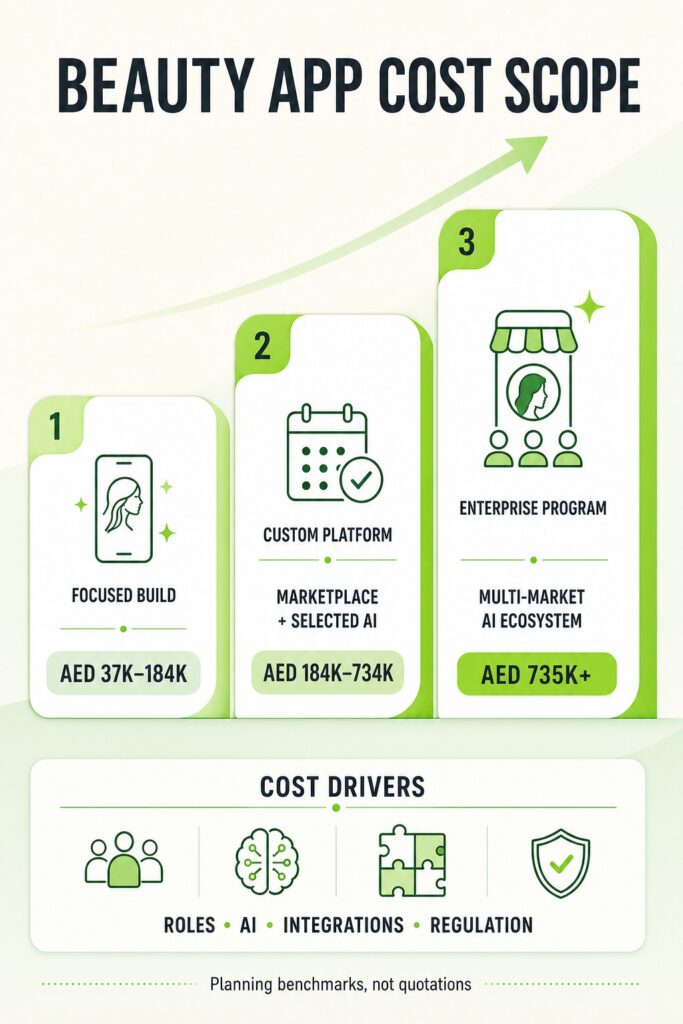
Clutch’s July 2026 reviewed mobile-app pricing data converts to a common planning band of approximately AED 37,000 to AED 184,000.
The table maps those public mobile-app bands to common beauty-product scopes.
| Planning band | Estimated cost in AED | Scope that may fit | Typical complexity |
| Focused build | AED 37,000 to AED 184,000 | Narrow booking release or limited workflow | Few roles, standard integrations, limited customization |
| Custom platform | AED 184,000 to AED 734,000 | Marketplace, connected commerce, selected AI, deeper integrations | Multiple roles, custom operations, richer data |
| Enterprise program | AED 735,000+ | Multi-market ecosystem, advanced AI, complex governance | High scale, extensive integrations, specialist controls |
What Increases Beauty App Development Cost?
Platform and role depth:
A customer-only booking release sits at the lower level. Adding provider workspaces, admin operations, seller tools, finance roles, dispatch, clinics, or multi-location management adds separate journeys, permissions, business rules, and testing.
Marketplace operations:
Basic provider listings add moderate work. Verification, ranking, commissions, payouts, refunds, disputes, service areas, quality controls, and contract-specific rules move the platform into a higher operating and engineering level.
AI recommendation depth:
A brand-specific intelligence system requires structured product data, retrieval, prompt, policy controls, evaluation, and monitoring. A custom model requires data collection, labelling, training, infrastructure, specialist testing, and continuous improvement.
AR and computer vision:
A standard SDK integration is the lowest level. A branded catalogue with accurate shades, devices, lighting tests, and fallback experiences adds more work.
Custom skin, hair, or visual-analysis models sit at the highest level because performance must be tested across relevant users and conditions.
Integration complexity:
One payment gateway, map service, and notification provider are a contained addition.
POS, CRM, inventory, accounting, loyalty, identity, video, and multi-provider payouts add data mapping, retries, reconciliation, monitoring, and support workflows.
Compliance and security:
Standard booking data requires identity, roles, encryption, logs, backups, and privacy controls.
Facial images, location history, provider documents, payments, cosmetic products, or regulated aesthetic services require stronger access, consent, retention, audit, and specialist review.
Scale and localization:
One city, one language, and one operating entity keep the release narrower. Multi-emirate or multi-country expansion adds languages, service rules, catalogues, currencies, taxes, licences, time zones, payments, hosting, and customer support requirements.
AI Integration Cost Should Be Scoped Separately
Do not price AI as one generic feature. Split the estimate into model or SDK fees, data preparation, integration, evaluation, user experience, monitoring, and human review.
A recommendation API and a custom computer-vision model carry different cost and risk profiles.
Need a fixed-scope beauty app estimate based on user roles, integrations, and AI depth?
Beauty App Monetization
Booking commission:
The platform earns from completed services. The model needs transparent provider terms, refunds, payout controls, and a clear definition of a completed transaction.
Business subscription:
Salons or professionals pay for scheduling, CRM, analytics, marketing, or multi-location tools. The product must save enough time or support enough revenue to justify renewal.
Consumer membership:
Users pay for perks such as preferred pricing, premium access, exclusive content, or enhanced consultation. Benefits should be easy to understand and use.
Product margin or marketplace fee:
The app earns from beauty products sold through its catalogue. Inventory, claims, fulfilment, returns, and product registration become part of operations.
Sponsored discovery:
Providers or brands pay for visible placement. Sponsored results should be labelled and should not override safety, relevance, or eligibility controls.
Licensing or enterprise software:
Chains, brands, or clinics pay for a branded platform, integrations, administration, and service-level support.
| Track contribution at the transaction level:
Contribution per completed booking = platform revenue – payment fees – refunds – incentives – variable support – provider acquisition cost allocated to the booking. |
Growth is not healthy when promotions hide poor repeat use, provider churn, support workload, or failed bookings. The admin dashboard should connect acquisition, booking completion, repeat behavior, support, and payout data.
How to Choose an AI Beauty Mobile App Development Company
An AI Beauty mobile app development company should be evaluated on product judgment, engineering quality, AI controls, compliance awareness, and post-launch operations.
Ask each shortlisted partner to provide:
- Scope narrative: The proposed user roles, workflows, integrations, exclusions, assumptions, and release sequence.
- Cost model: The work packages, dependencies, third-party fees, change process, maintenance model, and conditions that affect mobile app development cost.
- AI evaluation plan: Data source, model choice, accuracy measures, subgroup testing, failure handling, monitoring, and human review.
- Security plan: Identity, roles, encryption, secrets, logs, backups, incident response, and payment-data boundaries.
- Delivery plan: Product ownership, design validation, testing, release management, analytics, support, and knowledge transfer.
- Evidence that matches the claim: Public portfolio work, live products, references, or technical demonstrations relevant to the required capability.
Mobile app developers should be able to explain trade-offs in plain language. A partner that agrees to every feature without challenging the model, data, or operating cost is not reducing project risk.
Why Code Brew Labs for Beauty and Wellness App Development?
Code Brew Labs offers web, AI, marketplace, custom software development, and on-demand product development. Its public website reports 13+ years of digital engineering experience and 2,600+ business ventures transformed. These are company-reported proof points.
For a beauty or wellness product, the relevant capability is the ability to connect product strategy, customer and provider journeys, admin operations, AI services, AI automation services in Dubai, payments, integrations, and launch support within one delivery plan.
Code Brew Labs can support:
- Product discovery, market definition, workflow mapping, and MVP prioritization.
- Customer apps, provider apps, admin panels, marketplaces, and salon operations software.
- AI recommendations, conversational guidance, computer-vision integrations, analytics, and automation.
- Booking, payments, maps, notifications, CRM, POS, inventory, loyalty, and support integrations.
- Privacy-aware data architecture, role-based access, audit records, security testing, and monitoring.
- Release planning, performance testing, analytics, optimization, and post-launch development.
Want to receive a build roadmap tied to your beauty business, data, and compliance requirements?
Future Trends for Beauty Apps
Agent-Ready Booking
Search and assistant products are moving from discovery toward action. Beauty platforms will need accurate service data, live availability, clear policies, and dependable booking interfaces that AI agents can interpret without bypassing user consent.
Multimodal Beauty Guidance
Beauty advice will combine camera input, text, voice, catalogue data, purchase history, and expert content. The strongest products will show why a recommendation appears and allow the user to correct the context.
Smaller, Better-Governed Models
Not every feature needs a large general model. A narrow classifier, rules engine, search system, or specialized SDK may be cheaper, faster, easier to test, and easier to control.
Connected Online and In-Store Journeys
Profiles, consultations, preferences, purchases, bookings, and loyalty will connect across mobile, web, and physical locations. Consent and identity controls must travel with that connection.
Conclusion
A high-value beauty app is not a booking calendar with an AI label. It is a connected operating system for discovery, trust, service delivery, commerce, data, and support.
Start with one product model and one measurable user problem. Scope UAE licensing and data obligations before architecture.
Add AI only where permitted data, tested performance, user control, and monitoring support the promise. Use market cost bands as planning references, then request a feature-bound proposal.
Code Brew Labs can help translate that product boundary into a custom roadmap for mobile apps, provider workflows, admin operations, AI components, integrations, and release controls.
FAQs
How much does it cost to develop a beauty app?
Clutch’s 2026 reviewed project data converts to a common mobile-app planning band of about AED 37,000 to AED 184,000. Custom marketplaces, AI, AR, commerce, complex integrations, and enterprise controls can move the budget into higher bands. Treat the figures as market benchmarks and request a scope-based estimate.
What features should a Beauty Salon app include?
A Beauty Salon app should include services, staff availability, booking, rescheduling, reminders, deposits or payments, client profiles, consultation forms, reviews, loyalty, and an admin dashboard. Add marketplace, home-service, commerce, AI, or AR features only when the business model and data plan support them.
What is the difference between white-label and custom beauty app development?
White-label software offers standard workflows and a faster launch with limited differentiation. Custom software fits proprietary journeys, deeper integrations, specialized AI, unique marketplace rules, stronger ownership requirements, or multi-market expansion. Compare total ownership, change limits, data access, third-party fees, and exit terms before choosing.
How long does it take to build a custom beauty app?
Clutch reports an average reviewed mobile-app timeline of about 11 months. A narrow MVP may take less time, while a multi-role platform with AI, AR, commerce, and regulated workflows may take more. Approve the timeline after discovery, architecture, integration, and test requirements are defined.
Does a beauty app need Montaji registration in Dubai?
Not every booking app needs Montaji. Montaji is relevant when the business deals with regulated consumer products, including cosmetics and personal-care goods, in Dubai. A product-commerce module should be reviewed against Dubai Municipality registration, listing, import, and advertising requirements.
Do freelance beauticians need a licence to accept bookings through an app?
The provider should hold the authorisation required for the service and location. Requirements vary by emirate, activity, workplace, and whether the service occurs in a salon, clinic, event, or home. The platform should verify credentials and expiry dates with the relevant economic, municipal, free-zone, or health authority.
Can AI diagnose skin conditions in a beauty app?
A beauty app should not present cosmetic analysis as medical diagnosis unless the product, professional workflow, evidence, and regulatory position support that claim. Use clear disclaimers, validated performance, consent, expert escalation, and restricted outputs. Medical concerns should be directed to a qualified professional.
Can a business launch on one mobile platform first?
Yes, if user research supports that choice. A single-platform pilot can reduce the initial test surface, but the backend, design system, analytics, and account model should not block later expansion. Cross-platform development can also support both stores from a shared codebase when camera, AR, and performance requirements allow it.
Let's Convert Your Business Idea Into Success!
Free Consultation from Top Industry Experts
Let’s Build Your Dream App!
Share article on :





 No commitment required
 NDA on request
 24-hour response


