
Quick Summary:
- Mobile app development cost in Saudi Arabia in 2026 runs between SAR 95,000 and SAR 3.5 million.
- Pilot builds cost SAR 95,000 to 240,000. Enterprise platforms start at SAR 1.4 million.
- Compliance class moves your price harder than feature count. Decide it in week one.
- PDPL, NCA and CST cloud requirements add SAR 60,000 to SAR 400,000 per build.
- Nafath, mada and ZATCA integrations add SAR 55,000 to SAR 210,000 to Saudi apps.
- Riyadh agencies bill SAR 225 to 375 hourly. Hybrid delivery models bill 40 percent lower.
- Arabic-first architecture costs 60 percent less than retrofitting RTL after an English launch.
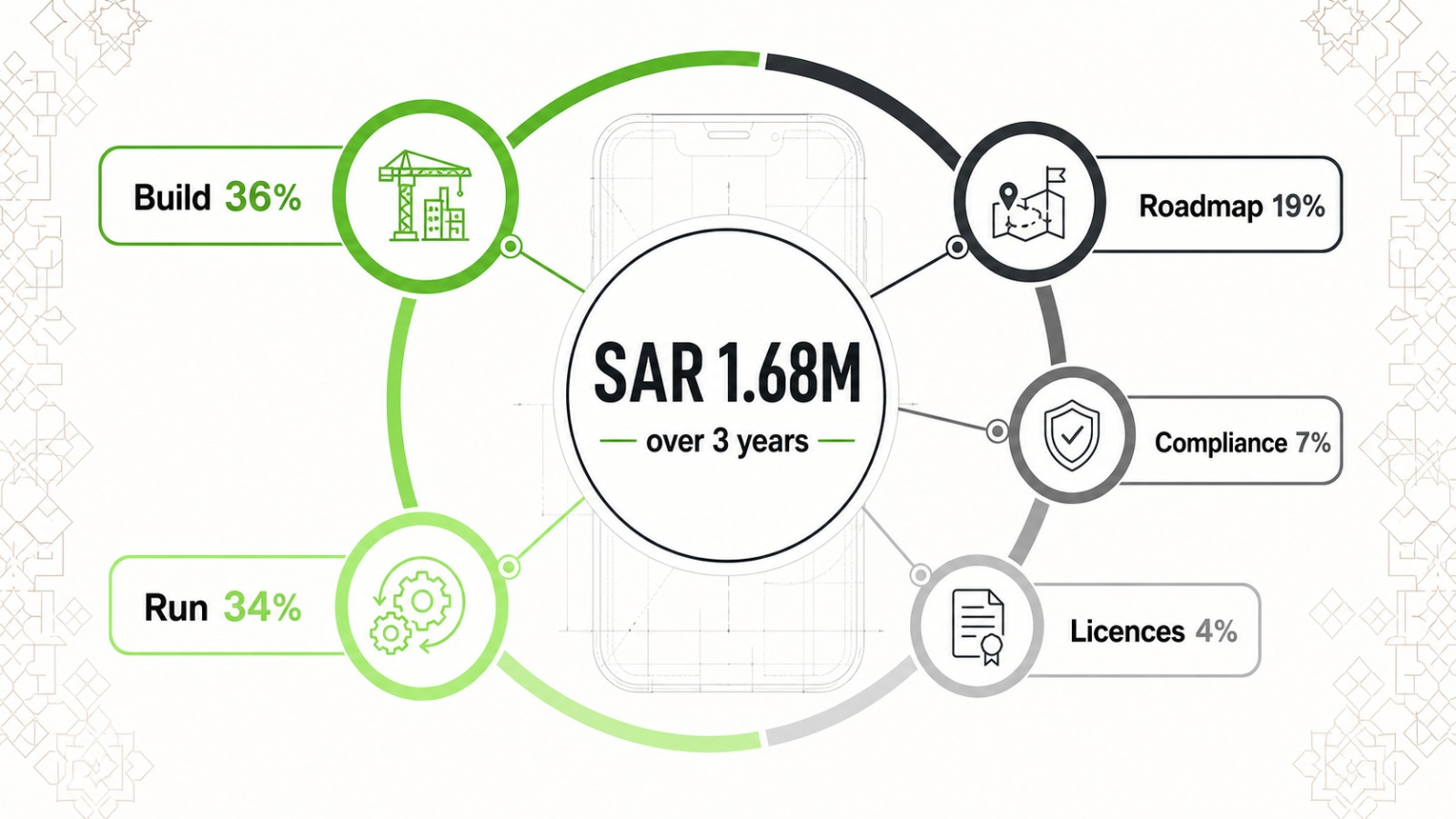
- Three-year running cost reaches 180 percent of your original build budget.
- Capped time-and-materials contracts protect enterprise budgets better than fixed bids.
The mobile app development market inside the Kingdom was valued at USD 2.2 billion in 2025. IMARC Group projects 11.20 percent annual growth through 2034.
Budgets are still being set the wrong way.
Saudi Arabia’s digital economy reached SAR 495 billion in 2025. That is 15.6 percent of national GDP, per GASTAT.
Most Saudi app budgets get built on a feature list, then broken by a regulator.
Feature count is a weak predictor of price. What your app costs depends first on which data it touches and who supervises it.
This piece prices that reality. Every figure below is derived from published rate benchmarks, with the source under each table.
Since 2013, our teams have engineered apps for Airbus, duPay and REDTAG.
How much does mobile app development cost in Saudi Arabia in 2026?
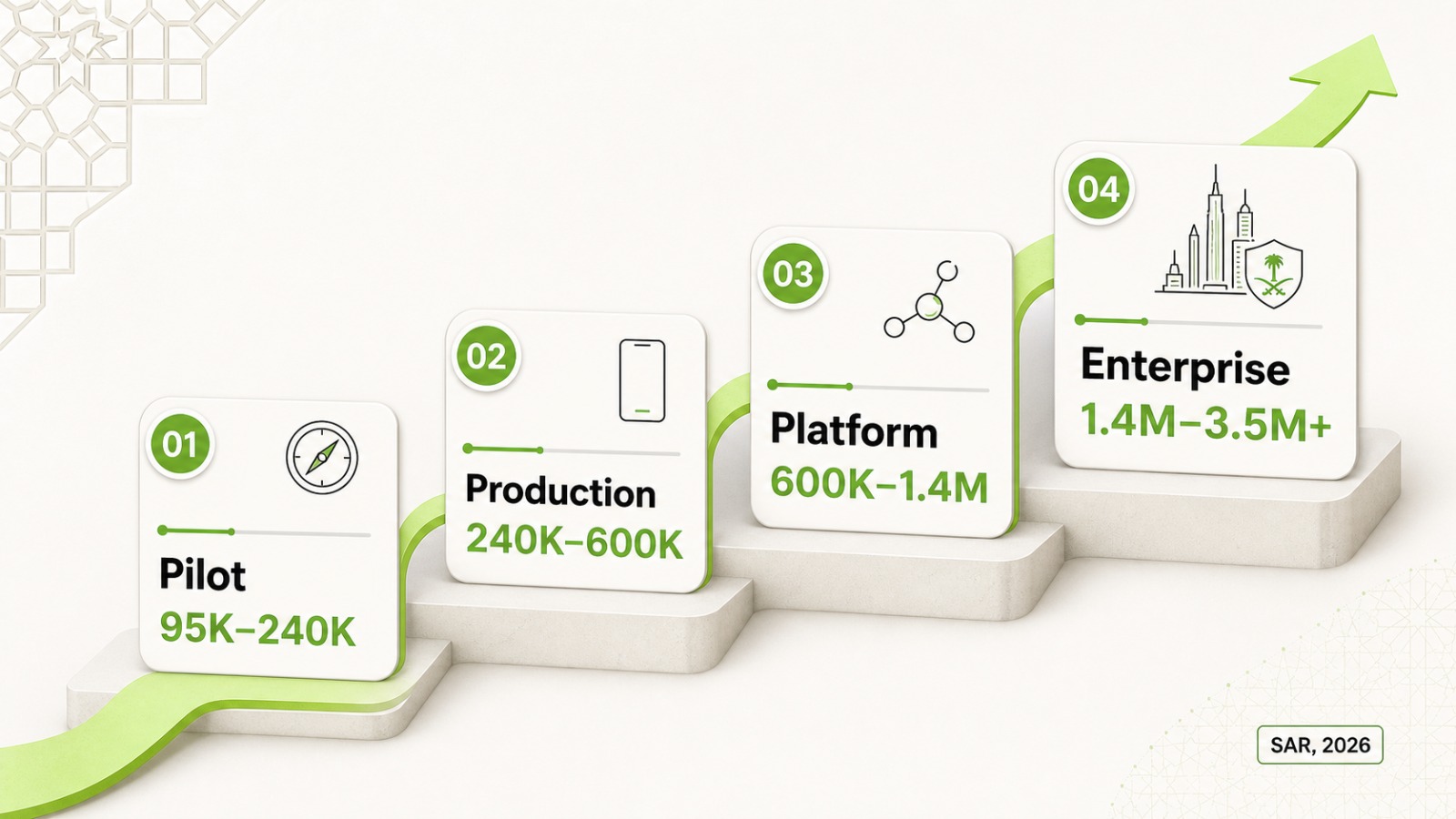
Mobile app development cost in Saudi Arabia in 2026 ranges from SAR 95,000 for a single-platform pilot to 3.5 million for a regulated enterprise platform. A production app for both platforms costs 240,000 to 600,000.
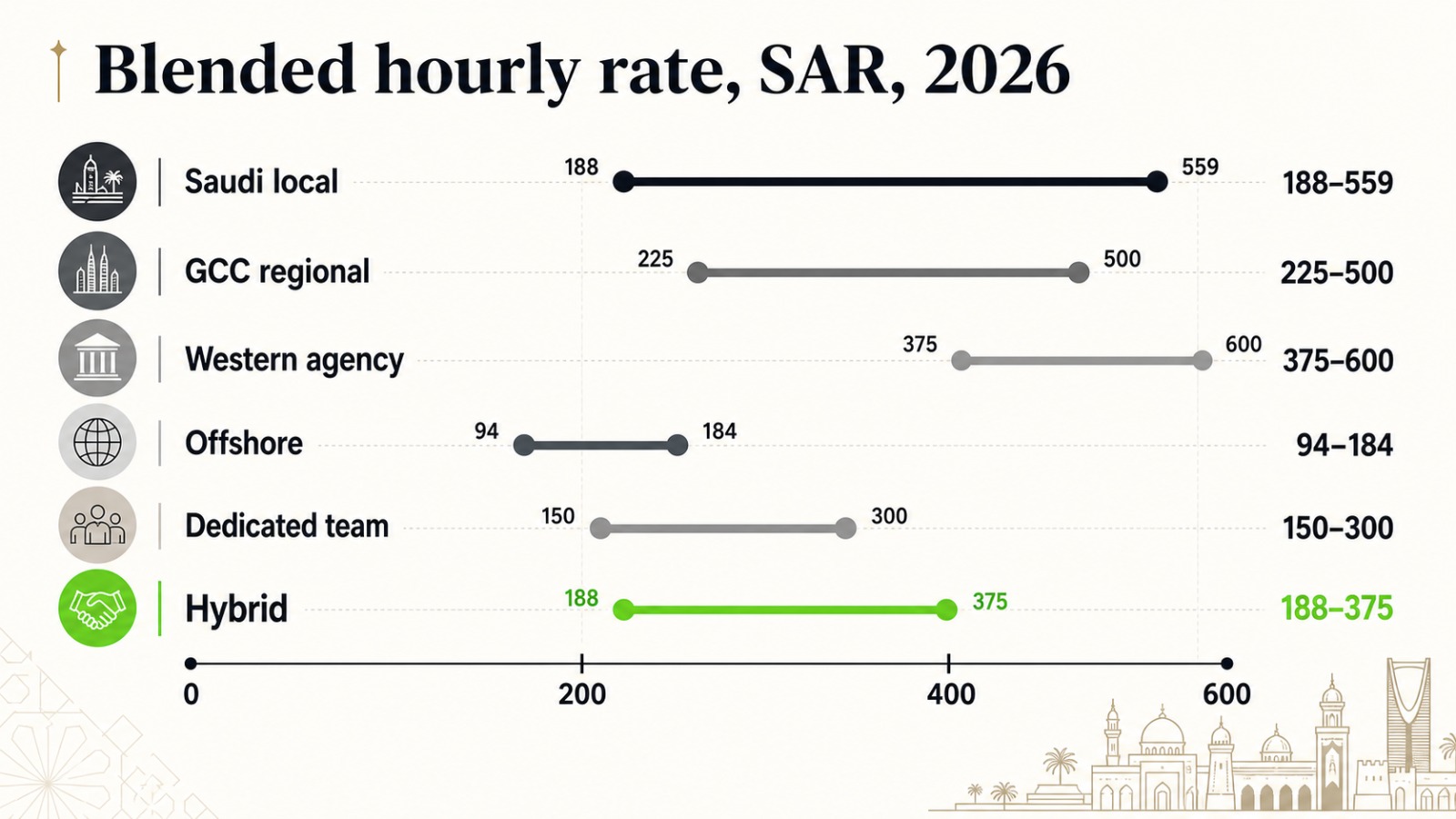
Those bands are not vendor guesswork. Clutch lists Saudi app development companies charging between USD 25 and USD 149 per hour. At the fixed SAR peg of 3.75, that is SAR 94 to SAR 559 hourly.
Multiply the hourly band by realistic engineering effort, and you get defensible ranges.
Mobile app development cost in Saudi Arabia by tier
| Tier | Scope | Engineering hours | Cost (SAR) | Timeline |
| Pilot / MVP | One platform, 8 to 12 screens, single integration | 650 – 1,400 | 95,000 – 240,000 | 10 – 16 weeks |
| Production app | Both platforms, 20 to 35 screens, payments, admin panel | 1,600 – 3,200 | 240,000 – 600,000 | 4 – 7 months |
| Multi-sided platform | Customer, provider, and operations apps, dispatch, live tracking | 3,500 – 6,500 | 600,000 – 1,400,000 | 7 – 11 months |
| Regulated enterprise platform | SAMA or NCA scope, core system integration, sovereign hosting | 7,000 – 14,000 | 1,400,000 – 3,500,000+ | 11 – 20 months |
Source and method: Hour estimates multiplied by blended rates of SAR 150 to SAR 260. Rate bands verified against Clutch Saudi Arabia app developer listings, the Clutch app development pricing guide, and the GoodFirms 2026 app development cost survey. SAR converted at the SAMA peg of 3.75.
Why do Saudi App Development quotes vary?
The proposals may use the same product label while describing different delivery commitments.
One quote may cover a mobile interface and basic backend. Another may include architecture, migration, security testing, and support.
Third is whether running costs sit inside the number.
Procurement teams should request effort, assumptions, and exclusions. Those details expose whether two proposals remain comparable.
What decides your app development cost in Saudi Arabia?
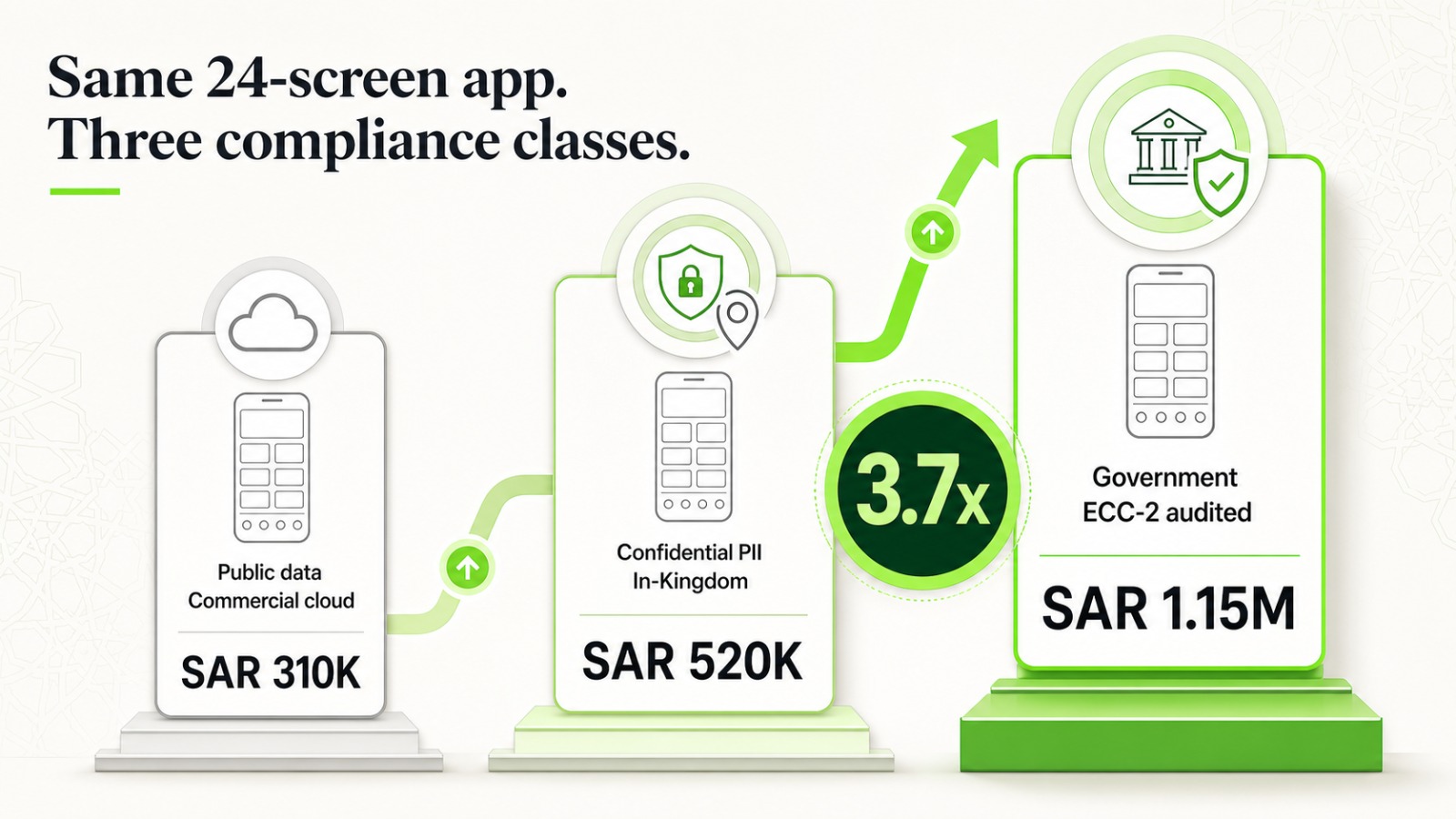
Two Saudi apps can share identical wireframes and price four times apart. The variable is data classification, not screen count.
That claim sounds strong. It holds up when you trace what classification triggers.
Saudi Arabia classifies data across four levels under the National Cybersecurity Authority taxonomy: Top Secret, Confidential, Restricted and Public.
Your classification decides your hosting options, audit obligations and your engineering standard.
The four questions that set your price band
- Which classification does the app touch?
Public data can sit on commercial cloud. Confidential and above pull you into the NCA Cloud Cybersecurity Controls tenant track.
- Which regulator supervises the workload?
SDAIA covers personal data. SAMA covers payments and insurance. NCA covers government and critical infrastructure.
- Where can the data legally live?
The MCIT Cloud First Policy and CST registration classes decide which cloud regions qualify. Sensitive workloads need providers holding CST Class B or Class C registration.
- Does the app carry a national rail?
Nafath, Absher, Mada, and Etimad each add approval cycles that sit outside your control.
The same build, three classifications
Consider a 24-screen HR application. Same wireframes, same feature list, same team.
Version one handles Public-classified internal content on commercial cloud. Build cost lands near SAR 310,000.
Version two processes employee personal data at Confidential level. Add a PDPL data protection impact assessment plus in-Kingdom hosting. Cost moves to roughly SAR 520,000.
Version three serves a government entity under ECC-2 with an NCA audit gate. Now you are at SAR 1,150,000.
Nothing changed in the product. Everything changed in the price.
App development cost by compliance tier: PDPL, NCA, SAMA, and CST cloud class
Compliance in Saudi Arabia is not a documentation exercise. SDAIA enforcement committees issued 48 decisions confirming PDPL violations across 2025 and 2026.
Those decisions covered processing without legal basis, unauthorised disclosure and missing technical safeguards. Every one of those is an engineering problem before it is a legal one.
What each requirement adds to a build.
| Requirement | Applies to | Added cost (SAR) | Added timeline |
| PDPL baseline: consent, data subject rights, retention, privacy notice | Any app handling personal data | 18,000 – 45,000 | 2 – 3 weeks |
| PDPL impact assessment and cross-border transfer review | Apps with offshore processing | 25,000 – 60,000 | 3 – 4 weeks |
| NCA Essential Cybersecurity Controls alignment | Government and critical infrastructure | 90,000 – 260,000 | 6 – 12 weeks |
| NCA Cloud Cybersecurity Controls, tenant track | Regulated cloud workloads | 40,000 – 120,000 | 4 – 8 weeks |
| CST Class C hosting migration | Sensitive classification workloads | 55,000 – 180,000 per year | 4 – 10 weeks |
| SAMA Cyber Security Framework | Fintech, payments, insurance | 140,000 – 420,000 | 10 – 20 weeks |
| SAMA open banking readiness: FAPI, mutual TLS, consent lifecycle | Account and payment initiation apps | 180,000 – 520,000 | 12 – 24 weeks |
| Independent penetration test and remediation | Regulated builds | 30,000 – 85,000 per cycle | 2 – 4 weeks |
Source and method: Control requirements sourced from the NCA Cloud Cybersecurity Controls, the PDPL implementing regulations analysis by Clyde & Co, King & Spalding on cross-border personal data transfers, and the ICLG Saudi Arabia data protection chapter 2026.
Cost derived from control-mapped engineering effort at Clutch Saudi rate bands.
Open banking changed the fintech number in 2026. SAMA began licensing open banking providers on 26 March 2026, after the regulatory sandbox phase closed. Read the SAMA announcement.
Licensed status carries operational, capital and governance obligations. For a fintech app development, that shifts compliance from a build task to a permanent function.
Budget for it as headcount, not as a line item.
Mobile app development cost in Saudi Arabia by industry
Sector matters because it decides your regulator, your integrations, and your data class.
A retail app and a telehealth app with the same screen count sit in different price universes.
| Industry | Typical build (SAR) | Primary cost driver | Regulator in scope |
| Retail and e-commerce | 280,000 – 750,000 | Catalogue scale, mada and BNPL rails, ZATCA e-invoicing | ZATCA, SDAIA |
| Fintech and digital wallet | 850,000 – 2,600,000 | SAMA framework, FAPI security profile, Absher-backed KYC | SAMA |
| Healthcare and telehealth | 420,000 – 1,300,000 | Patient data classification, health system integration, licensing | MoH, SDAIA |
| Logistics and last mile | 380,000 – 1,100,000 | Dispatch engine, driver app, tracking at scale | TGA |
| Real estate and PropTech | 300,000 – 800,000 | Ejar integration, listing verification, tour media | REGA |
| Government and B2G | 900,000 – 3,500,000 | ECC-2, Etimad, Nafath, accessibility standards | DGA, NCA |
| Education | 220,000 – 650,000 | Arabic content operations, video delivery, assessment logic | MoE |
| Sports and community platforms | 350,000 – 900,000 | Booking engine, payments, matchmaking logic | MoS |
Source and method: Sector segmentation follows the IMARC Saudi Arabia mobile app development market report, which tracks banking, retail, media, education, transport and government verticals.
Demand context cross-checked against Grand View Research Saudi mobile application market data. Build costs derived from vertical effort profiles at Clutch Saudi rate bands.
Where retail budgets get caught
Quick commerce operators tend to price the customer app and forget the tax layer.
ZATCA Fatoora Phase 2 requires invoice clearance and reporting integration.
Skipping it at the build stage costs more than including it.
Arabic-first app development cost in Saudi Arabia
Retrofitting right-to-left support after an English launch costs roughly 2.4 times what building Arabic-first costs. That gap is the single most avoidable overrun in Saudi projects.
Arabic is an architecture decision made at the wireframe stage. Treating it as translation at the end produces rework across every screen.
Right-to-left layout architecture: SAR 22,000 to 55,000
Mirrored navigation, icon direction, form field order, and gesture logic. Priced into design, this is cheap. Added later, it becomes SAR 65,000 to 160,000 of component rework.
Arabic typography and font licensing: SAR 8,000 to 30,000
Diacritics, Eastern Arabic numerals and line height rules break default type systems. Commercial Arabic font families carry their own licence fees.
Hijri and Gregorian dual calendar: SAR 12,000 to 35,000
Prayer times, Ramadan scheduling and Thursday-Friday weekend logic all depend on this. Booking and scheduling products cannot ship without it.
Arabic name normalisation: SAR 25,000 to 70,000
One Saudi citizen can hold six valid transliterations of the same name. Identity checks fail, support tickets climb, and the fix sits in your matching engine.
Most vendors discover this problem during KYC testing. By then the architecture is fixed.
Gulf dialect language models: SAR 60,000 to 220,000
Modern Standard Arabic models underperform on Najdi and Hijazi speech. Voice interfaces and support chatbots need dialect training data.
Bilingual content operations: SAR 30,000 to 90,000
Push notifications, in-app copy, store listings and support macros all ship in two languages. This is a recurring cost, not a build cost.
Source and method: Effort estimates derived from localisation task breakdowns priced at Clutch Saudi rate bands and GoodFirms 2026 development cost survey hourly benchmarks.
What do Saudi government and payment rails add to app development cost?
Saudi apps run on national infrastructure. Identity comes through Nafath. Payments clear through mada. Invoices report to ZATCA.
Demand for those rails is not theoretical. Ecommerce spending through mada cards rose 79.45 percent year on year to SAR 29.86 billion in a single month, per SAMA data reported by WORLDEF.
| Rail | Function | Integration cost (SAR) | Lead time including approval |
| Nafath national single sign-on | Identity verification and multi-factor login | 35,000 – 95,000 | 6 – 14 weeks |
| Absher Business | Entity and employee verification | 30,000 – 80,000 | 8 – 16 weeks |
| Mada payment gateway | Domestic debit rail | 22,000 – 48,000 | 3 – 6 weeks |
| Apple Pay and Google Pay | Wallet checkout | 12,000 – 26,000 each | 2 – 3 weeks |
| STC Pay, Tabby, Tamara | Wallet and buy-now-pay-later | 15,000 – 35,000 each | 2 – 5 weeks |
| SADAD | Bill and government collections | 25,000 – 55,000 | 4 – 8 weeks |
| ZATCA Fatoora Phase 2 | E-invoicing clearance and reporting | 45,000 – 130,000 | 8 – 14 weeks |
| Etimad | Government procurement and contracting | 60,000 – 180,000 | 12 – 20 weeks |
Source and method: Rail specifications sourced from the National Single Sign-On service listing on my.gov.sa and SAMA payment framework announcements. Transaction volume context from SAMA mada data via WORLDEF. Integration effort priced at Clutch Saudi rate bands.
Approval time is the real schedule risk
Engineering a Nafath integration takes a competent team three weeks. Getting approved takes considerably longer.
Onboarding runs on the regulator’s calendar. Your sprint plan has no influence over it.
Vendors who have shipped Nafath before will tell you this upfront. Vendors who have not will put six weeks in the Gantt chart and miss it.
App development company in Saudi Arabia vs offshore vs hybrid: 2026 rate cards
Rate is where enterprise procurement spends most of its attention. It deserves less than people give it, though the numbers still matter.
| Delivery model | Blended hourly (SAR) | Suited to | Real risk |
| Riyadh or Jeddah agency | 225 – 375 | Government contracts, ECC-2 scope | Thin senior bench, long queue |
| In-house Saudi team | 190 – 320 fully loaded | Long-horizon product ownership | Nitaqat exposure, 6 to 9 month hiring |
| Global firm with Riyadh RHQ | 375 – 560 | PIF and ministry tenders above SAR 1M | Premium rate, junior delivery bench |
| Hybrid: Riyadh lead plus offshore pod | 110 – 190 | Enterprise builds needing scale and accountability | Requires genuine in-Kingdom presence |
| Pure offshore | 75 – 150 | Internal tools outside regulatory scope | No standing for compliance sign-off |
| Freelance | 40 – 110 | Discrete short tasks | No continuity, no audit trail |
Source and method: Hourly bands verified against Clutch Saudi Arabia app developer listings, which show USD 25 to USD 149 per hour across the market, and the GoodFirms 2026 cost survey, which places 56 percent of global firms in the USD 20 to 50 band.
Fully loaded in-house figures modelled on Riyadh software engineer salary data from PayScale. Converted at the SAMA peg of 3.75.
Why app development companies in Saudi Arabia price higher
Three structural forces hold local rates up, and none of them are margin.
- Saudization quotas come first. The 2026 to 2028 Nitaqat phase raised thresholds across sectors, with technology employers sitting at 25 to 35 percent Saudi workforce. Falling below the band blocks expatriate visa issuance.
- Compensation is the second force. Senior engineers in Riyadh earn SAR 22,000 to 32,000 monthly. Cloud, AI and security specialists carry a further 20 to 40 percent premium.
- Demand is the third. Giga-project programmes absorb the senior bench faster than universities, and immigration replaces it.
The RHQ rule most foreign vendors will not mention.
Saudi government bodies, ministries and PIF subsidiaries cannot award contracts above SAR 1 million to firms without a Regional Headquarters licence.
If your app is a government-facing workload, your vendor’s entity structure becomes a procurement gate. Ask for the licence number before you shortlist.
Exemptions exist under defined competitive conditions as of 2026. Do not assume yours qualifies.
Grintafy crossed 1M downloads in Saudi Arabia on architecture our teams engineered.
How Do Enterprise Integrations Change Mobile App Development Cost?
AI Enterprise app development and integrations connect the app with operating systems. Their readiness affects effort, schedule, and delivery risk.
Common targets include SAP, Oracle, Salesforce, and Microsoft Dynamics 365. IAM, payment, and data platforms also need secure interfaces.
Why can one integration consume hundreds of App Development hours?
API documentation may be incomplete. Sandbox environments can differ from production systems.
Authentication rules require security review. Data formats and error states need mapping across both platforms.
Vendor coordination creates another workstream. Each organization may have separate release windows and approval processes.
What integration evidence should an App Development company request?
- Current API documentation
- Sandbox access
- Named system owner
- Authentication method
- Data classifications
- Volume limits
- Error codes
- Test data
- Release process
- Support contacts
Weak readiness requires discovery time. Mature interfaces give teams stronger estimate confidence.
How Much Do AI Features Add to Mobile App Development Cost?
AI development adds product, data, and operating work. The model API represents one component within the complete system.
| AI scope | Estimated effort | Incremental cost in SAR | Main workstreams |
| Hosted-model assistant | 400 to 1,000 hours | 60,000 to 300,000 | Integration, prompts, guardrails, UX and testing |
| Enterprise RAG or AI automation | 1,000 to 2,500 hours | 190,000 to 930,000 | Data ingestion, permissions, retrieval, evaluation and monitoring |
| Custom ML or computer vision | 2,500 to 6,000 hours | 560,000 to 3 million | Data preparation, training, deployment, and retraining |
Cost table resources: Clutch App Development Pricing, Clutch Saudi App Developers, and SAMA Exchange Rates.
How much does an AI-powered mobile app cost in Saudi Arabia?
An AI-powered mobile app cost can range from SAR 60,000 to SAR 3 million. Data readiness and model ownership explain much of that range.
A support assistant may use a hosted model. Computer vision may need labeled data, evaluation, and custom deployment.
Which AI Development costs continue after launch?
- Model consumption
- Vector storage
- Cloud inference
- Output evaluation
- Safety monitoring
- Human review
- Data refreshes
- Model retraining
- Incident response
Usage forecasts should cover requests, tokens, images, or processing time. Peak demand also affects reserved capacity decisions.
Does Arabic AI increase Mobile App Development cost?
Arabic evaluation needs representative language samples. Dialects, mixed-language text, and RTL interfaces require dedicated test coverage.
Enterprise RAG also needs permission-aware retrieval. Arabic documents may require separate extraction and chunking checks.
Phase-by-phase app development cost breakdown
Knowing your total helps less than knowing where it goes. Here is how a production build distributes across phases.
- Discovery, architecture, and compliance mapping: 10 to 14 percent. SAR 60,000 to 84,000. Skipping this phase does not remove the work. It reprices it as change orders at a 40 percent premium.
- Experience design and Arabic-first interface: 14 to 18 percent. SAR 84,000 to 108,000. Late right-to-left decisions are the most common source of overrun in this phase.
- Frontend engineering: 20 to 24 percent. SAR 120,000 to 144,000. Device and operating system matrix creep drives most of the variance.
- Backend, APIs and integrations: 22 to 28 percent. SAR 132,000 to 168,000. Legacy core system connectors sit here, and they are always harder than the demo suggested.
- Security and compliance engineering: 8 to 16 percent. SAR 48,000 to 96,000. Found in discovery, this is cheap. Found in user acceptance testing, it stops your launch.
- Quality assurance, automation and user acceptance: 10 to 14 percent. SAR 60,000 to 84,000. Manual-only test strategies save money in month three and cost it back in month nine.
- Launch, store submission and handover: 4 to 7 percent. SAR 24,000 to 42,000. Arabic store metadata rejections are common and add a week each time.
Discovery is 10 to 14 percent of a Saudi app development budget. It is also the phase that reduces the other 86 percent.
That is not a slogan. Research by McKinsey and the University of Oxford across 5,400 IT projects found large programmes run 45 percent over budget and deliver 56 percent less value than forecast.
What Is the Three-Year Mobile App Development Total Cost of Ownership?
Three-year TCO includes build, operations, security, cloud, and product change. Initial delivery represents one investment phase.
Use the following equation:
- Three-year TCO = build + integrations + security + cloud + support + AI usage + product change
The table shows an illustrative enterprise scenario.
| Cost area
|
(Year) One | Two | Three |
| Initial product build | 1.5 million | – | – |
| Support and cloud | 300,000 | 360,000 | 420,000 |
| Security and compliance | 150,000 | 180,000 | 200,000 |
| AI and data services | 120,000 | 180,000 | 240,000 |
| Product changes | 300,000 | 450,000 | 600,000 |
| Annual total | 2.37 million | 1.17 million | 1.46 million |
Cost table resources: Engineering uses Clutch Saudi rate bands. Currency conversion uses SAMA exchange rates.
The running costs that scale with success
- Cloud compute and storage climb with active users, though caching absorbs some of it. A five-times user base tends to move infrastructure spend around 3.2 times.
- AI inference behaves worse. Token cost scales close to linear with usage and has no caching relief on personalised outputs.
- Media egress and map API calls follow the same pattern. Video-heavy and location-heavy products should model these separately from base hosting.
- Support headcount is the fourth. Bilingual coverage doubles the staffing ratio compared with single-language products.
How to audit a mobile app development company quote in Saudi Arabia
Most enterprise buyers compare quotes on total price. That comparison is close to meaningless when two vendors have priced different products.
Use these four groups of questions instead. Every unanswered item is a cost you will absorb later.
Compliance and hosting
- Ask which data classification the vendor has assumed, and get it in writing. A quote without a stated classification has priced the cheapest one.
- Confirm the cloud region and the provider’s CST registration class. Confirm whether PDPL work is itemised or buried inside a line called security.
- Ask who pays for penetration test remediation. Vendors who exclude it are quoting a lower number for the same job.
Scope and schedule
- Check whether regulator approval lead time appears in the schedule, or whether only development effort was counted. Nafath and Etimad timelines belong on the Gantt chart.
- Verify that Arabic sits in the design scope rather than arriving as translation at the end. Ask how many devices and operating system versions are in the quality assurance matrix.
- Get the change request definition in writing, along with the hourly rate that applies to it.
Commercial terms
- Confirm whether third-party licence fees are passed through at cost or marked up.
- Ask who owns the source code, the deployment pipeline and the cloud account after handover.
- Establish the warranty period and, more usefully, what it excludes.
Delivery accountability
- Ask for a named delivery lead based in the Kingdom. Rotating account managers are a reliable predictor of scope drift.
- Request two references from Saudi builds that shipped, along with what those projects cost against their original estimate.
The six line items missing from most quotes
- Data migration from legacy systems.
- Analytics and event instrumentation.
- App store compliance rework.
- Bilingual support tooling.
- Load testing at Saudi peak concurrency.
- Knowledge transfer and documentation.
How to reduce app development cost in Saudi Arabia without losing compliance ground
Cost reduction in a regulated market has a floor. Below it, you are buying rework. These seven levers work. Each carries a trade-off worth stating plainly.
Classify your data in week one
Saving: 12 to 22 percent of build cost. Architecting once against a known classification removes the most expensive category of rework. The trade-off is a slower start, usually two to three weeks.
Use cross-platform for non-graphics-heavy products
Saving: 25 to 35 percent. Flutter and React Native cover most business application requirements in one codebase. Camera, biometric, and augmented reality features still need native modules, so budget for them separately.
Buy compliance-certified components instead of building them
Saving: 8 to 15 percent. Identity, payment, and logging components already certified for Saudi use save months of audit preparation. You accept vendor dependency in exchange.
Choose capped time and materials over fixed bid
Saving: 9 to 18 percent net. Fixed bids transfer estimation risk to the vendor, who returns it as change orders at premium rates. Capped time and materials with milestone gates costs less across the full engagement. It requires real product ownership on your side.
Run hybrid delivery with an in-Kingdom lead
Saving: 30 to 45 percent on blended rate. A Riyadh-based delivery lead holds compliance accountability while an offshore pod carries engineering volume. This fails when the local presence is a mailbox rather than a team.
Ship two releases instead of one launch
Saving: 15 to 25 percent in year one. Sequencing lets you validate demand before funding the full roadmap. Feature completeness arrives later, which some stakeholders will resist.
Reuse existing enterprise authentication & payment rails
Saving: 6 to 12 percent. Your organisation already has identity and payment infrastructure. Reusing it removes duplicate integration work, though legacy limitations become your limitations.
What not to cut
Discovery, security engineering and test automation. Each looks like an easy saving, and each returns as a multiple.
Why choose Code Brew Labs as your mobile app development company in Saudi Arabia
With thirteen years of delivery, Code Brew Labs is an AI enterprise app and AI-first digital product engineering and IT consulting company with the team operating across the GCC and MENA. Our enterprise-grade AI apps run live on Saudi payment and identity rails.
Our portfolio covers government entities, enterprises, Fortune 500 companies, and multi-role platforms. We price compliance class before we price features. That order is why our estimates hold.
Grintafy AI
We engineered Grintafy’s AI-enabled sports talent ecosystem. Footballers build performance profiles, organise matches and book facilities on the platform.
The product connects players with scouts and professional opportunities across the region.
- 1M+ application downloads
- 4.6/5 average rating
Pala De 7
We built Pala De 7’s Saudi padel platform. Player discovery, court reservations, practice scheduling, payments, and owner operations run inside one connected system.
Coverage is nationwide.
- 50K+ application downloads
- 500+ active courts
What you get from a first conversation is a costed scope with the compliance class stated before commercials.
Conclusion
Your price band was decided the moment you chose what data the app would touch. Everything after that is scope negotiation inside a fixed ceiling.
Discovery remains the first investment when integrations or compliance remain uncertain. A clear scope creates a defensible procurement decision.
Budget approvals written against build cost alone will come back for a second round.
Code Brew Labs can map the required workstreams and delivery risks. The result becomes a budget architecture, not a headline guess
The buyers who get this right in Saudi Arabia do one thing differently. They classify first, then design.
FAQs:
How much does it cost to build a mobile app in Saudi Arabia in 2026?
Between SAR 95,000 and 3.5 million. A single-platform pilot costs SAR 95,000 to 240,000. Production apps across both platforms run from SAR 240,000 to 600,000. Regulated enterprise platforms under SAMA or NCA supervision start at SAR 1.4 million and can exceed SAR 3 million.
How long does mobile app development take in Saudi Arabia?
Pilot builds ship in 10 to 16 weeks. Production apps take four to seven months. Multi-sided platforms need seven to 11 months. Regulated enterprise builds run 11 to 20 months, with regulator approval cycles accounting for six to 14 weeks of that.
Does PDPL compliance increase app development cost in Saudi Arabia?
Yes. Baseline PDPL work adds SAR 18,000 to 45,000 for consent management, data subject rights, and retention logic. Apps processing data offshore need a transfer assessment, adding SAR 25,000 to 60,000. SDAIA issued 48 enforcement decisions across 2025 and 2026, so the risk of skipping it is real.
Do I need to host my app data inside Saudi Arabia?
It depends on classification. Public data can sit on commercial cloud regions. Confidential and above pull you into NCA Cloud Cybersecurity Controls, which require an in-Kingdom geographic location. Your provider also needs the matching CST registration class.
How much do app developers charge per hour in Saudi Arabia?
Clutch lists Saudi app development companies between USD 25 and USD 149 hourly, which is SAR 94 to SAR 559. Riyadh agencies bill SAR 225 to 375 blended. Hybrid models with an in-Kingdom lead bill SAR 110 to 190.
Can I hire an offshore team for a Saudi app project?
For non-regulated internal tools, yes. For anything touching personal data, payments, or government systems, an offshore-only vendor cannot hold compliance accountability. Hybrid delivery with a Riyadh-based lead solves both the rate problem and the standing problem.
How much does Nafath integration cost?
SAR 35,000 to 95,000 in engineering effort. Approval and onboarding take six to 14 weeks, which sits outside vendor control. Plan the schedule around the approval window rather than the development sprint.
What is the annual maintenance cost for an app in Saudi Arabia?
Between 15 and 25 percent of the original build cost each year. On a 600,000 app, expect SAR 90,000 to 150,000 annually, covering operating system updates, security patching, and infrastructure. Feature roadmap work sits on top of that figure.
Is Riyadh more expensive than Jeddah or Dammam for app development?
Riyadh runs 10 to 20 percent higher on blended rate. Agency density, giga-project demand and senior talent concentration explain the gap. For regulated builds requiring frequent regulator contact, the premium often pays for itself.
What is the cheapest way to launch an app in Saudi Arabia in 2026?
A cross-platform pilot at SAR 95,000 to 140,000, scoped to one user journey and one payment rail. Classify your data before design starts. Skipping discovery to save SAR 60,000 is the most reliable way to spend LES later.
Let's Convert Your Business Idea Into Success!
Free Consultation from Top Industry Experts
Let’s Build Your Dream App!
Share article on :


 No commitment required
 NDA on request
 24-hour response


