
Quick Summary:
- AI now runs property valuation, virtual tours, and predictive search across Dubai's leading real estate platforms.
- Dubai recorded AED 761 billion in property deals during 2024, a 20 percent value jump.
- The Dubai PropTech Hub plans to push the sector past AED 4.5 billion by 2030.
- Listings with virtual tours pull 87 percent more views and close up to 31 percent faster.
- Dubai Land Department now tokenizes title deeds, opening fractional ownership from AED 2,000.
- A production-grade AI real estate app in Dubai costs between AED 150,000 and AED 550,000.
- Cloning Zillow seldom works here, since UAE buyers need Arabic interfaces and RERA-compliant data.
PropTech in Dubai now decides how property gets searched, valued, financed, and managed across the Emirates. What took months of viewings and paperwork three years ago can happen in an afternoon. A buyer in Riyadh shortlists five apartments, walks through each in a virtual tour, checks an AI valuation, and books a viewing before lunch.
That speed is not a gimmick. It sits on top of a market that moved AED 761 billion in 2024, according to the Dubai Land Department. Behind the scenes, artificial intelligence quietly rewrote real estate software development in Dubai that agents, developers, and portals depend on every day.
This guide is written for founders launching a property startup, real estate firms shipping branded apps, SaaS teams designing subscription platforms, and agencies delivering for clients. You will see the technology, real UAE examples, honest AED build costs, and a practical route to launch a platform that fits this market instead of copying one built for another.
See how a PropTech platform turns AI valuations and virtual tours into booked viewings & qualified leads
What is PropTech, and why does Dubai lead the Middle East?
PropTech means property technology. The term covers the software, artificial intelligence, and data systems that digitize how real estate gets discovered, valued, transacted, and operated. Property portals, agent CRMs, valuation engines, virtual tour tools, and tokenization platforms all sit under this one umbrella.
Dubai didn’t become a PropTech leader by accident. The emirate treats real estate as a headline economic sector, and it has spent a decade wiring that sector for data. Government registries went digital early. Escrow rules got codified. Foreign ownership zones expanded. Each of those moves created clean, structured property data, which happens to be the raw fuel that AI systems need.
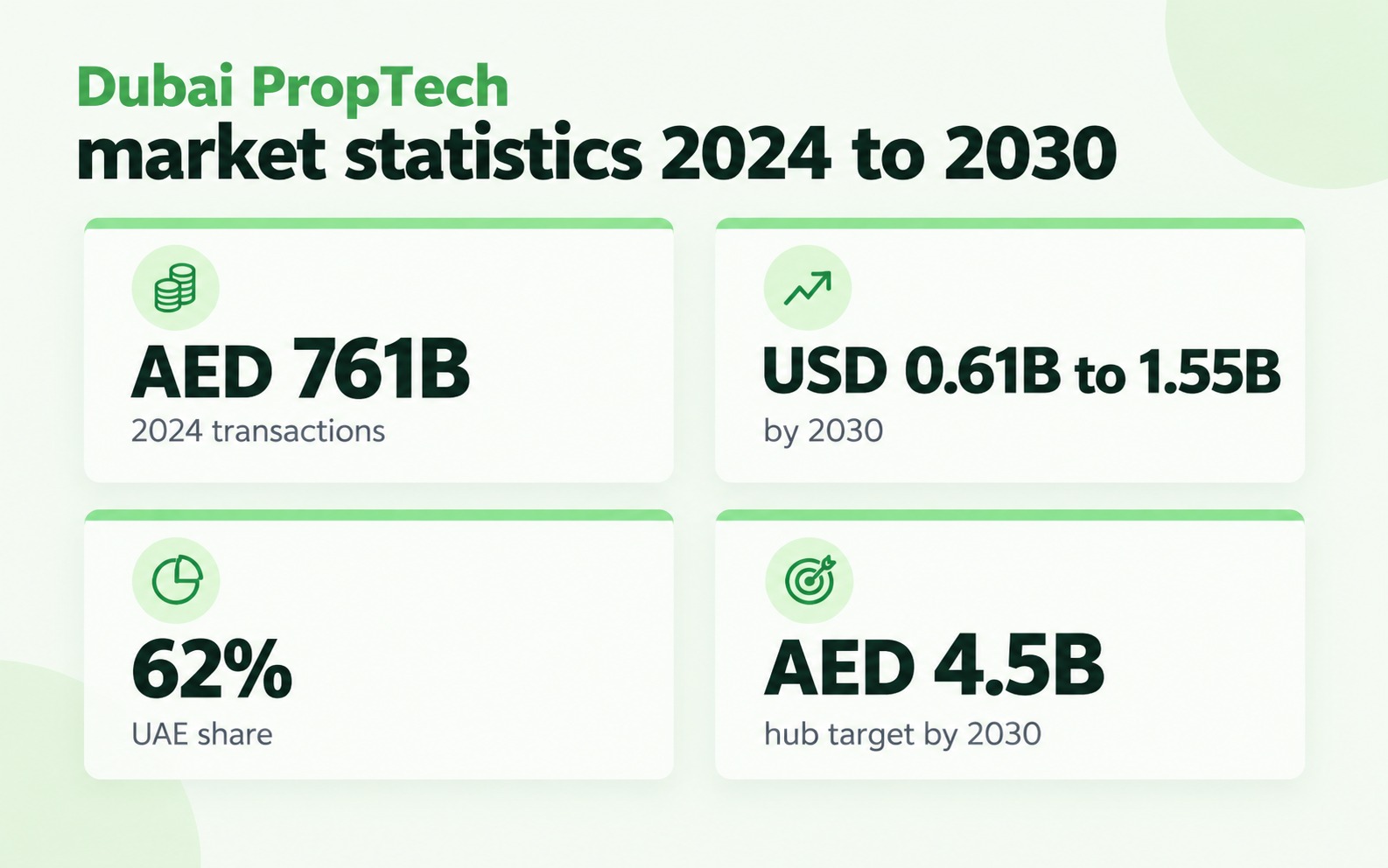
Scale then did the rest. Dubai holds close to 62 percent of the UAE PropTech market, and the number of PropTech firms across the country nearly tripled in two years to roughly 189 companies. Investors noticed. The UAE PropTech market sat at USD 0.61 billion in 2024 and is forecast to reach USD 1.55 billion by 2030, growing at a 17.49 percent compound rate.
Three structural traits keep Dubai ahead of the wider region:
A transaction volume that trains better models
With 226,000 deals logged in 2024, algorithms here learn from far denser data than smaller GCC markets can offer. More transactions mean sharper valuations and recommendations.
A regulator that ships technology
Dubai Land Department builds platforms itself, so PropTech founders integrate with public infrastructure rather than fighting it.
An international buyer base
Around three-quarters of Dubai property inquiries come from outside the UAE, which forces platforms to solve for remote viewing, multi-currency payments, and cross-border trust.
Put together, these conditions make Dubai the natural test bed for PropTech Middle East expansion. A product proven here tends to travel well into Saudi Arabia, Qatar, and beyond. Founders building real estate technology across the region increasingly treat the emirate as a launchpad and proof point at once.
How is AI transforming real estate platforms and property discovery?
Property search used to be a filtering exercise. You picked a location, set a price band, chose a bedroom count, and scrolled through whatever matched. Artificial intelligence changed the starting point. Modern platforms read intent, not just filters, then shape the results around the person searching.
The shift shows up across the whole discovery journey. Recommendation models watch which listings a user opens, how long they linger, and what they ignore. From those signals, the system predicts the next property worth showing, often before the buyer articulates the preference themselves. Discovery collapses from weeks of manual browsing into a guided shortlist.
Speed gains are measurable. Gulf News reported that AI-assisted diligence can cut buyer decision timelines by up to 80 percent, compressing a search that once ran five or six months into a matter of days, per its coverage of Dubai’s immersive real estate tech.
The next generation of real estate apps leans on a handful of capabilities working together:
- AI-powered recommendations that surface relevant homes based on behavior, so users stop hunting and start choosing.
- Personalized matching systems that weigh lifestyle signals such as commute, schools, and community, giving each buyer a different feed.
- Automated listing descriptions generated from property attributes, which lets agencies publish hundreds of listings without a copywriter for each.
- Faster lead qualification, where the platform separates a serious buyer from a casual browser before an agent spends a minute.
Firms building real estate app development in Dubai now treat these features as baseline, not luxury. A portal without intelligent discovery feels dated to a buyer who already expects Netflix-grade suggestions everywhere else.
How do AI property recommendations and personalization work in a PropTech?
Personalization sounds like magic to a buyer and looks like plumbing to an engineer. Underneath, it runs on a chain of models that turn raw clicks into ranked suggestions. Understanding that chain helps founders scope what they actually need to build.
The process moves through four connected stages:
Signal capture
Every tap, saved listing, filter change, and dwell time becomes a data point. Rich signals produce sharper personalization, which is why data architecture matters more than any single algorithm.
Preference modeling
The platform converts those signals into a mathematical profile using embeddings, a technique that places similar properties and similar users close together in a shared space.
Candidate ranking
A ranking model scores thousands of listings against that profile in milliseconds, then orders the feed so the most relevant homes appear first.
Continuous learning
Each new interaction feeds back into the model, so recommendations sharpen the longer someone uses the app.
Collaborative filtering
If two buyers behave alike, the system assumes properties that suited one may suit the other, even without explicit overlap in their searches. Content-based filtering complements this by matching listing attributes to stated preferences.
Personalization does more than delight users. It keeps them. When a platform consistently shows relevant homes, buyers return, and retention climbs across the funnel. That engagement loop is where AI automation quietly earns its keep for operators chasing repeat usage.
What AI technologies power modern PropTech apps?
A PropTech app rarely runs on a single model. It stitches together several branches of artificial intelligence, each handling a different job. Knowing which technology does what keeps a build focused and a budget realistic.
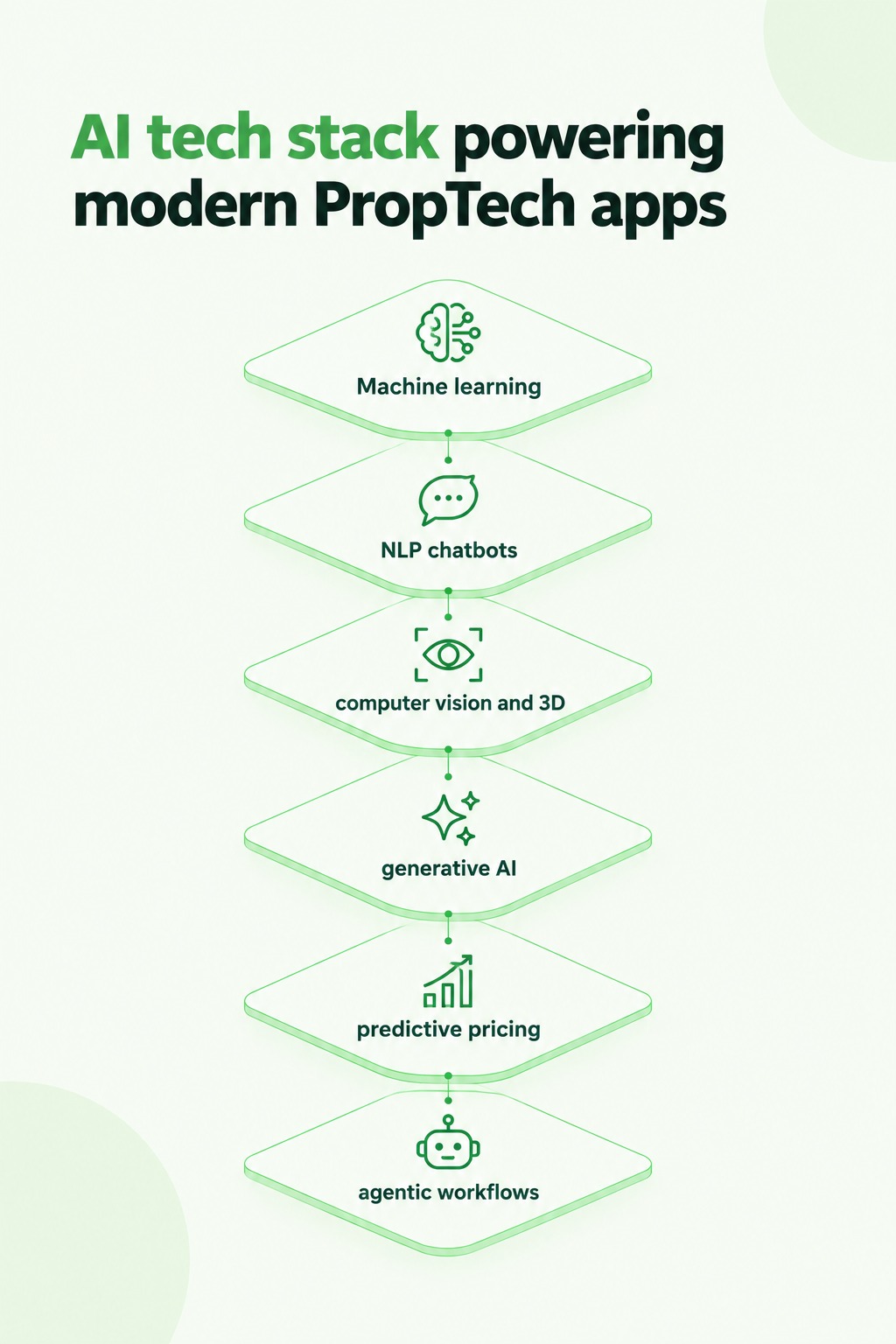
Below is the working stack behind most serious property platforms, and what each layer contributes.
| AI technology | What it does in a property app |
| Machine learning | Powers recommendations, valuation, and demand forecasting from historical transaction data |
| Natural language processing | Runs chatbots, parses buyer queries, and handles Arabic and English conversation |
| Computer vision | Reads floor plans, tags room types from photos, and drives 3D reconstruction |
| Generative AI | Writes listing descriptions and produces realistic renders for off-plan units |
| Predictive analytics | Forecasts price movement, rental yield, and maintenance needs |
| Agentic AI | Executes multi-step tasks such as scheduling viewings and following up on leads |
Generative and agentic AI represent the newest frontier, and most Dubai portals have only begun to adopt them. Generative models cut listing production time to near zero. Agentic systems go further, carrying out workflows on a user’s behalf rather than waiting for instructions at each step.
Teams designing this architecture often lean on specialist AI development teams in Dubai, since blending vision, language, and prediction models cleanly is harder than wiring any one of them alone.
The payoff is a platform where each capability reinforces the others instead of sitting in a silo. For a deeper look at how autonomous systems handle these workflows, agentic AI implementations show what production automation looks like in the UAE.
Virtual tours, 3D modeling, and AI valuation: the new PropTech experience
Dubai sells a large share of its property off-plan and to buyers who never set foot inside before signing. That reality made immersive technology less of a novelty and more of a requirement. Virtual tours, 3D modeling, and AI valuation now form the experience layer that decides whether a remote buyer trusts a listing enough to act.
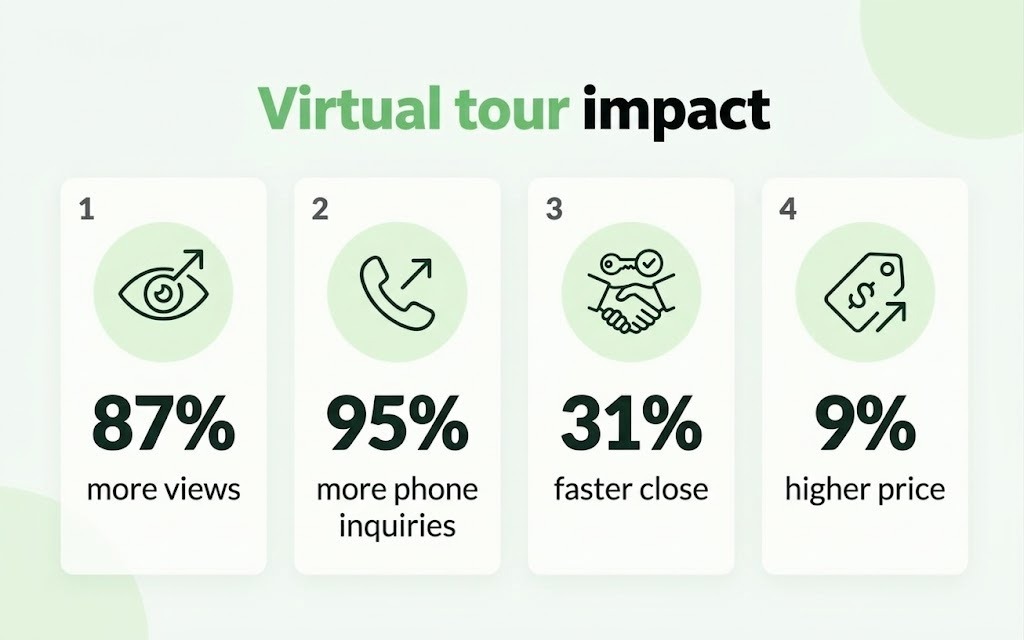
The engagement data explains why developers moved fast. According to Matterport, listings with 3D tours attract far more attention and convert more inquiries than flat photo galleries.
| Metric with virtual tour | Reported impact |
| Listing views | 87 percent more |
| Phone inquiries | 95 percent more |
| Email inquiries | 65 percent more |
| Time to close | Up to 31 percent faster |
| Sale price | Up to 9 percent higher |
Those numbers change the economics of a listing. A remote buyer who spends ten minutes walking through a virtual apartment arrives at a viewing already half-convinced, so agents spend their time closing rather than screening.
AI valuation runs alongside the visuals. Automated valuation models estimate a property’s worth by comparing it against thousands of recent transactions, adjusting for floor, view, layout, and building age. Buyers get an instant price sanity check. Sellers get a defensible asking figure. The combination of seeing a property and pricing it in the same session removes much of the guesswork that once slowed Dubai deals.
How accurate is AI property valuation and smart pricing in PropTech?
Accuracy is the question every operator asks before trusting a valuation engine, and the honest answer carries nuance. Well-trained automated valuation models in mature markets report accuracy bands between 85 and 95 percent against final sale prices. Dubai’s dense transaction record helps models land toward the higher end, since more comparable sales sharpen every estimate.
Smart pricing extends valuation into a live tool. Rather than fixing a number once, the system adjusts recommended prices as market conditions shift. A developer holding fifty similar units can price them dynamically, nudging figures up when demand spikes and easing them when a launch stalls.
Predictive analytics widens the lens further. The same modeling that values a home can forecast rental yield, project maintenance costs, and flag which assets in a portfolio deserve attention. Property managers use these forecasts to schedule repairs before a system fails, which trims operating expenses across a building.
Accuracy still has limits worth naming. Models struggle with unique properties that lack comparable sales, such as a bespoke penthouse or a first-of-its-kind tower. Sudden market shocks can also outrun training data. A responsible platform presents AI valuations as a strong guide and keeps a human valuer in the loop for high-stakes decisions. That balance protects both the operator and the buyer when a number carries real money behind it.
How does AI improve lead generation and property discovery in PropTech?
Lead generation is where AI pays back its cost fastest for most operators. A property portal collects thousands of inquiries a month, and the majority go nowhere. Artificial intelligence sorts the noise from the signal, so agents spend their hours on buyers who intend to transact.
The improvement runs across several touchpoints:
- Lead scoring ranks every inquiry by likelihood to convert, drawing on behavior such as repeat visits, mortgage calculator use, and viewing requests.
- Always-on qualification through chatbots answers questions at 2 a.m., captures requirements, and books viewings while human agents sleep.
- Intent routing sends a hot lead straight to the right agent, so a serious buyer never waits in a queue.
- Retention automation re-engages past visitors with fresh listings that match their earlier searches, reviving pipelines that would otherwise go cold.
The commercial case is straightforward for an enterprise team. When a platform qualifies leads before an agent touches them, cost per closed deal drops and agent productivity climbs. JLL found that property investors have shifted their AI focus toward revenue-generating uses, with most top objectives now tied to growth rather than cost-cutting, in its CRE technology survey.
Discovery and lead generation feed each other. Better discovery keeps buyers engaged longer, which produces richer behavioral data, which in turn sharpens lead scoring. That compounding loop is the quiet advantage a well-built PropTech app holds over a static listings site.
Get a feature-by-feature and cost breakdown for an AI real estate app built for Arabic-first users.
Why copying Zillow rarely works for a new UAE PropTech startup
Zillow gets cited in almost every property startup pitch, and for good reason. It built a category. Yet cloning it for the UAE tends to disappoint, because the model rests on foundations that do not exist here.
Consider what Zillow assumes. It relies on a Multiple Listing Service that aggregates most US inventory into one standardized feed and plugs into a domestic mortgage ecosystem. It serves buyers who read English and live in the same country as the homes. None of those three pillars hold in Dubai.
The UAE market runs on different rails. Listings live across competing portals with no single MLS. A large share of stock sells off-plan, before it physically exists, which Zillow’s resale-oriented model handles poorly. Buyers arrive from dozens of countries, expect Arabic and English interfaces, and pay in multiple currencies. Property data flows through Dubai Land Department, RERA, and Ejari, each with its own compliance rules.
A direct clone inherits none of these local strengths and all of the mismatches. The startups that win here build for UAE reality from the first line of code. They verify listings against government records, design Arabic-first, support escrow-based off-plan purchases, and treat international payment as a core feature rather than an afterthought.
This is where a considered approach to real estate app development in Dubai separates durable platforms from expensive experiments. Copying a foreign template ports the wrong assumptions. Building around local data, local rules, and local buyers produces something a competitor cannot easily replicate. That defensibility, more than any single feature, decides who survives past the second year.
What features does a modern PropTech app need in the UAE?
A UAE property platform carries a specific feature set that reflects the market it serves. Some capabilities appear in any real estate app. Others exist because Dubai regulations and buyer behavior demand them. Skipping the local ones tends to surface as friction the moment real users arrive, so each deserves a proper look rather than a checklist tick.
AI-powered search and recommendations
Buyers arriving from a portal or a Google search expect the feed to understand them within a few taps. Intent-based discovery reads their behavior and surfaces relevant homes, which means users choose from a smart shortlist instead of scrolling endless filters.
Verified listings with DLD and RERA validation
Trust collapses the moment a buyer hits a fake or expired listing. Checking each property against Dubai Land Department and RERA records keeps inventory genuine, and that verification carries far more weight here than in markets with looser data rules.
Virtual tours and 3D visualization
Answer a structural quirk of this market. Much of Dubai stock sells off-plan or to overseas buyers who never visit before signing. Immersive walkthroughs let someone in Riyadh or London inspect a unit properly, which turns a hesitant lead into a confident one.
An agent and broker CRM
It serves the professionals behind every listing. Each inquiry needs tracking, follow-up, and a clear owner. A built-in CRM manages that pipeline, schedules the next contact, and stops a ready buyer slipping through an unnoticed gap.
Arabic and English with right-to-left support
A sizable portion of the buyer base reads Arabic first and judges credibility partly on language. Genuine bilingual design, rather than a translation layer added late, signals the product was built for this region from the start.
Digital contracts and e-signing
This keeps remote deals moving. A cross-border buyer cannot wait for couriered paperwork and wet ink. Secure e-signing lets an offer get executed within minutes, which preserves the momentum that closes a deal before a buyer cools.
Escrow and multi-currency payments
These handle two non-negotiables at once. Off-plan purchases run through regulated escrow by law, and foreign buyers arrive with dirhams, riyals, dollars, and more. Supporting both natively removes the payment friction that quietly kills otherwise willing transactions.
An analytics dashboard
It gives operators sight of their own business. A team cannot improve what it cannot measure. Live dashboards expose demand patterns, listing performance, and lead quality, which turns a stream of raw activity into decisions a manager can act on.
Real builds show how these pieces fit together. Glyphora, a UAE real estate app from the Code Brew Labs portfolio, combines digital offers, e-signing, escrow, and tour scheduling in one flow. Aradi, another build, focuses on verified property viewings with agent calendars and RERA validation baked in. Neither product bolted these features on afterward, and that discipline is what holds up once genuine transaction volume arrives.
The table below groups the same features by who relies on them most.
| Feature | Primary user |
| AI search and recommendations | Buyer |
| Verified DLD and RERA listings | Buyer and operator |
| Virtual tours and 3D visualization | Buyer |
| Agent and broker CRM | Operator |
| Arabic and English with RTL | Buyer |
| Digital contracts and e-signing | Both |
| Escrow and multi-currency payments | Both |
| Analytics dashboard | Operator |
How to build a scalable AI real estate app that is not a Zillow clone
Building something original starts with a decision most founders rush past. Rather than replicate a general portal, pick a wedge where you can win, then expand from strength. A focused platform beats a broad imitation almost every time in a market this competitive.
A practical build path runs through five moves, each explained:
-
Choose a defensible wedge
Off-plan sales, short-term rentals, or fractional investment each have distinct needs. Owning one segment deeply gives you data and users before you widen scope.
-
Build a proprietary data advantage
Verified listings, exclusive developer inventory, or unique transaction data become the moat. Anyone can license an AI model, so the edge lives in the data you feed it.
-
Layer AI on trusted local data
Recommendations and valuations only work when the underlying records are clean and DLD-aligned. Quality data first, intelligence second.
-
Design Arabic-first, not Arabic-later
Retrofitting right-to-left support breaks layouts and erodes trust. A bilingual foundation signals the platform was made for this region.
-
Architect for the GCC from day one
Multi-currency, multi-language, and multi-jurisdiction structures cost little to plan early and a fortune to bolt on after launch.
Scalability is an engineering choice as much as a strategic one. Cloud-native infrastructure, modular services, and a clean API layer let a platform grow from one emirate to the whole region without a rebuild. Founders weighing timelines and budgets often review how long it takes to build an app in Dubai before committing, since realistic planning prevents the mid-project surprises that sink young platforms.
The goal throughout stays constant. You are creating property software that reflects its market, earns defensibility through data, and scales on purpose.
Steps involved in building an AI agent for a PropTech platform
An AI agent goes beyond a chatbot that answers questions. It carries out tasks. Within a property app, an agent can qualify a lead, schedule a viewing, pull a valuation, and follow up, all without a human triggering each action. Building one follows a sequence, and each stage rewards attention rather than a rushed pass.
Scoping the agent’s job
Every capable agent starts with a narrow remit. Deciding whether it handles lead qualification, viewing bookings, or valuation queries sets a boundary that keeps the build focused and the results testable. An agent asked to do everything tends to do none of it well.
Preparing the data and knowledge base
An agent reasons only as well as the information it can reach. Connecting live listings, pricing tables, and policy documents gives it a grounded source to draw on, which stops it from inventing prices or fabricating properties.
Choosing the model and tools
The language model supplies reasoning, while APIs and functions let the agent actually do things. Selecting the two together settles what the agent can understand and what it can execute on a user’s behalf.
Designing the reasoning flow
It turns a responder into a worker. A useful agent plans before it acts. Mapping how it breaks a request into steps, calls the right tool at the right moment, and recovers when something fails separates a production agent from a demo.
Adding guardrails and compliance
This protects the business in a regulated market. Freedom without limits creates real liability in property. Constraining what the agent can promise, quote, and disclose, in line with RERA and UAE data rules, keeps it safe for genuine buyers.
Testing against real scenarios
Lab conditions rarely match a live conversation. Running the agent through typos, mixed Arabic and English, and half-formed requests reveals the weak points before a customer stumbles into them.
Deploying, monitoring, and improving
Shipping is the start of the work, not the end. Watching how the agent behaves with real users and feeding those results back into it lets the system sharpen over weeks rather than freeze at version one.
A few of these stages carry outsized weight. Scoping the job well prevents the most common failure, where an agent spreads itself thin and satisfies no one. Grounding it in verified property data guards against a single fabricated answer that would cost a buyer’s trust for good. Guardrails matter most where money and law meet, since an agent quoting a binding figure it cannot support creates liability no operator wants.
| Step | Output |
| 1. Scope the agent’s job | A clear task boundary |
| 2. Prepare the data and knowledge base | A grounded knowledge layer |
| 3. Choose the model and tools | An agent runtime |
| 4. Design the reasoning flow | Orchestration logic |
| 5. Add guardrails and compliance | A safe operating envelope |
| 6. Test against real scenarios | A validated agent |
| 7. Deploy, monitor, and improve | A learning system |
Done with discipline, an AI agent turns a passive property app into an active assistant that works around the clock. It handles the repetitive front end of every deal, which frees human agents to close the ones that need judgment and a personal touch.
How much does it cost to build a PropTech app in Dubai?
Cost is the question that decides whether a project starts, so here is a straight answer. A real estate app development cost in Dubai runs from roughly AED 150,000 for a lean first version to AED 550,000 or more for a full AI platform. The spread reflects features, complexity, and how much intelligence you build in.
Three tiers cover most real-world projects, and each suits a different stage of ambition.
| Tier | What it includes | Estimated Cost (AED) | Timeline |
| MVP listing app | Search, listings, agent contact, maps | 150,000 to 184,000 | 3 to 5 months |
| Growth platform | Adds CRM, virtual tours, lead automation, dashboards | 275,000 to 400,000 | 6 to 9 months |
| Enterprise AI platform | Adds AI valuation, personalization, agentic workflows, multi-market support | 400,000 to 550,000+ | 9 to 14 months |
Several factors move a project within its band. Design complexity, the depth of AI features, third-party integrations such as DLD and payment gateways, and the number of platforms you target all shift the final figure.
A common mistake is underscoping the first release. Founders load an MVP with enterprise features, then run out of runway before launch. The wiser path ships a focused version, proves demand with real users, then reinvests into intelligence and scale.
Teams planning this sequence often study what AI development costs in the UAE separately, since the AI layer carries its own pricing logic tied to models, data, and infrastructure.
Cost, read correctly, is a sequencing decision. Spend where users feel it first, and defer the rest until traction justifies it.
What are the monetization models for AI-powered PropTech platforms?
A great platform still needs a revenue model, and PropTech offers several proven ones. The right choice depends on who pays, how often, and for what value. Many mature platforms blend two or three streams rather than betting on one.
Each of the streams carries distinct economics:
-
Subscription and SaaS tiers
Agents and agencies pay a recurring fee for listing slots, CRM access, and analytics. Predictable revenue makes this a favorite for SaaS founders building property software.
-
Featured listing fees
Sellers and agents pay to promote a property to the top of results. Simple to run, and it scales with listing volume.
-
Lead generation commissions
The platform charges per qualified lead delivered to an agent, which ties revenue directly to value created.
-
Transaction fees
A percentage of each closed deal, common on marketplace models where the platform sits inside the transaction.
-
Fractional investment fees
Tokenization platforms earn on each fractional purchase and secondary trade, a model Dubai’s regulation now actively enables.
-
Data and API licensing
Aggregated market data and valuation APIs become a product sold to banks, funds, and other platforms.
| Model | Who pays | Revenue rhythm |
| SaaS subscription | Agents, agencies | Recurring monthly |
| Featured listings | Sellers, agents | Per promotion |
| Lead commission | Agents | Per qualified lead |
| Transaction fee | Buyers or sellers | Per closed deal |
| Fractional fees | Investors | Per trade |
| Data and API | Institutions | Recurring or usage |
Choosing among them is a strategic act. A subscription model rewards a platform with sticky professional users. A transaction model suits high-volume marketplaces. Founders exploring subscription-based property platforms tend to start with SaaS tiers, then layer transaction or data revenue once the user base gives them leverage.
How do you scale a PropTech platform across the UAE, GCC, and Middle East?
Scaling a property platform beyond Dubai sounds like more of the same, and it rarely is. Each market brings its own regulator, language nuance, currency, and buyer psychology. A platform that treats Riyadh or Doha as a copy of Dubai stumbles fast.
Regional expansion works best when the groundwork was laid early. Saudi Arabia runs its own registry and its Vision 2030 property push, so listings and compliance differ from UAE norms. Qatar, Bahrain, and Oman each add variation. A platform architected for one jurisdiction needs surgery to enter another, while one built for many absorbs each new market with configuration rather than rework.
Several elements decide whether expansion scales or stalls:
-
Localization beyond translation
Arabic dialects, local property terms, and cultural expectations around negotiation all shape the experience. A literal translation feels foreign to a Saudi or Kuwaiti user.
-
Regulatory adaptability
Compliance logic must be configurable per market, since what satisfies RERA differs from Saudi or Qatari rules.
-
Currency and payment breadth
Cross-border buyers move between dirhams, riyals, and dollars, and the platform should make that invisible.
-
Cloud architecture that flexes
Regional data residency rules and traffic spikes demand infrastructure that scales horizontally without downtime.
The prize justifies the effort. PropTech UAE success stories increasingly become PropTech Middle East platforms, carrying a proven Dubai product into markets hungry for the same intelligence. Future PropTech growth across the region will favor the platforms that planned for scale before they needed it, since retrofitting multi-market support after launch costs far more than designing it in.
How is Dubai’s government engineering the PropTech boom?
Most cities let PropTech happen to them. Dubai builds it on purpose. The government treats real estate technology as public infrastructure, and that stance separates the emirate from nearly every competing market. Understanding this layer matters for any founder, because you build on top of it rather than around it.
Registry
Dubai Land Department digitized property records years ago and now ships its own tools. The Dubai REST app puts transactions, contracts, and services in residents’ hands, which means PropTech startups plug into a mature digital backbone instead of assembling one from scratch. That head start compresses build timelines and raises the trust baseline for every app in the market.
Flagship
In 2025, the DIFC Innovation Hub and Dubai Land Department launched the Dubai PropTech Hub, a dedicated district aiming to more than double the sector’s value beyond AED 4.5 billion by 2030. The hub targets over 200 startups, roughly 3,000 jobs, and hundreds of millions in fresh investment. It gathers developers, technology firms, regulators, and investors in one place, which shortens the distance between an idea and a live deployment.
Tokenization
Dubai Land Department became the first registration authority in the Middle East to tokenize property title deeds, running its Real Estate Tokenization Project through the Prypco Mint platform. Investors can now buy fractional ownership from AED 2,000, and officials project tokenized property could reach AED 60 billion, around 7 percent of transactions, by 2033.
Regulation
Regulation keeps pace with technology here rather than lagging it. The Virtual Assets Regulatory Authority oversees the digital asset side, giving tokenization legal footing that most markets still lack.
For a PropTech founder, this environment is rare. You launch into a market where the regulator has already cleared the path, funded the ecosystem, and signaled that intelligent property software is national policy. Few places on earth offer that combination, and it explains why capital and talent keep flowing toward Dubai real estate technology.
What are the risks of AI in PropTech, and how do you manage them?
Enthusiasm for AI should not crowd out judgment. Property carries real money and legal weight, so the failure modes matter as much as the features. A platform that ignores them invites regulatory trouble and lost trust. Naming the risks openly is itself a mark of a serious operator.
Four risks deserve active management:
Data privacy
Property apps collect sensitive financial and personal data. The UAE Personal Data Protection Law sets obligations around consent and handling, and a breach carries both penalties and reputational cost. Privacy has to be designed in, not patched later.
Algorithmic bias
A valuation or recommendation model trained on skewed data can quietly disadvantage certain areas or buyers. Regular auditing of model outputs keeps bias from hardening into policy.
Valuation error
AI estimates carry margins, and treating them as gospel on a high-value deal is dangerous. Keeping a human valuer in the loop for major transactions protects everyone.
Cybersecurity
A platform holding transaction and identity data is a target. Encryption, access controls, and monitoring are the cost of operating in this space, not optional extras.
Governance ties these together for enterprise decision-makers. Before scaling AI across a platform, leadership needs clear ownership of model behavior, data handling, and escalation paths when something goes wrong. That discipline is what lets a Fortune 500 operator or a fast-growing business deploy AI with confidence rather than crossed fingers.
Handled well, risk management becomes a competitive advantage. A platform that can prove its data practices and model oversight wins enterprise clients that a flashier, looser competitor never will.
Why choose Code Brew Labs for PropTech development?
Choosing the right PropTech app development partner shapes a PropTech product more than any single technology decision. Code Brew Labs builds real estate and AI platforms in Dubai, with a team that knows this market’s regulations, language, and buyer behavior firsthand. That local grounding, paired with deep engineering, is what turns a concept into a platform that survives contact with real users.
Products such as Sobha Realty, Glyphora, Aradi, and StayBuzz show working UAE property platforms with escrow, e-signing, verified viewings, and RERA validation already shipped and live. A genuine AI engineering bench.
We treat compliance as a design input from day one, so platforms integrate with Dubai’s registries rather than fighting them after launch. Arabic-first, region-ready design. Bilingual, right-to-left interfaces come standard, which matters for a buyer base that reads Arabic and spans the GCC.
Strategy, design, engineering, and post-launch scaling sit under one roof, so a founder deals with one accountable team through the whole journey.
The proof sits in the portfolio rather than the pitch. Clients range from property startups to established firms, and the common thread is software built for the market it serves. Teams evaluating AI development teams in Dubai can review the full portfolio and judge the work directly.
We are a real estate app development company that understands Dubai property law, Arabic-first design, and AI engineering at once, and builds something that belongs in this market from the first release.
Ready to launch an AI real estate platform that scales across the UAE & GCC instead of another Zillow clone?
Conclusion
Dubai turned PropTech from a buzzword into working infrastructure, and AI is the layer now deciding who leads. The emirate moved AED 761 billion in property during 2024, built a dedicated PropTech Hub, and became the first Middle East authority to tokenize title deeds. That momentum rewards builders who understand it.
The lesson for anyone launching here is consistent. Build for Dubai’s reality rather than a foreign template. Ground your AI in verified local data, design Arabic-first, plan for the GCC, and treat compliance as a foundation. A buyer who once needed months can now shortlist, value, and tour a home before lunch, and the platforms that made that possible were built on purpose, for this market.
Frequently Asked Questions
What is PropTech in Dubai?
PropTech in Dubai refers to the technology transforming how property gets searched, valued, bought, and managed. It spans AI-powered portals, virtual tours, valuation engines, agent CRMs, and tokenization platforms. Dubai leads the region because its digital registries and government backing give these tools clean data and legal footing to work with.
How is AI used in Dubai real estate?
AI powers personalized property search, automated valuation, virtual tour analysis, chatbot lead qualification, and predictive pricing. It compresses buyer decision timelines, sharpens investment forecasts, and automates repetitive agent tasks. Most leading Dubai portals now treat these capabilities as standard rather than premium features.
How much does it cost to build a PropTech app in the UAE?
A basic listing app starts around AED 150,000; a growth platform runs AED 275,000 to AED 400,000, and a full AI platform reaches AED 550,000 or more. The final cost depends on features, AI depth, integrations, and how many markets you target at launch.
Is it worth building a platform instead of cloning Zillow?
Cloning Zillow seldom works in the UAE, since it assumes US listing systems, mortgages, and English-only buyers. A platform built for local data, Arabic interfaces, off-plan sales, and RERA compliance holds a defensible edge. Original beats imitation because it fits how Dubai property actually trades.
How accurate are AI property valuations?
Well-trained valuation models report 85 to 95 percent accuracy against final sale prices in data-rich markets like Dubai. Accuracy drops for unique properties without comparable sales. Responsible platforms present AI valuations as a strong guide and keep human valuers involved for high-value deals.
What is the Dubai PropTech Hub?
The Dubai PropTech Hub is a government initiative launched by DIFC and Dubai Land Department in 2025. It aims to more than double the sector past AED 4.5 billion by 2030, supporting over 200 startups and creating around 3,000 jobs within a dedicated innovation district.
Let's Convert Your Business Idea Into Success!
Free Consultation from Top Industry Experts
Let’s Build Your Dream App!
Share article on :



 No commitment required
 NDA on request
 24-hour response


