
Quick Summary:
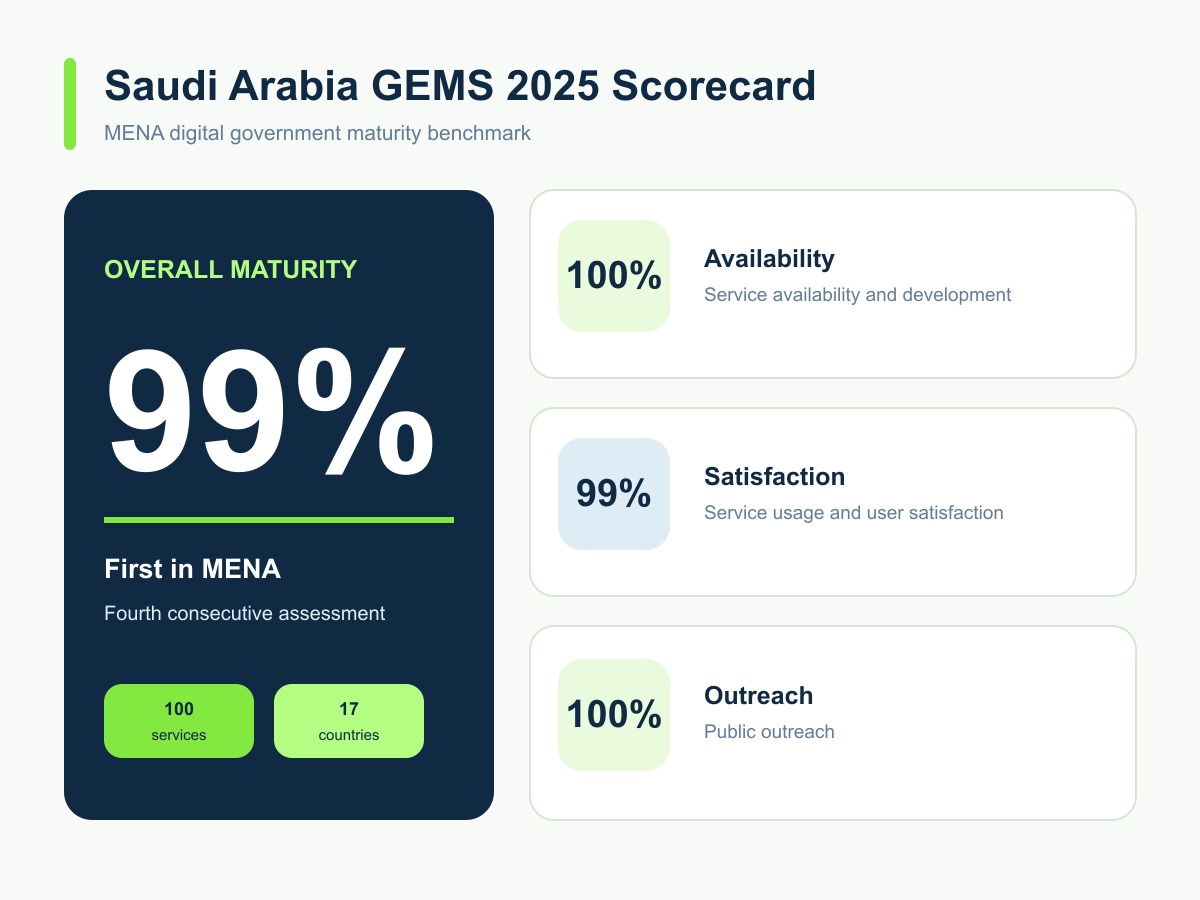
- Saudi Arabia scored 99% on the UN ESCWA GEMS 2025 index, ranking first in MENA for a fourth straight time.
- Government platforms have raised expectations for fast, integrated, mobile-first digital experiences across Saudi Arabia.
- Saudi establishment AI use reached 33.1% during 2025, according to official GASTAT data, a 20% annual rise.
- Enterprises should prioritize AI use cases with measurable value, governed data, and operational ownership.
- PDPL breaches carry fines up to SAR 5 million, making governance a build requirement.
- Arabic-first models outperform generic LLMs on Saudi dialect and entity handling.
- PwC projects AI will contribute 12.4% of Saudi GDP by 2030.
AI development in Saudi Arabia has shifted from an innovation line item to a service-parity requirement.
A Saudi resident renews a vehicle registration on Absher in under two minutes. No call centre and branch visit.
Then that same person opens your app and compares it with Absher.
Saudi customers now compare private services against mature public experiences. Business applications must offer faster decisions, connected journeys, Arabic service, and dependable mobile access.
On 2025 numbers from the UN ESCWA GEMS Maturity Index, the Saudi government delivers digital service at 99% maturity. Regional peers average 46%.
That gap has a commercial consequence. Saudi consumers and business buyers now carry a service expectation built by the state. Private companies inherit that benchmark without being consulted.
The question for boards is no longer whether to build. It is what to build first, where the data sits, and who signs off on the governance.
Since 2013, our teams have shipped AI systems for Airbus, duPay, and REDTAG.
What Saudi Arabia’s 99% Digital Government Score Means for AI Development
The Government Electronic and Mobile Services (GEMS) Maturity Index is a UN ESCWA measure of how developed government digital services are across Arab states. Saudi Arabia scored 99% in the 2025 edition, ranking first among 17 countries.
The assessment covered 100 priority services used by individuals and businesses across web portals and smart applications. ESCWA reviewed 956 services and 377 institutions region-wide.
Saudi Arabia’s 2025 result provides three enterprise signals.
First, digital access has become standard across essential journeys. Customers expect similar convenience from banks, hospitals, retailers, and utilities.
Second, satisfaction now matters beyond service availability. AI systems need usable answers, dependable actions, and clear escalation paths.
Third, public platforms have normalized integration. AI Enterprise development must include identity, payments, notifications, records, and support within connected journeys.
| GEMS 2025 measure | Saudi score | Business implication for AI development |
| Overall maturity | 99% | Competing digital experiences require production-grade quality |
| Service availability and development | 100% | Customers expect complete digital journeys |
| Service usage and user satisfaction | 99% | AI must improve real tasks and service outcomes |
| Public outreach | 100% | Arabic communication and proactive support matter |
| Assessment scope | 100 services, 17 countries | The result reflects broad service coverage |
Source: UN ESCWA GEMS 2025, Saudi Press Agency
Three things follow for private builders.
- Verified identity is available infrastructure. Nafath and Absher authenticate users at national scale. A business can plug into verified identity instead of building KYC from scratch.
- Consumer patience has been recalibrated. Sehhaty serves over 30 million users. Saudi users learned what same-session resolution feels like, then took that expectation everywhere else.
- Structured data now flows through the ecosystem. Government-grade service design pushes clean, machine-readable records across sectors. AI chatbots and models need exactly that input quality to perform.
Why Saudi Arabia Leads MENA in Digital Government Services
Four consecutive GEMS wins reflect a decade of consolidation rather than a single programme. On the UN E-Government Development Index 2024, the Kingdom climbed 25 places to sixth globally and second in the G20.
Riyadh ranked third among 193 cities assessed. Credit sits with three bodies: the Digital Government Authority for service standards, SDAIA for data governance, and MCIT for infrastructure.
Why Is 2026 the Right Time for AI Development in Saudi Arabia?
Saudi government services score 99% on digital maturity while 33.1% of Saudi businesses use AI. That 66-point spread is the commercial opening.
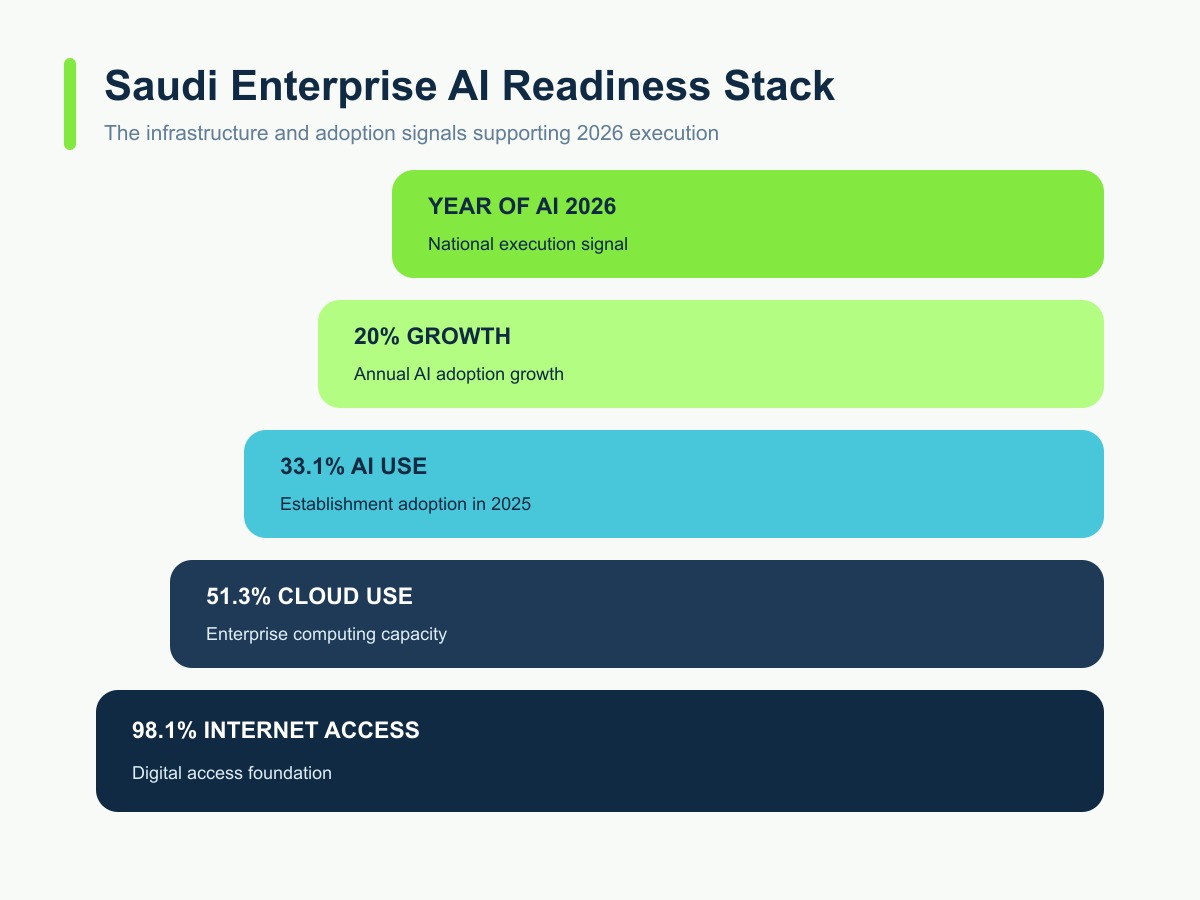
Adoption data comes from the General Authority for Statistics. Business AI use rose to 33.1% in 2025, growing 20% against the prior year, reported here.
Consumer uptake moved faster. Saudi internet users applying AI tools reached 45.2%, up from 21.5% a year earlier, per Asharq Al-Awsat.
Read those two numbers together. The people buying from Saudi companies adopted AI faster than the companies serving them. Pressure is arriving from below.
Market scale supports the case. PwC Middle East projects AI will contribute $135.2 billion to Saudi GDP by 2030, near 12.4% of output. Saudi AI market revenue sits around $5.2 billion for 2025, per P&S Intelligence.
AI Development Opportunities in Saudi Arabia by Industry
Demand is uneven across sectors. GASTAT recorded 61.1% AI automation and adoption in ICT against sub-average uptake in retail and healthcare. Both ends carry opportunity for different reasons.
Below sits every major Saudi sector with an active AI development mandate, the number that justifies it, and the systems worth building first.
1. Banking, Finance and Fintech
The Saudi fintech app development market was valued at $2.1 billion in 2025 and tracks toward $4.8 billion by 2034, per IMARC Group. Saudi Arabia targets 525 fintech firms by 2030 under its National Fintech Strategy.
Financial and insurance activities recorded 52.9% AI adoption, second highest in the Kingdom. High-value builds include real-time fraud scoring, Arabic credit-decision assistants, AML transaction monitoring, and PDPL-safe underwriting models.
Sharia-compliance checking through document intelligence remains underbuilt across Saudi banks.
2. Healthcare and HealthTech
Saudi digital healthcare development tracks toward $11.07 billion by 2033 at 18.79% CAGR, per Grand View Research.
AI in healthcare alone projects $191.3 million by 2030 at 35.5% CAGR.
Sehhaty set the patient expectation for instant access. Hospitals and insurers now need Arabic triage assistants, clinical documentation automation, radiology support tools, and no-show prediction.
Health data carries sensitive-data status under PDPL, so in-Kingdom inference is close to mandatory.
3. Retail and E-commerce
Saudi e-commerce development reached $27.96 billion in 2025 and projects $54.87 billion by 2031, per Mordor Intelligence. Internet penetration sits near 99%. Retail posted below-average AI adoption, which makes it the widest gap on this list.
Priority builds cover Arabic recommendation engines, demand forecasting for Ramadan and Eid peaks, dynamic pricing, visual search, and returns-fraud detection. Voice ordering in Saudi dialect remains rare and converts well.
4. Government and Public Sector
The 99% GEMS score raises rather than closes the workload. Every vendor serving a government entity now builds against that standard.
Opportunity concentrates in service providers and contractors: citizen-facing Arabic agents, case-triage automation, procurement document intelligence, and multilingual accessibility layers.
GovTech in Saudi Arabia demands audit trails, human-review gates, and data residency written into the architecture from day one.
5. Oil, Gas and Energy
Aramco expects $3 billion to $5 billion in technology-realised value for 2025, reported by AGBI. Its Wa’ed Ventures arm committed $100 million to early-stage Saudi AI startups.
Energy builds run technical: predictive maintenance on rotating equipment, reservoir analytics, drilling optimisation, HSE incident prediction, and emissions monitoring.
Supplier ecosystems around Aramco represent a large secondary market for AI development services in Saudi Arabia.
6. Real Estate and Construction
Saudi construction hit $101.4 billion in 2025, moving toward $140.4 billion by 2034, per IMARC Group.
Real estate development sits at $77.2 billion with a path to $141.6 billion.
Giga-projects generate document volume no manual team can absorb. Buildable systems include automated valuation models, drawing and BOQ extraction, site-safety computer vision, schedule-slip prediction, and Arabic tenant-service agents.
Ejar and Sakani integration adds trust for consumer-facing property products.
7. Logistics and Supply Chain
Transportation and storage recorded 44.4% AI adoption. Saudi ecommerce logistics app development projects $3.77 billion by 2030 at 10.94% CAGR, per Mordor Intelligence.
Vision 2030 positions the Kingdom as a global logistics hub, so throughput pressure keeps rising.
Build priorities cover route optimisation across Saudi road networks, dock scheduling, demand forecasting, customs document classification, and last-mile ETA prediction against Arabic address formats.
8. Education and EdTech
Saudi EdTech and school markets carry strong momentum, with the school segment at $65.3 billion in 2025, per IMARC Group. Education posted 51% AI adoption, the third highest nationally.
Over six million students access AI curricula, and 79% of Saudi universities run AI courses.
Institutions need adaptive Arabic learning paths, automated assessment, plagiarism detection tuned for Arabic text, and student-retention prediction. Teacher-facing tools trail student tools by a wide margin.
9. Travel, Tourism and Hospitality
Saudi Arabia welcomed 123 million visitors in 2025 with tourism spend at SAR 304 billion, per the Ministry of Tourism report. International arrivals reached 29.3 million.
Hospitality operators face multilingual demand at volume. Systems worth building include Arabic and English concierge agents, dynamic room pricing, itinerary personalisation for religious tourism, and review-sentiment analysis.
Hajj and Umrah operations carry distinct scheduling and crowd-flow modelling needs.
10. Manufacturing and Industry 4.0
Industrial diversification under Vision 2030 pushes factory digitisation across the Kingdom. Estimates place 30% to 40% of Saudi refineries on full-spectrum digital platforms by 2026.
Manufacturers need visual defect detection, predictive maintenance, energy-consumption optimisation, and production-yield forecasting.
Arabic-language operator interfaces matter here more than most sectors, since shop-floor teams rarely work in English.
11. Telecommunications
ICT recorded the highest AI adoption at 61.1%. Saudi operators run mature data estates and 5G coverage near 78%.
Maturity shifts the buying pattern toward depth. Telcos now purchase network-anomaly detection, churn prediction, Arabic customer-service agents with billing-system access, and capacity planning models.
Ticket deflection through Arabic conversational AI shows the fastest measurable return in this sector.
12. Mining and Metals
Mining forms the third pillar of Saudi industrial strategy alongside energy and manufacturing. Ma’aden and its supplier network drive most enterprise demand.
Applications include ore-grade prediction from sensor data, haul-fleet optimisation, equipment failure forecasting, and geological survey document intelligence.
Exploration data sits in unstructured formats across decades of records, which makes retrieval systems an early win.
13. Agriculture and Food Security
Food security is a stated national priority given water constraints. Saudi smart farming carries steady projected growth through 2033.
Growers and agri-processors need irrigation optimisation, crop-disease detection through computer vision, yield forecasting, and cold-chain monitoring.
Vertical farming operators around Riyadh present a concentrated buyer group for AI automation in Saudi Arabia.
14. Sports, Gaming and Entertainment
Saudi Arabia captured 20% of MENA gaming revenue, with 23.5 million players and 63% penetration, per Arab News. Per-capita gaming spend reached $308 against a MENA average of $102.4.
Savvy Games projects $13.3 billion for gaming and esports by 2030. Builds include player-behaviour prediction, Arabic in-game moderation, talent-scouting analytics, matchmaking systems, and personalised content feeds.
Sports platforms carry the same demand, as our Grintafy work shows.
15. Insurance
Insurance sits inside the 52.9% financial-activities adoption figure but trails banking on deployment. Regulatory pressure from the Insurance Authority is tightening claims transparency.
Insurers need claims-document extraction, fraud detection on motor and medical claims, Arabic policy-explanation agents, and risk-pricing models.
Medical claims processing carries the largest cost line and the clearest automation case.
16. Professional, Legal and Consulting Services
Professional activities recorded 43.9% AI adoption. Firms bill hours against work that document intelligence handles at a fraction of the cost.
Priority systems cover contract review against Saudi commercial law, Arabic legal research retrieval, due-diligence document processing, and proposal generation.
Confidentiality obligations make in-Kingdom hosting a client requirement rather than a preference.
17. Automotive and Mobility
Saudi EV adoption and the Ceer national brand anchor a new mobility segment. Ride-hailing and fleet operators run at national scale.
Applications include fleet-utilisation forecasting, driver-behaviour scoring, charging-network demand prediction, and Arabic in-vehicle assistants.
Insurance telematics forms a natural crossover build with the insurance sector above.
18. Mining and Quarrying
Mining and quarrying recorded 41.8% AI adoption, reflecting strong industrial potential.
High-value use cases include geological modeling, predictive maintenance, safety vision, grade estimation, and energy optimization.
Edge processing can support remote sites where connectivity, latency, or data sensitivity restrict cloud dependence.
How Should Enterprises Prioritize AI Development in Saudi Arabia?
Enterprises should rank AI opportunities through value, data, localization, safeguards, and integration readiness.
A large use-case list can weaken investment discipline. Executive teams need one shared scoring method across departments.
The VALUE framework provides that method.
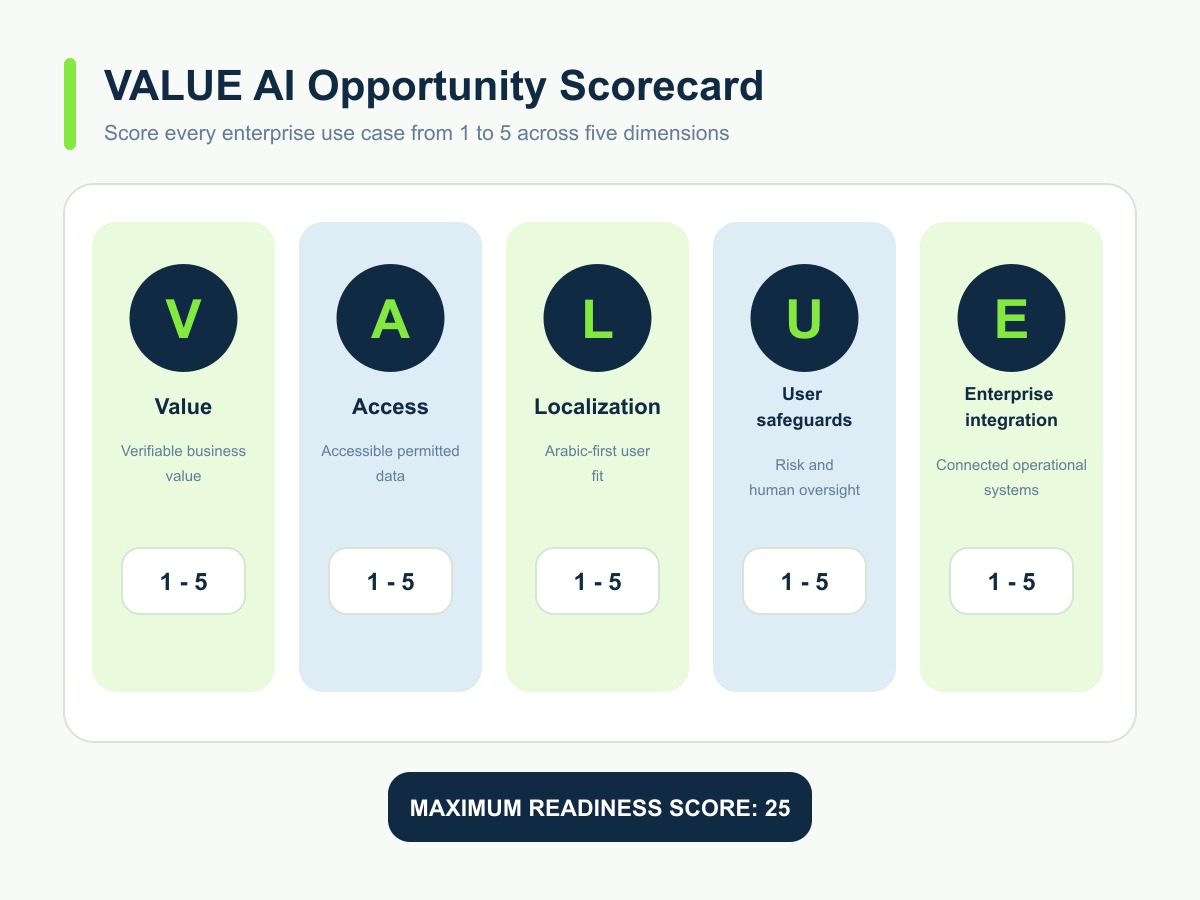
V: Verifiable business value
Define one measurable outcome before selecting models or vendors.
Useful outcomes include faster processing, fewer errors, higher conversion, reduced downtime, or improved service capacity.
Give each use case a named executive owner. Establish the baseline before development starts.
A: Accessible and permitted data
List every required data source, owner, format, permission, and quality issue.
Confirm whether the team can use production data for training, retrieval, testing, and monitoring.
Weak access can stall even attractive AI ideas. A small, governed dataset often supports a stronger first pilot.
L: Localized user fit
Test Arabic language, Saudi dialects, right-to-left interfaces, business terminology, and cultural context.
Arabic-first AI solutions need representative evaluation sets. Translation alone cannot test intent, tone, retrieval, or speech accuracy.
English support also matters across multinational workforces and customer segments.
U: User and regulatory safeguards
Classify affected users, decision risk, privacy exposure, cybersecurity, and required human controls.
High-impact use cases need traceable outputs, appeal routes, fallback behavior, and monitoring.
The SDAIA AI Adoption Framework provides cross-sector guidance for responsible adoption.
E: Enterprise integration readiness
Map the APIs, ERP, CRM, identity, payment, document, and analytics systems involved.
Assign system owners before development. Integration permissions and sandbox access should enter the discovery plan.
AI creates limited value when users must copy outputs between disconnected systems.
Score your highest-value Saudi AI opportunity across value, data, localization, safeguards, and integration.
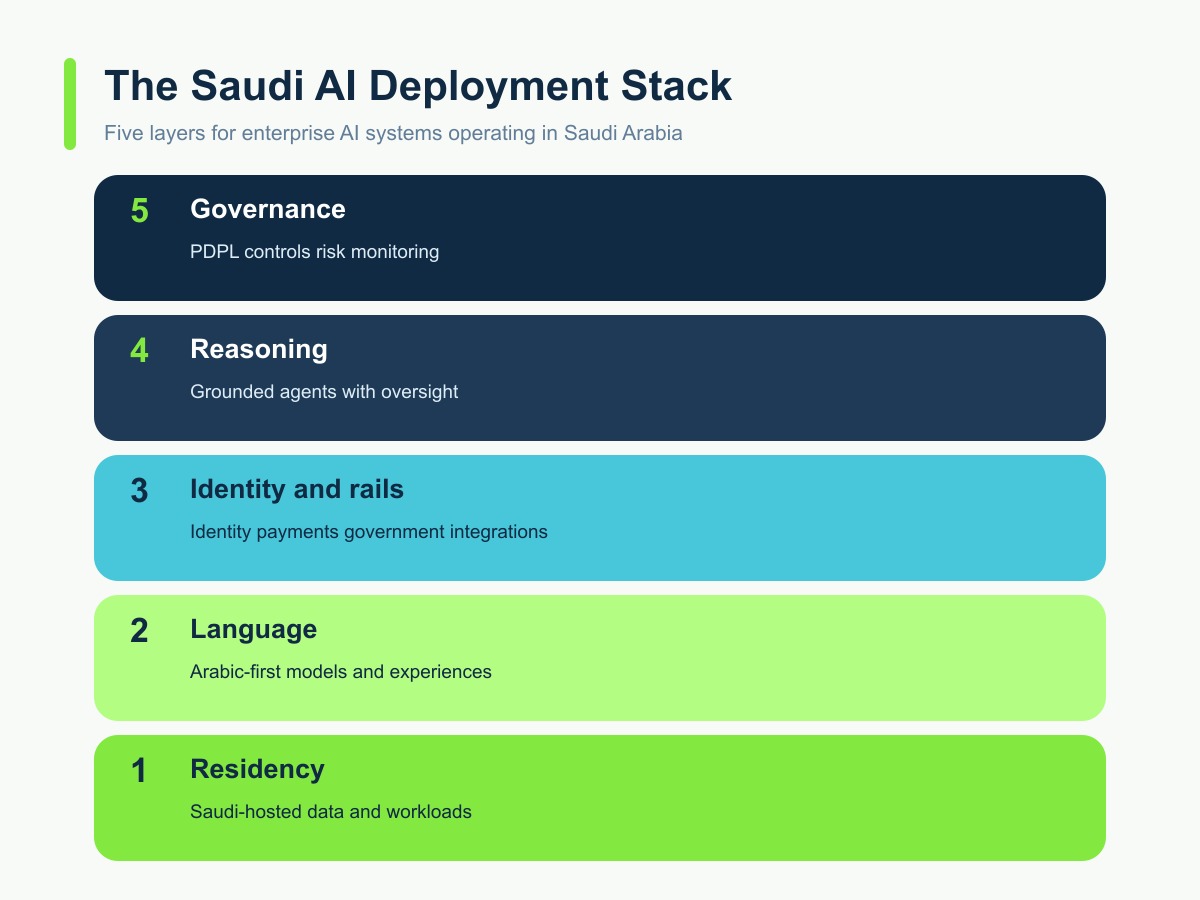
The Saudi AI Deployment Stack: A Framework for AI Development in Saudi Arabia
Most Saudi AI projects fail at a layer nobody scoped. Below is the five-layer stack we use to scope enterprise builds in the Kingdom.
Layer 1: Residency
Where model weights, embeddings, and logs physically sit. PDPL pushes sensitive data toward in-Kingdom hosting.
Common failure: teams pick a model API before checking its inference region.
Checkpoint: named hosting region documented before model selection.
Layer 2: Language
Arabic handling across Modern Standard Arabic and Saudi dialects. Covers Arabizi input, code-switching, Hijri dates, and Arabic name normalisation.
Common failure: the system passes English QA and breaks on real Arabic traffic.
Checkpoint: a dialect test set scored before launch.
Layer 3: Identity and rails
Nafath authentication, national ID verification, Saudi payment rails, and government API endpoints.
Common failure: an AI agent that cannot verify who it is talking to.
Checkpoint: one live integration proven in staging.
Layer 4: Reasoning
Models, retrieval over company data, and agent orchestration across systems.
Common failure: a chatbot with no write access to the ERP.
Checkpoint: task completion rate, not answer quality.
Layer 5: Governance
Audit logs, human-review gates, model cards, bias testing, and PDPL records of processing.
Common failure: governance added after go-live.
Checkpoint: a records-of-processing document signed by legal.
Map your build against the same dimensions ESCWA applied to government.
Arabic-First AI Development in Saudi Arabia: Why Generic Models Underperform
Most Arabic AI failures are evaluation failures. Teams choose a model before building a test set, then discover the gap in production.
Four problems recur across Saudi deployments.
Dialect distance
Models trained on Modern Standard Arabic stumble on Najdi, Hijazi, and Gulf usage. People write chat messages in dialect, not in newsprint Arabic.
Code-switching
A single Saudi customer message can mix Arabic script, Arabizi, and English product names. Tokenisers built for one script degrade on all three.
Entity handling
Arabic name variants, Hijri dates, and Saudi address formats break extraction pipelines built for Latin-script data.
Right-to-left behaviour
Interface bugs surface at the render layer even when the model performs well.
Sovereign capability exists to draw on. SDAIA developed ALLaM through its National Center for AI. HUMAIN, backed by PIF, launched an Arabic assistant on ALLaM 34B supporting over 30 Arabic dialects.
Practical rule: build a 300-example test set from your own Saudi transcripts before you compare models. Score every candidate on that set. Vendor benchmarks tell you nothing about your traffic.
What Must AI Development in Saudi Arabia Include Before Production?
Production AI needs governed data, tested models, secure integrations, human controls, and continuous monitoring.
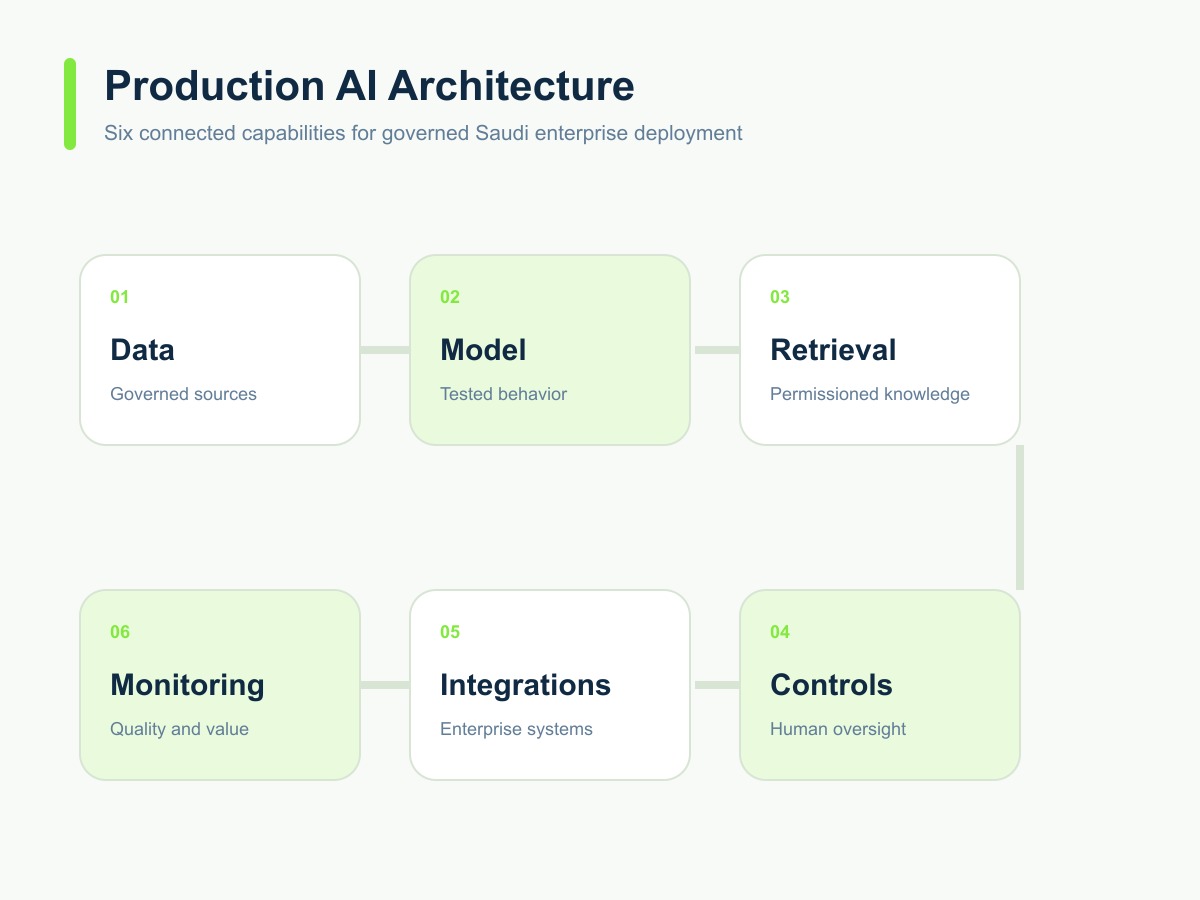
A successful demonstration proves technical possibility. Production systems must survive real users, failures, permissions, and changing data.
A controlled data foundation
Start with data inventory, ownership, classification, retention, consent, quality, and access controls.
Sensitive fields should enter models when the approved purpose requires them.
The Saudi PDPL guide explains controller duties and data-subject rights.
Legal counsel should review each specific processing purpose, transfer, retention schedule, and vendor arrangement.
Model and retrieval evaluation
Create test sets representing Arabic, English, Saudi terminology, edge cases, and unsafe requests.
Measure accuracy beside groundedness, refusal quality, bias, latency, and escalation behavior.
Retrieval systems need source permissions and citation checks. Recommendation models need outcome monitoring across relevant user groups.
Human oversight and fallback paths
Define which decisions require human approval. Assign staff for escalations, disputes, low-confidence outputs, and incident review.
Fallback experiences should remain useful during model, network, or integration failures.
Monitoring and AI governance
Track model quality, business outcomes, usage, cost, latency, complaints, and policy exceptions.
PwC found 62% of Saudi respondents had documented Responsible AI frameworks.
Another 64% used role-based data and AI access controls.
Those findings show governance has entered enterprise practice. Each project still needs operational evidence and named accountability.
Our AI systems pass legal and procurement review before they reach production.
How Much Does AI Development in Saudi Arabia Cost in 2026
Cost tracks three variables: data readiness, integration count, and hosting model. Ranges below reflect Saudi enterprise engagements, priced in Saudi riyals.
| Build type | Indicative range (in SAR) | Typical timeline |
| AI proof of concept, single workflow | 95,000 to 190,000 | 4 to 8 weeks |
| Arabic conversational agent, production grade | 225,000 to 560,000 | 3 to 5 months |
| Document intelligence with ERP or CRM integration | 340,000 to 750,000 | 4 to 6 months |
| Custom AI platform, multi-module | 750,000 to 2,250,000+ | 6 to 12 months |
| In-Kingdom hosted, PDPL-audited deployment | Add 15% to 30% | Add 3 to 6 weeks |
Six drivers move mobile app development cost inside those bands:
- Data readiness. Clean, labelled, accessible data cuts weeks. Scattered data adds them.
- Arabic evaluation depth. Dialect coverage requirements change test-set effort.
- Integration count. Each ERP, CRM, or core-banking connection adds scope.
- Hosting model. In-Kingdom deployment costs more than shared regional cloud.
- Human-review design. Regulated sectors need review interfaces built, not bolted on.
- Retraining commitment. Month-six accuracy needs a budgeted owner.
How Should Businesses Choose an AI Development Company in Saudi Arabia?
Choose a partner with Saudi proof, AI engineering depth, Arabic validation, integration experience, and governance discipline.
Procurement teams should evaluate delivery evidence beside presentations. Ask vendors to demonstrate live products, architecture decisions, and measurable outcomes.
Review six capability areas
- Use-case discipline: Can the team connect AI scope with one owned business metric?
- Data engineering: Can it prepare, govern, retrieve, and monitor enterprise data?
- Arabic AI: Can it test Arabic NLP, dialects, speech, search, and RTL journeys?
- Product engineering: Can it deliver secure mobile, web, backend, and administrative systems?
- Enterprise integration: Can it connect ERP, CRM, identity, payments, and existing APIs?
- AI governance: Can it document evaluation, human oversight, access, monitoring, and incidents?
Ask for procurement evidence
Request a solution architecture, data-flow map, evaluation plan, delivery stages, risk register, and ownership model.
The proposal should separate assumptions, exclusions, dependencies, recurring costs, and acceptance criteria.
Code ownership and model-provider terms deserve contract review. Data handling should match approved Saudi requirements and business policies.
Avoid shallow AI proposals
Generic chatbot demos cannot prove enterprise readiness. Strong proposals use company data, representative users, defined integrations, and measurable acceptance tests.
A vendor should explain model limitations in plain language. The delivery plan needs fallback behavior and post-launch accountability.
Why Choose Code Brew Labs for AI Development in Saudi Arabia
Code Brew Labs builds AI systems for regulated, high-volume environments. Our Saudi products show the pattern.
Grintafy AI
Developed Grintafy’s AI-enabled sports talent ecosystem. Footballers build performance profiles, organise matches, book facilities, and connect with scouts and professional opportunities across the region.
1M+ application downloads · 4.6/5 average rating
Pala De 7
Built Pala De 7’s Saudi padel platform. Player discovery, court reservations, practice scheduling, payments, and owner operations run inside one connected sports ecosystem nationwide.
50K+ application downloads · 500+ active courts
Our engineering teams work across Arabic-first product design, enterprise integration, and compliance-ready architecture. Every Saudi build ships with a documented hosting region and a governance layer.
Conclusion
Return to the Absher example. That two-minute renewal is now the baseline experience for 36 million people, and baselines do not move back down.
Saudi Arabia’s 99% GEMS score confirmed something the market had been sensing. Public digital service reached a standard that private companies get compared against, without anyone asking their permission.
Enterprise AI adoption at 33.1% shows how much room remains. Firms that close that gap in the next 24 months will define service expectations in their categories. The rest will spend the following decade catching up.
Start with one workflow, one cost line, and a 90-day number.
FAQs
What does Saudi Arabia’s 99% digital government score mean for private businesses?
The score reflects UN ESCWA’s 2025 assessment of 100 government services across 17 Arab countries. For private firms, it sets a service benchmark. Saudi users now expect verified identity, Arabic-native interfaces, and same-session resolution from every provider. Meeting that standard at reasonable cost pushes companies toward AI-supported service design.
Is AI development in Saudi Arabia regulated?
Yes. The Personal Data Protection Law became enforceable in September 2024, with SDAIA as the supervisory authority. Requirements cover lawful basis, data minimisation, retention limits, and cross-border transfer controls. Fines reach SAR 5 million per breach. SDAIA also publishes AI ethics principles that guide responsible AI development in Saudi Arabia.
Do AI applications in Saudi Arabia need to support Arabic dialects?
For consumer-facing products, yes. Saudi users write in Najdi, Hijazi, and Gulf dialects rather than Modern Standard Arabic. Systems tested only on MSA show accuracy drops in production. Build a dialect test set from your own transcripts before choosing a model, then score every candidate against it.
Can AI systems store Saudi customer data outside the Kingdom?
Sensitive and personally identifiable data must stay in Saudi Arabia unless an exemption applies. Cross-border transfer requires a lawful basis, an adequacy assessment of the destination country, and a documented risk assessment under SDAIA’s February 2025 guidelines. Conversation logs and embeddings from AI systems fall within scope.
How long does custom AI development in Saudi Arabia take?
A single-workflow proof of concept runs 4 to 8 weeks. A production Arabic conversational agent takes 3 to 5 months. Document intelligence with ERP integration runs 4 to 6 months. Multi-module platforms take 6 to 12 months. In-Kingdom hosted deployments add 3 to 6 weeks for compliance work.
Can AI integrate with existing ERP and CRM systems in Saudi Arabia?
Yes, and integration determines whether the project returns value. SAP, Oracle, Microsoft Dynamics, and Salesforce all support API-level integration. The build requirement is write access, not read access. An AI system that answers questions without updating records leaves the manual work in place.
What is the difference between off-the-shelf AI tools and custom AI development in Saudi Arabia?
Off-the-shelf tools deploy fast and suit generic tasks like drafting or summarising. Custom AI development handles Arabic dialect requirements, integrates with core systems, keeps data in-Kingdom, and produces auditable decisions. Regulated sectors and Arabic-facing consumer products rarely meet their requirements with generic tools alone.
Let's Convert Your Business Idea Into Success!
Free Consultation from Top Industry Experts
Let’s Build Your Dream App!
Share article on :


 No commitment required
 NDA on request
 24-hour response


